
Contents
- Assisted Living Move-In Checklist (Free PDF Download and Print)
- Ready to get organized?
- Key Takeaways
- Why a Detailed Checklist Matters
- What to Bring to Assisted Living
- What Not to Bring to Assisted Living
- How to Make Assisted Living Feel Like Home
- Moving Tips for Families
- Looking for Assisted Living in Los Angeles or Orange County?
- More Assisted Living Resources
- Choosing Assisted Living for Senior Couples
- History of Assisted Living |How the Option of Assisted Living Developed
- Choosing Assisted Living for Those with Alzheimer's or Dementia
- Paying for Assisted Living, Costs, Insurance, VA Benefits, and Smart Ways to Plan
- Six Myths About Assisted Living - What Senior Living Really Looks Like
- The Benefits of Assisted Living Over In-Home Care
- How to Care for a Loved One in Assisted Living From Afar
- Making a Smooth Transition to Assisted Living
- The Benefits of Small Assisted Living Facilities
- Tips for Selling Your Home to Pay for Assisted Living
- Signs It’s Time for Assisted Living, How to Know When Extra Support Is Needed
- Downsizing to Prepare for a Move to Assisted Living
- Discussing Assisted Living with a Reluctant Parent
- Does Assisted Living Provide Medical Care? Understanding Living Options and Care in Assisted Living Communities
- What Amenities Are Offered in Assisted Living? Services, Benefits, and Features for Residents
Assisted Living Move-In Checklist (Free PDF Download and Print)
Moving to assisted living marks a big step in life. Whether you’re helping a parent or planning ahead for yourself, this transition blends emotion, logistics, and new routines. It can feel like both an ending and a beginning.
With the right preparation, moving doesn’t have to be stressful. A clear checklist helps you stay organized, avoid last-minute decisions, and bring familiar touches that ease the adjustment.
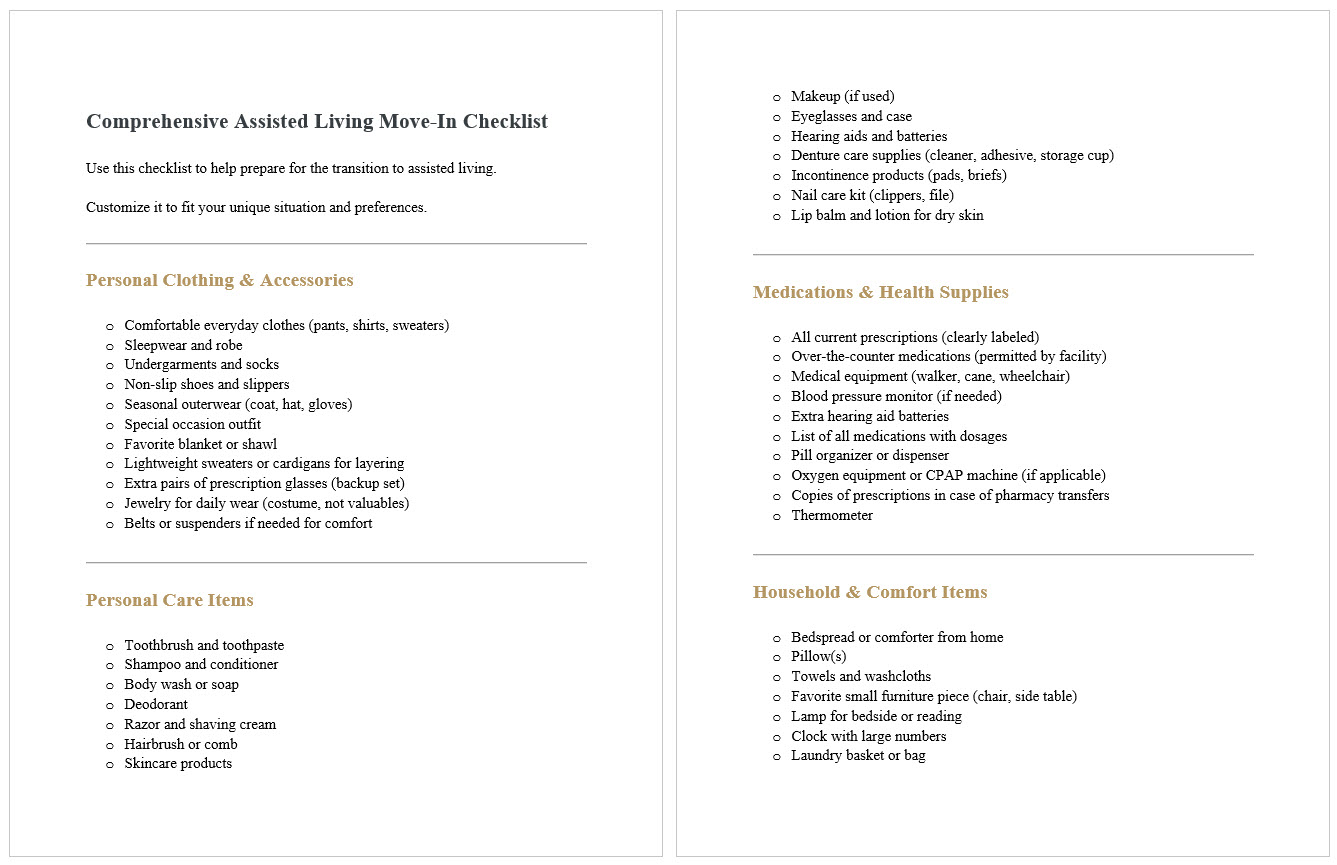
This guide walks you through everything to know about moving into assisted living, from what to pack, to what to leave behind, to how to make a new space feel like home. Download the free printable checklist at the end so you can keep track of each detail.
Ready to get organized?
Download your free printable checklist to help you track everything in one place.
This resource covers: What to bring | What not to bring | Notes for personal preferences | Space to track completion
Feel free to print multiple copies for family members or caregivers.
Key Takeaways
A move-in checklist helps prevent forgotten items and oversights.
Bringing personal mementos supports comfort and emotional well-being.
Knowing facility rules about what not to bring saves time.
Starting early and staying organized can reduce stress for everyone involved.

Why a Detailed Checklist Matters
A checklist for moving into assisted living does more than help you pack. It provides peace of mind, clarity, and structure during a time that can feel overwhelming.
Seniors benefit in several ways:
- Less anxiety when they see favorite things being carefully included.
- Fewer surprises when they arrive in the new space.
- A sense of control over what comes along.
Families benefit, too:
- Clear communication reduces tension and misunderstandings.
- Written plans make it easier to delegate tasks among siblings or helpers.
- Fewer urgent trips to pick up forgotten items later.
Whether you call it an assisted living check list, moving parents into assisted living checklist, or assisted living packing checklist PDF, the purpose is the same: make the transition smooth.

What to Bring to Assisted Living
Packing thoughtfully can make all the difference. You don’t need to recreate the entire house, but you do want to bring the essentials and a few comforts.
Here are examples of items most seniors appreciate having:
Personal Clothing & Accessories
- Comfortable everyday clothes (pants, shirts, sweaters)
- Sleepwear and robe
- Undergarments and socks
- Non-slip shoes and slippers
- Seasonal outerwear (coat, hat, gloves)
- Special occasion outfit
- Favorite blanket or shawl
- Lightweight sweaters or cardigans for layering
- Extra pairs of prescription glasses (backup set)
- Jewelry for daily wear (costume, not valuables)
- Belts or suspenders if needed for comfort
Personal Care Items
- Toothbrush and toothpaste
- Shampoo and conditioner
- Body wash or soap
- Deodorant
- Razor and shaving cream
- Hairbrush or comb
- Skincare products
- Makeup (if used)
- Eyeglasses and case
- Hearing aids and batteries
- Denture care supplies (cleaner, adhesive, storage cup)
- Incontinence products (pads, briefs)
- Nail care kit (clippers, file)
- Lip balm and lotion for dry skin
Medications & Health Supplies
- All current prescriptions (clearly labeled)
- Over-the-counter medications (permitted by facility)
- Medical equipment (walker, cane, wheelchair)
- Blood pressure monitor (if needed)
- Extra hearing aid batteries
- List of all medications with dosages
- Pill organizer or dispenser
- Oxygen equipment or CPAP machine (if applicable)
- Copies of prescriptions in case of pharmacy transfers
- Thermometer
Household & Comfort Items
- Bedspread or comforter from home
- Pillow(s)
- Towels and washcloths
- Favorite small furniture piece (chair, side table)
- Lamp for bedside or reading
- Clock with large numbers
- Laundry basket or bag
- Mattress pad or protector
- Small safe or locking box for personal items (if allowed)
- Extra blankets
- Scented sachets or drawer liners (if permitted)
Personal Belongings & Décor
- Family photos (framed or albums)
- Artwork or wall hangings
- Keepsakes and mementos
- Religious items (if applicable)
- A few favorite books or magazines
- Decorative touches (vase, plant, figurines)
- Bulletin board or corkboard for notices and reminders
- Calendar with large print
- Personal stationery and stamps for letters
- A favorite quilt or throw
Electronics & Entertainment
- Television or radio (if allowed)
- Tablet or e-reader with charger
- Phone and charger
- Music player loaded with favorite songs
- Hobby supplies (knitting, puzzles, crafts)
- Extra charging cables and power strip
- Headphones for TV or music
- Alarm clock with battery backup
- Nightlight
Kitchen & Snacks (if allowed)
- Favorite snacks or non-perishable treats
- Reusable water bottle
- Coffee maker or kettle (if permitted)
- Dishware and utensils (if needed)
- Small supply of preferred beverages
- Easy-open containers for snacks
- Favorite mug or cup
Important Documents
- Insurance cards
- Power of attorney papers
- List of emergency contacts
- Medical history summary
- Identification (ID card, driver’s license)
- Copies of any legal documents
- DNR orders or advance directives (if applicable)
- Copies of health insurance policies
- Emergency evacuation plan from the facility

What Not to Bring to Assisted Living
Some items won’t fit or may not be permitted in your new space. Before packing, ask the facility for a list of prohibited belongings.
Common items to leave behind:
- Large rugs or runners
- Space heaters or electric blankets
- Candles or open flames
- Large furniture that won’t fit
- Excessive duplicate items
- Valuable jewelry or irreplaceable heirlooms
- Extension cords or overloaded power strips
- Cleaning chemicals or hazardous products
- Weapons (firearms, knives)
- Too many seasonal decorations
If you’re unsure whether something is appropriate, check with the community’s staff. This helps avoid frustration on moving day.

How to Make Assisted Living Feel Like Home
Personal touches can transform a new apartment from sterile to welcoming. Start by setting up the bed with familiar sheets and a favorite pillow.
Arrange photos and keepsakes where they can be easily seen, and bring along a special lamp or reading light for added warmth.
A small candy dish or fresh flowers on the nightstand can offer a comforting detail, while a cozy throw blanket draped over the armchair helps the space feel inviting. Drawer organizers are a simple way to keep belongings orderly and accessible.
Calling the new place “home” and spending unhurried time together during the first days can ease the adjustment and help your loved one feel more secure.

Moving Tips for Families
Moving elderly parents into assisted living requires more than just packing boxes. Emotions can run high, and logistics can be complex.
Start early by sorting and downsizing a month or two in advance so no one feels rushed. Work in stages to keep the process manageable. It helps to keep your loved one involved, giving them the opportunity to choose what to bring and what to leave behind.
Clearly labeling boxes by room and priority simplifies unpacking on move-in day.
Be sure to coordinate with the facility ahead of time to confirm the move-in date, parking arrangements, and elevator access.
When you arrive, set up the essentials first, including the bed, bathroom supplies, and a few favorite items. This way, the new apartment feels settled right away.
Above all, stay patient! This is a significant life change, and it takes time to process.
Looking for Assisted Living in Los Angeles or Orange County?
If you’re exploring options for assisted living, Raya’s Paradise offers personalized support every step of the way.
Schedule a tour or speak with a care advisor to learn how we can help you or your loved one feel at home.
Call us at (310) 289-8834 to schedule a tour with one of our LA or OC communities. You can also email us at Info@RayasParadise.com.
 https://rayasparadise.com/wp-content/uploads/2013/03/Choosing-Assisted-Living-for-Senior-Couples.jpg
1700
2555
Moti Gamburd
https://rayasparadise.com//wp-content/uploads/2019/07/RP-LOGO-Horizontal-Name-Only-websitetrans.png
Moti Gamburd2026-02-14 06:37:342026-02-15 16:24:24Choosing Assisted Living for Senior Couples
https://rayasparadise.com/wp-content/uploads/2013/03/Choosing-Assisted-Living-for-Senior-Couples.jpg
1700
2555
Moti Gamburd
https://rayasparadise.com//wp-content/uploads/2019/07/RP-LOGO-Horizontal-Name-Only-websitetrans.png
Moti Gamburd2026-02-14 06:37:342026-02-15 16:24:24Choosing Assisted Living for Senior Couples https://rayasparadise.com/wp-content/uploads/2012/12/How-the-Option-of-Assisted-Living-Developed.jpg
1702
2553
Moti Gamburd
https://rayasparadise.com//wp-content/uploads/2019/07/RP-LOGO-Horizontal-Name-Only-websitetrans.png
Moti Gamburd2026-02-12 04:33:042026-02-14 21:30:20History of Assisted Living |How the Option of Assisted Living Developed
https://rayasparadise.com/wp-content/uploads/2012/12/How-the-Option-of-Assisted-Living-Developed.jpg
1702
2553
Moti Gamburd
https://rayasparadise.com//wp-content/uploads/2019/07/RP-LOGO-Horizontal-Name-Only-websitetrans.png
Moti Gamburd2026-02-12 04:33:042026-02-14 21:30:20History of Assisted Living |How the Option of Assisted Living Developed https://rayasparadise.com/wp-content/uploads/2012/10/Choosing-Assisted-Living-for-Those-with-Alzheimers-or-Dementia.jpeg
1695
2546
Moti Gamburd
https://rayasparadise.com//wp-content/uploads/2019/07/RP-LOGO-Horizontal-Name-Only-websitetrans.png
Moti Gamburd2026-02-11 08:14:422026-02-14 20:05:38Choosing Assisted Living for Those with Alzheimer's or Dementia
https://rayasparadise.com/wp-content/uploads/2012/10/Choosing-Assisted-Living-for-Those-with-Alzheimers-or-Dementia.jpeg
1695
2546
Moti Gamburd
https://rayasparadise.com//wp-content/uploads/2019/07/RP-LOGO-Horizontal-Name-Only-websitetrans.png
Moti Gamburd2026-02-11 08:14:422026-02-14 20:05:38Choosing Assisted Living for Those with Alzheimer's or Dementia https://rayasparadise.com/wp-content/uploads/2012/10/Paying-for-Assisted-Living.jpg
1700
2542
Moti Gamburd
https://rayasparadise.com//wp-content/uploads/2019/07/RP-LOGO-Horizontal-Name-Only-websitetrans.png
Moti Gamburd2026-02-10 03:30:062026-02-11 17:07:19Paying for Assisted Living, Costs, Insurance, VA Benefits, and Smart Ways to Plan
https://rayasparadise.com/wp-content/uploads/2012/10/Paying-for-Assisted-Living.jpg
1700
2542
Moti Gamburd
https://rayasparadise.com//wp-content/uploads/2019/07/RP-LOGO-Horizontal-Name-Only-websitetrans.png
Moti Gamburd2026-02-10 03:30:062026-02-11 17:07:19Paying for Assisted Living, Costs, Insurance, VA Benefits, and Smart Ways to Plan https://rayasparadise.com/wp-content/uploads/2012/10/Six-Myths-About-Assisted-Living.jpg
1702
2555
Moti Gamburd
https://rayasparadise.com//wp-content/uploads/2019/07/RP-LOGO-Horizontal-Name-Only-websitetrans.png
Moti Gamburd2026-02-09 04:02:312026-02-11 18:00:01Six Myths About Assisted Living - What Senior Living Really Looks Like
https://rayasparadise.com/wp-content/uploads/2012/10/Six-Myths-About-Assisted-Living.jpg
1702
2555
Moti Gamburd
https://rayasparadise.com//wp-content/uploads/2019/07/RP-LOGO-Horizontal-Name-Only-websitetrans.png
Moti Gamburd2026-02-09 04:02:312026-02-11 18:00:01Six Myths About Assisted Living - What Senior Living Really Looks Like https://rayasparadise.com/wp-content/uploads/2026/02/Assisted-Living-vs-In-Home-Care.jpg
1695
2553
Moti Gamburd
https://rayasparadise.com//wp-content/uploads/2019/07/RP-LOGO-Horizontal-Name-Only-websitetrans.png
Moti Gamburd2026-02-08 06:00:482026-02-15 17:35:09The Benefits of Assisted Living Over In-Home Care
https://rayasparadise.com/wp-content/uploads/2026/02/Assisted-Living-vs-In-Home-Care.jpg
1695
2553
Moti Gamburd
https://rayasparadise.com//wp-content/uploads/2019/07/RP-LOGO-Horizontal-Name-Only-websitetrans.png
Moti Gamburd2026-02-08 06:00:482026-02-15 17:35:09The Benefits of Assisted Living Over In-Home Care https://rayasparadise.com/wp-content/uploads/2013/01/Caring-for-a-Parent-in-Assisted-Living-From-Afar.jpeg
1702
2556
Moti Gamburd
https://rayasparadise.com//wp-content/uploads/2019/07/RP-LOGO-Horizontal-Name-Only-websitetrans.png
Moti Gamburd2026-02-06 08:00:312026-02-13 00:13:06How to Care for a Loved One in Assisted Living From Afar
https://rayasparadise.com/wp-content/uploads/2013/01/Caring-for-a-Parent-in-Assisted-Living-From-Afar.jpeg
1702
2556
Moti Gamburd
https://rayasparadise.com//wp-content/uploads/2019/07/RP-LOGO-Horizontal-Name-Only-websitetrans.png
Moti Gamburd2026-02-06 08:00:312026-02-13 00:13:06How to Care for a Loved One in Assisted Living From Afar https://rayasparadise.com/wp-content/uploads/2012/10/Smooth-Transition-to-Assisted-Living.jpeg
1696
2555
Moti Gamburd
https://rayasparadise.com//wp-content/uploads/2019/07/RP-LOGO-Horizontal-Name-Only-websitetrans.png
Moti Gamburd2026-02-06 01:00:082026-02-12 23:35:09Making a Smooth Transition to Assisted Living
https://rayasparadise.com/wp-content/uploads/2012/10/Smooth-Transition-to-Assisted-Living.jpeg
1696
2555
Moti Gamburd
https://rayasparadise.com//wp-content/uploads/2019/07/RP-LOGO-Horizontal-Name-Only-websitetrans.png
Moti Gamburd2026-02-06 01:00:082026-02-12 23:35:09Making a Smooth Transition to Assisted Living https://rayasparadise.com/wp-content/uploads/2012/10/Benefits-of-Small-Assisted-Living-Facilities.jpg
1702
2551
Moti Gamburd
https://rayasparadise.com//wp-content/uploads/2019/07/RP-LOGO-Horizontal-Name-Only-websitetrans.png
Moti Gamburd2026-02-04 04:23:062026-02-11 19:20:11The Benefits of Small Assisted Living Facilities
https://rayasparadise.com/wp-content/uploads/2012/10/Benefits-of-Small-Assisted-Living-Facilities.jpg
1702
2551
Moti Gamburd
https://rayasparadise.com//wp-content/uploads/2019/07/RP-LOGO-Horizontal-Name-Only-websitetrans.png
Moti Gamburd2026-02-04 04:23:062026-02-11 19:20:11The Benefits of Small Assisted Living Facilities https://rayasparadise.com/wp-content/uploads/2026/01/Tips-for-Selling-Your-Home-to-Pay-for-Assisted-Living.jpg
1702
2555
Moti Gamburd
https://rayasparadise.com//wp-content/uploads/2019/07/RP-LOGO-Horizontal-Name-Only-websitetrans.png
Moti Gamburd2026-01-22 04:00:552026-01-22 18:04:19Tips for Selling Your Home to Pay for Assisted Living
https://rayasparadise.com/wp-content/uploads/2026/01/Tips-for-Selling-Your-Home-to-Pay-for-Assisted-Living.jpg
1702
2555
Moti Gamburd
https://rayasparadise.com//wp-content/uploads/2019/07/RP-LOGO-Horizontal-Name-Only-websitetrans.png
Moti Gamburd2026-01-22 04:00:552026-01-22 18:04:19Tips for Selling Your Home to Pay for Assisted Living https://rayasparadise.com/wp-content/uploads/2012/10/Signs-Its-Time-for-Assisted-Living.jpg
1697
2555
Raya's Paradise
https://rayasparadise.com//wp-content/uploads/2019/07/RP-LOGO-Horizontal-Name-Only-websitetrans.png
Raya's Paradise2026-01-19 03:09:442026-01-20 17:17:15Signs It’s Time for Assisted Living, How to Know When Extra Support Is Needed
https://rayasparadise.com/wp-content/uploads/2012/10/Signs-Its-Time-for-Assisted-Living.jpg
1697
2555
Raya's Paradise
https://rayasparadise.com//wp-content/uploads/2019/07/RP-LOGO-Horizontal-Name-Only-websitetrans.png
Raya's Paradise2026-01-19 03:09:442026-01-20 17:17:15Signs It’s Time for Assisted Living, How to Know When Extra Support Is Needed https://rayasparadise.com/wp-content/uploads/2012/12/Downsizing-to-Prepare-for-Assisted-Living.jpeg
1704
2558
Moti Gamburd
https://rayasparadise.com//wp-content/uploads/2019/07/RP-LOGO-Horizontal-Name-Only-websitetrans.png
Moti Gamburd2026-01-13 04:02:202026-01-15 22:28:54Downsizing to Prepare for a Move to Assisted Living
https://rayasparadise.com/wp-content/uploads/2012/12/Downsizing-to-Prepare-for-Assisted-Living.jpeg
1704
2558
Moti Gamburd
https://rayasparadise.com//wp-content/uploads/2019/07/RP-LOGO-Horizontal-Name-Only-websitetrans.png
Moti Gamburd2026-01-13 04:02:202026-01-15 22:28:54Downsizing to Prepare for a Move to Assisted Living https://rayasparadise.com/wp-content/uploads/2012/11/How-to-Discuss-Assisted-Living-With-a-Reluctant-Parent.jpeg
1704
2553
Moti Gamburd
https://rayasparadise.com//wp-content/uploads/2019/07/RP-LOGO-Horizontal-Name-Only-websitetrans.png
Moti Gamburd2026-01-12 02:33:232026-01-15 23:41:56Discussing Assisted Living with a Reluctant Parent
https://rayasparadise.com/wp-content/uploads/2012/11/How-to-Discuss-Assisted-Living-With-a-Reluctant-Parent.jpeg
1704
2553
Moti Gamburd
https://rayasparadise.com//wp-content/uploads/2019/07/RP-LOGO-Horizontal-Name-Only-websitetrans.png
Moti Gamburd2026-01-12 02:33:232026-01-15 23:41:56Discussing Assisted Living with a Reluctant Parent https://rayasparadise.com/wp-content/uploads/2025/08/Does-Assisted-Living-Provide-Medical-Care.jpg
1704
2548
Raya's Paradise
https://rayasparadise.com//wp-content/uploads/2019/07/RP-LOGO-Horizontal-Name-Only-websitetrans.png
Raya's Paradise2025-08-27 20:32:462026-01-14 19:35:28Does Assisted Living Provide Medical Care? Understanding Living Options and Care in Assisted Living Communities
https://rayasparadise.com/wp-content/uploads/2025/08/Does-Assisted-Living-Provide-Medical-Care.jpg
1704
2548
Raya's Paradise
https://rayasparadise.com//wp-content/uploads/2019/07/RP-LOGO-Horizontal-Name-Only-websitetrans.png
Raya's Paradise2025-08-27 20:32:462026-01-14 19:35:28Does Assisted Living Provide Medical Care? Understanding Living Options and Care in Assisted Living Communities https://rayasparadise.com/wp-content/uploads/2025/08/What-Amenities-Are-Offered-In-Assisted-Living.jpg
1080
1621
Raya's Paradise
https://rayasparadise.com//wp-content/uploads/2019/07/RP-LOGO-Horizontal-Name-Only-websitetrans.png
Raya's Paradise2025-08-27 16:58:562025-10-22 19:10:12What Amenities Are Offered in Assisted Living? Services, Benefits, and Features for Residents
https://rayasparadise.com/wp-content/uploads/2025/08/What-Amenities-Are-Offered-In-Assisted-Living.jpg
1080
1621
Raya's Paradise
https://rayasparadise.com//wp-content/uploads/2019/07/RP-LOGO-Horizontal-Name-Only-websitetrans.png
Raya's Paradise2025-08-27 16:58:562025-10-22 19:10:12What Amenities Are Offered in Assisted Living? Services, Benefits, and Features for Residents
