
Contents
- Assisted Living vs In-Home Care
- Key Takeaways
- Assisted Living vs In-Home Care, What You Are Really Comparing
- Why Assisted Living Often Wins on Safety, Consistency, and Quality of Life
- Cost and Value, Why Assisted Living Can Be More Predictable Than Home Care
- Caregiver Burnout, The Hidden Cost That Changes the Decision
- When In-Home Care Can Be the Better Fit
- How to Choose Confidently | A Practical Decision Framework
- Where Raya’s Paradise Fits | Assisted Living, Memory Care, Respite, and Hospice Support
- Sources & Additional Resources
- More Assisted Living Resources
- Choosing Assisted Living for Senior Couples
- History of Assisted Living |How the Option of Assisted Living Developed
- Choosing Assisted Living for Those with Alzheimer's or Dementia
- Paying for Assisted Living, Costs, Insurance, VA Benefits, and Smart Ways to Plan
- Six Myths About Assisted Living - What Senior Living Really Looks Like
- The Benefits of Assisted Living Over In-Home Care
- How to Care for a Loved One in Assisted Living From Afar
- Making a Smooth Transition to Assisted Living
- The Benefits of Small Assisted Living Facilities
- Tips for Selling Your Home to Pay for Assisted Living
- Signs It’s Time for Assisted Living, How to Know When Extra Support Is Needed
- Downsizing to Prepare for a Move to Assisted Living
- Discussing Assisted Living with a Reluctant Parent
- Does Assisted Living Provide Medical Care? Understanding Living Options and Care in Assisted Living Communities
- What Amenities Are Offered in Assisted Living? Services, Benefits, and Features for Residents
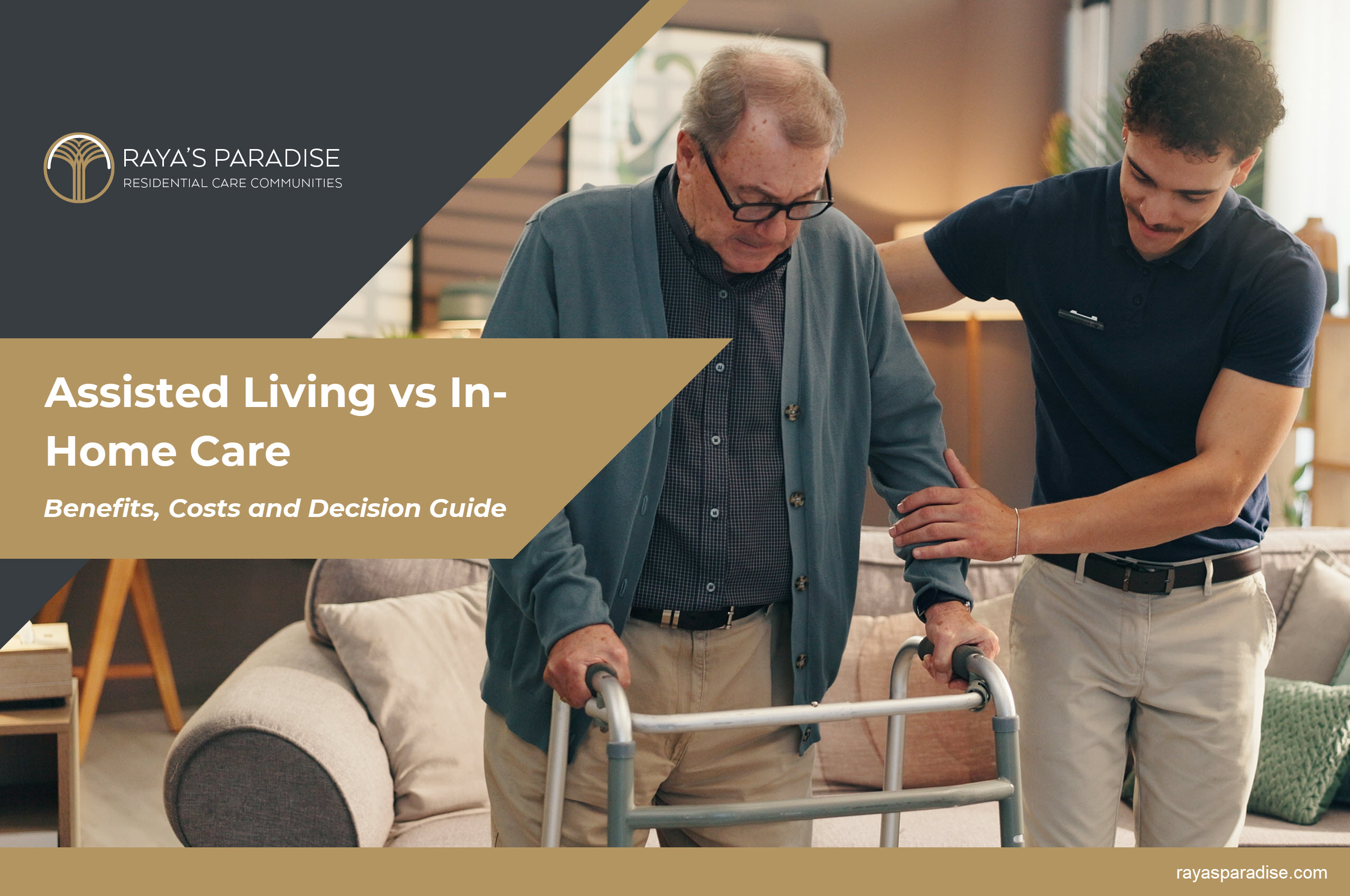
Assisted Living vs In-Home Care
Benefits, Costs & Decision Guide
Key Takeaways
- Assisted living can reduce day-to-day risk while preserving independence through built-in support, routines, and supervision.
- In-home care can work well when needs are light or a strong family support system is available, but coverage gaps and caregiver burnout are common pain points.
- Costs are not always apples-to-apples. Assisted living bundles housing, meals, utilities, social engagement, and care support, while home care often scales up fast as hours increase.
- The best choice is the one that stays safe and sustainable for months and years, not just for a stressful week.
Deciding between assisted living and in-home care can feel like you are choosing between “safety” and “home.” In real life, it is rarely that simple. Most families are trying to protect independence while reducing risk, exhaustion, and last-minute emergencies. If you are comparing options in Los Angeles or Orange County, this guide will walk you through the benefits of assisted living, when home care makes more sense, and how to choose with confidence.
Quick next step: If you want to talk through your situation with a care team that does this every day, explore our residential care communities and reach out through our contact page. If you are ready to see a setting in person, you can request a Los Angeles assisted living tour or a San Clemente community tour.

Assisted Living vs In-Home Care, What You Are Really Comparing
When families say “in-home care,” they can mean a few different things. Sometimes it’s non-medical help for a few hours a week (companionship, meals, errands, light personal care). Sometimes it’s longer daily shifts for hands-on support, and in higher-need situations it can mean live-in care or 24-hour care with rotating caregivers so someone is present around the clock. Assisted living, on the other hand, is a residential setting that combines housing with daily support. It often includes meals, housekeeping, scheduled activities, and help with activities of daily living like bathing, dressing, transfers, and medication assistance or reminders depending on the care plan.
If you want a deeper overview of how assisted living works, start with what assisted living is and how it works day to day. Many families find that once they understand the structure, the decision gets less emotional and more practical.
For families in Southern California who want a smaller, more home-like setting, our team can also explain the benefits of personalized support through assisted living services and options like assisted living in Orange County.

Why Assisted Living Often Wins on Safety, Consistency, and Quality of Life
Assisted living is built around day-to-day aging support. Many communities use safety-oriented layouts and routines, and staff support is available on-site as part of daily life rather than something a family has to schedule and manage alone. That consistency matters because many problems happen in the “in-between” moments, like a trip to the bathroom at night, a missed meal, or medication that is skipped, doubled, or taken incorrectly.
There is also a quality-of-life piece that families sometimes underestimate. A good community creates reasons to get up and participate. When loneliness or isolation creeps in at home, it can quietly accelerate decline. Assisted living creates a steady baseline of connection, conversation, and routine. If you want ideas on what that looks like in real life, take a look at common assisted living amenities that matter most.
Assisted living can also be a healthier structure for the family relationship. When daily care tasks move off the family’s shoulders, visits stop being all logistics and start feeling like time together again. If caregiver strain is already showing up, this can be a turning point. You may find helpful, honest guidance in practical ways to reduce caregiver stress.

Cost and Value, Why Assisted Living Can Be More Predictable Than Home Care
The biggest mistake I see families make is comparing only the caregiver’s hourly rate to an assisted living monthly rate. That is not a complete comparison. Assisted living typically includes housing, meals, utilities, housekeeping, scheduled activities, and a built-in support structure. Home care is usually an add-on cost layered on top of mortgage or rent, groceries, home maintenance, and utilities. As care needs increase, home care hours often ramp up quickly and that is when budgets get stressed.
For a local benchmark, our guide on assisted living costs in Los Angeles and Orange County breaks down what families commonly see in this region and why prices vary.
It also helps to understand what Medicare does and does not cover. In general, Medicare does not pay for long-term custodial care, which is the type of help most people mean when they say “assisted living.” That does not mean seniors cannot receive Medicare-covered medical services while living in assisted living. It means assisted living room, board, and ongoing custodial support (help with daily activities) are not covered by Medicare. If you want the official wording, you can review Medicare’s long-term care coverage overview.
If your family is juggling cost planning and timing, you may also want to explore short-term options first. A short-term respite care stay can be a helpful bridge after hospitalization, during a caregiver’s travel, or while you sort out a longer-term plan.
Caregiver Burnout, The Hidden Cost That Changes the Decision
Home care can feel cozy and familiar, but it often turns family members into care managers. Someone has to coordinate schedules, supervise quality, handle call-outs, manage groceries and medications, and cover gaps when a caregiver is sick or late. Even with a strong agency, the emotional load tends to land on the family.
Burnout is not just feeling tired. It shows up as irritability, sleep problems, resentment, withdrawal, and the sense that you can never truly exhale. If you recognize that pattern, it does not mean you failed. It means you are human and the needs have outgrown what one household can reasonably provide.
Assisted living can give the family back the role that matters most, being a spouse, child, sibling, or friend. When support is consistent, families often notice fewer crisis calls and fewer “something happened while no one was watching” moments.
When In-Home Care Can Be the Better Fit
There are situations where home care truly makes sense, especially when needs are limited and predictable. Home care may be a good fit when a senior is stable, oriented, and mostly independent, when the home is safe and easy to navigate, when the family has reliable backup coverage, and when social engagement is strong.
Home care can also be useful as a step-down plan after rehab, or as a short-term boost while the family decides on a longer-term move. If you are weighing levels of care, this broader guide on types of senior care and how to choose can help you map out the options without guessing.
One more note that matters in real life. If memory loss is part of the picture, in-home care can become complicated fast as needs increase. Wandering risk, nighttime confusion, agitation, and medication safety may require more supervision and structure than many households can sustain without 24-hour coverage or significant family involvement. In those cases, it may be worth exploring dedicated cognitive support through memory care services or, for families in South Orange County, memory care in Orange County.

How to Choose Confidently | A Practical Decision Framework
Step 1, List the non-negotiables
Start with what must be true for your loved one to be safe. For example, no unsupervised stove use, consistent meals, reliable bathing support, fall risk monitoring, medication reminders, or overnight coverage. If any of these are non-negotiable and your home setup cannot consistently meet them, that is important data.
Step 2, Ask “What happens when the plan fails?”
Every plan fails sometimes. A caregiver cancels. A family member gets sick. A senior refuses help. The right choice is the one that still works on a messy Tuesday night, not just on a good day.
Step 3, Tour with a checklist and watch for red flags
When you tour communities, take notes on cleanliness, staff engagement, resident mood, odor control, and how calmly the environment runs. You can use this printable guide as a starting point: assisted living facility tour checklist. Also review warning signs to watch for when touring assisted living.
Step 4, Make sure the level of care matches the need
Assisted living is not the same as independent living and it is not the same as skilled nursing. If your loved one needs more medical support, that is a different level of care. This comparison can help clarify the middle ground: assisted living vs independent living.
Where Raya’s Paradise Fits | Assisted Living, Memory Care, Respite, and Hospice Support
Families come to Raya’s Paradise at different moments. Some are planning ahead. Some are coming after a fall, a hospital stay, or a slow stretch of decline that finally became undeniable. Our goal is to make the next step feel clear and doable.
If your loved one needs daily support with independence preserved, explore our assisted living services and, if you are looking in South Orange County, our assisted living options in Orange County. If memory loss is driving the need, take a look at our memory care approach and memory care communities in Orange County.
If you need a bridge plan, a short-term respite stay can provide relief while you evaluate next steps. If you are navigating end-of-life needs and want support in a calmer residential setting, we also coordinate with hospice partners through hospice care services.
To see locations and get a feel for the environment, visit our communities page. When you are ready, start a conversation through our contact form or request a tour in Los Angeles or San Clemente.
Our Senior Assisted Living with Memory Care Community in Orange County
Our Assisted Living Residences in Los Angeles
Educational note
This article is for general education. It is not medical advice, financial advice, or legal advice. For guidance specific to your family, consult a qualified professional.
 https://rayasparadise.com/wp-content/uploads/2013/03/Choosing-Assisted-Living-for-Senior-Couples.jpg
1700
2555
Moti Gamburd
https://rayasparadise.com//wp-content/uploads/2019/07/RP-LOGO-Horizontal-Name-Only-websitetrans.png
Moti Gamburd2026-02-14 06:37:342026-02-15 16:24:24Choosing Assisted Living for Senior Couples
https://rayasparadise.com/wp-content/uploads/2013/03/Choosing-Assisted-Living-for-Senior-Couples.jpg
1700
2555
Moti Gamburd
https://rayasparadise.com//wp-content/uploads/2019/07/RP-LOGO-Horizontal-Name-Only-websitetrans.png
Moti Gamburd2026-02-14 06:37:342026-02-15 16:24:24Choosing Assisted Living for Senior Couples https://rayasparadise.com/wp-content/uploads/2012/12/How-the-Option-of-Assisted-Living-Developed.jpg
1702
2553
Moti Gamburd
https://rayasparadise.com//wp-content/uploads/2019/07/RP-LOGO-Horizontal-Name-Only-websitetrans.png
Moti Gamburd2026-02-12 04:33:042026-02-14 21:30:20History of Assisted Living |How the Option of Assisted Living Developed
https://rayasparadise.com/wp-content/uploads/2012/12/How-the-Option-of-Assisted-Living-Developed.jpg
1702
2553
Moti Gamburd
https://rayasparadise.com//wp-content/uploads/2019/07/RP-LOGO-Horizontal-Name-Only-websitetrans.png
Moti Gamburd2026-02-12 04:33:042026-02-14 21:30:20History of Assisted Living |How the Option of Assisted Living Developed https://rayasparadise.com/wp-content/uploads/2012/10/Choosing-Assisted-Living-for-Those-with-Alzheimers-or-Dementia.jpeg
1695
2546
Moti Gamburd
https://rayasparadise.com//wp-content/uploads/2019/07/RP-LOGO-Horizontal-Name-Only-websitetrans.png
Moti Gamburd2026-02-11 08:14:422026-02-14 20:05:38Choosing Assisted Living for Those with Alzheimer's or Dementia
https://rayasparadise.com/wp-content/uploads/2012/10/Choosing-Assisted-Living-for-Those-with-Alzheimers-or-Dementia.jpeg
1695
2546
Moti Gamburd
https://rayasparadise.com//wp-content/uploads/2019/07/RP-LOGO-Horizontal-Name-Only-websitetrans.png
Moti Gamburd2026-02-11 08:14:422026-02-14 20:05:38Choosing Assisted Living for Those with Alzheimer's or Dementia https://rayasparadise.com/wp-content/uploads/2012/10/Paying-for-Assisted-Living.jpg
1700
2542
Moti Gamburd
https://rayasparadise.com//wp-content/uploads/2019/07/RP-LOGO-Horizontal-Name-Only-websitetrans.png
Moti Gamburd2026-02-10 03:30:062026-02-11 17:07:19Paying for Assisted Living, Costs, Insurance, VA Benefits, and Smart Ways to Plan
https://rayasparadise.com/wp-content/uploads/2012/10/Paying-for-Assisted-Living.jpg
1700
2542
Moti Gamburd
https://rayasparadise.com//wp-content/uploads/2019/07/RP-LOGO-Horizontal-Name-Only-websitetrans.png
Moti Gamburd2026-02-10 03:30:062026-02-11 17:07:19Paying for Assisted Living, Costs, Insurance, VA Benefits, and Smart Ways to Plan https://rayasparadise.com/wp-content/uploads/2012/10/Six-Myths-About-Assisted-Living.jpg
1702
2555
Moti Gamburd
https://rayasparadise.com//wp-content/uploads/2019/07/RP-LOGO-Horizontal-Name-Only-websitetrans.png
Moti Gamburd2026-02-09 04:02:312026-02-11 18:00:01Six Myths About Assisted Living - What Senior Living Really Looks Like
https://rayasparadise.com/wp-content/uploads/2012/10/Six-Myths-About-Assisted-Living.jpg
1702
2555
Moti Gamburd
https://rayasparadise.com//wp-content/uploads/2019/07/RP-LOGO-Horizontal-Name-Only-websitetrans.png
Moti Gamburd2026-02-09 04:02:312026-02-11 18:00:01Six Myths About Assisted Living - What Senior Living Really Looks Like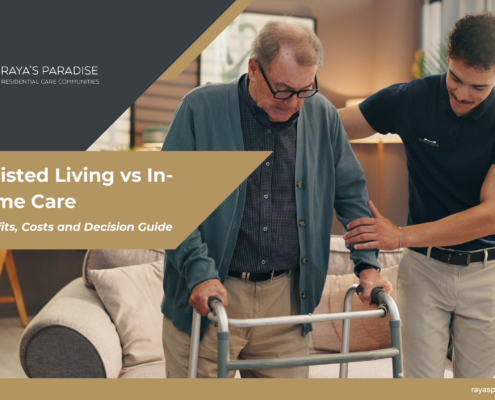 https://rayasparadise.com/wp-content/uploads/2026/02/Assisted-Living-vs-In-Home-Care.jpg
1695
2553
Moti Gamburd
https://rayasparadise.com//wp-content/uploads/2019/07/RP-LOGO-Horizontal-Name-Only-websitetrans.png
Moti Gamburd2026-02-08 06:00:482026-02-15 17:35:09The Benefits of Assisted Living Over In-Home Care
https://rayasparadise.com/wp-content/uploads/2026/02/Assisted-Living-vs-In-Home-Care.jpg
1695
2553
Moti Gamburd
https://rayasparadise.com//wp-content/uploads/2019/07/RP-LOGO-Horizontal-Name-Only-websitetrans.png
Moti Gamburd2026-02-08 06:00:482026-02-15 17:35:09The Benefits of Assisted Living Over In-Home Care https://rayasparadise.com/wp-content/uploads/2013/01/Caring-for-a-Parent-in-Assisted-Living-From-Afar.jpeg
1702
2556
Moti Gamburd
https://rayasparadise.com//wp-content/uploads/2019/07/RP-LOGO-Horizontal-Name-Only-websitetrans.png
Moti Gamburd2026-02-06 08:00:312026-02-13 00:13:06How to Care for a Loved One in Assisted Living From Afar
https://rayasparadise.com/wp-content/uploads/2013/01/Caring-for-a-Parent-in-Assisted-Living-From-Afar.jpeg
1702
2556
Moti Gamburd
https://rayasparadise.com//wp-content/uploads/2019/07/RP-LOGO-Horizontal-Name-Only-websitetrans.png
Moti Gamburd2026-02-06 08:00:312026-02-13 00:13:06How to Care for a Loved One in Assisted Living From Afar https://rayasparadise.com/wp-content/uploads/2012/10/Smooth-Transition-to-Assisted-Living.jpeg
1696
2555
Moti Gamburd
https://rayasparadise.com//wp-content/uploads/2019/07/RP-LOGO-Horizontal-Name-Only-websitetrans.png
Moti Gamburd2026-02-06 01:00:082026-02-12 23:35:09Making a Smooth Transition to Assisted Living
https://rayasparadise.com/wp-content/uploads/2012/10/Smooth-Transition-to-Assisted-Living.jpeg
1696
2555
Moti Gamburd
https://rayasparadise.com//wp-content/uploads/2019/07/RP-LOGO-Horizontal-Name-Only-websitetrans.png
Moti Gamburd2026-02-06 01:00:082026-02-12 23:35:09Making a Smooth Transition to Assisted Living https://rayasparadise.com/wp-content/uploads/2012/10/Benefits-of-Small-Assisted-Living-Facilities.jpg
1702
2551
Moti Gamburd
https://rayasparadise.com//wp-content/uploads/2019/07/RP-LOGO-Horizontal-Name-Only-websitetrans.png
Moti Gamburd2026-02-04 04:23:062026-02-11 19:20:11The Benefits of Small Assisted Living Facilities
https://rayasparadise.com/wp-content/uploads/2012/10/Benefits-of-Small-Assisted-Living-Facilities.jpg
1702
2551
Moti Gamburd
https://rayasparadise.com//wp-content/uploads/2019/07/RP-LOGO-Horizontal-Name-Only-websitetrans.png
Moti Gamburd2026-02-04 04:23:062026-02-11 19:20:11The Benefits of Small Assisted Living Facilities https://rayasparadise.com/wp-content/uploads/2026/01/Tips-for-Selling-Your-Home-to-Pay-for-Assisted-Living.jpg
1702
2555
Moti Gamburd
https://rayasparadise.com//wp-content/uploads/2019/07/RP-LOGO-Horizontal-Name-Only-websitetrans.png
Moti Gamburd2026-01-22 04:00:552026-01-22 18:04:19Tips for Selling Your Home to Pay for Assisted Living
https://rayasparadise.com/wp-content/uploads/2026/01/Tips-for-Selling-Your-Home-to-Pay-for-Assisted-Living.jpg
1702
2555
Moti Gamburd
https://rayasparadise.com//wp-content/uploads/2019/07/RP-LOGO-Horizontal-Name-Only-websitetrans.png
Moti Gamburd2026-01-22 04:00:552026-01-22 18:04:19Tips for Selling Your Home to Pay for Assisted Living https://rayasparadise.com/wp-content/uploads/2012/10/Signs-Its-Time-for-Assisted-Living.jpg
1697
2555
Raya's Paradise
https://rayasparadise.com//wp-content/uploads/2019/07/RP-LOGO-Horizontal-Name-Only-websitetrans.png
Raya's Paradise2026-01-19 03:09:442026-01-20 17:17:15Signs It’s Time for Assisted Living, How to Know When Extra Support Is Needed
https://rayasparadise.com/wp-content/uploads/2012/10/Signs-Its-Time-for-Assisted-Living.jpg
1697
2555
Raya's Paradise
https://rayasparadise.com//wp-content/uploads/2019/07/RP-LOGO-Horizontal-Name-Only-websitetrans.png
Raya's Paradise2026-01-19 03:09:442026-01-20 17:17:15Signs It’s Time for Assisted Living, How to Know When Extra Support Is Needed https://rayasparadise.com/wp-content/uploads/2012/12/Downsizing-to-Prepare-for-Assisted-Living.jpeg
1704
2558
Moti Gamburd
https://rayasparadise.com//wp-content/uploads/2019/07/RP-LOGO-Horizontal-Name-Only-websitetrans.png
Moti Gamburd2026-01-13 04:02:202026-01-15 22:28:54Downsizing to Prepare for a Move to Assisted Living
https://rayasparadise.com/wp-content/uploads/2012/12/Downsizing-to-Prepare-for-Assisted-Living.jpeg
1704
2558
Moti Gamburd
https://rayasparadise.com//wp-content/uploads/2019/07/RP-LOGO-Horizontal-Name-Only-websitetrans.png
Moti Gamburd2026-01-13 04:02:202026-01-15 22:28:54Downsizing to Prepare for a Move to Assisted Living https://rayasparadise.com/wp-content/uploads/2012/11/How-to-Discuss-Assisted-Living-With-a-Reluctant-Parent.jpeg
1704
2553
Moti Gamburd
https://rayasparadise.com//wp-content/uploads/2019/07/RP-LOGO-Horizontal-Name-Only-websitetrans.png
Moti Gamburd2026-01-12 02:33:232026-01-15 23:41:56Discussing Assisted Living with a Reluctant Parent
https://rayasparadise.com/wp-content/uploads/2012/11/How-to-Discuss-Assisted-Living-With-a-Reluctant-Parent.jpeg
1704
2553
Moti Gamburd
https://rayasparadise.com//wp-content/uploads/2019/07/RP-LOGO-Horizontal-Name-Only-websitetrans.png
Moti Gamburd2026-01-12 02:33:232026-01-15 23:41:56Discussing Assisted Living with a Reluctant Parent https://rayasparadise.com/wp-content/uploads/2025/08/Does-Assisted-Living-Provide-Medical-Care.jpg
1704
2548
Raya's Paradise
https://rayasparadise.com//wp-content/uploads/2019/07/RP-LOGO-Horizontal-Name-Only-websitetrans.png
Raya's Paradise2025-08-27 20:32:462026-01-14 19:35:28Does Assisted Living Provide Medical Care? Understanding Living Options and Care in Assisted Living Communities
https://rayasparadise.com/wp-content/uploads/2025/08/Does-Assisted-Living-Provide-Medical-Care.jpg
1704
2548
Raya's Paradise
https://rayasparadise.com//wp-content/uploads/2019/07/RP-LOGO-Horizontal-Name-Only-websitetrans.png
Raya's Paradise2025-08-27 20:32:462026-01-14 19:35:28Does Assisted Living Provide Medical Care? Understanding Living Options and Care in Assisted Living Communities https://rayasparadise.com/wp-content/uploads/2025/08/What-Amenities-Are-Offered-In-Assisted-Living.jpg
1080
1621
Raya's Paradise
https://rayasparadise.com//wp-content/uploads/2019/07/RP-LOGO-Horizontal-Name-Only-websitetrans.png
Raya's Paradise2025-08-27 16:58:562025-10-22 19:10:12What Amenities Are Offered in Assisted Living? Services, Benefits, and Features for Residents
https://rayasparadise.com/wp-content/uploads/2025/08/What-Amenities-Are-Offered-In-Assisted-Living.jpg
1080
1621
Raya's Paradise
https://rayasparadise.com//wp-content/uploads/2019/07/RP-LOGO-Horizontal-Name-Only-websitetrans.png
Raya's Paradise2025-08-27 16:58:562025-10-22 19:10:12What Amenities Are Offered in Assisted Living? Services, Benefits, and Features for Residents
