
Contents
- Exercises for the Later Stages of Dementia
- Key Takeaways
- Why movement still matters in late-stage dementia
- Safety first, how to make late-stage exercise safer
- Bed-based movements for comfort and flexibility
- Chair-based exercises that support posture and transfers
- Supported standing and balance when appropriate
- How to build a routine without causing anxiety
- When home routines are not enough
- Specialized memory care in Orange County for later-stage dementia support
- Sources & Additional Resources
- More Family Resources
- When Your Spouse Has Dementia
- Where to Start with Power of Attorney
- Estate Planning, Planning a Grand Finale with Care and Clarity
- A Will, A Living Will, A Living Trust…What is the Difference?
- Do You Have Compassion Fatigue?
- Creating a Plan for Aging Parents
- When a Residential Care Community Is an Option for Temporary Hospice or Palliative Care
- Are You Responsible for Your Elderly Parent's Debt?
- How Children Can Help with Caregiving
- Selling the Home of a Parent Who Has Alzheimer's
- How to Talk to Someone Who is Dying
- Caring for Aging In-Laws
- How to Maintain a Positive Attitude
- Advice for New Caregivers
- Telling Your Loved One They Have Alzheimer's
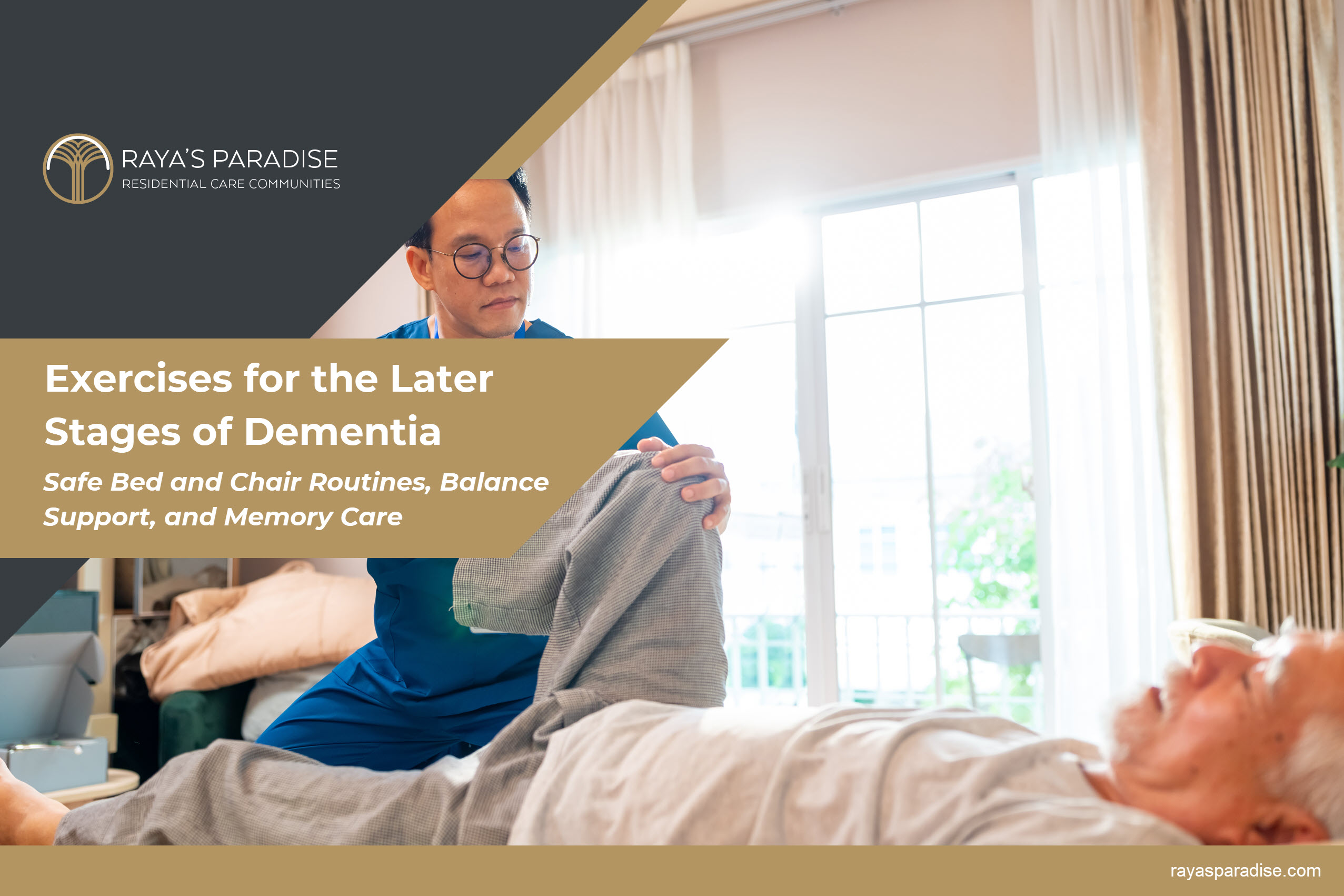
Exercises for the Later Stages of Dementia
Late-stage dementia changes almost everything about movement. Walking may be limited or no longer safe. Standing might require hands-on help. Even sitting upright can feel tiring. That does not mean movement is over. It just means the goal shifts. In the later stages, movement is about comfort, circulation, posture, safer transfers, and protecting dignity.
Families often worry about doing the wrong thing. A good rule is this: small, gentle movement is usually the right starting point, especially when it is guided by safety cues and your loved one’s energy that day. The National Institute on Aging exercise and physical activity guidance explains why older adults benefit from staying active in ways that fit their abilities. That still applies in advanced dementia, even when activity looks like supported sitting, a few seconds of standing with help, or assisted range of motion.
If you want help matching movement to the right level of care, you can explore our memory care services and review locations on our communities page.
Key Takeaways
- In later-stage dementia, movement is less about fitness and more about comfort, posture, circulation, safer transfers, and reducing stiffness.
- Short sessions work best. Think 1 to 5 minutes repeated through the day instead of one long routine.
- Safety comes first. Supported sitting and assisted movements are often the safest options.
- Watch for warning signs like dizziness, new pain, shortness of breath, sudden fatigue, or agitation that escalates during movement.
- If caregiving is becoming physically unsafe or emotionally exhausting, more structured support may be the safer plan.

Why movement still matters in late-stage dementia
When mobility declines, the risk is not only weakness. It is also stiffness, discomfort, pressure points, and reduced tolerance for basic daily care. Gentle movement can help support:
- Comfort and flexibility by easing stiffness from staying in one position too long
- Posture and head control which can make eating, conversation, and breathing feel more comfortable for some people
- Safer daily care routines by keeping joints moving and maintaining familiar movement patterns when possible
- Day-to-day rhythm because small movement breaks can reduce restlessness for some individuals
If you want a fuller overview of how movement supports dementia quality of life earlier in the journey, see exercise benefits for dementia patients.

Safety first, how to make late-stage exercise safer
Before you choose an exercise, set up the environment. Late-stage dementia often includes impaired judgment, slower reaction time, and increased fall risk. The CDC’s fall prevention resources for older adults are a helpful reminder of how common and serious falls can be, and why prevention and supervision matter: CDC STEADI patient and caregiver fall prevention resources.
Use this quick safety checklist
- Stay within arm’s reach. If sitting balance or standing is not stable, keep hands-on support ready.
- Use stable surfaces. A firm chair with arms, a bed at appropriate height, or a sturdy counter with caregiver support.
- Keep the space clear. No throw rugs, cords, clutter, or slippery socks.
- Watch breathing and color. Stop if breathing becomes labored, or skin becomes pale, sweaty, or unusually flushed.
- Stop for new symptoms. New pain, dizziness, sudden weakness, unusual fatigue, or agitation that escalates.
If falls have already become part of your daily worry, this guide is practical and family-friendly: how seniors can avoid falls.

Bed-based movements for comfort and flexibility
Bed exercises are often the most realistic option in later stages, especially when standing is unsafe. The goal is gentle motion, not perfect form. If your loved one is medically fragile, has recent injuries, or is very weak, ask a clinician about physical therapy guidance for safe positioning and range-of-motion.
1) Comfortable repositioning and supported stretch time
If your loved one tolerates it, short periods lying comfortably on their back can relieve pressure on the neck and hips. Use pillows to support knees, ankles, or shoulders as needed. Think minutes, not a strict time goal, and stop if discomfort or agitation rises.
2) Gentle leg motion (assisted if needed)
- Bend and straighten one knee at a time, slowly
- Ankle circles and toe points
- Short heel slides (heel glides toward the body, then away)
3) Gentle arm and hand motion
- Slow reaches toward the ceiling, then down
- Open and close hands, then relax
- Small shoulder rolls if tolerated
Tip that helps: narrate with calm, short phrases. “We’re going to move your leg a little.” “Good job.” “All done.”

Chair-based exercises that support posture and transfers
When your loved one can sit with assistance, chair exercises can support posture muscles and reduce stiffness. Choose a sturdy chair with arms, and stay close.
1) Supported sitting practice
Help your loved one sit upright for short periods with support. Start with seconds, then build to a minute or two as tolerated. If they slump, grimace, or become distressed, shorten the time and add more support.
2) Seated scooting practice (functional movement)
Scooting while seated is functional practice. It can help with repositioning and getting closer to the edge of a bed or chair for safer transfers. Keep hands-on support and go slowly.
3) Sit-to-stand preparation (only if safe)
If standing is possible with assistance, practice the “lean forward, push, stand” sequence with supervision. Even partial stand attempts can reinforce the movement pattern. If your loved one becomes fearful, dizzy, or unsteady, return to seated movement and ask a clinician whether physical therapy would help.
If care tasks like bathing are triggering agitation or resistance, this guide can help with pacing and approach: helping a loved one with Alzheimer’s bathe.
Supported standing and balance when appropriate
Standing is not required for movement, but if your loved one can stand with support, even brief moments can help maintain leg strength and tolerance for transfers. This should only be done when it is clearly safe, and never as a solo activity.
Safe ways to practice standing
- Stand at a counter with caregiver support at the side and slightly behind
- Stand during care moments that already require it, such as supervised toileting or dressing
- Hold for a few seconds, sit, then repeat if tolerated
If movement triggers agitation, this companion guide can help you reduce escalation: addressing agitation in someone who has dementia.
How to build a routine without causing anxiety
Late-stage dementia often comes with sensitivity to change. The most sustainable movement plan is the one that feels familiar.
A simple routine that works for many families
- Morning: 1 to 2 minutes of bed-based leg motion
- After lunch: 30 to 60 seconds of supported sitting posture practice
- Late afternoon: music plus gentle hand and arm movement
Keep the routine predictable, and stop while it still feels successful. If late afternoon is when distress rises, use this as your playbook: tips for handling sundowning syndrome.
For meaningful engagement beyond exercise, this resource is a strong benchmark list: activities to do with a loved one who has dementia.
When home routines are not enough
There may come a point when movement support requires more hands than a family can safely provide. Signs include repeated falls, frequent nighttime wake-ups, escalating agitation, and caregiver physical strain. If you need time to stabilize after a hospitalization or a rough stretch, short-term respite care can offer a practical bridge while you evaluate longer-term options.
If you are feeling depleted, it helps to name it early. This is a straightforward gut-check: signs of caregiver burnout.
Specialized memory care in Orange County for later-stage dementia support
Late-stage dementia care often requires consistent routines, hands-on support, and an environment designed to reduce distress. For Orange County families, specialized memory care in Orange County can provide structured daily rhythm, supervision, and activity support that is difficult to recreate at home. If your loved one’s needs are lighter and mostly related to daily assistance, you may also explore assisted living in Orange County as part of the comparison.
If you want a structured way to evaluate care settings, this guide can help you tour smarter: how to choose a memory care facility.
Contact Us Today
If you want help matching movement to safety needs and care level, we are here. Start with our contact page, call (949) 420-9898 for Orange County or (310) 289-8834 for Los Angeles, or email Info@RayasParadise.com.
If you would rather evaluate in person, request a San Clemente tour or schedule a Los Angeles tour.
Our Orange County Specialized Memory Care Community
Our Los Angeles Assisted Living Residences
Disclaimer: This article is educational and general, not medical advice, diagnosis, or treatment guidance. Always follow the guidance of a qualified clinician who knows your loved one’s medical history, especially if there are recent falls, fractures, heart or lung disease, stroke history, severe osteoporosis, or new pain. Stop immediately for chest pain, fainting, stroke-like symptoms, severe shortness of breath, a serious fall, or sudden severe confusion, and seek emergency care.
 https://rayasparadise.com/wp-content/uploads/2013/08/When-Your-Spouse-Has-Dementia.jpg
1703
2555
Moti Gamburd
https://rayasparadise.com//wp-content/uploads/2019/07/RP-LOGO-Horizontal-Name-Only-websitetrans.png
Moti Gamburd2026-02-14 08:39:382026-02-15 17:12:50When Your Spouse Has Dementia
https://rayasparadise.com/wp-content/uploads/2013/08/When-Your-Spouse-Has-Dementia.jpg
1703
2555
Moti Gamburd
https://rayasparadise.com//wp-content/uploads/2019/07/RP-LOGO-Horizontal-Name-Only-websitetrans.png
Moti Gamburd2026-02-14 08:39:382026-02-15 17:12:50When Your Spouse Has Dementia https://rayasparadise.com/wp-content/uploads/2013/03/Where-to-Start-With-Power-of-Attorney-in-California.jpg
1700
2551
Moti Gamburd
https://rayasparadise.com//wp-content/uploads/2019/07/RP-LOGO-Horizontal-Name-Only-websitetrans.png
Moti Gamburd2026-01-14 04:00:392026-01-15 18:29:23Where to Start with Power of Attorney
https://rayasparadise.com/wp-content/uploads/2013/03/Where-to-Start-With-Power-of-Attorney-in-California.jpg
1700
2551
Moti Gamburd
https://rayasparadise.com//wp-content/uploads/2019/07/RP-LOGO-Horizontal-Name-Only-websitetrans.png
Moti Gamburd2026-01-14 04:00:392026-01-15 18:29:23Where to Start with Power of Attorney https://rayasparadise.com/wp-content/uploads/2014/05/Estate-Planning-Planning-a-Grand-Finale-with-Care-and-Clarity.jpg
1695
2551
Moti Gamburd
https://rayasparadise.com//wp-content/uploads/2019/07/RP-LOGO-Horizontal-Name-Only-websitetrans.png
Moti Gamburd2026-01-06 14:14:472026-01-06 23:58:10Estate Planning, Planning a Grand Finale with Care and Clarity
https://rayasparadise.com/wp-content/uploads/2014/05/Estate-Planning-Planning-a-Grand-Finale-with-Care-and-Clarity.jpg
1695
2551
Moti Gamburd
https://rayasparadise.com//wp-content/uploads/2019/07/RP-LOGO-Horizontal-Name-Only-websitetrans.png
Moti Gamburd2026-01-06 14:14:472026-01-06 23:58:10Estate Planning, Planning a Grand Finale with Care and Clarity https://rayasparadise.com/wp-content/uploads/2014/01/LivingTrust.jpg
300
573
Raya's Paradise
https://rayasparadise.com//wp-content/uploads/2019/07/RP-LOGO-Horizontal-Name-Only-websitetrans.png
Raya's Paradise2020-01-28 07:20:192026-01-14 18:41:47A Will, A Living Will, A Living Trust…What is the Difference?
https://rayasparadise.com/wp-content/uploads/2014/01/LivingTrust.jpg
300
573
Raya's Paradise
https://rayasparadise.com//wp-content/uploads/2019/07/RP-LOGO-Horizontal-Name-Only-websitetrans.png
Raya's Paradise2020-01-28 07:20:192026-01-14 18:41:47A Will, A Living Will, A Living Trust…What is the Difference? https://rayasparadise.com/wp-content/uploads/2019/12/Do-You-Have-Compassion-Fatigue.jpg
1698
2556
Raya's Paradise
https://rayasparadise.com//wp-content/uploads/2019/07/RP-LOGO-Horizontal-Name-Only-websitetrans.png
Raya's Paradise2019-12-13 07:30:422026-01-14 19:38:02Do You Have Compassion Fatigue?
https://rayasparadise.com/wp-content/uploads/2019/12/Do-You-Have-Compassion-Fatigue.jpg
1698
2556
Raya's Paradise
https://rayasparadise.com//wp-content/uploads/2019/07/RP-LOGO-Horizontal-Name-Only-websitetrans.png
Raya's Paradise2019-12-13 07:30:422026-01-14 19:38:02Do You Have Compassion Fatigue? https://rayasparadise.com/wp-content/uploads/2018/04/Aging-with-friends.jpg
700
900
Raya's Paradise
https://rayasparadise.com//wp-content/uploads/2019/07/RP-LOGO-Horizontal-Name-Only-websitetrans.png
Raya's Paradise2019-10-04 00:40:262026-01-14 18:55:11Creating a Plan for Aging Parents
https://rayasparadise.com/wp-content/uploads/2018/04/Aging-with-friends.jpg
700
900
Raya's Paradise
https://rayasparadise.com//wp-content/uploads/2019/07/RP-LOGO-Horizontal-Name-Only-websitetrans.png
Raya's Paradise2019-10-04 00:40:262026-01-14 18:55:11Creating a Plan for Aging Parents https://rayasparadise.com/wp-content/uploads/2018/10/When-a-Residential-Care-Community-Is-an-Option-for-Temporary-Hospice-or-Palliative-Care.jpg
1692
2551
Raya's Paradise
https://rayasparadise.com//wp-content/uploads/2019/07/RP-LOGO-Horizontal-Name-Only-websitetrans.png
Raya's Paradise2018-10-11 09:13:382026-01-14 19:25:50When a Residential Care Community Is an Option for Temporary Hospice or Palliative Care
https://rayasparadise.com/wp-content/uploads/2018/10/When-a-Residential-Care-Community-Is-an-Option-for-Temporary-Hospice-or-Palliative-Care.jpg
1692
2551
Raya's Paradise
https://rayasparadise.com//wp-content/uploads/2019/07/RP-LOGO-Horizontal-Name-Only-websitetrans.png
Raya's Paradise2018-10-11 09:13:382026-01-14 19:25:50When a Residential Care Community Is an Option for Temporary Hospice or Palliative Care https://rayasparadise.com/wp-content/uploads/2013/12/Senior-Reviewing-Debt-scaled.jpg
1707
2560
Raya's Paradise
https://rayasparadise.com//wp-content/uploads/2019/07/RP-LOGO-Horizontal-Name-Only-websitetrans.png
Raya's Paradise2013-12-24 04:00:552026-01-14 19:40:13Are You Responsible for Your Elderly Parent's Debt?
https://rayasparadise.com/wp-content/uploads/2013/12/Senior-Reviewing-Debt-scaled.jpg
1707
2560
Raya's Paradise
https://rayasparadise.com//wp-content/uploads/2019/07/RP-LOGO-Horizontal-Name-Only-websitetrans.png
Raya's Paradise2013-12-24 04:00:552026-01-14 19:40:13Are You Responsible for Your Elderly Parent's Debt? Raya's Paradise
https://rayasparadise.com//wp-content/uploads/2019/07/RP-LOGO-Horizontal-Name-Only-websitetrans.png
Raya's Paradise2013-12-19 04:00:422026-01-14 19:01:29How Children Can Help with Caregiving
https://rayasparadise.com/wp-content/uploads/2013/12/Selling-the-Home-of-a-Parent-Who-Has-Alzheimers.jpg
1701
2555
Raya's Paradise
https://rayasparadise.com//wp-content/uploads/2019/07/RP-LOGO-Horizontal-Name-Only-websitetrans.png
Raya's Paradise2013-12-10 06:11:492026-01-14 19:40:46Selling the Home of a Parent Who Has Alzheimer's
Raya's Paradise
https://rayasparadise.com//wp-content/uploads/2019/07/RP-LOGO-Horizontal-Name-Only-websitetrans.png
Raya's Paradise2013-12-05 04:00:132026-01-14 19:03:27How to Talk to Someone Who is Dying
Raya's Paradise
https://rayasparadise.com//wp-content/uploads/2019/07/RP-LOGO-Horizontal-Name-Only-websitetrans.png
Raya's Paradise2013-11-12 08:10:052026-01-14 18:42:51Caring for Aging In-Laws
Raya's Paradise
https://rayasparadise.com//wp-content/uploads/2019/07/RP-LOGO-Horizontal-Name-Only-websitetrans.png
Raya's Paradise2013-10-29 08:03:162026-01-14 19:03:03How to Maintain a Positive Attitude
Raya's Paradise
https://rayasparadise.com//wp-content/uploads/2019/07/RP-LOGO-Horizontal-Name-Only-websitetrans.png
Raya's Paradise2013-10-10 04:00:272026-01-14 18:38:53Advice for New Caregivers
Raya's Paradise
https://rayasparadise.com//wp-content/uploads/2019/07/RP-LOGO-Horizontal-Name-Only-websitetrans.png
Raya's Paradise2013-09-17 04:00:582026-01-14 19:13:40Telling Your Loved One They Have Alzheimer's
Raya's Paradise
https://rayasparadise.com//wp-content/uploads/2019/07/RP-LOGO-Horizontal-Name-Only-websitetrans.png
Raya's Paradise2013-12-19 04:00:422026-01-14 19:01:29How Children Can Help with Caregiving
https://rayasparadise.com/wp-content/uploads/2013/12/Selling-the-Home-of-a-Parent-Who-Has-Alzheimers.jpg
1701
2555
Raya's Paradise
https://rayasparadise.com//wp-content/uploads/2019/07/RP-LOGO-Horizontal-Name-Only-websitetrans.png
Raya's Paradise2013-12-10 06:11:492026-01-14 19:40:46Selling the Home of a Parent Who Has Alzheimer's
Raya's Paradise
https://rayasparadise.com//wp-content/uploads/2019/07/RP-LOGO-Horizontal-Name-Only-websitetrans.png
Raya's Paradise2013-12-05 04:00:132026-01-14 19:03:27How to Talk to Someone Who is Dying
Raya's Paradise
https://rayasparadise.com//wp-content/uploads/2019/07/RP-LOGO-Horizontal-Name-Only-websitetrans.png
Raya's Paradise2013-11-12 08:10:052026-01-14 18:42:51Caring for Aging In-Laws
Raya's Paradise
https://rayasparadise.com//wp-content/uploads/2019/07/RP-LOGO-Horizontal-Name-Only-websitetrans.png
Raya's Paradise2013-10-29 08:03:162026-01-14 19:03:03How to Maintain a Positive Attitude
Raya's Paradise
https://rayasparadise.com//wp-content/uploads/2019/07/RP-LOGO-Horizontal-Name-Only-websitetrans.png
Raya's Paradise2013-10-10 04:00:272026-01-14 18:38:53Advice for New Caregivers
Raya's Paradise
https://rayasparadise.com//wp-content/uploads/2019/07/RP-LOGO-Horizontal-Name-Only-websitetrans.png
Raya's Paradise2013-09-17 04:00:582026-01-14 19:13:40Telling Your Loved One They Have Alzheimer's
