
Contents
- When Your Spouse Has Dementia
- Key Takeaways
- Grief, Guilt, and the Shock of a New Life
- Rebuilding the Relationship, Intimacy After Memory Care
- How to Have Meaningful Visits Without Burnout
- Take Care of Yourself, Support Groups, Counseling, Respite, and Hospice
- How Raya’s Paradise Helps Spouses Navigate Dementia Care in Los Angeles and Orange County
- Sources & Additional Resources
- More Family Resources
- Discussing Alzheimer's with Family Members and Friends
- When Your Spouse Has Dementia
- Where to Start with Power of Attorney
- Estate Planning, Planning a Grand Finale with Care and Clarity
- A Will, A Living Will, A Living Trust…What is the Difference?
- Do You Have Compassion Fatigue?
- Creating a Plan for Aging Parents
- When a Residential Care Community Is an Option for Temporary Hospice or Palliative Care
- Are You Responsible for Your Elderly Parent's Debt?
- How Children Can Help with Caregiving
- Selling the Home of a Parent Who Has Alzheimer's
- How to Talk to Someone Who is Dying
- Caring for Aging In-Laws
- How to Maintain a Positive Attitude
- Advice for New Caregivers
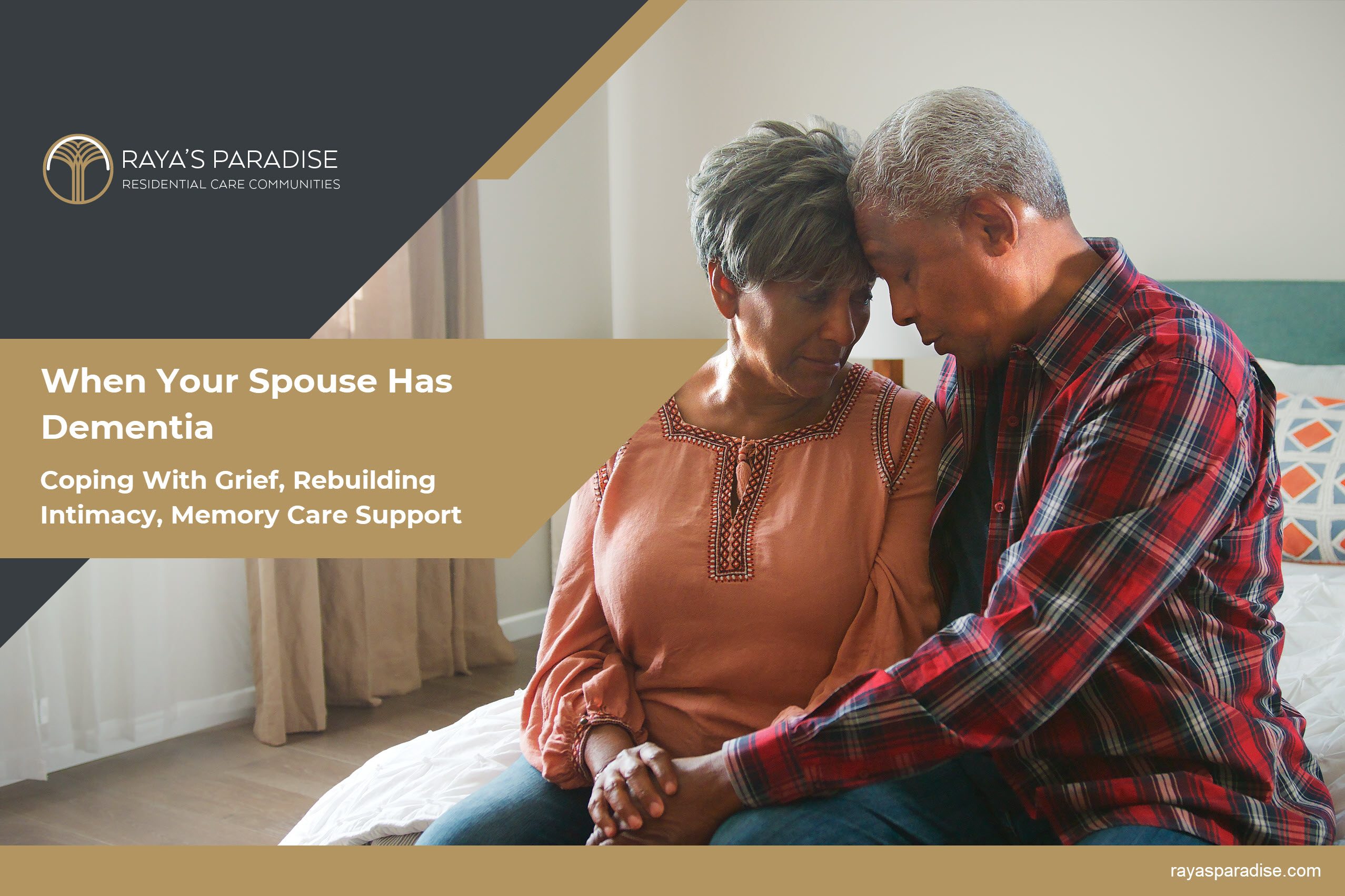
When Your Spouse Has Dementia
Coping With Grief, Rebuilding Intimacy and Memory Care Support
Key Takeaways
- What you are feeling is normal. Grief, guilt, anger, relief, and fear can show up together.
- Moving your spouse to memory care does not end the marriage. It changes how you express it.
- Meaningful visits are less about explaining reality and more about creating calm connection.
- Support groups, counseling, and respite can protect your health and help you stay present.
- Ask care communities how they handle progression, communication, and behaviors, not just activities.
When your spouse has dementia, life can start to feel unfamiliar even while you are standing in the same kitchen, sleeping in the same bed, living in the same zip code. If a move to memory care becomes necessary, that change can hit like a wave. The home gets quieter. Your daily responsibilities shift. Your identity as a partner, caregiver, decision-maker, and protector gets rearranged all at once.
This article combines the heart of two earlier posts into one practical guide. It is written for the spouse who is trying to do the right thing while carrying grief, love, exhaustion, and that strange mix of relief and sadness that can feel impossible to explain.
If you want a team to talk through options and timing: explore our Raya’s Paradise communities, then reach out through the contact page. If you are ready to visit in person, you can schedule a Los Angeles tour or request a visit at our San Clemente community.

Grief, Guilt, and the Shock of a New Life
Long marriages are built on daily intimacy. Shared routines. Private jokes. The quiet knowing of each other. Dementia can interrupt that in ways that feel deeply unfair, and a move to memory care can add a layer of separation that breaks your heart even when you know it is safer.
In the first few months after a transition, spouses commonly describe:
- A loss of control because you are no longer managing every detail
- An empty home and a sudden increase in unstructured time
- Guilt about not keeping your spouse at home
- Anger and sadness about the life you expected to keep living
- Fear about what comes next and second guessing the decision
None of those feelings mean you love your spouse less. They mean you are human, and you are adjusting to a major change. Many spouses also experience a form of grief that starts before death, often described in dementia caregiving research as “ambiguous loss,” meaning your spouse can be physically present while parts of their personality, memory, and relationship role feel absent. If you want language for the grief process and what support can look like, this resource from the National Institute on Aging on coping with grief and loss can be grounding.
If your spouse’s dementia is reaching a point where safety and daily support are hard to manage at home, it can help to review what a dementia-focused setting provides through memory care services, including options for memory care in South Orange County. For earlier stages when support needs are lighter, some families explore assisted living services and help with daily living in Orange County while they plan ahead.
If you feel like you are grieving the relationship as you knew it, you are not alone. You may also appreciate coping with the loss of your loved one to Alzheimer’s, which speaks directly to that unique kind of heartbreak.

Rebuilding the Relationship, Intimacy After Memory Care
When your spouse moves into memory care, your relationship does not end, it transforms. Many spouses worry, “What are we now?” The honest answer is that you are still partners, but the ways you communicate love may shift toward presence, comfort, and reassurance.
One of the most painful changes is when your spouse no longer knows who you are, or cannot place you correctly. In those moments, trying to force recognition can backfire and create stress for both of you. Instead, aim for connection over correction. Your spouse may not know your name, yet still know you are safe, familiar, and important. That matters.
If you are living this reality, you may find comfort and practical ideas in when your loved one forgets who you are. The article is written for families, and many spouses say it captures what they struggle to put into words.
Intimacy in dementia can still include:
- Holding hands, sitting close, a gentle hug if it feels welcome
- Listening to favorite music together
- Looking at photos and letting your spouse lead the story, even if details are wrong
- Simple shared routines like a cup of tea, a walk, brushing hair
- Quiet companionship without pressure to “perform” conversation
A strong care team should also support your need for private, respectful time. Ask whether there are quiet spaces for visits, how they support couple time, and what their approach is if your spouse becomes overwhelmed.

How to Have Meaningful Visits Without Burnout
Many spouses leave visits feeling shaken, especially early on. You may feel like you have to be upbeat, bring the right activity, say the right thing, and fix the unfixable. Take that pressure off. Meaningful visits are usually built on calm and familiarity.
Try this simple visit framework:
- Arrive gently. Give your spouse a minute to orient to your presence.
- Choose one easy activity. Music, a snack, a short walk, folding towels, a photo album.
- Follow their energy. If they are tired, a shorter visit is not a failure.
- Exit with reassurance. A consistent closing phrase can reduce anxiety.
If distress shows up, treat it as information. Dementia-related agitation can be triggered by noise, hunger, discomfort, confusion, or fatigue. This guide on addressing agitation in someone with dementia can help you spot patterns and communicate what you are seeing to staff.
Also consider scheduling a care conference during one of your visits. Ask how your spouse is sleeping, eating, participating, and adjusting. Ask what helps on difficult days. If you want a deeper decision-making resource, how to choose a memory care facility offers a helpful lens on what good support looks like.
Privacy clarification that prevents frustration: HIPAA rules apply to covered healthcare providers and health plans, and they generally require patient permission unless you are your spouse’s legally recognized personal representative. If your spouse can still provide consent, ask the provider what authorization form they use so you can be included in updates. If capacity is changing, ask an attorney about the right legal documents for your situation (often an advance health care directive or other authorization). This HHS resource on sharing health information with family and friends under HIPAA explains the basics in plain language.

Take Care of Yourself, Support Groups, Counseling, Respite, and Hospice
When you have been the primary caregiver, it is common to realize how much you postponed your own needs. Doctor visits, friendships, hobbies, exercise, sleep, mental health. Dementia caregiving can slowly shrink a life, then memory care can leave you standing in the space that caregiving used to fill.
Self-care is not a bubble bath. It is rebuilding the basics: health appointments, regular meals, sleep, movement, social connection, and emotional support that is not dependent on “being strong.” If you are feeling depleted, this article on signs of caregiver burnout can help you name what is happening and take action earlier.
Support groups are especially powerful for spouses because they offer understanding without explanation. If you have avoided them because you are not sure what you will find, read the pros and cons of joining a dementia care support group and decide based on fit, not fear.
Sometimes you need a true break, not just a shorter visit. A short-term respite care stay can help families reset after a hospitalization, during caregiver exhaustion, or while you stabilize a longer-term plan.
If your spouse has advanced illness alongside dementia, you may also be navigating end-of-life support. In many situations, hospice partners can provide additional comfort-focused care while your loved one remains in a residential setting. Medicare covers hospice services for eligible patients, but it generally does not cover facility room and board when hospice is provided in an assisted living or nursing facility. Learn how we coordinate support through hospice care services.
Choosing care is emotional, and it also needs to be practical. Families want safety, dignity, and a team that communicates clearly. Raya’s Paradise supports seniors through memory care services and Orange County memory care, and for earlier-stage support we also offer assisted living services including assisted living in Orange County.
If you want to see locations and decide what feels right, visit our communities page. When you are ready to talk, reach out through the contact page. If you prefer to start with an in-person tour, schedule a Los Angeles tour or a San Clemente tour.
Our Senior Assisted Living with Specialized Memory Care Community in Orange County
Our Los Angeles Assisted Living Residences with Specialized Memory Care
Sources & Additional Resources
Alzheimers.gov tips for caregivers and families
Alzheimer’s Association guidance on relationship changes and intimacy
National Institute on Aging overview of coping with grief and loss
National Institute on Aging overview of intimacy and sexuality changes in Alzheimer’s
HHS explanation of sharing health information with family and friends under HIPAA
Medicare hospice coverage and room and board limits
California CDSS dementia care information and resources for RCFEs
Alzheimer Society of Canada overview of ambiguous loss and grief in dementia
Disclaimer:
This article is for general educational purposes only and is not medical advice, diagnosis, or treatment guidance. It also does not provide legal or financial advice. Dementia experiences vary widely, and decisions about memory care timing, safety, medications, mental health support, and end-of-life planning should be made with qualified professionals who understand your spouse’s specific situation. If there is immediate safety risk, severe agitation, threats of harm, suicidal thoughts, sudden confusion, fever, chest pain, breathing trouble, or a recent fall, seek urgent medical care or call emergency services right away. Any discussion of HIPAA and information sharing is general and may not reflect your legal authority in your state; for guidance about consent, personal representative status, advance directives, or powers of attorney, consider speaking with an elder law attorney or your spouse’s care team.
 https://rayasparadise.com/wp-content/uploads/2013/07/Discussing-Alzheimers-With-Family-Members-and-Friends.jpg
1702
2551
Moti Gamburd
https://rayasparadise.com//wp-content/uploads/2019/07/RP-LOGO-Horizontal-Name-Only-websitetrans.png
Moti Gamburd2026-08-07 11:09:072026-08-07 16:13:16Discussing Alzheimer's with Family Members and Friends
https://rayasparadise.com/wp-content/uploads/2013/07/Discussing-Alzheimers-With-Family-Members-and-Friends.jpg
1702
2551
Moti Gamburd
https://rayasparadise.com//wp-content/uploads/2019/07/RP-LOGO-Horizontal-Name-Only-websitetrans.png
Moti Gamburd2026-08-07 11:09:072026-08-07 16:13:16Discussing Alzheimer's with Family Members and Friends https://rayasparadise.com/wp-content/uploads/2013/08/When-Your-Spouse-Has-Dementia.jpg
1703
2555
Moti Gamburd
https://rayasparadise.com//wp-content/uploads/2019/07/RP-LOGO-Horizontal-Name-Only-websitetrans.png
Moti Gamburd2026-02-14 08:39:382026-10-12 22:07:03When Your Spouse Has Dementia
https://rayasparadise.com/wp-content/uploads/2013/08/When-Your-Spouse-Has-Dementia.jpg
1703
2555
Moti Gamburd
https://rayasparadise.com//wp-content/uploads/2019/07/RP-LOGO-Horizontal-Name-Only-websitetrans.png
Moti Gamburd2026-02-14 08:39:382026-10-12 22:07:03When Your Spouse Has Dementia https://rayasparadise.com/wp-content/uploads/2013/03/Where-to-Start-With-Power-of-Attorney-in-California.jpg
1700
2551
Moti Gamburd
https://rayasparadise.com//wp-content/uploads/2019/07/RP-LOGO-Horizontal-Name-Only-websitetrans.png
Moti Gamburd2026-01-14 04:00:392026-10-12 23:00:18Where to Start with Power of Attorney
https://rayasparadise.com/wp-content/uploads/2013/03/Where-to-Start-With-Power-of-Attorney-in-California.jpg
1700
2551
Moti Gamburd
https://rayasparadise.com//wp-content/uploads/2019/07/RP-LOGO-Horizontal-Name-Only-websitetrans.png
Moti Gamburd2026-01-14 04:00:392026-10-12 23:00:18Where to Start with Power of Attorney https://rayasparadise.com/wp-content/uploads/2014/05/Estate-Planning-Planning-a-Grand-Finale-with-Care-and-Clarity.jpg
1695
2551
Moti Gamburd
https://rayasparadise.com//wp-content/uploads/2019/07/RP-LOGO-Horizontal-Name-Only-websitetrans.png
Moti Gamburd2026-01-06 14:14:472026-01-06 23:58:10Estate Planning, Planning a Grand Finale with Care and Clarity
https://rayasparadise.com/wp-content/uploads/2014/05/Estate-Planning-Planning-a-Grand-Finale-with-Care-and-Clarity.jpg
1695
2551
Moti Gamburd
https://rayasparadise.com//wp-content/uploads/2019/07/RP-LOGO-Horizontal-Name-Only-websitetrans.png
Moti Gamburd2026-01-06 14:14:472026-01-06 23:58:10Estate Planning, Planning a Grand Finale with Care and Clarity https://rayasparadise.com/wp-content/uploads/2014/01/LivingTrust.jpg
300
573
Raya's Paradise
https://rayasparadise.com//wp-content/uploads/2019/07/RP-LOGO-Horizontal-Name-Only-websitetrans.png
Raya's Paradise2020-01-28 07:20:192026-01-14 18:41:47A Will, A Living Will, A Living Trust…What is the Difference?
https://rayasparadise.com/wp-content/uploads/2014/01/LivingTrust.jpg
300
573
Raya's Paradise
https://rayasparadise.com//wp-content/uploads/2019/07/RP-LOGO-Horizontal-Name-Only-websitetrans.png
Raya's Paradise2020-01-28 07:20:192026-01-14 18:41:47A Will, A Living Will, A Living Trust…What is the Difference? https://rayasparadise.com/wp-content/uploads/2019/12/Do-You-Have-Compassion-Fatigue.jpg
1698
2556
Raya's Paradise
https://rayasparadise.com//wp-content/uploads/2019/07/RP-LOGO-Horizontal-Name-Only-websitetrans.png
Raya's Paradise2019-12-13 07:30:422026-01-14 19:38:02Do You Have Compassion Fatigue?
https://rayasparadise.com/wp-content/uploads/2019/12/Do-You-Have-Compassion-Fatigue.jpg
1698
2556
Raya's Paradise
https://rayasparadise.com//wp-content/uploads/2019/07/RP-LOGO-Horizontal-Name-Only-websitetrans.png
Raya's Paradise2019-12-13 07:30:422026-01-14 19:38:02Do You Have Compassion Fatigue? https://rayasparadise.com/wp-content/uploads/2018/04/Aging-with-friends.jpg
700
900
Raya's Paradise
https://rayasparadise.com//wp-content/uploads/2019/07/RP-LOGO-Horizontal-Name-Only-websitetrans.png
Raya's Paradise2019-10-04 00:40:262026-05-30 02:40:39Creating a Plan for Aging Parents
https://rayasparadise.com/wp-content/uploads/2018/04/Aging-with-friends.jpg
700
900
Raya's Paradise
https://rayasparadise.com//wp-content/uploads/2019/07/RP-LOGO-Horizontal-Name-Only-websitetrans.png
Raya's Paradise2019-10-04 00:40:262026-05-30 02:40:39Creating a Plan for Aging Parents https://rayasparadise.com/wp-content/uploads/2018/10/When-a-Residential-Care-Community-Is-an-Option-for-Temporary-Hospice-or-Palliative-Care.jpg
1692
2551
Raya's Paradise
https://rayasparadise.com//wp-content/uploads/2019/07/RP-LOGO-Horizontal-Name-Only-websitetrans.png
Raya's Paradise2018-10-11 09:13:382026-01-14 19:25:50When a Residential Care Community Is an Option for Temporary Hospice or Palliative Care
https://rayasparadise.com/wp-content/uploads/2018/10/When-a-Residential-Care-Community-Is-an-Option-for-Temporary-Hospice-or-Palliative-Care.jpg
1692
2551
Raya's Paradise
https://rayasparadise.com//wp-content/uploads/2019/07/RP-LOGO-Horizontal-Name-Only-websitetrans.png
Raya's Paradise2018-10-11 09:13:382026-01-14 19:25:50When a Residential Care Community Is an Option for Temporary Hospice or Palliative Care https://rayasparadise.com/wp-content/uploads/2013/12/Senior-Reviewing-Debt-scaled.jpg
1707
2560
Raya's Paradise
https://rayasparadise.com//wp-content/uploads/2019/07/RP-LOGO-Horizontal-Name-Only-websitetrans.png
Raya's Paradise2013-12-24 04:00:552026-01-14 19:40:13Are You Responsible for Your Elderly Parent's Debt?
https://rayasparadise.com/wp-content/uploads/2013/12/Senior-Reviewing-Debt-scaled.jpg
1707
2560
Raya's Paradise
https://rayasparadise.com//wp-content/uploads/2019/07/RP-LOGO-Horizontal-Name-Only-websitetrans.png
Raya's Paradise2013-12-24 04:00:552026-01-14 19:40:13Are You Responsible for Your Elderly Parent's Debt? Raya's Paradise
https://rayasparadise.com//wp-content/uploads/2019/07/RP-LOGO-Horizontal-Name-Only-websitetrans.png
Raya's Paradise2013-12-19 04:00:422026-01-14 19:01:29How Children Can Help with Caregiving
https://rayasparadise.com/wp-content/uploads/2013/12/Selling-the-Home-of-a-Parent-Who-Has-Alzheimers.jpg
1701
2555
Raya's Paradise
https://rayasparadise.com//wp-content/uploads/2019/07/RP-LOGO-Horizontal-Name-Only-websitetrans.png
Raya's Paradise2013-12-10 06:11:492026-01-14 19:40:46Selling the Home of a Parent Who Has Alzheimer's
Raya's Paradise
https://rayasparadise.com//wp-content/uploads/2019/07/RP-LOGO-Horizontal-Name-Only-websitetrans.png
Raya's Paradise2013-12-05 04:00:132026-01-14 19:03:27How to Talk to Someone Who is Dying
Raya's Paradise
https://rayasparadise.com//wp-content/uploads/2019/07/RP-LOGO-Horizontal-Name-Only-websitetrans.png
Raya's Paradise2013-11-12 08:10:052026-01-14 18:42:51Caring for Aging In-Laws
Raya's Paradise
https://rayasparadise.com//wp-content/uploads/2019/07/RP-LOGO-Horizontal-Name-Only-websitetrans.png
Raya's Paradise2013-10-29 08:03:162026-01-14 19:03:03How to Maintain a Positive Attitude
Raya's Paradise
https://rayasparadise.com//wp-content/uploads/2019/07/RP-LOGO-Horizontal-Name-Only-websitetrans.png
Raya's Paradise2013-10-10 04:00:272026-05-31 06:53:13Advice for New Caregivers
Raya's Paradise
https://rayasparadise.com//wp-content/uploads/2019/07/RP-LOGO-Horizontal-Name-Only-websitetrans.png
Raya's Paradise2013-12-19 04:00:422026-01-14 19:01:29How Children Can Help with Caregiving
https://rayasparadise.com/wp-content/uploads/2013/12/Selling-the-Home-of-a-Parent-Who-Has-Alzheimers.jpg
1701
2555
Raya's Paradise
https://rayasparadise.com//wp-content/uploads/2019/07/RP-LOGO-Horizontal-Name-Only-websitetrans.png
Raya's Paradise2013-12-10 06:11:492026-01-14 19:40:46Selling the Home of a Parent Who Has Alzheimer's
Raya's Paradise
https://rayasparadise.com//wp-content/uploads/2019/07/RP-LOGO-Horizontal-Name-Only-websitetrans.png
Raya's Paradise2013-12-05 04:00:132026-01-14 19:03:27How to Talk to Someone Who is Dying
Raya's Paradise
https://rayasparadise.com//wp-content/uploads/2019/07/RP-LOGO-Horizontal-Name-Only-websitetrans.png
Raya's Paradise2013-11-12 08:10:052026-01-14 18:42:51Caring for Aging In-Laws
Raya's Paradise
https://rayasparadise.com//wp-content/uploads/2019/07/RP-LOGO-Horizontal-Name-Only-websitetrans.png
Raya's Paradise2013-10-29 08:03:162026-01-14 19:03:03How to Maintain a Positive Attitude
Raya's Paradise
https://rayasparadise.com//wp-content/uploads/2019/07/RP-LOGO-Horizontal-Name-Only-websitetrans.png
Raya's Paradise2013-10-10 04:00:272026-05-31 06:53:13Advice for New Caregivers