How much do family members get paid for caregiving?
- Most family caregivers are unpaid, but several programs do pay relatives, including Medicaid self-directed care, VA caregiver programs and some long-term care insurance policies
- Through Medicaid, family caregiver pay varies by state, program and approved care plan; reported personal care provider rates run from below $15 to over $30 an hour, with a median of about $19
- Some programs cap monthly payments or use daily stipends rather than hourly wages, so families should confirm the current limit with their state Medicaid agency
- The unpaid value is far higher; a 2024 compensation study estimated a family dementia caregiver’s work would be worth about $114,000 a year at market rates
| Pay type |
How it works |
| Home health and personal care aide |
Wage; median about $17 an hour ($34,900 a year) |
| Medicaid family caregiver |
Program payment; varies by state, waiver and care plan |
| VA caregiver stipend (PCAFC) |
Stipend; locality examples about $1,896 to $3,793 a month |
| Medicare GUIDE respite |
Provider reimbursement; up to $2,500 a year per patient |
| In-home or live-in caregiver |
Posted rate; about $22 an hour nationally, varies by market |
The right path depends on the care recipient’s eligibility and the family’s situation. Each program below has its own rules, rates and payment method.
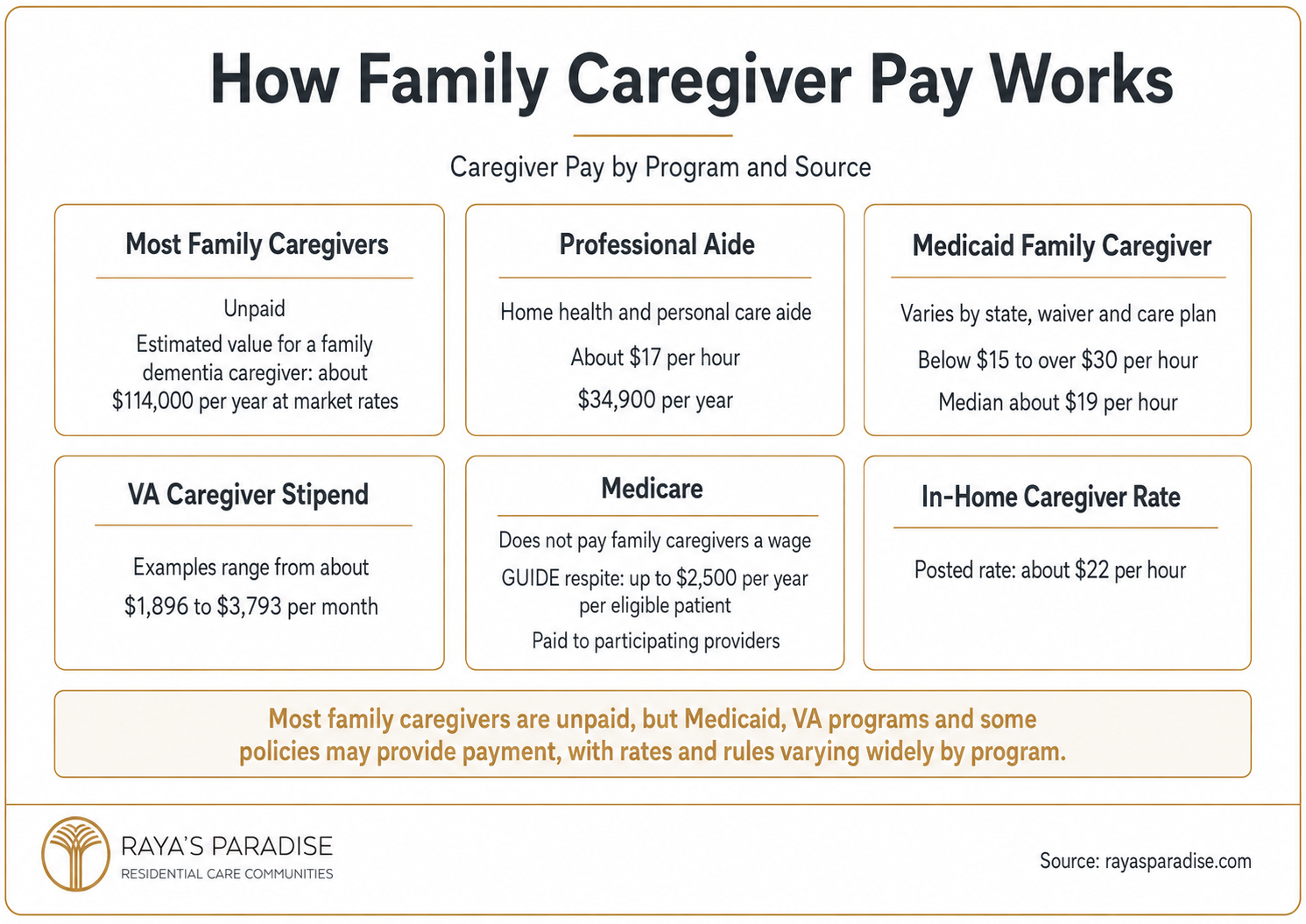
Most family caregivers are unpaid, but Medicaid, VA programs and some policies may provide payment, with rates and rules varying widely by program.
How much do caregivers make per hour?
- Home health and personal care aides earn a median wage of about $17 an hour, or $34,900 a year as of May 2024
- The lowest 10% earned under $25,600, while the highest 10% earned over $44,190
- It is one of the largest occupations in the country, with about 4.3 million workers
- Wages track local labor markets, so high-cost states pay well above the national median
| Home health and personal care aides (May 2024) |
Wage |
| Median annual wage |
$34,900 (about $17 an hour) |
| Lowest 10% |
Under $25,600 |
| Highest 10% |
Over $44,190 |
These figures cover professional aides employed by agencies or families. Demand is rising fast; the field is projected to grow 17% through 2034, much faster than average.
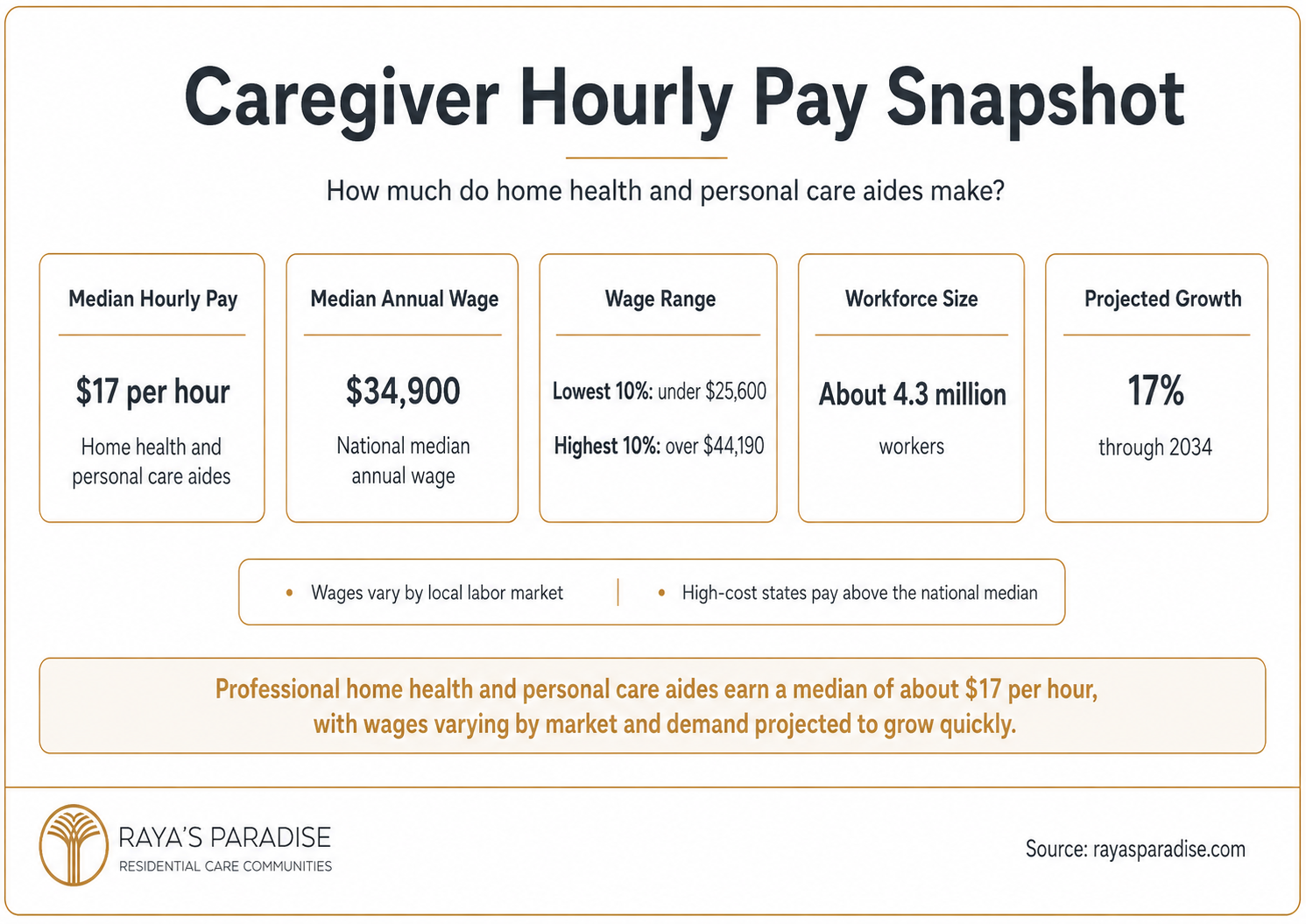
Professional home health and personal care aides earn a median of about $17 per hour, with wages varying by market and demand projected to grow quickly.
How much does Medicaid pay a family caregiver?
- Nearly all states let a Medicaid recipient self-direct home care and hire a family caregiver in at least some programs; Alaska is the only state that does not
- Pay varies by state, program and the recipient’s approved budget; reported Medicaid personal care provider rates run from below $15 to over $30 an hour, with a median of about $19
- Most states pay family caregivers an hourly wage, though 11 states use structured family caregiving programs that pay a daily stipend instead
- Rules on who qualifies vary; some states do not allow a spouse to be the paid caregiver, and a needs assessment sets the approved hours
Medicaid family caregiver pay varies too much by state and waiver to express as a single national rate. To start, families contact their state Medicaid agency about consumer-directed options and confirm the current rate, approved hours and relationship rules. State rules appear in our Medicaid long-term care research.
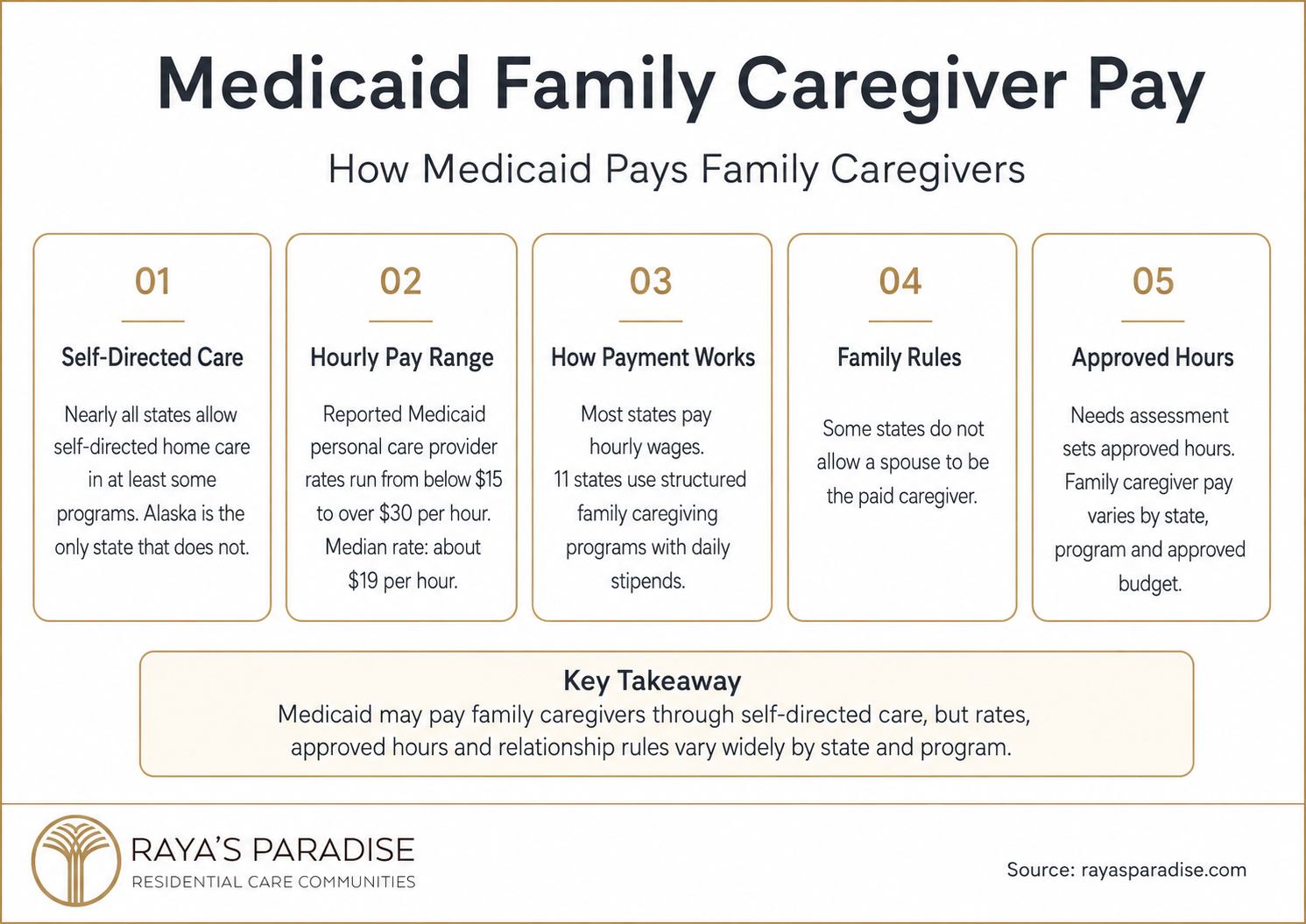
Medicaid may pay family caregivers through self-directed care, but rates, approved hours and relationship rules vary widely by state and program.
How much is the VA caregiver stipend?
- The VA pays a primary family caregiver a monthly stipend through the Program of Comprehensive Assistance for Family Caregivers
- In 2026, locality-based examples range from about $1,896 a month in lower-cost areas to about $3,793 in the highest-cost areas, depending on the veteran’s locality and VA care level
- It pays 62.5% of the monthly rate at Level 1 and 100% at Level 2, when the veteran is unable to self-sustain
- The program requires a veteran or service member with a serious service-connected disability rated at 70% or higher, or a combined 70% rating, who needs in-person personal care at home for at least six continuous months
A separate VA option, Veteran Directed Care, gives eligible veterans a flexible budget to hire their own workers, including family members in some cases, with rates and budgets that vary by location and care plan. Full eligibility and rate details appear in our veterans benefits research.
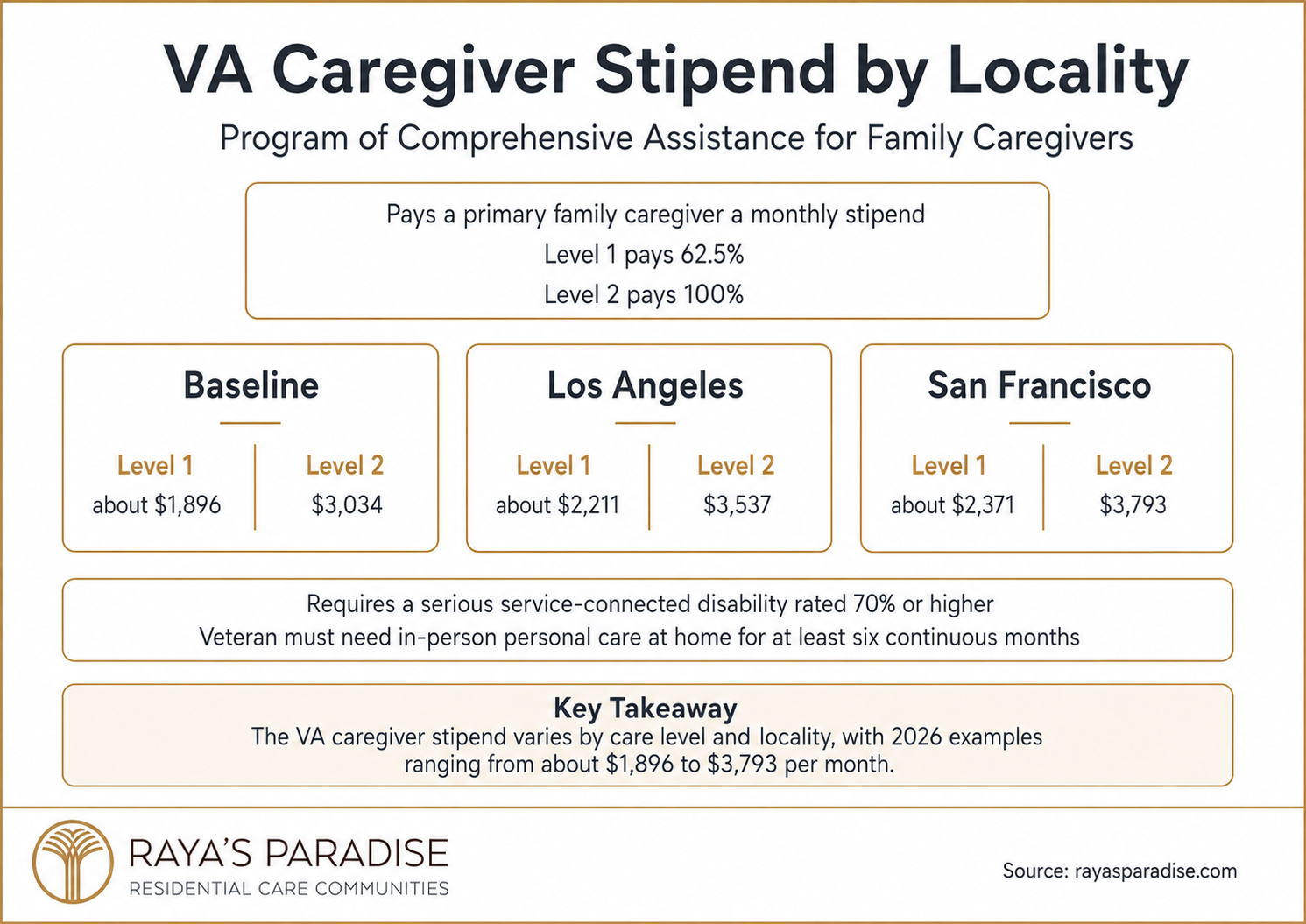
The VA caregiver stipend varies by care level and locality, with 2026 examples ranging from about $1,896 to $3,793 per month.
How much does Medicare pay for family caregivers?
- Medicare does not pay family caregivers a wage, since it covers medical services rather than custodial care
- Its GUIDE model, launched in 2024 for dementia, can reimburse participating providers up to $2,500 a year per eligible patient for respite that temporarily relieves qualifying caregivers
- GUIDE also provides care coordination, a 24-hour support line and caregiver training at no direct cost
- It is for people with dementia who have Medicare Parts A and B (not Medicare Advantage or PACE), with Medicare as the primary payer, who live in a private home or an approved residential care community such as an assisted living facility, not a long-term nursing home
- Beginning July 1, 2026, residents of approved residential care communities, including assisted living, can receive most GUIDE services but not GUIDE respite; memory care unit residents are not eligible for GUIDE
So while Medicare will not replace a caregiver’s income, the GUIDE model can ease the burden through respite and guidance for those who qualify. Families combine it with Medicaid or VA pay where they are eligible.
How much do live-in caregivers make?
- Posted in-home caregiver rates average about $22 an hour nationally and vary widely by market
- Rates run higher in high-cost states like California, where posted rates average about $25 an hour
- Live-in arrangements may be quoted hourly, daily or weekly, depending on the hours worked, overnight and sleep-time rules, state labor laws and whether the caregiver is hired privately or through an agency
- Agency caregivers may earn less per hour but gain benefits, while private hires negotiate directly with the family
Live-in arrangements can rival the cost of assisted living once around-the-clock needs set in. The full comparison appears in our in-home care cost research.
This research is for informational purposes only and is not financial or benefits advice. Caregiver pay rates, program rules and eligibility vary widely by state, program and year. Confirm current figures with the relevant agency or a qualified advisor before making decisions.
Sources and additional resources
Source note: The $34,900 median annual wage, the under-$25,600 and over-$44,190 tenth-percentile figures, the 4.3 million jobs and the 17% projected growth come from the Bureau of Labor Statistics. The roughly $17 hourly figure is derived from the $34,900 annual median.
Source note: Medicaid self-directed care comes from Medicaid.gov. KFF’s 2025 home care surveys found that nearly all states allow self-direction (Alaska is the exception), that most states pay family caregivers under at least some waivers and that reported personal care provider rates run from below $15 to over $30 an hour, with a $19 median.
Source note: The VA stipend formula (grade 4, step 1 locality pay divided by 12, times 0.625 at Level 1 or 1.00 at Level 2), the 70% disability rule and the six-month care requirement come from VA Caregiver Support. The $1,896 to $3,793 examples derive from 2026 federal pay tables. Veteran Directed Care details come from VA Geriatrics.
Source note: The GUIDE respite cap of $2,500 a year per eligible patient, paid to participating providers, and the residential care community and memory care rules come from CMS. The point that Medicare does not cover custodial long-term care comes from Medicare.gov.
Source note: The $114,000 family dementia caregiver value comes from a 2024 Salary.com compensation study sponsored by Otsuka. The national posted in-home caregiver average of about $22 an hour and the higher California figure come from Care.com.
Source note: The point that most family caregivers are unpaid reflects AARP and the National Alliance for Caregiving’s Caregiving in the U.S. 2025 report, which counts about 63 million U.S. family caregivers.
Raya’s Paradise provides assisted living, memory care, hospice support, short-term respite care and in-home care across Southern California, giving families a professional option when caregiving outgrows what one person can manage. Explore in-home care in Los Angeles and Orange County in-home care.