How much does Medicare pay for assisted living?
- Medicare pays nothing toward assisted living room, board or custodial personal care
- Medicare still covers medical services a resident receives, such as doctor visits and hospital care, regardless of where they live
- It covers short-term skilled nursing of up to 100 days in a skilled nursing facility after a qualifying hospital stay, but not an assisted living community
- Some Medicare Advantage plans add limited supplemental benefits, but Medicare Advantage generally does not cover assisted living room, board or the facility fee itself
| Service |
Medicare coverage |
| Assisted living room and board |
Not covered |
| Custodial and personal care |
Not covered |
| Doctor visits and hospital care |
Covered, regardless of residence |
| Short-term skilled nursing facility care |
Up to 100 days, not assisted living |
Because Medicare leaves assisted living unfunded, families turn to the programs below. For a fuller breakdown, see our research on what Medicare covers for senior care.
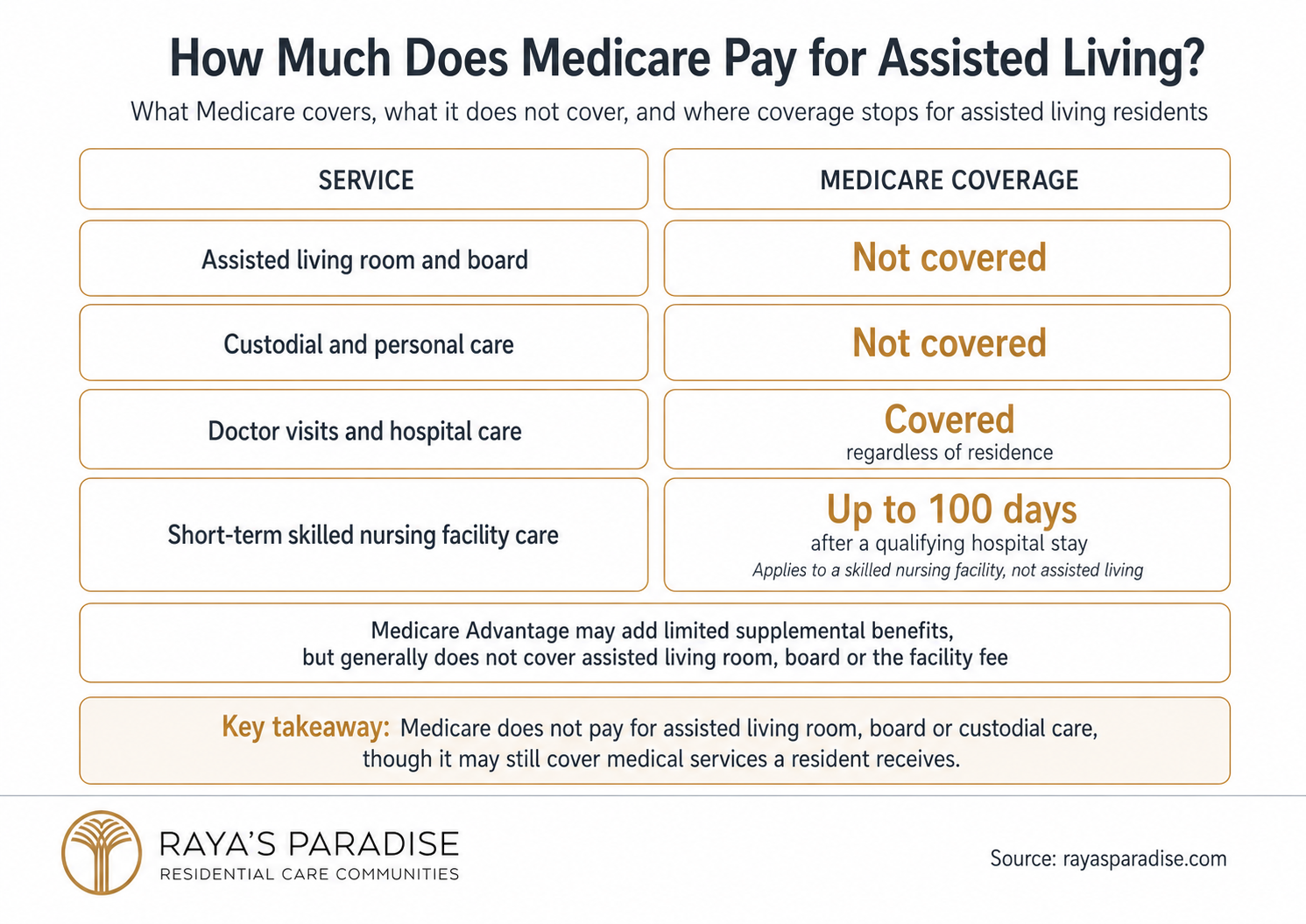
Medicare does not pay for assisted living room, board or custodial care, though it may still cover medical services a resident receives.
How much does Medicaid pay for assisted living?
- Medicaid does not pay room and board in assisted living, but many states cover some care services through home- and community-based services programs or waivers
- Coverage varies widely by state, and waiver slots are often limited, so waitlists are common
- Medicaid is means-tested; many programs use a low countable-asset limit, often around $2,000 for a single applicant, while income limits vary by state and program
- The resident’s own income, including Social Security, generally goes toward room and board, sometimes offset by a state supplement
Medicaid is the largest public payer of long-term care, covering 61% of national spending. Eligibility rules and covered services differ by state, detailed in our Medicaid long-term care research.
How much will the VA pay for assisted living (Aid and Attendance)?
- VA Aid and Attendance pays a tax-free monthly benefit toward assisted living for wartime veterans and surviving spouses who need help with daily activities
- For 2026, the maximum is about $2,424 a month for a single veteran and $2,874 for a veteran with a spouse
- A surviving spouse can receive up to about $1,558 a month, and two married veterans up to $3,845
- These are maximums; the actual benefit equals the pension rate minus countable income, after assisted living and other medical costs are deducted
- Because unreimbursed assisted living and medical costs may reduce countable income, they can increase the benefit and may help some applicants qualify for a larger payment
| Recipient |
2026 monthly maximum |
Annual maximum |
| Single veteran |
$2,424 |
$29,093 |
| Veteran with a spouse or dependent |
$2,874 |
$34,488 |
| Surviving spouse |
$1,558 |
$18,697 |
| Two married veterans, both qualifying |
$3,845 |
$46,143 |
Eligibility requires wartime service and a net worth under $163,699 for the 2026 period. The benefit can fund home care, assisted living or memory care, as detailed in our veterans senior care research.
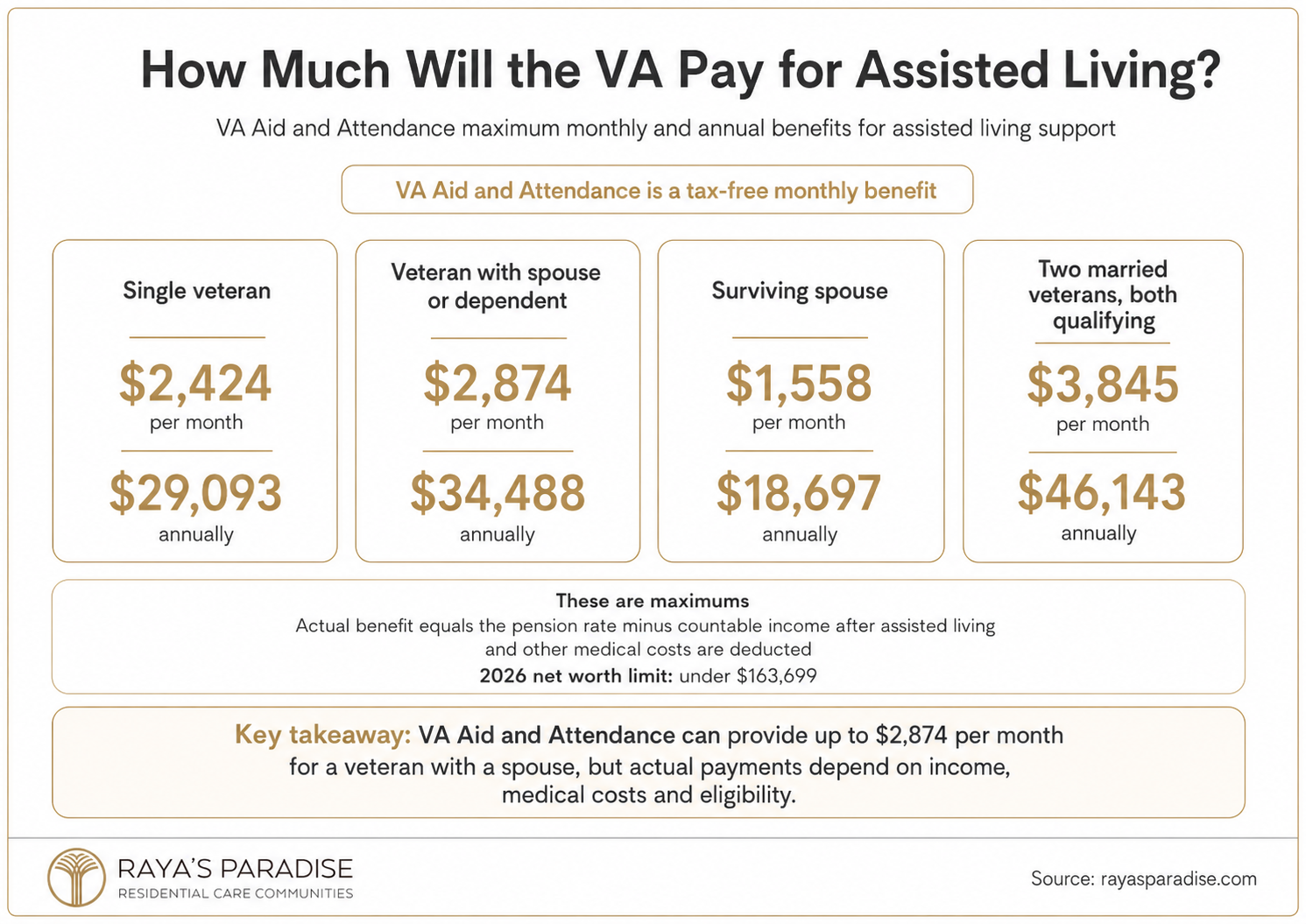
VA Aid and Attendance can provide up to $2,874 per month for a veteran with a spouse, but actual payments depend on income, medical costs and eligibility.
How much does long-term care insurance pay for assisted living?
- Long-term care insurance may reimburse eligible assisted living costs up to the policy’s daily or monthly benefit, if assisted living is covered under the policy
- Most buyers select an initial maximum monthly benefit of $3,000 to $6,000, often enough to cover much of the $6,200 national median
- Benefits usually begin after an elimination period, often 90 days, and once the policyholder needs help with two or more daily activities
- The average claim across all settings now reaches about $180,000 over the life of the policy
Whether a policy fully covers assisted living depends on its benefit cap and inflation protection. Premiums and benefit design are detailed in our long-term care insurance cost research.
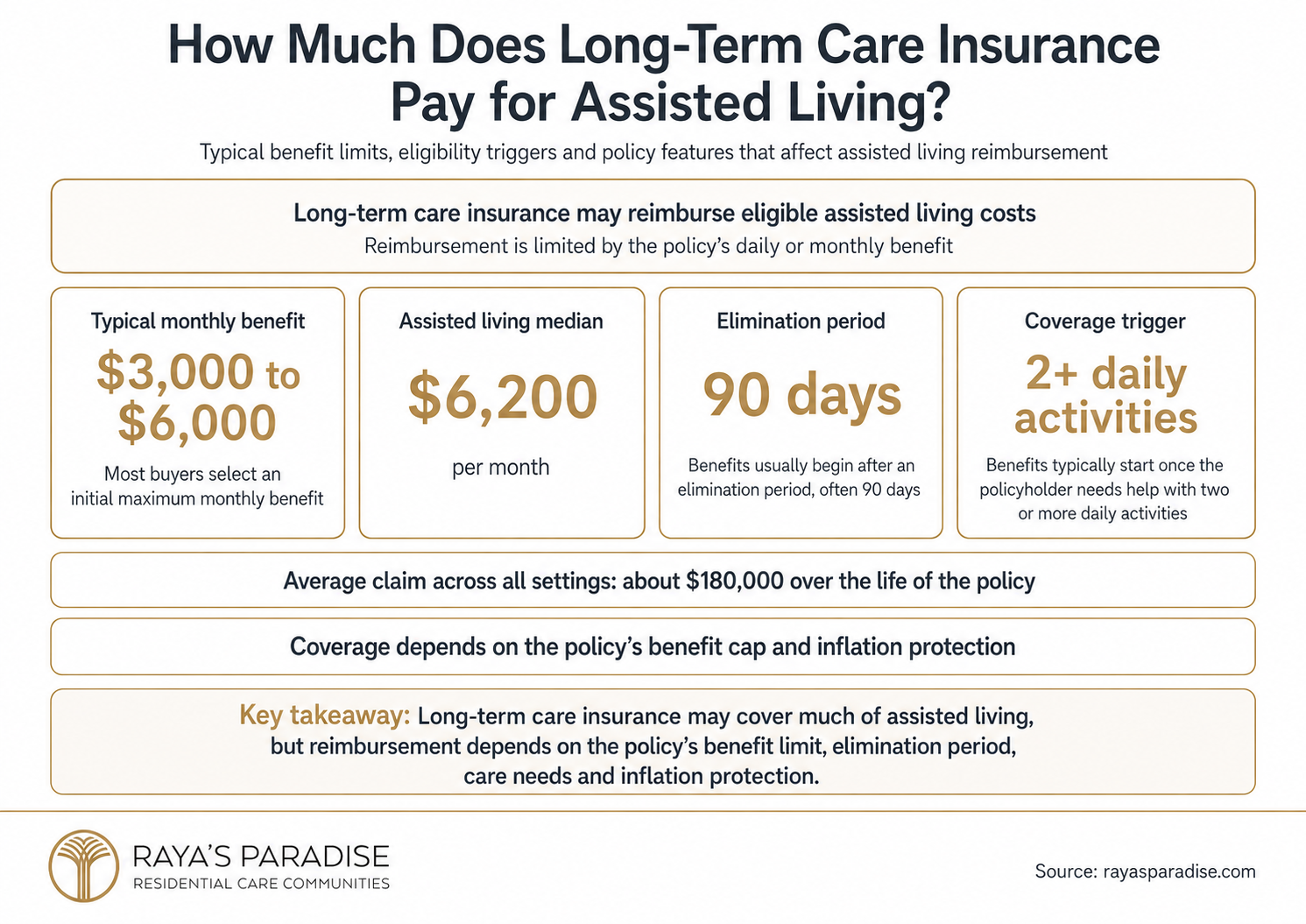
Long-term care insurance may cover much of assisted living, but reimbursement depends on the policy’s benefit limit, elimination period, care needs and inflation protection.
How much does Social Security pay toward assisted living?
- Social Security does not pay assisted living directly, but the benefit is income a resident applies toward the cost
- The average retired worker receives about $2,071 a month in 2026, and a married couple about $3,208
- That covers roughly a third of the $6,200 national median assisted living cost, so most families combine it with savings or other benefits
- Low-income seniors may also receive SSI, and some states add an optional supplement for assisted living residents
| Social Security benefit (2026) |
Average monthly amount |
| Retired worker |
$2,071 |
| Married couple, both receiving |
$3,208 |
| National median assisted living cost |
$6,200 |
The gap between a benefit check and the monthly bill is why payment planning matters. Benefit details appear in our Social Security benefits research.
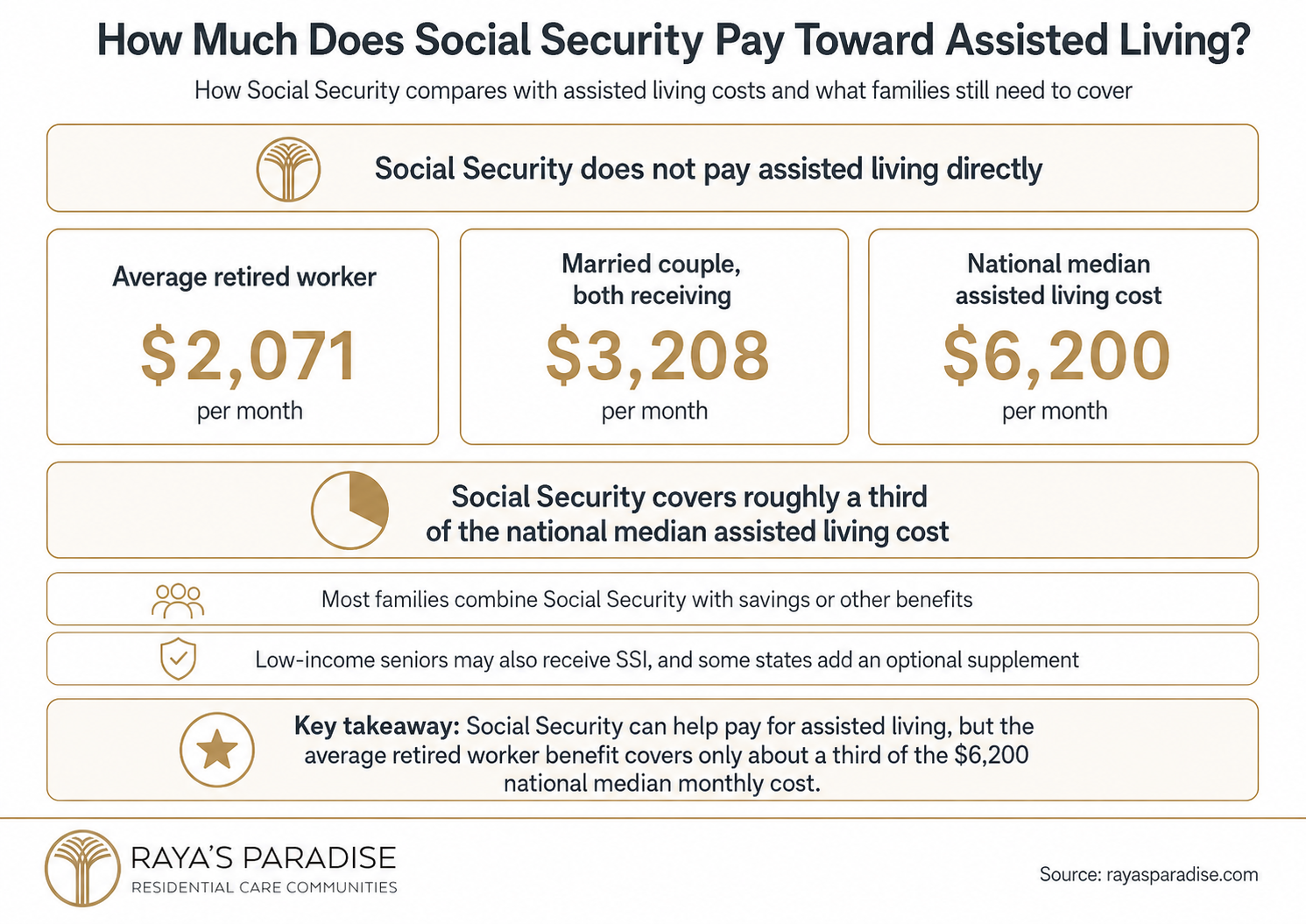
Social Security can help pay for assisted living, but the average retired worker benefit covers only about a third of the $6,200 national median monthly cost.
What percentage of assisted living is tax deductible?
- There is no fixed percentage; only the medical portion of assisted living qualifies as a deductible medical expense
- For a resident certified as chronically ill and under a prescribed care plan, more of the cost may qualify, and meals and lodging may be deductible if the principal reason for being in the facility is medical care
- A person is chronically ill if a licensed practitioner certifies they need help with two or more daily activities, or substantial supervision due to cognitive impairment
- Only medical expenses above 7.5% of adjusted gross income are deductible, and only if the filer itemizes on Schedule A
An adult child paying a parent’s care may also claim the deduction under certain conditions. Tax rules are nuanced, so families should confirm specifics with a tax professional and review our caregiver tax credits research.
This research is for informational purposes only and is not financial, legal, tax or medical advice. Benefit amounts, eligibility rules and tax thresholds change and vary by state and circumstance. Confirm current figures with the relevant agency and consult a qualified professional before making decisions.
Sources and additional resources
Source note: VA Aid and Attendance maximums ($29,093 single veteran, $34,488 with a spouse, $18,697 surviving spouse and $46,143 for two married veterans) and the $163,699 net worth limit reflect the VA rates effective December 1, 2025. The average Social Security figures ($2,071 and $3,208) come from the SSA 2026 cost-of-living fact sheet.
The $6,200 assisted living median comes from the 2025 CareScout survey. The $3,000 to $6,000 maximum monthly benefit comes from AALTCI’s 2024 buyer data, and the roughly $180,000 average claim from Milliman. Medicaid covering 61% of long-term care spending and the exclusion of assisted living room and board both come from KFF, and the deduction rules come from IRS Publication 502.
Raya’s Paradise provides residential assisted living, memory care, hospice support, short-term respite care and in-home care across Southern California. Families piecing together how to fund care can tour our West Hollywood and Los Angeles care homes or an upscale Orange County assisted living residence and ask how each payment source applies.