What is the average lifetime cost of long-term care?
- The average lifetime long-term care cost for a person turning 65 is about $120,900
- That average masks a highly skewed distribution; many people incur little cost while a minority face enormous bills
- Among higher-income adults, about 10% can expect out-of-pocket costs above $250,000 after age 65
- The figure reflects an average 3.1 years of need but less than one year of paid care, since most care is provided unpaid by family
- Because costs are so uneven, planning tools like long-term care insurance exist to protect against the worst-case bills
| Lifetime long-term care measure |
Projection for a 65-year-old |
| Will need some long-term care |
About 70% |
| Will use paid care |
About 48% |
| Average duration of need |
About 3.1 years |
| Average lifetime cost |
About $120,900 |
These figures come from two different federal models. The cost and duration projections, including the $120,900 average and the 3.1-year need, come from one model. The 70% and 48% lifetime-risk figures come from a separate analysis that uses a different method, so the two sets are not drawn from a single projection.
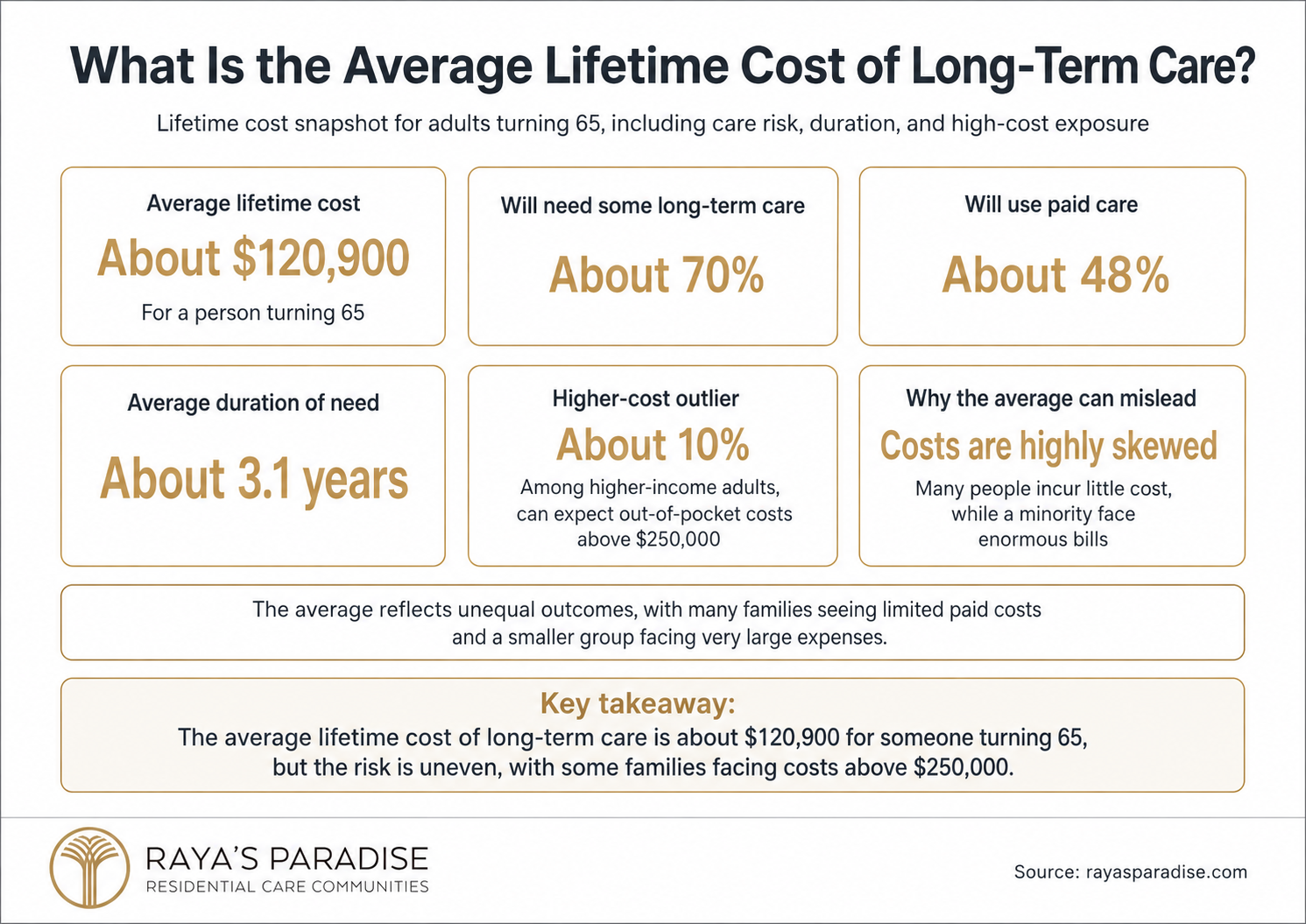
The average lifetime cost of long-term care is about $120,900 for someone turning 65, but costs are uneven, with some families facing bills above $250,000.
How much does senior care cost overall?
- The United States spent over $400 billion on long-term services and supports in a recent year, most of it on home and community-based care
- For a family, the overall cost depends on setting and duration; a three-year episode roughly matches the average length of need
- Three years of assisted living totals about $223,200, while three years in a private nursing home room totals about $388,725
- Among people who use any paid care, the implied average lifetime total reaches roughly $266,000, far above the all-population average
| Care setting |
Annual cost |
Three-year total |
| Adult day care |
$24,700 |
$74,100 |
| Assisted living |
$74,400 |
$223,200 |
| Home care (44 hours a week) |
$80,080 |
$240,240 |
| Memory care |
$80,280 |
$240,840 |
| Nursing home, semi-private |
$114,975 |
$344,925 |
| Nursing home, private |
$129,575 |
$388,725 |
Three-year totals multiply current national medians and do not include annual price increases. Care setting figures are 2025 and 2026 national medians, detailed in our senior living cost research.
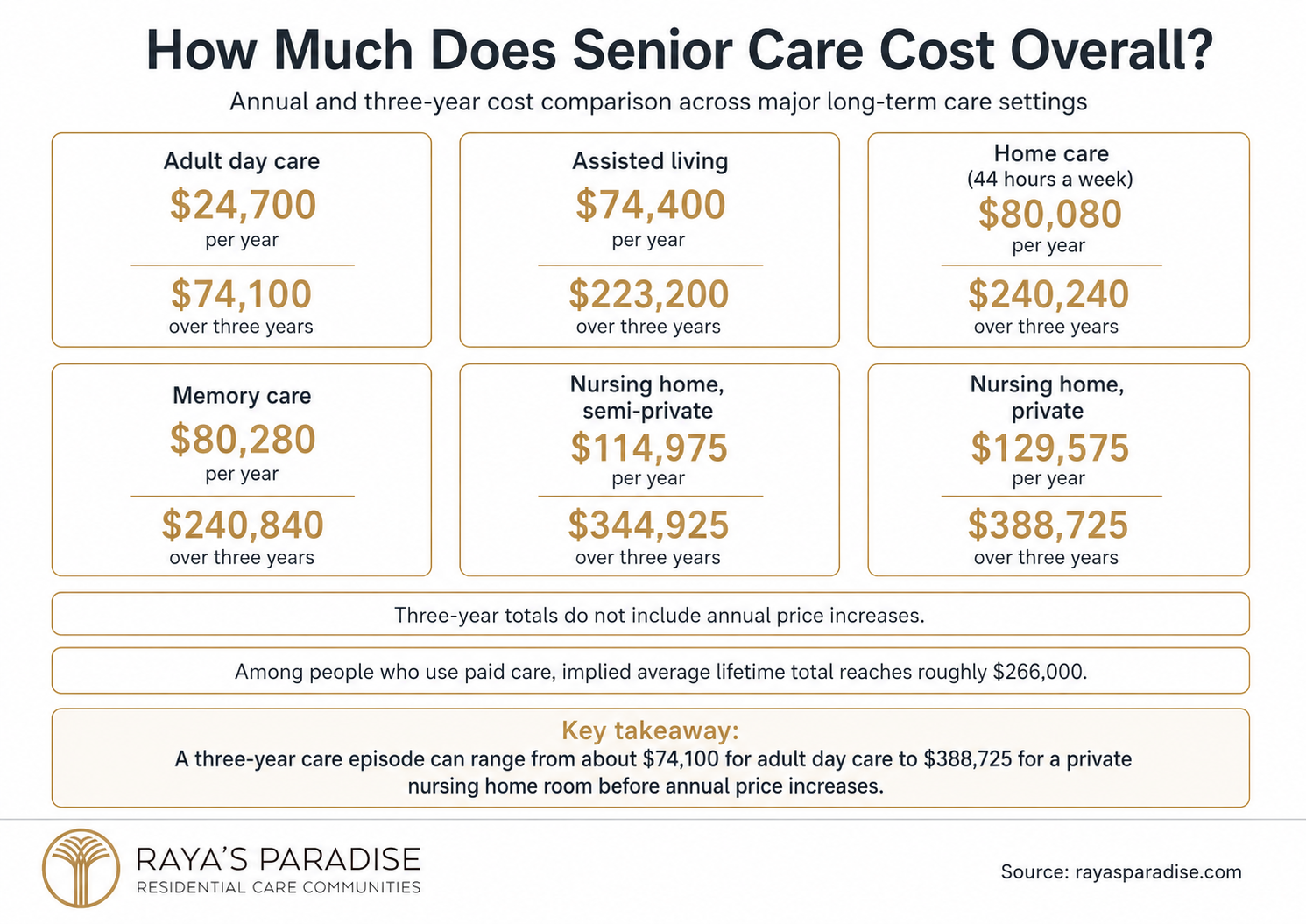
A three-year care episode can range from about $74,100 for adult day care to $388,725 for a private nursing home room before annual price increases.
What percentage of 65-year-olds will need long-term care?
- About 70% of adults who reach 65 will develop a serious long-term care need before they die
- Roughly 48% will use some paid care over their lifetime, while many people who need care receive only unpaid help from family or friends
- After 65, about 29% receive paid home care, 5% move into residential care like assisted living and 28% spend at least 90 days in a nursing home; these categories can overlap, since one person may use more than one type of paid care over time
- The odds rise sharply with age; among adults 85 and older, about 40% have severe care needs in a given year
These probabilities explain why long-term care planning matters even for healthy retirees. The demographic forces behind rising need are covered in our aging and long-term care demand research.

About 70% of adults who reach 65 will need long-term care, and nearly half will use paid care during their lifetime.
How long does the average person need long-term care?
- The average person who reaches 65 needs long-term care for about 3.1 years, though paid care averages less than one year
- Most of that time is spent receiving care at home, with the remainder in a nursing home or assisted living
- Roughly half of people who use paid care need it for no more than two years, and only 28% need paid care beyond four years
- A small group faces very long episodes; about 9% of those with severe needs require care for more than ten years
This wide range is why averages can mislead; planning for the long tail matters more than the typical case. Duration directly drives total cost, the math behind our long-term care utilization research.
What share of long-term care costs are paid out of pocket?
- Families pay about 17% of total long-term care spending directly out of pocket
- Medicaid is the largest payer at 61%, but it only serves those who meet strict income and asset limits
- Other public and private payers cover the remaining 21%
- The out-of-pocket share understates the family burden, since many spend down their savings to qualify for Medicaid and most care is unpaid family help
| Payer |
Share of long-term care spending |
| Medicaid |
61% |
| Out of pocket |
17% |
| Other public and private |
21% |
Because Original Medicare does not cover long-term custodial care, many families rely on private funds, unpaid help, Medicaid when eligible or other resources. Funding strategies are detailed in our research on paying for a nursing home and paying for assisted living.
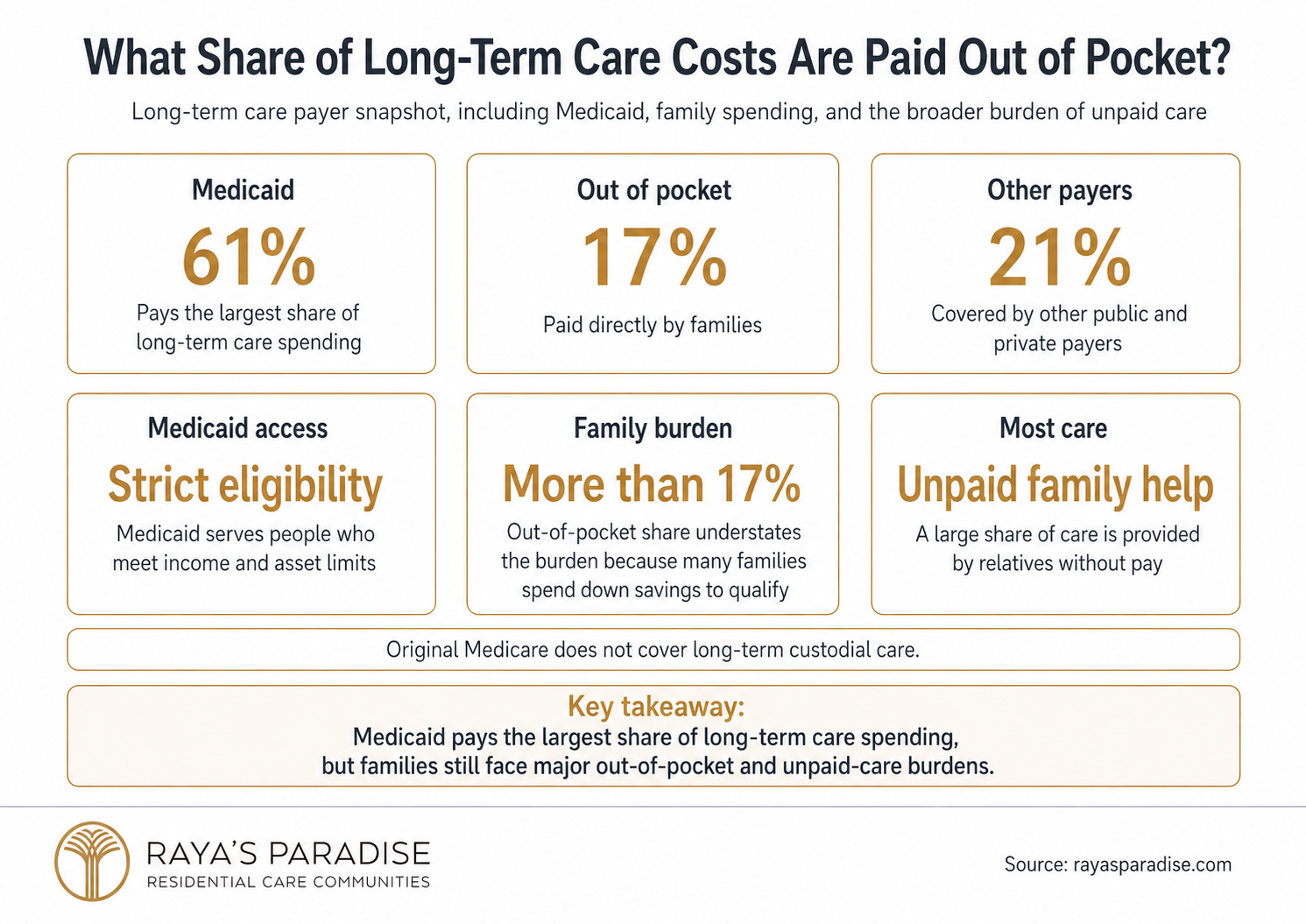
Medicaid pays the largest share of long-term care spending, but families still face major out-of-pocket and unpaid-care burdens.
How much does long-term care cost by setting?
- Adult day care is the most affordable at about $95 a day, or $24,700 a year for full-time weekday attendance
- Home care runs about $35 an hour, reaching $80,080 a year at 44 hours a week
- Assisted living costs about $6,200 a month and memory care about $6,690
- A nursing home is the priciest, at $9,581 to $10,798 a month for semi-private to private rooms
| Care setting |
Monthly cost |
Annual cost |
| Adult day care |
$2,058 |
$24,700 |
| Assisted living |
$6,200 |
$74,400 |
| Memory care |
$6,690 |
$80,280 |
| Home care (44 hours a week) |
$6,673 |
$80,080 |
| Nursing home, semi-private |
$9,581 |
$114,975 |
| Nursing home, private |
$10,798 |
$129,575 |
Each setting has its own deep-dive in this research series, from in-home care and adult day care to memory care. Figures are 2025 and 2026 national medians.
This research is for informational purposes only and is not financial, legal or medical advice. Cost figures are projections and medians that vary by individual, setting and location. They also change over time. Confirm current pricing and verify benefit eligibility with the relevant agency.
Sources and additional resources
Source note: The $120,900 average lifetime cost, the 3.1-year average need (less than one year of it paid) and the roughly 10% of higher-income adults facing out-of-pocket costs above $250,000 come from the 2022 ASPE Risks and Financing brief. That brief uses a strict disability definition and projects that 56% will need care and 45% will use paid care.
The 70% lifetime-need and 48% paid-care figures, the 29% home care, 5% residential and 28% nursing home shares and the 40% of adults 85 and older come from ASPE’s 2019 lifetime-risk research.
The paid-care duration distribution, including the shares needing care for no more than two years, beyond four years or beyond ten years, comes from that 2019 research and a related affordability brief. The roughly $266,000 implied average among paid-care users follows from the 2022 brief’s all-population average and paid-care share.
National spending of over $400 billion and the payer shares, with Medicaid at 61% and out of pocket at 17%, come from KFF. Care-setting costs come from the 2025 CareScout survey and A Place for Mom, and the three-year totals multiply current national medians without adding future price increases.
Raya’s Paradise provides assisted living, memory care, hospice support, short term respite care and in-home care across Southern California, helping families turn a long-term care plan into real, daily support. Families mapping out the years ahead can tour assisted living in Los Angeles and assisted living in Orange County as part of that plan.