How much is the VA survivor pension?
- The Survivors Pension pays a surviving spouse with no dependents up to $11,699 a year ($974 a month) at the basic level in 2026
- That rises to $14,298 a year with the Housebound allowance and $18,697 a year ($1,558 a month) with Aid and Attendance
- The benefit is tax-free and equals the maximum rate minus the survivor’s countable income, divided by twelve
- Eligibility requires the deceased veteran’s wartime service, a surviving spouse who has not remarried in most cases and a net worth under $163,699
| Surviving spouse benefit (2026) |
Annual |
Monthly |
| Basic Survivors Pension |
$11,699 |
$974 |
| With Housebound allowance |
$14,298 |
$1,191 |
| With Aid and Attendance |
$18,697 |
$1,558 |
Survivors already receiving the basic pension should apply for the enhanced tiers once medical needs qualify, since the extra money often covers a meaningful share of senior care costs. Rates with dependent children are higher.
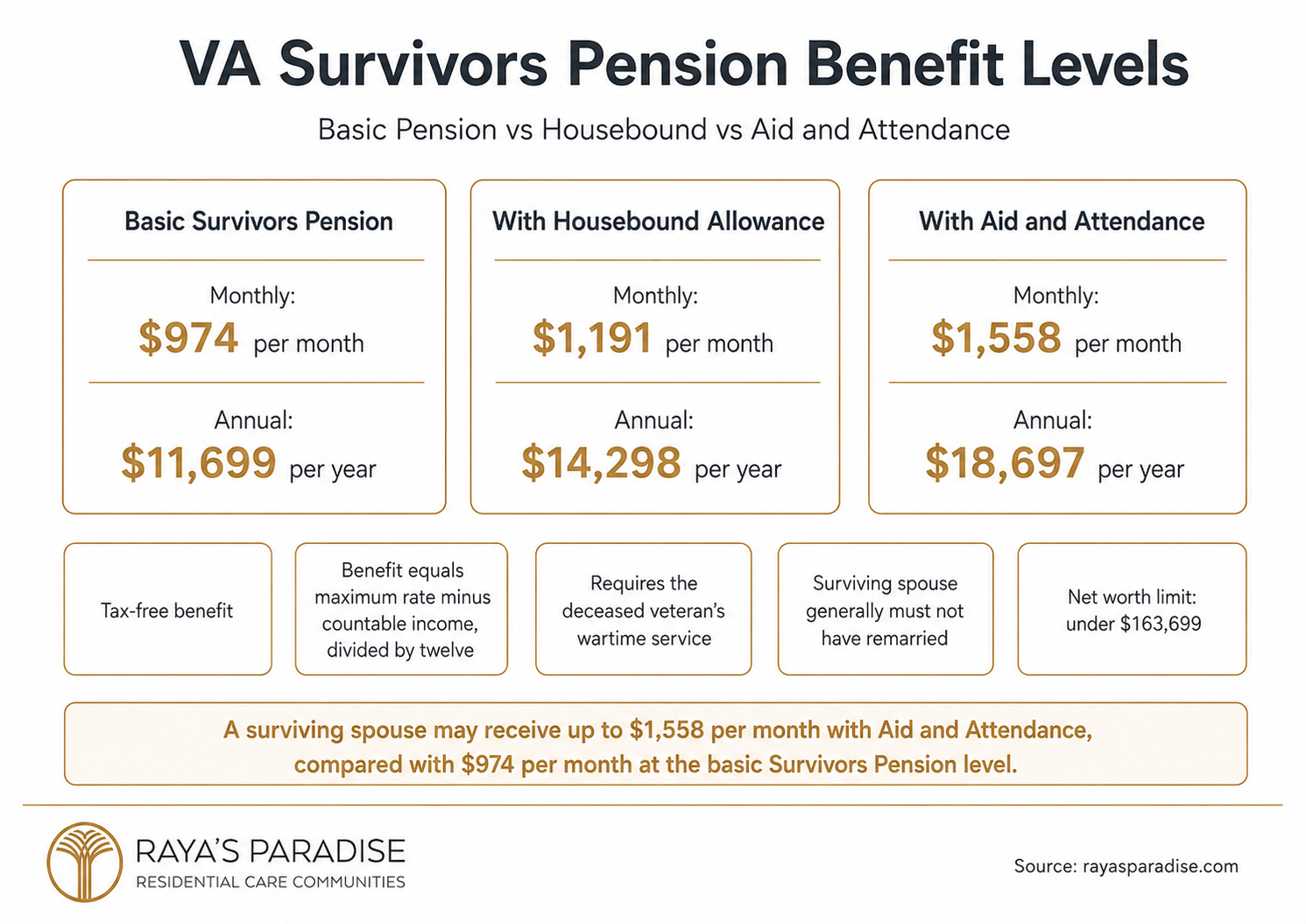
A surviving spouse may receive up to $1,558 per month with Aid and Attendance, compared with $974 per month at the basic Survivors Pension level.
What is the average VA pension payout per month?
- There is no flat payout; the VA pension equals the maximum annual pension rate minus countable income, divided by twelve
- For seniors in assisted living or memory care, eligible unreimbursed care expenses may reduce countable income when VA accepts them as allowable medical expenses, often increasing the monthly pension payment
- 2026 monthly maximums range from about $974 for a basic survivor to $3,845 for two married veterans with Aid and Attendance
- A single veteran with Aid and Attendance and little countable income after medical deductions can receive up to $2,424 a month
Because the formula subtracts income, a veteran with high retirement income may receive little, while one with heavy care costs may receive close to the ceiling. The maximums below show the upper bound for each situation.
What is the maximum VA Aid and Attendance benefit?
- Aid and Attendance adds to the basic pension for wartime veterans and survivors who need help with daily activities or supervision
- The 2026 maximum is $2,424 a month for a single veteran and $2,874 for a veteran with a spouse
- A surviving spouse can receive up to $1,558 a month, while two married veterans who both qualify reach $3,845
- The benefit is tax-free and can help pay for home care, assisted living, memory care or a nursing home
| Recipient |
2026 monthly maximum |
Annual maximum |
| Single veteran |
$2,424 |
$29,093 |
| Veteran with a spouse or dependent |
$2,874 |
$34,488 |
| Surviving spouse |
$1,558 |
$18,697 |
| Two married veterans, both qualifying |
$3,845 |
$46,143 |
Aid and Attendance is needs-based, not service-connected, so the disability does not have to come from military service. Eligibility hinges on wartime service, care needs, income and the net worth limit. Eligible memory care costs may reduce countable income when they qualify as unreimbursed medical expenses, as our guide to paying for memory care explains.
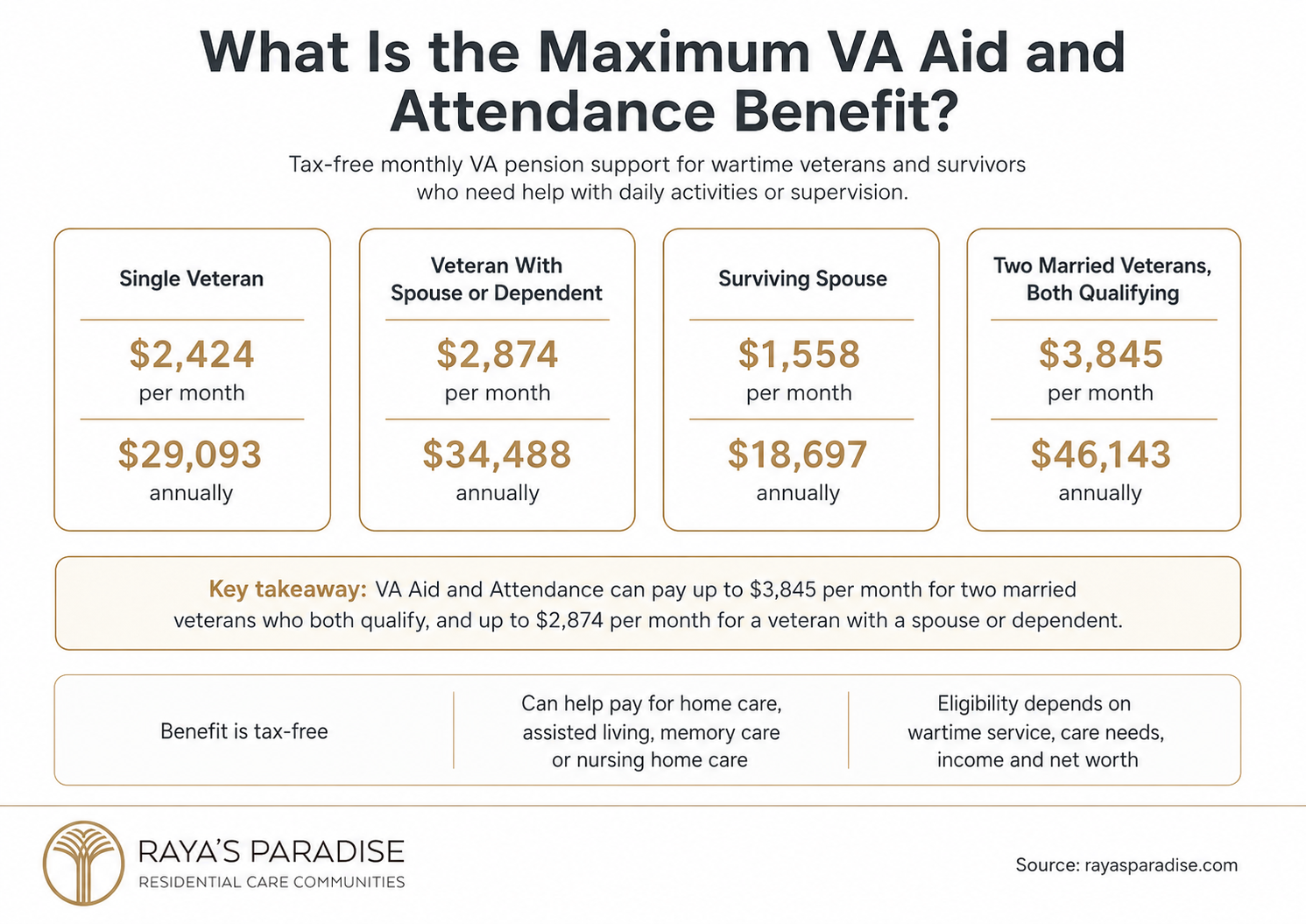
VA Aid and Attendance can pay up to $3,845 per month for two married veterans who both qualify, and up to $2,874 per month for a veteran with a spouse or dependent.
What percentage of veterans are 65 or older?
- Nearly half (49%) of all veterans in the United States are 65 or older, about 8.1 million people, based on 2021 survey data
- That share implies roughly 16.5 million total veterans, and the largest older group, about 5.5 million, served during the Vietnam era
- Older veterans are more likely to have a functional disability than other older adults, raising their care needs
- This aging pattern is one reason VA long-term care benefits matter for older veterans and their families
| Veteran population |
Approximate figure |
| Total veterans (derived) |
About 16.5 million |
| Age 65 and older |
About 8.1 million (49%) |
| Largest older group (Vietnam era) |
About 5.5 million |
Because older veterans are more likely to face functional disability than other older adults, some may qualify for VA care-related benefits if they also meet service, income, net worth and medical-need rules. This aging pattern is one reason VA long-term care benefits, and broader long-term care demand, matter for older veterans and their families.
How much is the VA caregiver stipend?
- The caregiver stipend under the Program of Comprehensive Assistance for Family Caregivers pays a primary family caregiver a monthly amount
- It equals the federal GS-4 Step 1 salary for the veteran’s area, divided by twelve, times 62.5% at Level 1 or 100% at Level 2
- In the 2026 examples below, that ranges from about $1,896 a month in baseline areas to about $3,793 in the San Jose-San Francisco-Oakland locality
- The program requires a veteran with a 70% or higher service-connected disability who needs in-person care for at least six months at home
| Locality (2026) |
Level 1 (62.5%) |
Level 2 (100%) |
| Baseline (rest of United States) |
About $1,896 |
About $3,034 |
| Los Angeles area |
About $2,211 |
About $3,537 |
| San Francisco area |
About $2,371 |
About $3,793 |
This stipend is separate from the needs-based pension and applies only when the veteran meets PCAFC service-connected disability and care-need rules. It pays the family member providing care, not the veteran. Eligible primary caregivers may also receive CHAMPVA health coverage if they do not already qualify for another health plan, plus at least 30 days of respite care per year and other supports. Families weighing this against paid help can compare in-home care costs.

The VA caregiver stipend varies by locality and care level, with examples ranging from about $1,896 to $3,793 per month.
How much can VA Aid and Attendance help pay for assisted living?
- Aid and Attendance can help offset assisted living costs, with monthly pension maximums of up to $2,424 for a single veteran and $2,874 for a veteran with a spouse
- Eligible assisted living fees may count as unreimbursed medical expenses when paid out of pocket, not reimbursed, properly reported and accepted by VA, which can reduce countable income
- The money is paid to the veteran or spouse, not the community, so the family applies it toward the monthly bill
- A surviving spouse can use up to $1,558 a month toward assisted living the same way
For many veterans, Aid and Attendance may help make assisted living more affordable, especially when combined with Social Security and savings. Application details and the full payment picture appear in our assisted living payment research.
This research is for informational purposes only and is not financial, legal or benefits advice, and it is not affiliated with or endorsed by the U.S. Department of Veterans Affairs. Benefit rates and eligibility rules change annually and vary by circumstance. Confirm current figures at VA.gov or with a VA-accredited representative.
Sources and additional resources
Source note: Aid and Attendance maximums (single $2,424 a month, veteran with a spouse $2,874, two married veterans $3,845), the $163,699 net worth limit and the maximum-rate-minus-income formula come from the VA current pension rates, effective December 1, 2025.
Source note: Survivors Pension figures (basic $974 a month, Housebound $1,191, Aid and Attendance $1,558) come from the VA current Survivors Pension benefit rates, effective December 1, 2025.
Source note: The caregiver stipend formula and eligibility come from the VA PCAFC stipend page. The dollar ranges apply OPM 2026 GS-4 Step 1 locality rates (Rest of U.S. $36,409, Los Angeles $42,446, San Jose-San Francisco-Oakland $45,516), divided by twelve and multiplied by 62.5% or 100%.
Source note: Veteran population figures (49% age 65 or older, 8.1 million seniors, 5.5 million Vietnam-era) come from the U.S. Census Bureau aging-veterans report using 2021 American Community Survey data. The roughly 16.5 million total is derived, since 8.1 million represents 49% of all veterans.
Source note: The tax-free treatment of VA pension and Aid and Attendance payments reflects IRS guidance, which excludes VA disability and pension payments to veterans or their families from gross income.
Source note: Whether assisted living or memory care fees reduce countable income depends on VA review. Unreimbursed medical expenses are reported on VA Form 21P-8416, and facility payments qualify only when the worksheet conditions are met. Eligibility rules come from the VA pension and Survivors Pension pages.
Raya’s Paradise provides assisted living, memory care, hospice support, short-term respite care and in-home care across Southern California and welcomes veterans applying Aid and Attendance toward their care. Families can tour assisted living care in Los Angeles and Orange County senior assisted living and ask how VA benefits apply.