How long will Medicare pay for home health care?
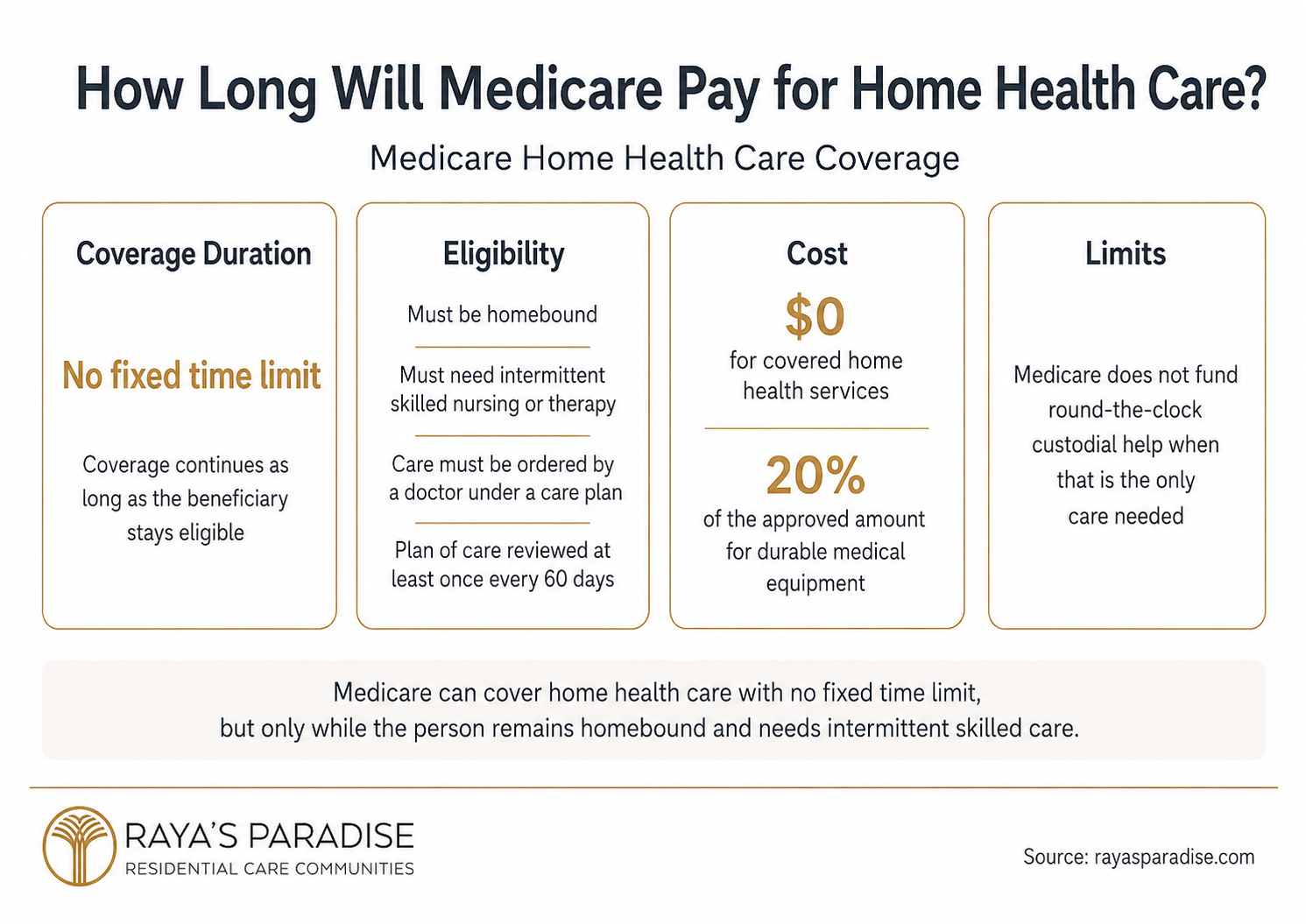
- Medicare pays for home health care with no fixed time limit, as long as the beneficiary stays eligible
- Eligibility requires being homebound and needing intermittent skilled nursing or therapy, ordered by a doctor under a care plan
- The home health plan of care is reviewed at least once every 60 days, and coverage can continue as long as the skilled need and homebound status remain
- Beneficiaries pay $0 for covered home health services and 20% of the approved amount for any durable medical equipment
The key word is intermittent; Medicare home health is part-time skilled care, not round-the-clock custodial help. For ongoing daily non-medical support, families turn to private in-home care, which Medicare generally does not fund when custodial help is the only care needed.
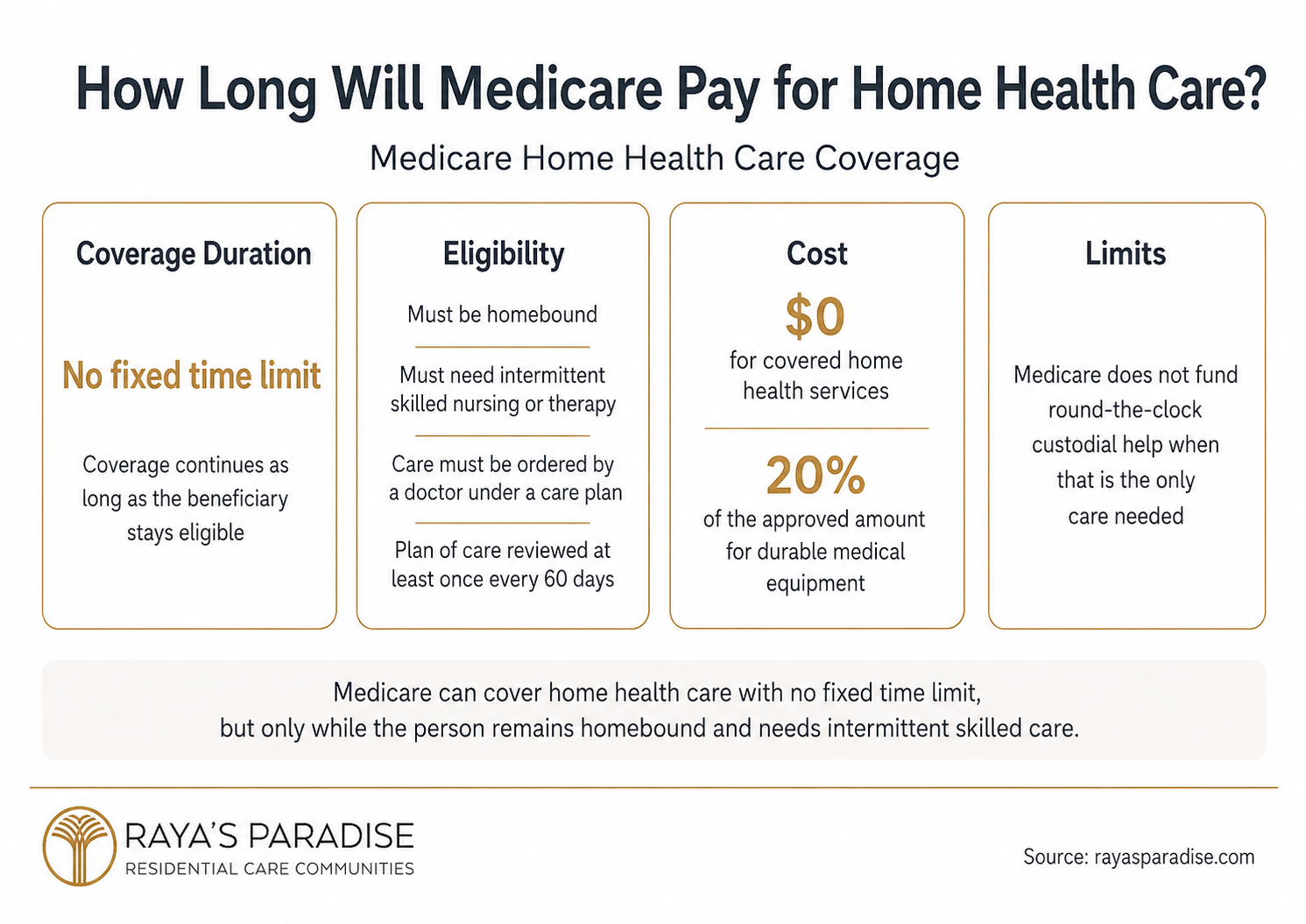
Medicare can cover home health care with no fixed time limit, but only while the person remains homebound and needs intermittent skilled care.
How long does Medicare pay for rehab?
- Skilled nursing facility rehab is covered up to 100 days per benefit period after a qualifying hospital stay, with a $217 daily coinsurance after day 20
- Inpatient rehabilitation facility care is covered under Part A hospital rules, subject to the $1,736 deductible and coinsurance for long stays
- Outpatient therapy like physical, occupational and speech therapy has no annual dollar cap, with Medicare paying 80% as long as care stays medically necessary
- Rehab coverage depends on documented medical necessity and skilled need, subject to each setting’s Medicare limits
| Rehab setting |
Medicare coverage |
| Skilled nursing facility rehab |
Up to 100 days per benefit period |
| Inpatient rehabilitation facility |
Covered under Part A hospital rules |
| Outpatient therapy (PT, OT, speech) |
No annual dollar limit, 80% covered |
The old outpatient therapy dollar cap was repealed, so coverage now depends on documented medical necessity. Skilled nursing rehab details appear in our nursing home payment research.
Medicare rehab coverage depends on the setting, with up to 100 days for skilled nursing rehab, Part A rules for inpatient rehab and no annual dollar cap for medically necessary outpatient therapy.
How many people are on Medicare?
- About 68 million people have Medicare, including roughly 61 million age 65 and older and 7 million under 65 with disabilities
- More than half (55%) of eligible beneficiaries, about 35 million people in 2026, are now in Medicare Advantage
- The rest stay in traditional Medicare, often paired with a Medigap policy
- Enrollment keeps growing as the population ages, adding pressure to the program’s finances
| Medicare population |
Approximate count |
| Total beneficiaries |
About 68 million |
| Age 65 and older |
About 61 million |
| Under 65 with disabilities |
About 7 million |
| Enrolled in Medicare Advantage |
About 35 million (55%) |
Medicare covers a comprehensive set of medical services, yet long-term care remains the major gap. Program costs are detailed in our Medicare cost research.
What home medical equipment does Medicare cover?
- Part B covers durable medical equipment that is medically necessary and prescribed for home use, such as wheelchairs, walkers, hospital beds and oxygen equipment
- Beneficiaries pay 20% of the Medicare-approved amount after the Part B deductible, and Medicare pays the rest
- Equipment should come from a Medicare-enrolled supplier, and beneficiaries can limit costs by using suppliers that accept assignment
- Many home modifications and safety upgrades, such as permanent ramps, stairlifts or remodeling, generally fall outside Original Medicare durable medical equipment coverage
| Covered durable medical equipment |
Not covered as DME |
| Wheelchairs, walkers, canes |
Grab bars and bathroom rails |
| Hospital beds |
Stairlifts and wheelchair ramps |
| Oxygen equipment, CPAP machines |
Widened doorways |
| Blood sugar monitors, nebulizers |
General home remodeling |
The line Medicare draws is medical equipment versus home improvement. Families often cover safety modifications themselves or through other programs.
Does Medicare cover long-term custodial care?
- Original Medicare generally does not cover long-term custodial care, the daily help with bathing, dressing and eating that many seniors eventually need
- Custodial care in assisted living, memory care or a nursing home, including room and board, falls outside Medicare entirely
- Medicare only covers short-term skilled care tied to recovery, not ongoing personal care
- For long-term care, families rely on Medicaid, long-term care insurance, VA benefits or private pay
This gap surprises most families, since it leaves out the very care seniors are most likely to need. Funding options appear in our research on paying for assisted living.
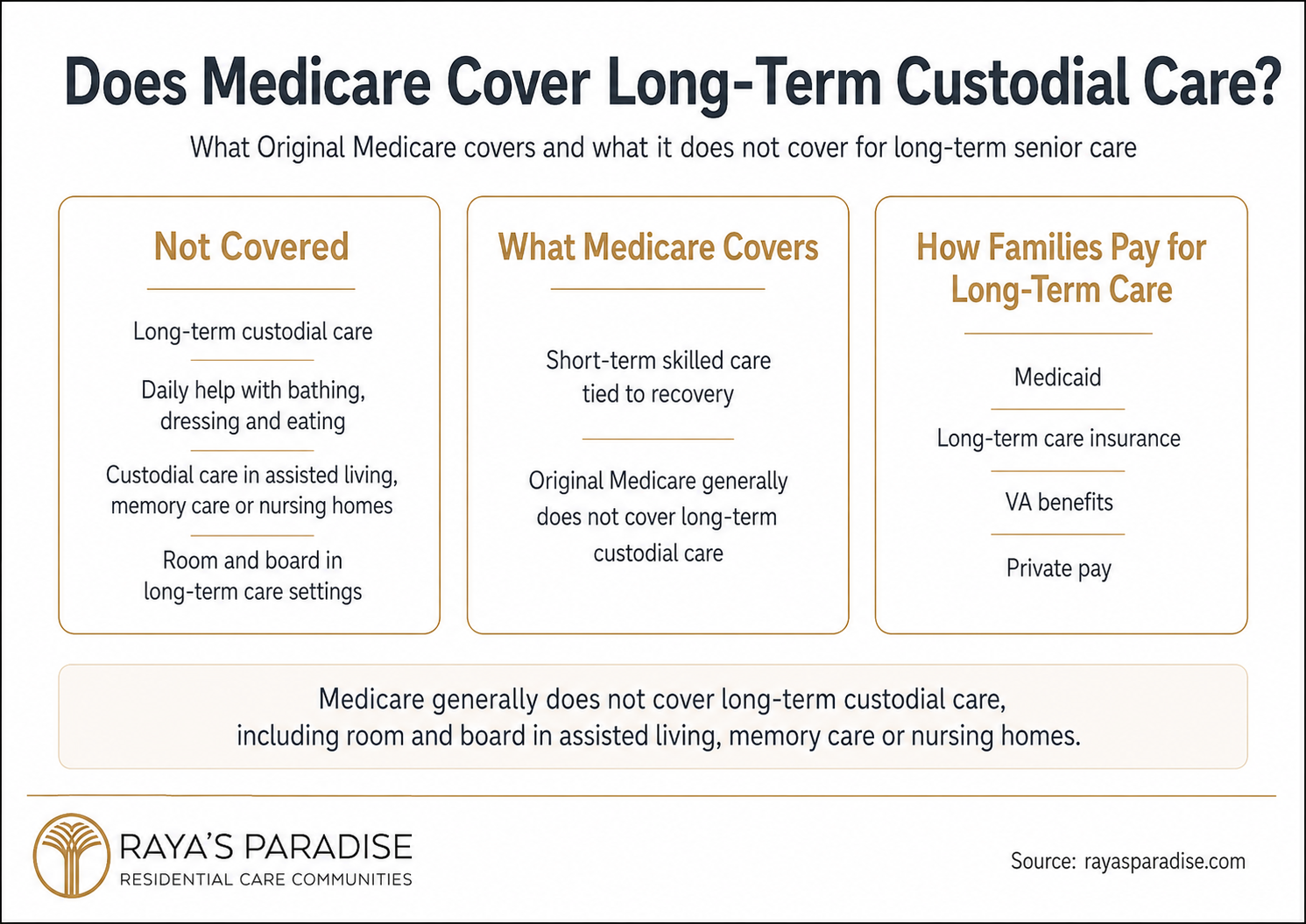
Medicare generally does not cover long-term custodial care, including room and board in assisted living, memory care or nursing homes.
How long will Medicare pay for hospice care?
- Medicare covers hospice for two 90-day benefit periods, followed by an unlimited number of 60-day periods, with no lifetime cap
- It requires a doctor’s certification of a terminal illness with a prognosis of six months or less, plus a choice of comfort care over cure
- Patients who live longer than six months keep coverage as long as a hospice physician recertifies eligibility
- Cost is minimal; $0 for hospice care, up to $5 per drug for symptom relief and 5% for inpatient respite
| Hospice benefit period |
Length |
| First period |
90 days |
| Second period |
90 days |
| Each later period |
60 days, unlimited |
Hospice can be provided at home, in assisted living or in a nursing home, though Medicare does not cover room and board in those settings. The care follows the patient wherever they live.
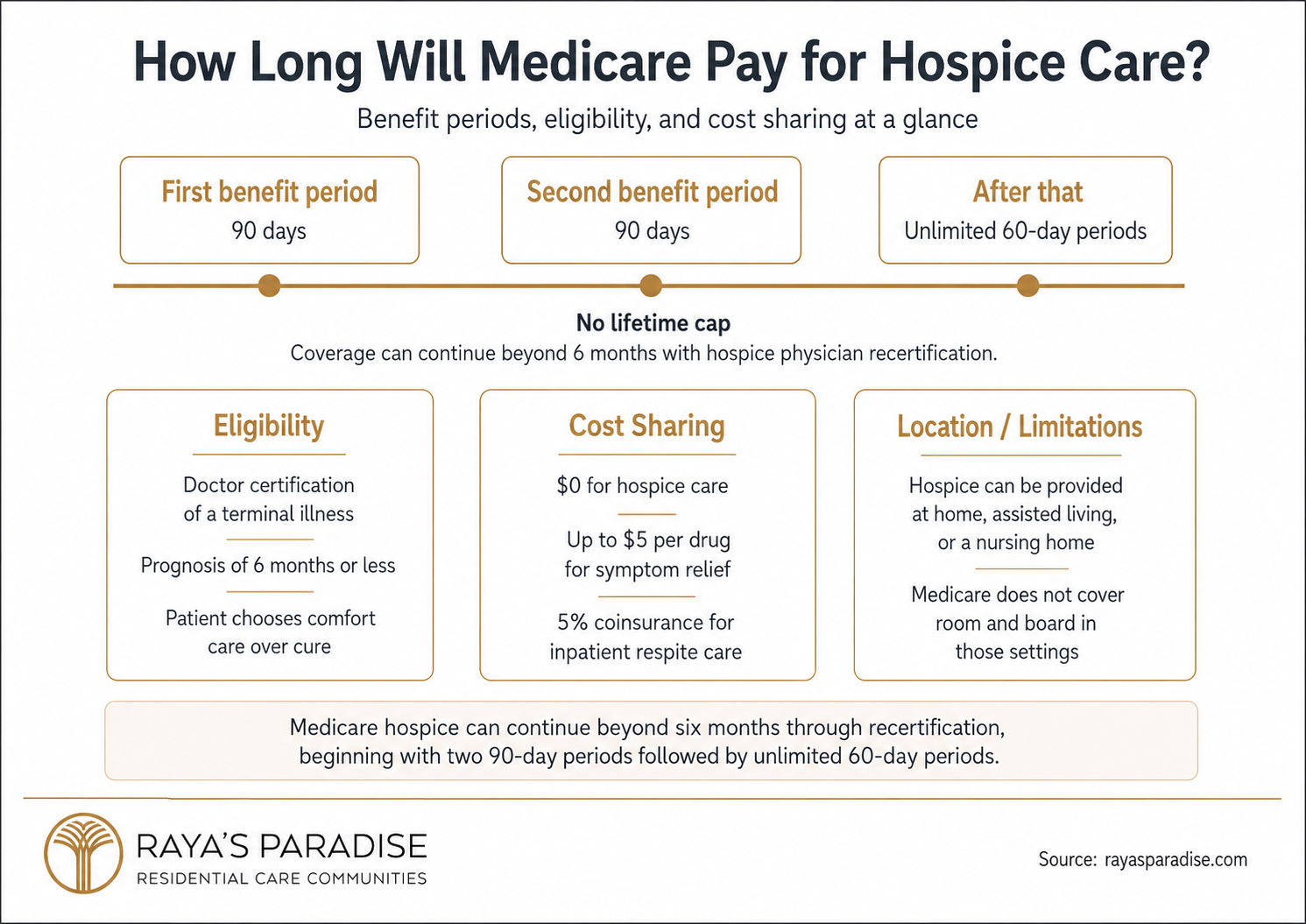
Medicare hospice can continue beyond six months through recertification, beginning with two 90-day periods followed by unlimited 60-day periods.
This research is for informational purposes only and is not medical or insurance advice. Medicare coverage rules, cost-sharing and eligibility criteria change over time and depend on individual circumstances. Confirm current coverage at Medicare.gov or with a licensed advisor before making decisions.
Sources and additional resources
Source note: Home health having no fixed time limit, the homebound and intermittent rules, the 60-day plan of care review, the $0 home health cost and 20% equipment share come from Medicare. The 100-day skilled nursing limit with $217 coinsurance, inpatient rehabilitation rules and outpatient therapy coverage come from Medicare. The 2018 therapy cap repeal comes from CMS.
Hospice covering two 90-day periods then unlimited 60-day periods, the six-month prognosis, the $0 cost, the $5 drug copay and 5% respite coinsurance come from Medicare. Original Medicare not covering long-term custodial care, including facility room and board, also comes from Medicare. Home modifications falling outside equipment coverage come from Medicare Interactive.
The 68 million total Medicare beneficiaries, 61 million age 65 and older and 7 million under 65, come from KFF Medicare 101. More than half (55%) of eligible beneficiaries, about 35 million in 2026, being in Medicare Advantage comes from KFF’s 2026 Medicare Advantage enrollment update.
Raya’s Paradise provides assisted living, memory care, hospice support, short term respite care and in-home care across Southern California, bridging the long-term care Medicare does not cover with hands-on daily support. Families navigating that gap can tour Los Angeles assisted living and assisted living in Orange County, CA.