
Contents
- A Dementia Diagnosis Alone Does Not Unlock Hospice Respite
- Hospice Respite Eligibility Starts With a Terminal Certification
- The Second Condition Is Choosing Comfort Care
- The Third Condition Is a Signed Hospice Election
- Respite Options When Hospice Is Not a Fit
- Find the Right Respite Care for Your Loved One, With or Without Hospice
- Sources & Additional Resources
- More Respite and Short-Term Care Resources
A Dementia Diagnosis Alone Does Not Unlock Hospice Respite
The 3 Medicare Conditions for Hospice Respite Eligibility

It’s 2 a.m., and Dad is searching the house for his car keys again. You’re exhausted from weeks of interrupted sleep, but you still need to be alert enough to keep him safe. When another caregiver mentions five days of hospice respite, it sounds like exactly the break you’ve been hoping for.
Before making arrangements, it’s important to understand hospice respite eligibility. Dementia alone doesn’t qualify someone for Medicare hospice. Dad must have Medicare Part A and meet three hospice conditions. These are a certified terminal prognosis, a decision to receive comfort-focused care for that illness and a signed hospice election.
The respite benefit follows hospice enrollment; it isn’t a separate dementia benefit. That distinction can be disappointing when you urgently need help. It also points you toward the right options. If Dad qualifies for hospice, ask his team about inpatient respite. If he doesn’t, consider caregiver resource programs or a short-term residential stay instead.
Here are the key takeaways.
- Medicare hospice requires that your hospice doctor and your regular doctor certify a terminal illness with a life expectancy of 6 months or less.
- The person must accept comfort care instead of care to cure the illness, and sign a statement choosing hospice.
- Hospice respite is short-term inpatient care, and federal rules limit it to no more than five consecutive days at a time.
- You may pay 5% of the Medicare-approved amount for inpatient respite care.
- California’s Caregiver Resource Centers offer respite help for dementia caregivers, and no means test is required.
Hospice Respite Eligibility Starts With a Terminal Certification
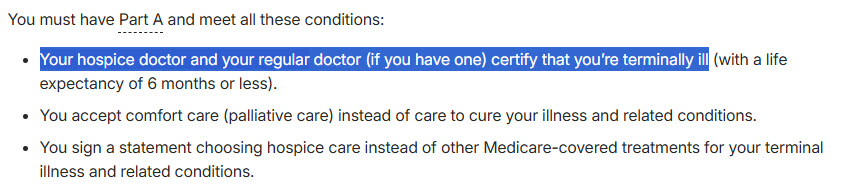
Hospice begins with a medical assessment, not a request for a caregiver break. Medicare’s hospice care page says “Your hospice doctor and your regular doctor (if you have one) certify that you’re terminally ill,” with a life expectancy of 6 months or less.
Medicare Part A is another requirement. There is no separate application that makes dementia caregivers eligible for five days of hospice respite without hospice enrollment. The hospice benefit must already apply to the patient, and the hospice team must arrange the respite stay.
What This Means for Hospice Eligibility With Dementia
A diagnosis of Alzheimer’s disease or another dementia doesn’t tell a physician how much time someone has left. Hospice eligibility with dementia depends on the overall clinical picture and a physician’s certification that the illness is terminal, with a life expectancy of 6 months or less.
Ask Dad’s physician whether a hospice evaluation makes sense. Be specific about changes in his eating, mobility, communication, infections or ability to manage daily activities. Those observations are useful clinical context, but they don’t replace the medical certification.
Hospice Can Continue Past 6 Months
Six months is a prognosis, not an automatic end date. Medicare allows hospice to continue when the hospice physician recertifies that the person remains terminally ill. The benefit begins with two 90-day periods and then continues through additional 60-day periods when requirements are met. Ask the hospice how recertification visits work.
The Second Condition Is Choosing Comfort Care
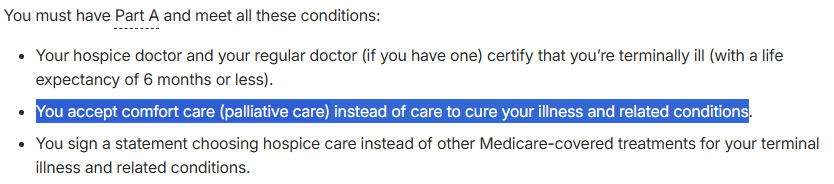
The second condition is a change in the goal of care. Medicare’s rule reads “You accept comfort care (palliative care) instead of care to cure your illness and related conditions.” Comfort care hospice focuses on pain relief, symptom control and quality of life.
After a hospice election, Medicare generally does not cover treatment intended to cure the terminal illness or related conditions. Medicare still pays for covered care for health problems that aren’t part of the terminal illness and related conditions.
A Choice That Can Be Revisited
It’s important to make this choice around Dad’s condition and wishes, not simply because the family is tired. Caregiving exhaustion deserves attention, but enrolling in hospice changes how Medicare covers treatment for the terminal illness. Ask the doctor to explain what would change, what would continue and what Dad would want.
This decision can be reconsidered. Medicare tells families to talk with the doctor about getting treatment to cure the illness, and someone can stop hospice to pursue that treatment. Before electing hospice, ask the team what the process would look like and how care would transition. Understanding that choice can make a difficult conversation more manageable.
The Third Condition Is a Signed Hospice Election
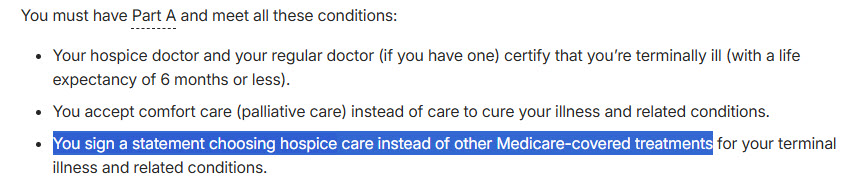
The third condition is a deliberate, documented choice. Medicare requires that “You sign a statement choosing hospice care instead of other Medicare-covered treatments” for the terminal illness and related conditions.
The document is called a Hospice Election Statement. It identifies the hospice provider, the effective date and the attending physician chosen by the patient. Medicare says it must be completed before hospice services begin. Ask for a copy and have someone explain it before signing.
How Hospice Respite Works Once You Qualify
The respite benefit exists to give caregivers relief. Under federal rules, it’s short-term inpatient care given only when necessary to relieve the family members or others caring for the patient. It’s offered “only on an occasional basis,” up to five consecutive days at a time.
Five days is a limit on consecutive reimbursable inpatient respite days, not a guarantee that a bed will be available whenever you want one. Ask the hospice coordinator about suitable facilities, timing and how often respite can realistically be arranged for your family.
Hospice respite isn’t a caregiver coming to the house for five days. It is a temporary inpatient stay at an appropriate Medicare-approved facility, such as a qualifying nursing home, hospice inpatient facility or hospital. The hospice is responsible for arranging suitable care. Confirm the location, travel plans and who will coordinate medications before the stay.
The Day-Six Rule and What You Pay
Confirm the discharge date before the respite stay starts. The payment rule says “Payment for the sixth and any subsequent day of respite care is made at the routine home care rate.” Ask the hospice what happens if Dad stays longer than five days, including who pays.
Medicare says the patient may owe 5% of the Medicare-approved amount for inpatient respite, capped at the inpatient deductible amount. Ask the hospice for an estimate rather than assuming the stay is free. Also confirm whether any proposed extra days or noncovered arrangements could produce a separate bill.
The sixth-day regulation is a Medicare payment rule for the hospice, not permission to extend covered inpatient respite indefinitely. If you need a longer break, ask about a separate arrangement and the full cost before the fifth day ends. Do not assume the same coverage continues.
Respite Options When Hospice Is Not a Fit
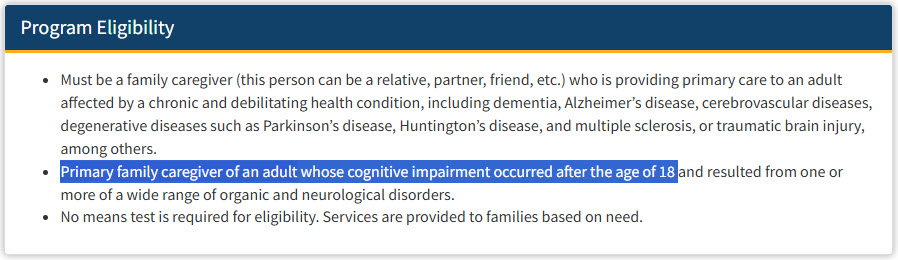
If Dad doesn’t meet hospice eligibility requirements, you still have ways to get support. California’s Caregiver Resource Centers serve a “Primary family caregiver of an adult whose cognitive impairment occurred after the age of 18.” That includes many families caring for a relative with dementia.
Depending on availability and assessment, caregiver center respite assistance includes “Financial assistance for temporary in-home support, adult day care services, short-term or weekend care and transportation.” The state says “No means test is required for eligibility.”
A caregiver resource center can help you think through what kind of relief would actually work, such as a few hours of in-home help, an adult day program or time away while someone else provides care. Ask what services are available locally and whether there is a waitlist or an assessment process.
Respite Care for Dementia Patients in a Residential Setting
Some families prefer an arranged short stay in a residential care home. Our short-term stay and respite program “is designed to provide caregivers with the opportunity for a temporary rest” while their loved ones keep getting care. Its services include a wandering alert system for residents with dementia.
Before booking a residential respite stay, explain Dad’s nighttime habits, wandering risk, medications, mobility and personal-care needs. Ask how the staff handle evening supervision and changes in behavior. A good match depends on whether the setting can safely support him, not just whether a room is open.
At our Los Angeles residences, short-term respite care offers an opportunity to see how residential support feels. Our page explains that “Short-term residents receive the same thoughtful support, daily assistance, meals, and engagement opportunities as our longer-term residents.” These are separate private-pay or insurance arrangements, not Medicare-covered hospice inpatient respite.
If Your Parent Is Already on Hospice
If Dad is already receiving hospice at home or in assisted living, he may be able to remain in familiar surroundings for routine hospice services. Medicare explains that hospice can usually be provided in the home or another place where the person lives. That does not mean Medicare pays ordinary residential room and board.
For families asking about hospice care in Los Angeles residences, “Our team continues daily routines, personal care, and residential support, while hospice agency partners provide the equipment, medications, therapies, and clinical services that are part of the care plan.” Families in South Orange County can also learn about our hospice care in Orange County.
There are two separate questions here. Who provides Dad’s clinical hospice services, and who helps him with meals, dressing, supervision and other daily routines? Ask both teams to review the care plan together. Hospice support and residential care can complement each other, but they do not have identical responsibilities.
Find the Right Respite Care for Your Loved One, With or Without Hospice
When you’re caring for a parent with dementia, exhaustion can build slowly until even a few uninterrupted nights of sleep feel out of reach. You may need someone to help with Dad’s daily routines, provide supervision when you’re away or give you time to recharge. The good news is that your loved one doesn’t have to qualify for hospice before you can explore other forms of caregiver relief.
At Raya’s Paradise, our short-term residential care options for Orange County seniors provide temporary support in a comfortable setting. If your parent has Alzheimer’s disease or another form of dementia, our specialized dementia and memory care services in Orange County may also be worth exploring. Families in Los Angeles can learn about our temporary stays at our residential senior care homes, where older adults can receive personalized assistance while family caregivers take a much-needed break.
If your parent is already receiving hospice services, our Los Angeles residential hospice support program explains how we coordinate everyday care with outside hospice providers. You can also explore our comfort-focused residential care in Orange County. Before making arrangements, contact Raya’s Paradise to discuss your loved one’s care needs, available residential services and whether a short stay is appropriate. Our residential respite services are separate from inpatient hospice respite arranged by a licensed hospice provider.
Our Orange County Community with Specialized Memory Care and Hospice Support
Our Los Angeles Residences with Specialized Memory Care and Hospice Support
Sources & Additional Resources
- Medicare.gov. “Hospice care.” Centers for Medicare & Medicaid Services.
- Electronic Code of Federal Regulations. “42 CFR 418.204, Special coverage requirements.” eCFR.
- California Department of Aging. “Program Narrative & Fact Sheets, Caregiver Resource Centers.” California Department of Aging.
- Electronic Code of Federal Regulations. “42 CFR 418.108, Condition of participation, Short-term inpatient care.” eCFR.
- Electronic Code of Federal Regulations. “42 CFR 418.302, Payment procedures for hospice care.” eCFR.
Disclaimer: This article provides general educational information about hospice eligibility, inpatient hospice respite and alternative respite care options for individuals living with dementia. It is not medical advice or a determination of an individual’s eligibility for hospice services. A diagnosis of Alzheimer’s disease or another form of dementia does not automatically establish hospice eligibility. Medicare hospice enrollment generally requires physician certification of a terminal prognosis, an election of comfort-focused care for the terminal illness and a signed hospice election statement. Inpatient hospice respite is subject to separate medical, facility and duration requirements and must be coordinated by the hospice provider. Families should consult their loved one’s physician and licensed hospice team before making decisions about end-of-life care or respite arrangements. Raya’s Paradise provides residential assisted living, memory care and supportive services in coordination with outside hospice agencies, not inpatient hospice or skilled nursing facility care.
 https://rayasparadise.com/wp-content/uploads/2026/10/Compassionate-Senior-Caregiver-Providing-Comfort-and-Respite-Support-to-an-Older-Adult.jpg
1707
2560
Moti Gamburd
https://rayasparadise.com//wp-content/uploads/2019/07/RP-LOGO-Horizontal-Name-Only-websitetrans.png
Moti Gamburd2026-11-04 18:20:432026-10-30 17:06:42A Dementia Diagnosis Alone Does Not Unlock Hospice Respite | The 3 Medicare Conditions for Hospice Respite Eligibility
 https://rayasparadise.com/wp-content/uploads/2026/10/Healthcare-Professional-Documenting-Hospital-Observation-Status-and-Discharge-Notes.jpg
1707
2560
Moti Gamburd
https://rayasparadise.com//wp-content/uploads/2019/07/RP-LOGO-Horizontal-Name-Only-websitetrans.png
Moti Gamburd2026-11-02 16:07:082026-10-30 17:06:11The Medicare Outpatient Observation Notice | Hospitals Must Tell You About Observation Within 36 Hours