
Edit, Download and Print the Orange County Assisted Living Move-In Checklist
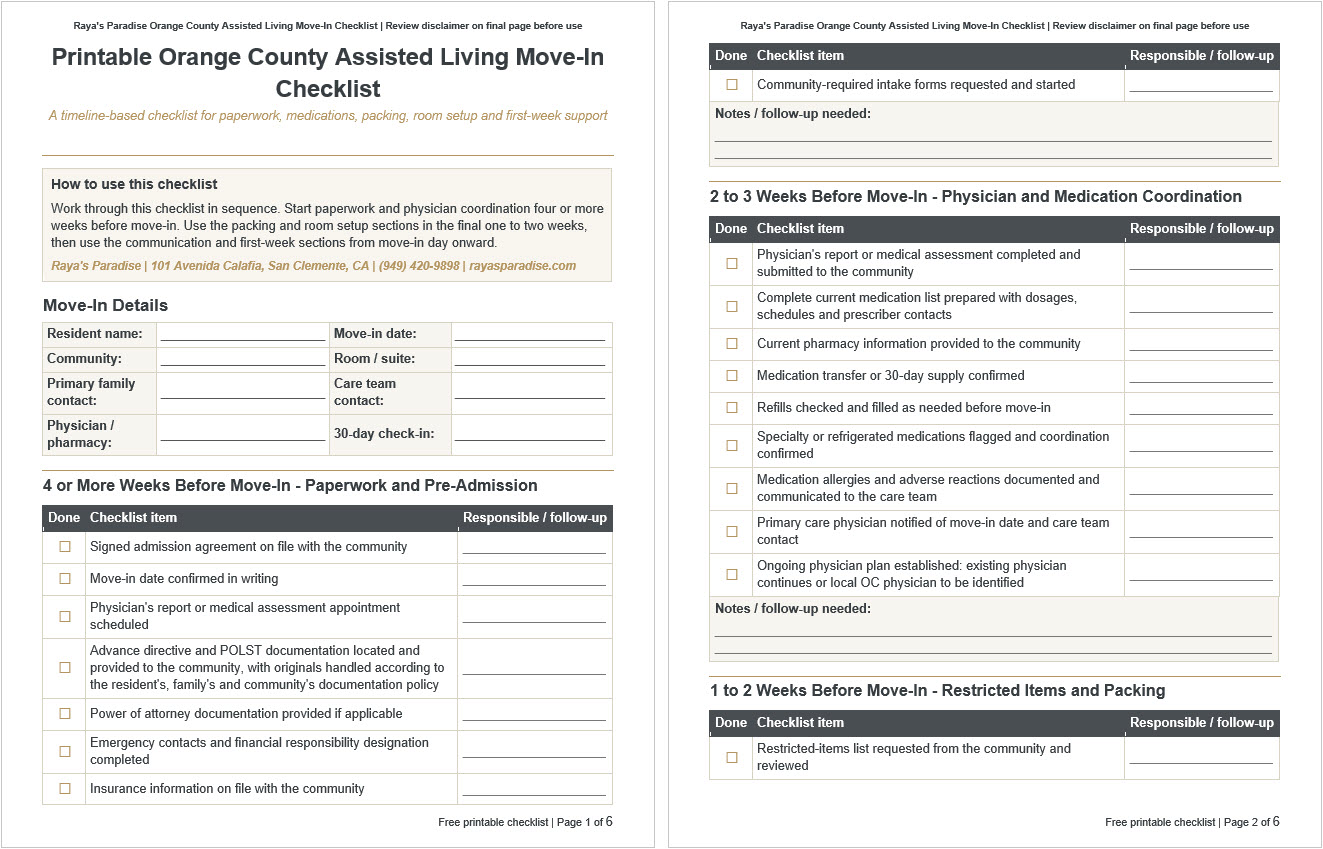
The printable checklist included with this page covers every phase of the move-in process: paperwork and pre-admission requirements, physician and medication coordination, what to pack, what community policies and fire and life-safety rules typically restrict, room setup considerations for South OC’s coastal climate, the family communication plan and what to expect during the first week. There is space beside each item to note status, responsible family member and any follow-up needed.
Available as a print-ready PDF and an editable Word document.
This page assumes the decision is made. You’ve chosen a community, signed the admission agreement and now have a move-in date.
What comes next is a distinct phase of preparation that the evaluation and comparison checklists don’t cover. This is about logistics, coordination and emotional readiness, not about choosing a community.
The helpful national blog post at Assisted Living Move-In Checklist covers the general packing list in detail.
This page does something different. It adds the California-specific regulatory and administrative steps that must happen before move-in day, the physician and medication coordination that many families handle too late, the practical realities of packing for a coastal South OC community, and the first-week communication plan that significantly affects how the transition goes.
Move-in day itself is rarely what families worry about.
The weeks before it, when paperwork stalls or medications aren’t transferred properly, and the week after it, when adjustment is hard and families aren’t sure how much to visit, are where things can go sideways. This checklist is designed to prevent both.
Moving into Raya’s Paradise in San Clemente? Contact our care team to confirm move-in logistics and what to have ready before arrival.
Key Takeaways
- California’s Title 22 regulations require RCFEs to complete a pre-admission appraisal and obtain a medical assessment before accepting a new resident. Families who wait until the week before move-in to schedule this risk delaying the move-in date.
- Medication handoff is one of the most error-prone parts of the transition. A complete, current medication list with dosing instructions, prescriber contact information and pharmacy details needs to reach the care team before move-in day, not on it.
- Fire and life-safety rules, local fire authority requirements and community policies may restrict items such as space heaters, electric blankets, candles, open flames, extension cords and cooking appliances. Confirm the community’s current restricted-items list before packing.
- South OC’s coastal climate requires specific packing and room setup considerations around humidity, sun exposure and salt air that apply to communities in San Clemente and the surrounding coastal area.
- The first week is an adjustment period. A predictable visiting schedule is more supportive than frequent unscheduled visits during this phase.
- A 30-day check-in with the care team after move-in gives families a structured opportunity to review how the transition is going before issues become entrenched.
Before Move-In – Paperwork and Pre-Admission Requirements
California’s Title 22 regulations require RCFEs to complete a pre-admission appraisal and obtain documentation of a medical assessment before accepting a new resident.
The medical assessment must be signed by a licensed medical professional acting within their scope of practice and made within the last year. Confirm exact documentation requirements with the specific community, as communities may have additional intake requirements beyond the state baseline.
Families who wait until the week before move-in to schedule the medical assessment or physician’s report frequently encounter delays.
Many primary care physicians in Orange County have appointment lead times of two or more weeks. If the physician is also updating prescriptions or making care recommendations as part of this process, pharmacy coordination may add additional time. Start the physician coordination process at least three to four weeks before the scheduled move-in date.
The signed admission agreement is also the foundation of the administrative process and should already be in the community’s hands before this checklist phase begins.
If there are outstanding questions about the agreement, resolve them at least two weeks before move-in so they don’t create last-minute complications.
Paperwork and Pre-Admission Checklist
- ☐ Signed admission agreement on file with the community
- ☐ Move-in date confirmed in writing with the community
- ☐ Physician’s report or medical assessment scheduled (at least 3 to 4 weeks before move-in)
- ☐ Physician’s report or medical assessment completed and submitted to the community
- ☐ Pre-admission appraisal completed by the community’s care team
- ☐ Emergency contact designations completed and on file
- ☐ Financial responsibility designation completed
- ☐ Advance directive and POLST documentation provided to the community, with originals handled according to the resident’s, family’s and community’s documentation policy
- ☐ Insurance information (Medicare, supplemental, long-term care) on file with the community
- ☐ Power of attorney documentation on file if applicable
- ☐ Community-required intake forms completed (personal preferences, daily routine, food preferences, life history)
- ☐ Confirmed any community-specific move-in day requirements (arrival window, elevator reservation, parking)
Physician and Medication Coordination Before Move-In
Medication management during the transition period is where errors are most likely to occur and where preparation most directly prevents harm.
Under California Title 22, RCFEs are residential care settings, not skilled nursing facilities. Medication support is handled according to physician orders, facility policy, staff training and applicable licensing rules.
The care team depends on complete documentation from families, physicians and pharmacies so medication assistance can be handled safely and consistently from day one. Incomplete medication lists, missing prescription labels or gaps in pharmacy coordination create real risk in the first days after move-in.
Prepare a current, complete medication list well before move-in day.
It should include every prescription medication with the full name, dosage and dosing schedule; every over-the-counter medication, supplement and vitamin the resident takes regularly; prescriber name and contact information for each medication; the current pharmacy name and contact; and the date each medication was last filled and when the next refill is needed.
Also confirm with the community how medications will be transferred.
Some communities require families to bring a 30-day supply on move-in day. Others coordinate directly with the pharmacy. Clarify this process at least two weeks before move-in so there are no gaps in coverage during the transition.
If the resident’s primary care physician is based in another area of Orange County or further away, ask the community whether they can share information about local primary care, geriatric or mobile medical providers families commonly use.
UCI Health’s senior health resources and other Orange County primary care or geriatric practices may help families establish continuity of care after a move.
Physician and Medication Checklist
- ☐ Current medication list prepared: all prescriptions, OTC medications, supplements and vitamins
- ☐ Each medication listed with full name, dosage, dosing schedule and prescriber contact
- ☐ Current pharmacy name, address and phone number provided to the community
- ☐ 30-day supply of all medications confirmed for move-in day (or pharmacy transfer arranged)
- ☐ Refill dates checked and any medications due for refill before or shortly after move-in handled in advance
- ☐ Medication delivery method confirmed (pill, liquid, patch, injection) and documented
- ☐ Community informed of any medication allergies or adverse reactions history
- ☐ Specialty medications (refrigerated, controlled substances, specialty pharmacy) flagged and coordination confirmed
- ☐ Primary care physician notified of move-in date and community contact information
- ☐ Ongoing physician follow-up plan established: will existing physician continue or will a local OC physician be designated?
- ☐ Any specialist care (cardiology, neurology, oncology) notified of change of residence and new care team contact

What to Pack for an Orange County Assisted Living Community
The national packing guide at the assisted living move-in checklist covers the general packing list in full, including clothing, personal care items, comfort items, décor and documents.
This section focuses on what makes packing for an Orange County coastal community specifically different, and on the categories that are most commonly handled poorly during the transition.
A few principles worth keeping in mind.
First, many assisted living rooms are smaller than the resident’s previous bedroom or living space. Overpacking creates clutter that can become a safety hazard and makes the space feel institutional rather than personal. Bring what is meaningful and functional, not everything that fits.
Second, the community has its own routine, schedule and environment. Packing should support the resident’s comfort within that new structure, not attempt to replicate the independence of an entire home.
Third, leave valuables, irreplaceable items and anything with high financial or sentimental value at home or in secure family storage.
Clothing and Personal Items
- ☐ Comfortable everyday clothing appropriate for a mild coastal climate: light layers, cardigans, breathable fabrics
- ☐ Non-slip shoes and slippers (essential for fall prevention)
- ☐ Lightweight jacket or wrap for air-conditioned common areas
- ☐ Sun-protective clothing and a wide-brimmed hat for outdoor time in the South OC sun
- ☐ Sleepwear and robe
- ☐ Undergarments (label all items with resident’s name)
- ☐ One special occasion outfit
- ☐ Backup pair of prescription glasses
- ☐ Hearing aids and extra batteries
- ☐ Denture care supplies if applicable
Personal Care Items
- ☐ Toothbrush, toothpaste and dental care supplies
- ☐ Shampoo, conditioner and body wash
- ☐ Deodorant and skincare products
- ☐ Moisturizer (coastal air can be drying; quality lotion matters)
- ☐ Lip balm with SPF for outdoor time
- ☐ Sunscreen (broad-spectrum SPF 30 or higher; South OC sun exposure is significant year-round)
- ☐ Hairbrush, comb or styling tools
- ☐ Nail care kit
- ☐ Incontinence products if applicable
- ☐ Razor and shaving cream if applicable
Comfort, Décor and Personal Items
- ☐ Family photos (framed or in an album), often one of the most effective ways to make a new space feel like home
- ☐ A familiar blanket or throw from home
- ☐ Favorite pillow
- ☐ One or two meaningful personal decorative items
- ☐ A small clock with large numbers
- ☐ Books, magazines or hobby supplies
- ☐ Religious or spiritual items if applicable
- ☐ A calendar with large print (helps with orientation to day and date)
- ☐ A small bulletin board for reminders, cards and photos (if wall space allows)
Technology and Communication
- ☐ Phone and charger (confirm charging setup with the community)
- ☐ Tablet or e-reader with charger if used
- ☐ Power strip with surge protection (confirm whether permitted under the community’s policy before bringing)
- ☐ Headphones for TV or music
- ☐ Television if the room does not include one (confirm size restrictions with the community)
- ☐ Music player or speaker loaded with familiar music
- ☐ Nightlight
Important Documents to Bring on Move-In Day
- ☐ Photo ID
- ☐ Medicare and supplemental insurance cards
- ☐ Copies of advance directive and POLST, plus originals if requested by the community
- ☐ Emergency contact list with names, relationships and phone numbers
- ☐ Current medication list (duplicate of what was already provided to the community)
- ☐ Primary care physician contact information

What Not to Bring – Fire and Life-Safety Rules and Community Policies
Fire and life-safety rules, local fire authority requirements and community policies may restrict certain items regardless of individual preference.
Individual communities may have additional restrictions based on their specific building, licensing conditions and local fire authority. Families should request a current restricted-items list from the specific community before packing, not after arriving on move-in day to discover an item cannot come in.
Items commonly restricted or prohibited under community policies and fire and life-safety requirements include the following.
Space heaters and portable heating devices are typically not permitted because they create fire and burn hazards, particularly in settings where residents may have limited mobility. Electric blankets are similarly restricted or prohibited at most California RCFEs. Candles, incense and other open-flame items are typically not permitted under community fire-safety policies.
Extension cords and overloaded power strips are restricted or prohibited at most RCFE communities because of fire hazard risk.
A surge-protected power strip is not the same as a standard extension cord, but confirm the community’s specific policy before bringing one. Large area rugs and runners create trip hazards and are typically not permitted. Firearms, ammunition and weapons policies vary: ask the community for its written policy before move-in day. Many communities prohibit them; facilities that allow firearms must follow California storage requirements.
Hazardous chemicals, cleaning products and medical waste items are not appropriate for resident rooms. Cooking appliances including hot plates, toaster ovens and microwaves are typically not permitted in individual rooms; confirm the specific community’s policy before bringing any cooking device.
Valuable jewelry, irreplaceable heirlooms and items with high financial value are not prohibited but are strongly discouraged. Even in well-run communities, the risk of loss, damage or misplacement is real.
What Not to Bring Checklist
- ☐ Confirmed current restricted-items list with the community in writing before packing
- ☐ Space heaters and portable heating devices: confirm community policy; typically not permitted
- ☐ Electric blankets: confirm community policy; often restricted at California RCFEs
- ☐ Candles, incense and open-flame items: typically not permitted under community fire-safety policies
- ☐ Extension cords: confirm power strip policy with the community before bringing
- ☐ Large area rugs and runners: typically not permitted (trip hazard)
- ☐ Firearms, ammunition and weapons: confirm the community’s written policy before move-in
- ☐ Hazardous chemicals and cleaning products: not appropriate for resident rooms
- ☐ Cooking appliances: confirm community policy before bringing any cooking device
- ☐ Valuables, irreplaceable heirlooms and high-value jewelry: strongly discouraged
- ☐ Large furniture that does not fit the room dimensions: confirm room measurements before move-in

Room Setup and South OC Coastal Climate Considerations
Room setup on move-in day sets the emotional tone for the first week.
The goal is not to recreate the family home in a smaller space. It’s to make the room feel like it belongs to the person who lives in it, quickly and without clutter. Arriving with a plan for where things will go, rather than making decisions room by room on moving day, significantly reduces the stress and time involved.
For communities in San Clemente and the South OC coastal area, a few climate-specific considerations apply that don’t factor into general move-in guides.
Coastal humidity, sun exposure and salt air can affect some belongings over time.
Books and paper materials do better in breathable storage than on exposed open shelving. Solid wood furniture handles coastal humidity better than pressed wood or particle board. Fabric items benefit from good airflow rather than being packed tightly in drawers or closets. For framed photos and accessories, non-metal frames and hardware hold up better in a coastal environment.
Sun exposure is significant year-round in South OC, and coastal-facing rooms can receive strong afternoon light.
UV-filtering window treatments protect both the resident and items in the room. Bring sun-protective outdoor items including sunscreen, a hat and a light jacket or wrap for time in garden or courtyard spaces, which are a genuine quality-of-life advantage at coastal OC communities.
Room Setup Checklist
- ☐ Room dimensions confirmed with the community before moving day; furniture plan sketched in advance
- ☐ Bed made with familiar bedding from home as the first priority on move-in day
- ☐ Family photos placed where they are easily visible from the bed and favorite chair
- ☐ Personal items and comfort objects positioned in familiar locations (reading lamp, clock, small personal items)
- ☐ Drawers and closet organized in a way that matches the resident’s habits as closely as possible
- ☐ Nightlight in place and working
- ☐ Phone or tablet charged and accessible
- ☐ Sunscreen and sun-protective outdoor items stored accessibly for outdoor time
- ☐ UV-filtering window treatment in place if room has significant sun exposure
- ☐ Breathable storage used for paper items and fabrics
- ☐ Non-metal picture frames used for coastal-facing rooms
- ☐ Emergency contact list posted or placed in an accessible visible location
- ☐ Large-print calendar placed where the resident can see it from bed or their regular chair
Family Communication Plan for the Transition Period
Move-in is often a multi-family-member event, and the days after it frequently involve multiple siblings, relatives and family friends reaching out to the care team independently.
From the community’s perspective, overlapping family contacts create confusion and can disrupt the resident’s routine during the most sensitive phase of the transition. Establishing a clear family communication plan before move-in day simplifies things for everyone.
Designate one primary family contact for the care team.
This is the person who receives updates from the community, relays information to other family members and coordinates family visits during the transition period. This role can rotate over time but should be a single person for at least the first month.
Also establish an agreed family communication method for sharing updates with each other.
A shared notes app, a group text thread or a brief weekly email prevents the same questions from reaching the care team multiple times and reduces the anxiety that comes from everyone checking in independently.
For families in Orange County who are navigating this from different parts of the county or from out of the area, a structured check-in cadence in the first weeks, rather than ad hoc calls, prevents both over-communication and gaps.
Agree on how often the primary contact will call the community, how often the family will connect with each other and what would trigger an unplanned call or visit.
Family Communication Plan Checklist
- ☐ Primary family contact designated and communicated to the care team in writing
- ☐ Primary contact’s name and phone number posted in the resident’s room and on file with the community
- ☐ Family communication method established for sharing updates among family members
- ☐ Agreed visiting schedule for the first two weeks confirmed among family members
- ☐ Protocol established for what triggers an unplanned call or visit versus routine check-in
- ☐ 30-day check-in with the community’s care team scheduled or confirmed
- ☐ Family informed of the community’s family notification protocol (how and when they call, who they call)
- ☐ Community’s after-hours contact confirmed and shared with primary contact

First-Week Support and What to Expect
The first week is the adjustment period, not the settled state.
It is normal for a new resident to feel disoriented, withdrawn, tearful, resistant or unusually quiet in the first days after move-in. These responses are common and do not necessarily indicate that the move was wrong or that the community is not the right fit.
They reflect the profound change a person experiences when their daily environment, routine and sense of control shifts all at once.
Families can support adjustment during this period in a few specific ways.
Visit on a predictable schedule rather than dropping in frequently and unscheduled. Frequent unpredictable visits can interrupt routine-building and may increase confusion or emotional intensity for some residents.
A clear, consistent visiting schedule gives the resident something to orient toward and reassures them of continued family connection without disrupting the new routine.
When visiting, focus on the present rather than the past.
Conversations that center on what is happening now in the community, in family life and in the world, rather than on what was left behind, support adjustment more effectively.
If the resident expresses unhappiness, resistance or sadness in the first week, acknowledge it without immediately treating it as a problem to solve.
The first two to three weeks often involve some emotional difficulty. Ongoing sadness, withdrawal or resistance should be discussed with the care team, especially if it persists beyond the first few weeks.
Any safety concern, medication issue, nutrition or hydration concern, severe distress or sudden change in behavior should be raised with the care team immediately, regardless of how recently the move occurred.
The Orange County First Month in Assisted Living Checklist picks up where this page ends, covering what to monitor and communicate with the care team throughout the full first month.
First-Week Checklist
- ☐ Visiting schedule agreed among family for the first two weeks: predictable and consistent
- ☐ Care team briefed on any specific concerns, preferences or emotional vulnerabilities ahead of move-in
- ☐ Care team’s first-week check-in or orientation meeting confirmed (ask when this typically happens)
- ☐ Community notified immediately of any safety concerns, health changes, medication issues, severe distress or sudden behavioral changes observed during visits
- ☐ 30-day care team check-in scheduled
- ☐ Any unresolved questions from move-in day collected and submitted to the primary contact for follow-up

Orange County-Specific Transition Tips
A few considerations apply specifically to assisted living moves in South OC that don’t appear in general national move-in guides.
Drive time and visit planning. South Orange County covers a significant geographic area.
If other family members are driving from different parts of OC, Los Angeles or San Diego to visit, coordinating visits in advance reduces wasted trips and makes visits feel purposeful rather than chaotic. The I-5 corridor through San Clemente can be unpredictable during commute hours and summer beach traffic.
Early afternoon visits on weekdays are often easier to time than weekend visits in summer months.
Outdoor access as part of the transition plan. Coastal South OC’s climate is one of its genuine advantages for assisted living residents.
Outdoor time may help some residents feel calmer, more oriented and more connected to the new environment. A short walk in a garden or courtyard, time sitting outside in the morning, or simply fresh air and natural light can support adjustment in ways indoor environments can’t replicate.
If the community has outdoor spaces, ask the care team to incorporate outdoor time into the resident’s routine during the first week.
San Clemente and South OC physician access. For residents whose previous physicians were based in another part of OC or in Los Angeles, establishing care with a South OC or San Clemente-area physician sooner rather than later reduces care disruption.
Ask the community whether they can share information about local primary care, geriatric or mobile medical providers families commonly use.
Emergency access and contact information. Families should ensure their own emergency contact chain is updated for the new location.
This includes updating ICE (In Case of Emergency) contacts on the resident’s phone if they have one, ensuring the primary family contact has the community’s direct line and after-hours number, and knowing the nearest emergency department, hospital and urgent care options.
Ask the community which nearby emergency care facilities they use most often, and verify current availability because local healthcare access can change.
OC-Specific Transition Checklist
- ☐ Family visiting schedule coordinated to account for South OC drive times and seasonal traffic
- ☐ Care team asked to incorporate outdoor time into the resident’s first-week routine
- ☐ Sun-protective outdoor items in place and accessible for outside time
- ☐ South OC or San Clemente-area physician identified or information requested through the care team
- ☐ ICE contacts on resident’s phone (if applicable) updated with community address and direct line
- ☐ Primary family contact has community direct line and after-hours number
- ☐ Nearest emergency department, hospital and urgent care confirmed with the community and shared with family members

Printable Orange County Assisted Living Move-In Checklist
Work through this checklist in sequence.
The paperwork and physician coordination sections need to begin four or more weeks before move-in. The packing and room setup sections come in the final one to two weeks. The family communication plan and first-week sections apply from move-in day onward.
Raya’s Paradise • 101 Avenida Calafia, San Clemente, CA • (949) 420-9898 • rayasparadise.com
4 or More Weeks Before Move-In: Paperwork and Pre-Admission
- ☐ Signed admission agreement on file with the community
- ☐ Move-in date confirmed in writing
- ☐ Physician’s report or medical assessment appointment scheduled
- ☐ Advance directive and POLST documentation located and provided to the community, with originals handled according to the resident’s, family’s and community’s documentation policy
- ☐ Power of attorney documentation provided if applicable
- ☐ Emergency contacts and financial responsibility designation completed
- ☐ Insurance information on file with the community
- ☐ Community-required intake forms requested and started
2 to 3 Weeks Before Move-In: Physician and Medication Coordination
- ☐ Physician’s report or medical assessment completed and submitted to the community
- ☐ Complete current medication list prepared with dosages, schedules and prescriber contacts
- ☐ Current pharmacy information provided to the community
- ☐ Medication transfer or 30-day supply confirmed
- ☐ Refills checked and filled as needed before move-in
- ☐ Specialty or refrigerated medications flagged and coordination confirmed
- ☐ Medication allergies and adverse reactions documented and communicated to the care team
- ☐ Primary care physician notified of move-in date and care team contact
- ☐ Ongoing physician plan established: existing physician continues or local OC physician to be identified
1 to 2 Weeks Before Move-In: Restricted Items and Packing
- ☐ Restricted-items list requested from the community and reviewed
- ☐ Room dimensions confirmed
- ☐ Furniture plan sketched; oversized or prohibited furniture identified for removal
- ☐ Clothing packed and labeled with resident’s name
- ☐ Personal care items packed (include sunscreen and coastal climate items)
- ☐ Family photos, familiar bedding, throw and comfort items packed
- ☐ Technology items packed with chargers (power strip policy confirmed with community)
- ☐ Documents for move-in day gathered
- ☐ Valuables and irreplaceable items left at home or in secure family storage
- ☐ Move-in day logistics confirmed: arrival time, parking, elevator access
Move-In Day
- ☐ All paperwork confirmed complete with the care team on arrival
- ☐ Medication list and medications handed to the care team using the community’s required intake process
- ☐ Bed made first: familiar bedding, pillow and throw in place
- ☐ Family photos placed in visible locations
- ☐ Personal items, clock, lamp and comfort objects arranged
- ☐ Sunscreen and outdoor items stored accessibly
- ☐ UV window treatment in place if needed
- ☐ Emergency contact list posted in the room
- ☐ Phone or tablet charged and accessible
- ☐ Primary family contact confirmed with care team
- ☐ After-hours contact number obtained from the care team
Family Communication Plan
- ☐ Primary family contact designated and on file with the care team
- ☐ Family communication method established for sharing updates
- ☐ Visiting schedule agreed among family for the first two weeks
- ☐ Protocol for unplanned calls agreed (what triggers one, who calls)
- ☐ 30-day care team check-in scheduled
First-Week Support
- ☐ Visiting consistently and on the agreed schedule
- ☐ Any safety, medication, nutrition, hydration, severe distress or sudden behavioral concerns reported to the care team immediately
- ☐ Care team asked to incorporate outdoor time into the resident’s daily routine
- ☐ Ongoing sadness, withdrawal or resistance beyond the first few weeks raised with the care team
- ☐ 30-day check-in confirmed with the care team
Orange County-Specific Items
- ☐ Family visiting schedule accounts for South OC drive times and seasonal I-5 traffic
- ☐ Sun-protective clothing, hat and sunscreen packed and accessible
- ☐ Non-metal picture frames used for coastal room
- ☐ Breathable storage used for paper items and fabrics
- ☐ South OC or San Clemente-area physician identified or care team asked for information on local providers
- ☐ ICE contacts on resident’s phone updated with community address and direct line
- ☐ Nearest emergency department, hospital and urgent care confirmed with the community and shared with family
Using this checklist: Work through each section in order, starting at least four weeks before move-in.
Items left to the final week, particularly the medical assessment and medication coordination, frequently cause delays. This checklist covers logistics; for what to watch for and how to communicate with the care team throughout the full first month, see the Orange County First Month in Assisted Living Checklist.

Talk With Our Care Team About Move-In at Raya’s Paradise in San Clemente
Raya’s Paradise at 101 Avenida Calafia in San Clemente is a licensed RCFE offering assisted living, memory care, hospice support in coordination with appropriate providers and short-term respite care in a coastal residential setting.
Our care team works with families through every step of the move-in process, from coordinating pre-admission paperwork to supporting the first-week transition.
If you have questions about move-in logistics, what to prepare or what to expect during the transition to our San Clemente community, our team is available to walk you through it.
There is no commitment required to have that conversation.
Schedule a tour or contact our care team | Explore our San Clemente community
For the next phase of the transition, see the Orange County First Month in Assisted Living Checklist, which picks up where this page ends and covers what to monitor, communicate and watch for throughout the first 30 days.
Preparing for an Assisted Living Move in Orange County?
Moving a parent into assisted living is not just a packing project. It is a care transition, an emotional shift and a series of decisions that need to be handled carefully. At Raya’s Paradise in San Clemente, our team helps families understand what needs to happen before move-in, what to bring, what to leave at home and how to make the first days feel calmer for everyone involved.
Our licensed Orange County RCFE offers assisted living, memory care, respite care and hospice support in coordination with appropriate providers, all within a coastal residential setting designed to feel personal, comfortable and attentive.
Whether your family is still preparing paperwork or already has a move-in date, we can walk you through the next steps and answer questions about care, routines, room setup, medication coordination and the transition process.
Questions? Call (949) 420-9898 or e-mail Info@RayasParadise.com for assistance.
Disclaimer:
This checklist is for informational and educational purposes only and does not constitute medical, legal, financial or emergency advice. California RCFE regulations, facility policies and clinical requirements vary by community and are subject to change. Families should verify all pre-admission requirements, restricted-items policies, medication-related processes and care coordination steps directly with the specific community before move-in. For health, medication or care-related concerns during the transition, consult a qualified healthcare professional. For sudden confusion, serious injury, suspected stroke or immediate danger, call 911.
Locations & Contact
Corporate Office
Raya’s Paradise, Inc.
1156 N Gardner St.
West Hollywood, CA 90046
(Directions)
Tel: (310) 289-8834
Fax: (323) 851-0375
San Clemente Community
101 Avenida Calafia
San Clemente, CA 92672
(Directions)
Tel: (949) 420-9898
E-mail: Info@RayasParadise.com
Featured by Assisted Living Magazine as one of the best communities in Orange County