
Edit, Download & Print the First Month Family Checklist and 30-Day Tracker
The printable checklist and tracker covers the full first month after move-in: what to observe during visits, what to communicate to the care team, how to support emotional adjustment, what red flags warrant prompt follow-up and what to ask at the 30-day check-in. The tracker section is designed to be completed weekly so families have a documented record of the transition rather than impressions that fade.
Available as a print-ready PDF and an editable Word document.
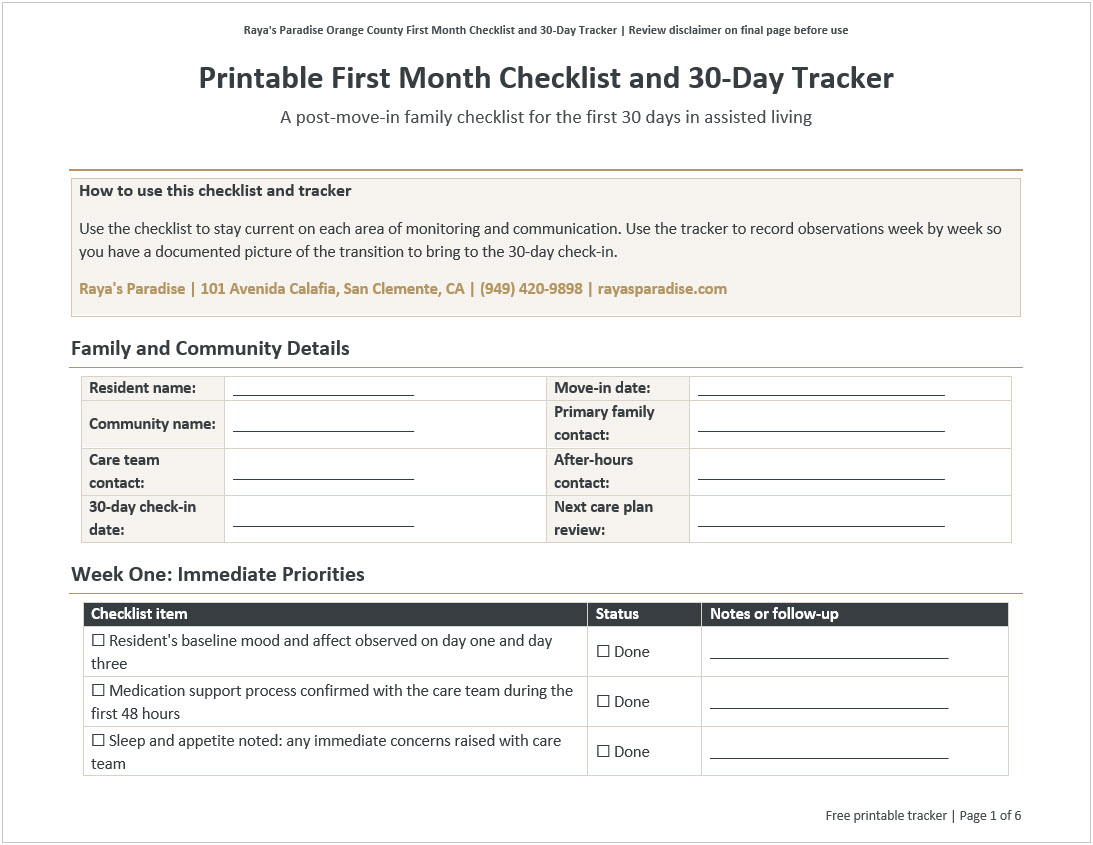
This page picks up where the Orange County Assisted Living Move-In Checklist ends.
That checklist covers preparation, paperwork, packing and move-in day logistics. This one starts the morning after move-in and covers the thirty days that follow.
The first month in assisted living is the period when the transition either takes hold or starts to unravel, and the difference usually comes down to two things: how well families stay engaged with the care team, and how clearly they understand what normal adjustment looks like versus what requires intervention.
Many families struggle during this period because they are reacting to each visit emotionally rather than observing systematically.
This checklist gives you that framework.
It is structured for families in Orange County who want to be informed, active partners in the transition. The tone throughout is supportive rather than clinical. The decisions have been made. The work now is showing up well for the next thirty days.
Questions about how the first month works at Raya’s Paradise? Contact our care team directly. Our staff walks every new family through what to expect and how we support the transition.
Key Takeaways
- First-week distress, mood changes and resistance are common and do not automatically indicate placement failure, but sudden confusion, severe distress, safety concerns or health changes should be addressed promptly.
- Consistent, predictable visiting is more supportive than frequent unscheduled visits during the routine-building phase of the first month.
- Families should observe and document rather than just visit and react. A weekly tracking habit gives you a real picture of progress over time rather than impressions from individual visits.
- Medication continuity is one of the most important areas to confirm during the first two weeks. Any concern about whether medication assistance is happening as ordered should be raised with the care team immediately, not noted for later.
- A 30-day care team check-in is a useful opportunity to review care plan alignment, raise concerns formally and set expectations for the next phase. Request it proactively if the community does not schedule it automatically.
- Emotional adjustment takes time, but severe distress, sudden behavior changes, safety concerns, refusal of food or fluids, or statements about feeling unsafe should be raised immediately. Persistent unhappiness beyond the first few weeks deserves a structured care team conversation.

What the First Week Typically Looks Like
The first week in a new care setting is disorienting for almost every new resident, regardless of how well the move was handled or how good the community is.
The environment is new, the faces are unfamiliar, the daily schedule is different and the full weight of the life change has arrived. It is normal to see sadness, irritability, withdrawal, difficulty sleeping, reduced appetite or resistance to participating in activities during this period.
What families observe in the first week is an adjustment period in motion.
It is not a verdict on the placement and it is not an indicator of how things will be in six weeks. The families who handle this phase best are the ones who expected it, named it and gave it space while staying steadily present.
A few behaviors during the first week genuinely warrant prompt attention, as distinct from normal adjustment difficulty.
These include confusion or disorientation that is significantly worse than the resident’s baseline before the move, new injuries or unexplained physical changes, apparent pain that is not being addressed, signs that medication assistance may not be happening as ordered, or any indication that the resident is in distress that staff are not responding to.
Those are not adjustment symptoms. They are care concerns and should be raised with the care team the same day.
First Week Observation Checklist
- ☐ Resident’s mood and affect observed: note baseline, not just negative moments
- ☐ Sleep quality asked about or observed: is the resident sleeping?
- ☐ Appetite and meal participation confirmed with staff: is the resident eating?
- ☐ Medication support process confirmed with the care team during the first 48 hours
- ☐ Staff interactions observed: are caregivers engaging with the resident by name?
- ☐ Room setup confirmed as comfortable: familiar items visible and accessible
- ☐ Any physical changes, new injuries or unexplained symptoms noted and reported immediately
- ☐ Care team introduced: primary caregiver contact confirmed
- ☐ After-hours contact number confirmed and shared with family primary contact

What to Monitor During the First Month
The most useful thing a family can do during the first month is observe and document consistently rather than react to individual visits.
A resident who is tearful on Tuesday and engaged on Thursday is showing you an adjustment process in motion. A resident who is consistently withdrawn, consistently refusing meals and consistently not interacting with staff across four weeks of visits is showing you something that needs care team attention.
The categories below are the ones that most reliably indicate how the transition is going.
Notice them during every visit and note them briefly somewhere, even a note on your phone. The weekly tracker at the bottom of this page gives you a structured format for doing this.
Physical health and condition. Is the resident’s physical condition stable, improving or declining relative to move-in? Are there any new injuries, bruises or unexplained physical changes? Is pain being managed? Is the resident moving around the community or primarily staying in the room?
Medication continuity. This is the highest-risk area in the first two weeks.
Ask the care team directly whether medication assistance is happening as ordered. If the resident is capable of telling you, ask them. If you have any concern that a medication may have been missed or medication assistance may not be happening as ordered, raise it with the care team immediately.
California RCFE medication rules require documentation related to medication assistance and centrally stored medications. If you have a concern, ask the care team what medication records or documentation can be reviewed and who can walk you through the process.
If you are the resident’s authorized representative, responsible party or otherwise have the resident’s permission, ask what medication-related documentation can be reviewed and what the community’s process is for doing so.
Appetite and nutrition. Is the resident eating meals? Is there a dietary concern or preference that isn’t being accommodated?
Weight changes in the first month can be significant. Ask the care team whether they are monitoring weight and what their protocol is for residents who are consistently not eating.
Sleep quality. Sleep disruption is common in the first weeks of a transition and typically improves as routine establishes.
Persistent severe sleep disruption, particularly in residents with dementia, may warrant a physician conversation. Note this with the care team at the two-week mark if it continues.
Social and emotional engagement. Is the resident participating in any community activities? Are they interacting with other residents or staff? Is there any sign of connection beginning to form?
Social withdrawal that persists beyond three to four weeks is worth raising directly rather than noting passively.
Staff responsiveness and care quality. During visits, observe how staff interact with your loved one when they don’t know you’re watching.
Are needs being met? Is the resident clean, groomed and comfortable? Are call buttons or requests being responded to in a reasonable time?
First Month Monitoring Checklist
- ☐ Physical condition: stable, improving or declining relative to baseline?
- ☐ Any new injuries, bruises or unexplained physical changes: note and report immediately if observed
- ☐ Pain management: is the resident expressing or showing signs of pain that isn’t being addressed?
- ☐ Medication continuity: confirmed with care team at week one and week two
- ☐ Appetite and meal participation: consistent or concerning patterns noted
- ☐ Weight: care team asked whether weight is being monitored and whether any concern has been noted
- ☐ Sleep quality: improving, stable or persistently disrupted?
- ☐ Activity participation: any engagement with community programming or other residents?
- ☐ Emotional affect: pattern across multiple visits, not single moments
- ☐ Staff responsiveness observed during visits
- ☐ Room condition: clean, organized and comfortable during visits at different times of day?
- ☐ Care plan being implemented as agreed: any gaps or concerns?

How to Communicate Effectively With the Care Team
The relationship between a family and a care team in the first month sets the tone for everything that follows.
Families who communicate proactively, specifically and without escalating every concern to urgency end up with better outcomes than those who either disengage entirely or treat every observation as a crisis.
The most useful communication habit in the first month is brief, specific and regular.
“My mother seemed more engaged on Thursday than Tuesday. Has the care team noticed anything?” is useful. “I’m very concerned about my mother” without specifics is not. Specific observations give the care team actionable information. Generalized concern puts the care team in the position of reassuring rather than responding.
For Orange County families managing this from different parts of the county or from further away, the primary family contact system established at move-in carries the full weight of the communication relationship with the care team.
The primary contact should be the one reaching out to the community and synthesizing information for other family members, not each family member independently calling the care team with the same question.
A few communication principles that consistently help during the first month.
First, call during business hours unless the concern is urgent. Most care team members are not able to have substantive care conversations during evenings and weekends even if they are reachable.
Second, ask questions rather than making assumptions. “Has staff noticed her appetite changing?” produces more information than “I don’t think she’s eating enough.”
Third, when you have a concern, state it clearly and ask what the care team’s plan is. You do not need to have the solution, but you should understand what the care team plans to do next.
Care Team Communication Checklist
- ☐ Primary family contact actively managing communication with the care team
- ☐ Brief, specific update call or contact made at end of week one
- ☐ Medication continuity confirmed in writing or direct conversation at week two
- ☐ Any physical concern raised the same day it is observed, not noted for later
- ☐ Care team asked about appetite, sleep and activity participation at week two
- ☐ Any discrepancy between care plan commitments and observed care raised directly
- ☐ 30-day check-in scheduled or confirmed with the care team
- ☐ Family communication method updated: all family members routing observations through primary contact rather than calling the community independently

Supporting Emotional Adjustment During the First Month
The emotional adjustment process in the first month of assisted living is real and it takes different shapes for different people.
For some residents, the first weeks bring sadness and a grief-like response to the losses involved in the transition, including the former home, familiar routines and a sense of independence. For others, the primary response is disorientation or anxiety about the new environment. For others still, particularly those who moved under difficult circumstances, there may be genuine relief alongside the difficulty. All of these are legitimate responses.
What families can do to support adjustment during this period is more about consistency and calm than about activity or intervention.
Visit on a predictable schedule rather than appearing unexpectedly multiple times a day. Bring your own emotional steadiness to visits rather than your anxiety. Focus conversations on the present, what’s happening in the community, in family life, in the news rather than repeatedly referencing the former home or the circumstances of the move.
Resist the pull to “fix” the adjustment by visiting more, bringing more items from home or advocating to change things that are part of normal transition.
A resident who is sad in week two may not need more frequent visits as much as steady, predictable presence, calm reassurance and time for the care team to build a daily relationship.
For families managing the emotional weight of this period themselves, the caregiving and caregiver burnout resources on the blog address the family side of this transition specifically.
You are also going through something significant. That deserves acknowledgment.
Emotional Adjustment Support Checklist
- ☐ Visiting schedule consistent and predictable: same days and times as much as possible
- ☐ Visits focused on present connection rather than past or circumstances of the move
- ☐ Family’s own emotional reactions managed outside of visits rather than brought into them
- ☐ Resident’s adjustment difficulty acknowledged during visits without amplification
- ☐ Care team informed of any significant emotional events the resident has mentioned (grief, fear, anger) so they can support appropriately
- ☐ Persistent withdrawal or distress beyond week three noted and raised with the care team
- ☐ Outside support resources considered for family members managing their own adjustment: physician, counselor, caregiver support group

How Visiting During the First Month Actually Helps
Visits during the first month serve two distinct purposes and it helps to hold both of them in mind when you arrive.
One purpose is connection, being present for your loved one in a way that signals continuity and reassurance. The other is observation, gathering a firsthand impression of the community’s daily operation that supplements what the care team tells you.
Visiting at different times of day occasionally, while respecting resident privacy, community routines and facility policies, gives you a broader picture of daily life than a single scheduled visit during a predictable time window.
An early morning visit may show you the routine around breakfast and medication support. A late afternoon visit may show you how the community manages the transitional hours before dinner, which can be difficult for residents with dementia. A weekend visit may show you a different staffing picture than a weekday visit.
For families managing visits from different parts of Orange County, the I-5 corridor through San Clemente and the surrounding South OC geography can make visit timing a practical challenge, particularly during beach season.
Planning visits around traffic patterns rather than on impulse reduces the frustration of shortened visits and supports the consistency that adjustment depends on.
When you visit, pay attention to what is happening beyond the time you spend with your loved one.
How are staff interacting with other residents? Are common areas in use? Does the environment feel calm and organized or rushed and understaffed? These observations give you context that direct conversation with your loved one can’t provide.
Visiting Checklist
- ☐ Visiting schedule established and communicated to the resident so they know when to expect you
- ☐ At least one visit per week at a time outside the usual window during the first month
- ☐ South OC traffic patterns considered when scheduling visits (beach season, commute hours)
- ☐ Observations from visits recorded briefly after each one: mood, physical condition, environment, staff interaction
- ☐ Common areas observed during visits, not only time spent in the resident’s room
- ☐ Any significant concern from a visit communicated to the care team the same day
- ☐ Visits at different times of day used to observe daily life while respecting resident privacy, community routines and facility policies

Red Flags That Warrant Prompt Attention
Most of what families observe in the first month is adjustment-related and resolves with time, consistency and good care.
Some things are not adjustment-related and warrant prompt, direct communication with the care team and potentially the resident’s physician. This section is about the latter.
The items below are not intended as a source of anxiety.
They’re a clear-eyed list of the things that require a same-day or next-day response rather than being noted in passing. If you observe any of these, contact the care team directly and ask specifically how the concern is being addressed. A well-run community should be able to respond with specific information, a follow-up plan or a clear explanation of what will be reviewed.
If symptoms suggest an immediate medical emergency, including suspected stroke, severe injury, chest pain, sudden severe confusion or danger to self or others, call 911 first rather than waiting for a routine care-team response.
If a concern is not being addressed satisfactorily by the care team, the next step is the community’s administrator.
If it is still not resolved, California residents have the right to contact the Community Care Licensing Division through the CDSS CCLD Complaint Hotline and the right to contact the Long-Term Care Ombudsman program, which provides free resident advocacy.
Red Flags Checklist
- ☐ Unexplained new injuries, bruises or cuts: raise immediately, ask how and when they occurred and what documentation exists
- ☐ Significant unexplained decline in alertness, cognition or physical function relative to pre-move-in baseline: contact the care team immediately and ask whether physician evaluation or urgent medical care is needed
- ☐ Any indication that medication assistance may not be happening as ordered: ask for review of the current medication record or medication assistance documentation immediately
- ☐ Refusal of meals, signs of dehydration or significant weight loss: ask what the care team’s protocol is and whether a physician has been notified
- ☐ Unaddressed pain or physical discomfort: ask what the care team’s pain management process is and whether a physician has been contacted
- ☐ Room conditions that are unsafe, unsanitary or significantly below what was agreed at admission
- ☐ Staff behavior that is dismissive, disrespectful or inattentive to the resident’s stated needs: raise directly with the administrator
- ☐ Persistent emotional distress, escalating agitation, unsafe exit-seeking or repeated statements of wanting to leave that do not diminish by week three or four: request a care team meeting
- ☐ Any statement from the resident about feeling unsafe, being mistreated or being afraid: take seriously, investigate calmly and document what was said and when

The 30-Day Check-In With the Care Team
Many families find it helpful to request a structured 30-day check-in, even if the community does not automatically schedule one.
Request it in advance and confirm that it will be a structured conversation, whether in person, by phone or by video. Come with prepared observations and questions rather than arriving open-ended.
The purpose of the 30-day check-in is to review the transition systematically: how the resident has adjusted, whether the care plan is aligned with actual current needs, whether any concerns from the first month have been resolved or require ongoing attention and what the care team recommends for the next phase.
It is also the right time to raise anything you’ve been observing but haven’t yet brought to the care team’s attention.
Come to the check-in with your weekly tracking notes from the first month.
They give you a factual basis for the conversation rather than impressions, and they signal to the care team that you are an engaged family partner rather than a passive observer.
30-Day Check-In Questions
- ☐ “How would you describe the overall adjustment over the past 30 days?”
- ☐ “Is the current care plan still accurate for my loved one’s actual needs, or do you recommend any changes?”
- ☐ “Are there any care level changes anticipated in the near term?”
- ☐ “Have there been any medication concerns, missed doses or changes since move-in? Can we review the current medication record or medication assistance documentation?”
- ☐ “What has appetite and meal participation been like overall? Is weight being monitored?”
- ☐ “Is my loved one participating in any community activities? What have you noticed about their engagement with staff and other residents?”
- ☐ “Has the care team identified any concerns we should know about that haven’t come up in our regular communication?”
- ☐ “Is there anything we as a family could do differently that would support the transition or the care team’s work?”
- ☐ “What do you recommend for the next 30 to 60 days in terms of visiting, communication and family involvement?”
- ☐ “When should we schedule the next formal care plan review?”

Printable First Month Checklist and 30-Day Tracker
Use the checklist to stay current on each area of monitoring and communication.
Use the tracker to record your observations week by week so you have a documented picture of the transition to bring to the 30-day check-in.
Raya’s Paradise • 101 Avenida Calafia, San Clemente, CA • (949) 420-9898 • rayasparadise.com
Week One: Immediate Priorities
- ☐ Resident’s baseline mood and affect observed on day one and day three
- ☐ Medication support process confirmed with the care team during the first 48 hours
- ☐ Sleep and appetite noted: any immediate concerns raised with care team
- ☐ Primary family contact confirmed with care team
- ☐ Care team primary contact and after-hours number confirmed
- ☐ Any unexplained physical changes or new injuries noted and reported immediately
- ☐ Room setup confirmed as comfortable and familiar items accessible
- ☐ Brief care team check-in at end of week one: any concerns or questions from staff?
Week Two: Early Adjustment Review
- ☐ Medication continuity confirmed directly with care team
- ☐ Appetite and meal participation asked about
- ☐ Sleep quality asked about; any ongoing concern noted
- ☐ Physical condition: any changes since move-in?
- ☐ Care team observations on emotional adjustment asked for specifically
- ☐ Any care plan gaps or discrepancies raised directly
- ☐ Weekly tracking notes completed (see tracker below)
Week Three: Mid-Transition Assessment
- ☐ Emotional adjustment pattern assessed: improving, stable or persistent difficulty?
- ☐ Activity and meal participation observed during at least one visit this week
- ☐ Persistent withdrawal or refusal raised with care team if present
- ☐ Visit at a different time of day this week: any observations outside normal pattern?
- ☐ 30-day check-in confirmed and scheduled
- ☐ Weekly tracking notes completed
Week Four and 30-Day Check-In
- ☐ Monthly tracking notes reviewed and compiled for 30-day meeting
- ☐ 30-day check-in held with care team: structured in-person, phone or video conversation
- ☐ Care plan reviewed and updated if needed
- ☐ Medication records or medication assistance documentation reviewed if any concern arose during the month
- ☐ Next care plan review date confirmed
- ☐ Any outstanding concerns from the first month formally noted and a response requested
- ☐ Care team asked for recommendations for the next 30 to 60 days
Weekly Observation Tracker
| Observation Area | Week 1 | Week 2 | Week 3 | Week 4 |
| Overall mood and affect | ||||
| Physical condition and mobility | ||||
| Appetite and meal participation | ||||
| Sleep quality | ||||
| Medication continuity confirmed | ||||
| Activity participation | ||||
| Staff responsiveness observed | ||||
| Room condition on visit | ||||
| Concerns raised with care team | ||||
| Care team response to concerns | ||||
| Overall transition direction |
Using this tracker: Note briefly what you observed in each category after each week’s visits.
You don’t need detailed notes; a word or two captures a pattern. “Tearful but ate well” is enough. What matters is the pattern across four weeks, not the prose. Bring the completed tracker to the 30-day check-in.

Talk With Our Care Team About Move-In at Raya’s Paradise in San Clemente
At Raya’s Paradise at 101 Avenida Calafia in San Clemente, the first month is not the end of the care conversation. It is the beginning of it.
Our care team works with new residents and their families through the adjustment period, staying proactive about communication and responsive when concerns arise.
If your loved one has recently moved in, or if you’re preparing for a move and want to understand what our first-month support looks like, reach out directly to our care team.
We’re here to answer questions about how we communicate with families, how we monitor new residents during the transition and what our 30-day check-in process looks like.
For families still in the exploration or decision stage, schedule a private tour of our San Clemente community.
Meeting the care team and seeing the environment firsthand is the clearest way to understand what the transition experience would actually look like.
You can also explore our Avenida Calafia community page or the broader assisted living in Orange County page for more context on our care approach and services.
Visit Our San Clemente Assisted Living Community
Raya’s Paradise is located at 101 Avenida Calafia in San Clemente, serving families throughout South Orange County, including San Clemente, Dana Point, San Juan Capistrano, Laguna Niguel, Mission Viejo and surrounding coastal communities.
If you are planning a move, comparing care options or helping a parent adjust after move-in, visiting in person can give you a clearer sense of the environment, care team and daily rhythm of the community.
During your visit, you can ask about assisted living, memory care, short-term respite care, hospice support coordination, family communication and what the first month typically looks like for new residents.
Use the map to find our San Clemente location, then call (949) 420-9898 or email Info@RayasParadise.com to ask questions or schedule a private tour.
Disclaimer:
This checklist and tracker are for informational and educational purposes only and does not constitute medical, legal or emergency advice. Care needs, adjustment timelines and regulatory requirements vary by individual, community and circumstance. For health concerns observed during the transition, contact the care team and the resident’s physician promptly. For sudden confusion, serious injury, suspected stroke or immediate danger, call 911. For unresolved care concerns in a licensed RCFE, contact the California Community Care Licensing Division or the Long-Term Care Ombudsman program.