
Download the Orange County Assisted Living Evaluation Checklist
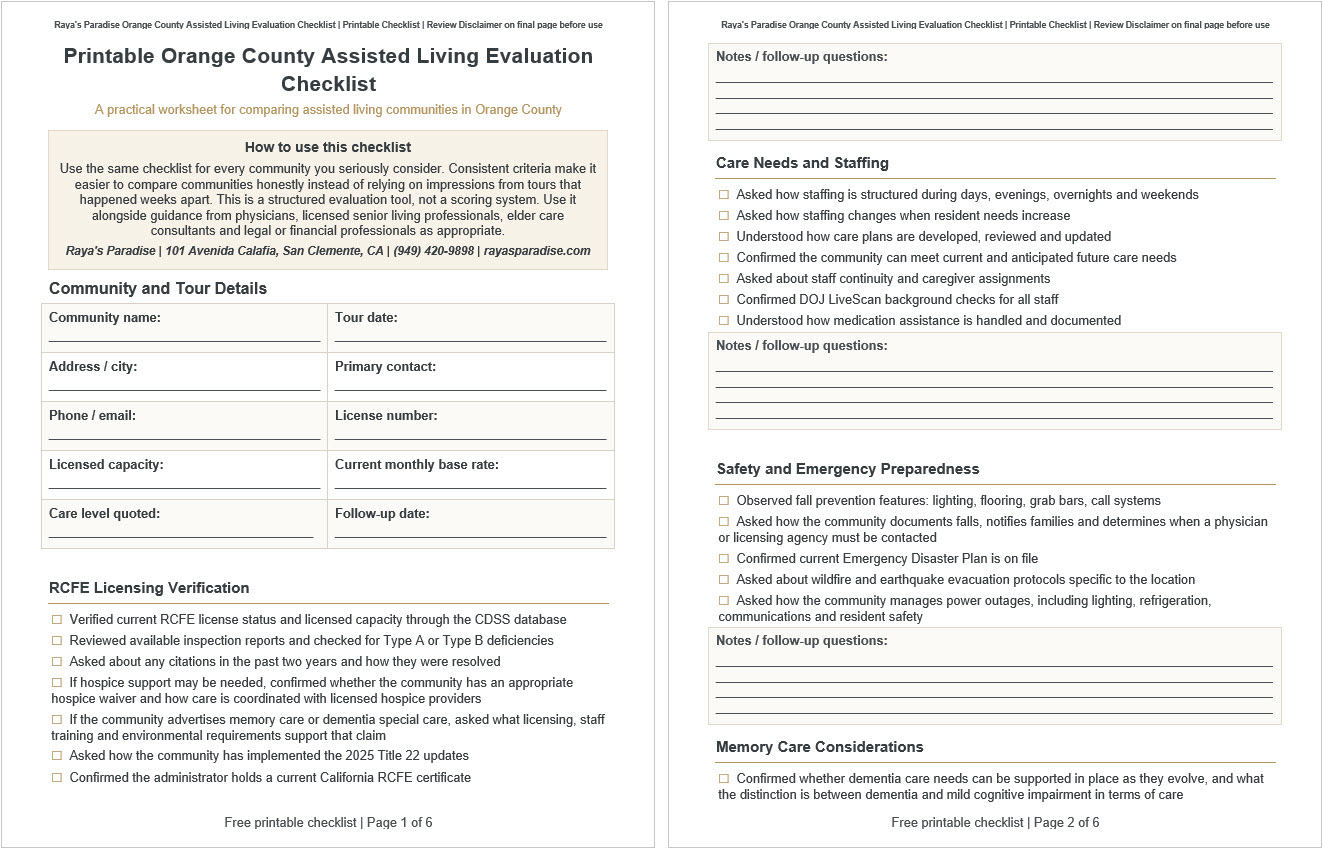
Touring assisted living communities can get overwhelming fast, especially when every visit blends together by the end of the week. Before you start comparing options, download the printable evaluation checklist. It gives Orange County families one consistent worksheet to use at each community, with prompts for RCFE licensing, staffing, safety, memory care, meals, family communication, costs, contracts and tour observations.
There’s space to record the community name, license details, monthly rate, care level quoted, follow-up questions and your clearest impressions after the visit. Use it during tours, bring it to family discussions or review it with a physician, elder care consultant, senior living advisor, attorney or financial professional when appropriate.
Available as a print-ready PDF and an editable Word document so you can edit it, fill it out by hand, type into it digitally or share it with family members helping you compare options.
Choosing an assisted living community for a parent is one of the most consequential decisions a family makes, and in Orange County, it comes with a layer of complexity that generic national checklists simply don’t address. California has its own licensing framework, its own inspection system and its own regulatory requirements for Residential Care Facilities for the Elderly. The OC market includes everything from small residential board and care homes to larger assisted living campuses, and the differences between them matter more than square footage or amenity lists.
This checklist is designed specifically for Orange County families who are in the evaluation and comparison phase. If you’re still figuring out whether assisted living is the right next step, start with the Orange County assisted living readiness checklist first. If you’ve recognized the signs and are now actively comparing communities, this page is built for you.
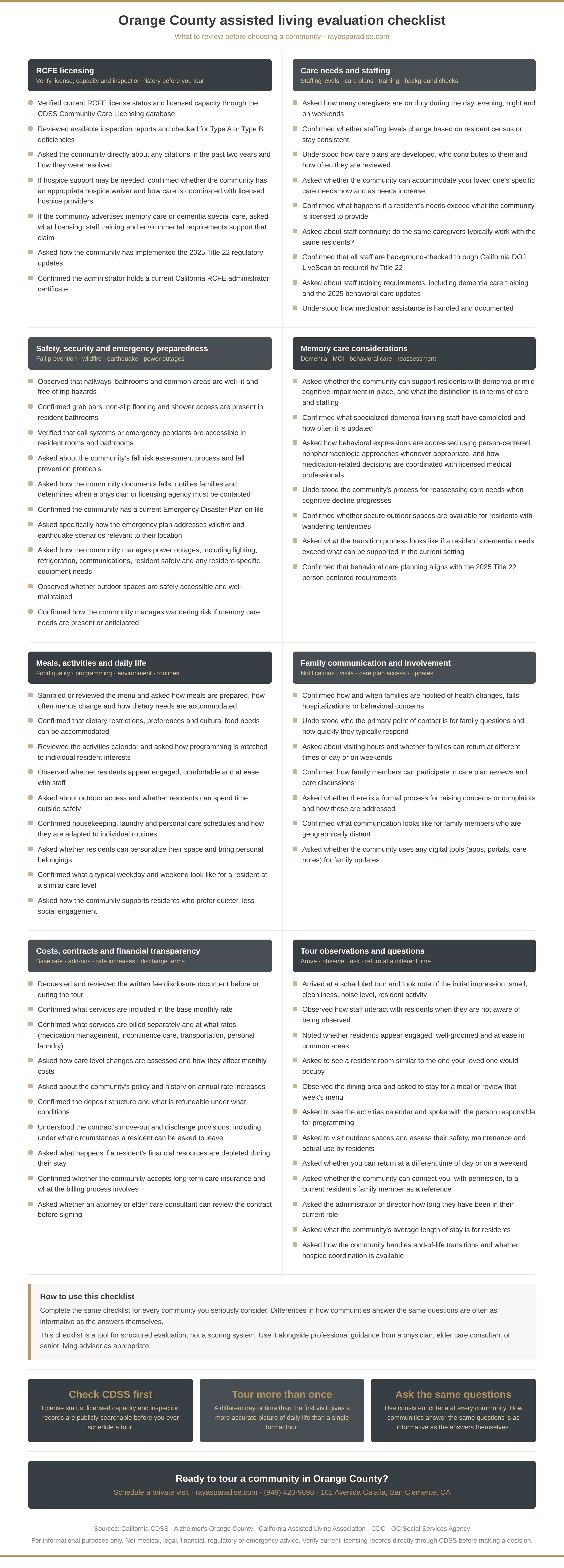
The checklist covers eight evaluation areas: California RCFE licensing verification, care needs and staffing, safety and emergency preparedness, memory care considerations, meals and daily life, family communication and visiting, costs and contracts, and what to observe and ask on a tour. A printable version is available at the bottom of the page.
Ready to see a community in person? Schedule a private tour at Raya’s Paradise in San Clemente.
Key Takeaways
- All California assisted living communities must be licensed as RCFEs by the CDSS. Families can verify available public information, including license status, inspection history and citation records, through the CDSS database before making a decision.
- The 2025 updates to California’s Title 22 RCFE regulations strengthened dementia care requirements, integrated dementia-related standards across multiple sections, added more person-centered behavioral-expression language and updated requirements around appraisals, reappraisals, resident access to certain items, elopement reporting and firearms-policy disclosures.
- California’s Title 22 regulations require RCFEs to maintain enough qualified staff to meet resident needs, but families should not assume a universal caregiver-to-resident ratio applies. Asking how staffing is structured during evenings, nights and weekends is a meaningful evaluation question.
- Orange County’s residential RCFE market includes both smaller residential board and care homes and larger campus-style communities. The right fit depends on your loved one’s care needs, social preferences and how they respond to different environments.
- Cost structures vary significantly in OC. Understanding what is included in the base rate versus billed separately, and how rates can change over time, is essential before signing any contract.
- Touring more than once, including at a different day or time than the first visit, gives families a more accurate picture of daily life than a single formal tour.

Assisted Living in Orange County – What Families Are Choosing Between
Orange County families evaluating assisted living are typically choosing between two broad types of licensed care settings, each with a meaningfully different feel, staffing structure and daily experience.
Smaller residential RCFEs, often called board and care homes, commonly serve a smaller number of residents in a more home-like setting. In California, many smaller RCFEs fall in the 6 to 15 bed range, while larger assisted living communities may be licensed for dozens or even more than 100 residents. These smaller settings can feel quieter and more personal, though capacity and staffing vary by license and resident needs.
Larger assisted living communities typically offer more on-site programming, dedicated common spaces and a broader range of amenities. Neither type is inherently better. The right fit depends on your loved one’s personality, care needs and comfort level. A parent who is social and thrives in structured group activity may do well in a larger campus. A parent who is private, has moderate-to-high care needs, or was uncomfortable during an initial tour of a larger community may respond better to a smaller residential setting.
Raya’s Paradise at 101 Avenida Calafia in San Clemente is a licensed RCFE with a coastal residential feel and boutique-style environment. Families should always verify each community’s licensed capacity directly through the CDSS database before comparing options. This checklist is designed to help families evaluate any type of licensed community rigorously and fairly.
For context on how the two models compare more broadly, see the difference between large assisted living facilities and smaller board and care homes.

California RCFE Licensing – What to Verify Before You Tour
Every assisted living community in California, regardless of size or branding, must hold a current RCFE license issued by the California Department of Social Services (CDSS). This is not optional and cannot be waived. The license specifies the facility’s approved capacity and the type of care it is authorized to provide.
What many families don’t realize is that this information is publicly available and searchable before you ever schedule a tour. The CDSS Community Care Licensing facility search allows families to look up any licensed RCFE in California by name or address and review available public information, including current license status, licensed capacity, inspection reports, citations and related facility records.
California generally distinguishes between Type A and Type B deficiencies. Type A deficiencies involve an immediate or substantial threat to resident health, safety or personal rights. Type B deficiencies generally involve lower-risk or technical noncompliance. The label matters, but so does the pattern, severity, recency and how the community corrected the issue. A community with multiple Type A deficiencies in the past two years warrants careful scrutiny and direct questions during your visit.
The 2025 updates to California’s Title 22 regulations, which govern all RCFEs statewide, strengthened dementia care requirements, integrated dementia-related standards across multiple regulatory sections, added more person-centered behavioral-expression language and updated requirements around appraisals, reappraisals, resident access to certain items, elopement reporting and firearms-policy disclosures in admission agreements. When touring a community, asking how they have implemented the 2025 Title 22 updates is a reasonable and legitimate question.
If a community advertises memory care or dementia special care, ask what specific regulatory requirements, staff training and environmental safeguards support that claim. California regulates how facilities advertise dementia special care, programming and environments under Title 22 Section 87706.
RCFE Licensing Checklist
- ☐ Verified current RCFE license status and licensed capacity through the CDSS Community Care Licensing database
- ☐ Reviewed available inspection reports and checked for Type A or Type B deficiencies
- ☐ Asked the community directly about any citations in the past two years and how they were resolved
- ☐ If hospice support may be needed, confirmed whether the community has an appropriate hospice waiver and how care is coordinated with licensed hospice providers
- ☐ If the community advertises memory care or dementia special care, asked what licensing, staff training and environmental requirements support that claim
- ☐ Asked how the community has implemented the 2025 Title 22 regulatory updates
- ☐ Confirmed the administrator holds a current California RCFE administrator certificate

Care Needs Assessment and Staffing
California’s Title 22 regulations require RCFEs to maintain enough qualified staff to meet resident needs, but families should not assume a universal caregiver-to-resident ratio applies. Staffing can vary by facility size, resident acuity, time of day and whether residents need dementia supervision, mobility support, medication assistance or overnight monitoring.
What this means practically is that families need to ask direct questions rather than assume a standard ratio applies. The answers matter most on evenings, nights and weekends, when staffing levels are typically lower and response times may be longer. A community that is fully staffed during a weekday tour may look very different at 9pm on a Saturday.
Some Title 22 requirements vary by facility size, resident needs and care type. Rather than relying on assumptions, families should ask each community how staffing is structured during days, evenings, overnights and weekends, and how staffing changes when resident needs increase.
Every resident in a California RCFE must have an individualized care plan that is reviewed and updated at least annually or following a significant change in condition. Under the 2025 Title 22 updates, behavioral expressions must be supported with individualized, least-restrictive interventions regardless of whether a resident has a formal dementia diagnosis. Asking to understand how care plans are developed and updated, and who is involved in the process, gives families meaningful insight into how a community actually operates.
Care Needs and Staffing Checklist
- ☐ Asked how many caregivers are on duty during the day, evening, night and on weekends
- ☐ Confirmed whether staffing levels change based on resident census or stay consistent
- ☐ Understood how care plans are developed, who contributes to them and how often they are reviewed
- ☐ Asked whether the community can accommodate your loved one’s specific care needs now and as needs increase
- ☐ Confirmed what happens if a resident’s needs exceed what the community is licensed to provide
- ☐ Asked about staff continuity: do the same caregivers typically work with the same residents?
- ☐ Confirmed that all staff are background-checked through California DOJ LiveScan as required by Title 22
- ☐ Asked about staff training requirements, including dementia care training and the 2025 behavioral care updates
- ☐ Understood how medication assistance is handled and documented

Safety, Security and Emergency Preparedness
Safety evaluation in an Orange County assisted living community involves the standard questions about fall prevention, bathroom equipment and call systems, but it also requires attention to factors specific to Southern California. All California RCFEs are required to maintain a formal Emergency Disaster Plan covering evacuation, shelter-in-place and relocation protocols. In Orange County, this plan should address wildfire evacuation procedures relevant to the community’s specific geography, earthquake preparedness and the logistics of relocating residents if the facility becomes uninhabitable.
San Clemente and the surrounding South OC coastal communities have experienced wildfire risk and road closure scenarios that affect evacuation logistics differently than inland Orange County communities. Asking specifically how a community’s emergency plan accounts for its local geography is a reasonable and important question.
Fall prevention is the other area that deserves more attention than a checkbox. Falls are the leading cause of injury among adults 65 and older, and a community’s approach to fall risk assessment, flooring materials, lighting, bathroom equipment and immediate response protocols reflects a great deal about the quality of daily care. Ask how the community documents falls, when families are notified, when a physician or other licensed medical professional is contacted and which incidents must be reported to Community Care Licensing under California reporting rules.
Safety and Emergency Preparedness Checklist
- ☐ Observed that hallways, bathrooms and common areas are well-lit and free of trip hazards
- ☐ Confirmed grab bars, non-slip flooring and shower access are present in resident bathrooms
- ☐ Verified that call systems or emergency pendants are accessible in resident rooms and bathrooms
- ☐ Asked about the community’s fall risk assessment process and fall prevention protocols
- ☐ Asked how the community documents falls, notifies families and determines when a physician or licensing agency must be contacted
- ☐ Confirmed the community has a current Emergency Disaster Plan on file
- ☐ Asked specifically how the emergency plan addresses wildfire and earthquake scenarios relevant to their location
- ☐ Asked how the community manages power outages, including lighting, refrigeration, communications, resident safety and any resident-specific equipment needs
- ☐ Observed whether outdoor spaces are safely accessible and well-maintained
- ☐ Confirmed how the community manages wandering risk if memory care needs are present or anticipated

Memory Care Considerations
Even if your loved one does not currently have a dementia diagnosis, this section is worth working through. Cognitive decline often develops gradually and unpredictably after an assisted living move, and understanding whether a community can support those needs in place, without requiring a disruptive transfer to a different facility, is a meaningful factor in choosing a long-term home rather than a temporary placement.
Alzheimer’s Orange County reports that 164,346 Orange County residents are living with dementia or mild cognitive impairment. Because mild cognitive impairment is not the same as dementia under California’s Title 22 regulations, families should ask specific questions about what level of cognitive support a community can provide, what dementia-related staff training is in place and when a resident may need a higher level of supervision. California’s 2025 Title 22 updates strengthened dementia care requirements significantly, including person-centered behavioral care planning, individualized assessment of what each resident can safely access, and a clear shift away from diagnosis-based restrictions toward individualized care decisions.
For families where memory care is already the primary concern, the memory care services in Orange County page provides a more detailed framework for that specific context.
Memory Care Considerations Checklist
- ☐ Asked whether the community can support residents with dementia or mild cognitive impairment in place, and what the distinction is in terms of care and staffing
- ☐ Confirmed what specialized dementia training staff have completed and how often it is updated
- ☐ Asked how behavioral expressions are addressed using person-centered, nonpharmacologic approaches whenever appropriate, and how medication-related decisions are coordinated with licensed medical professionals
- ☐ Understood the community’s process for reassessing care needs when cognitive decline progresses
- ☐ Confirmed whether secure outdoor spaces are available for residents with wandering tendencies
- ☐ Asked what the transition process looks like if a resident’s dementia needs exceed what can be supported in the current setting
- ☐ Confirmed that behavioral care planning aligns with the 2025 Title 22 person-centered requirements

Meals, Activities and Daily Life
Licensing compliance and staffing ratios matter enormously, but so does the texture of daily life. A parent who moves into assisted living and spends most of their day in a recliner watching television has not gained much, regardless of how clean the facility is or how current its certifications are. Quality of life in assisted living is built from meals people genuinely want to eat, activities that match who they actually are, staff who know their name and their preferences, and an environment that feels like living rather than waiting.
When evaluating this dimension, what you observe during a visit is at least as important as what you’re told. Pay attention to how staff interact with residents when they don’t know they’re being observed. Look at whether residents are engaged or withdrawn. Notice whether the dining area feels like a meal or a feeding schedule. A community that is proud of its daily life will encourage you to return at a different time, stay for a meal and spend time with residents independently.
Meals and Daily Life Checklist
- ☐ Sampled or reviewed the menu and asked how meals are prepared, how often menus change and how dietary needs are accommodated
- ☐ Confirmed that dietary restrictions, preferences and cultural food needs can be accommodated
- ☐ Reviewed the activities calendar and asked how programming is matched to individual resident interests
- ☐ Observed whether residents appear engaged, comfortable and at ease with staff
- ☐ Asked about outdoor access and whether residents can spend time outside safely
- ☐ Confirmed housekeeping, laundry and personal care schedules and how they are adapted to individual routines
- ☐ Asked whether residents can personalize their space and bring personal belongings
- ☐ Confirmed what a typical weekday and weekend look like for a resident at a similar care level
- ☐ Asked how the community supports residents who prefer quieter, less social engagement

Family Communication and Involvement
Many families are surprised to discover that the community they chose based on a positive tour becomes difficult to communicate with after move-in. This is one of the most consistent sources of dissatisfaction in assisted living, and it is entirely predictable if the right questions are asked before signing a contract.
In Orange County, where many family caregivers live 20 to 60 minutes away from a parent’s care community, or are visiting from out of the area, the reliability and quality of communication from the care team can meaningfully affect whether a family feels confident or anxious about a placement. Asking direct questions about how and when families are notified of health changes, incidents, care plan updates and day-to-day concerns is not an imposition. A community that is confident in its communication practices will answer these questions readily and specifically.
Family Communication Checklist
- ☐ Confirmed how and when families are notified of health changes, falls, hospitalizations or behavioral concerns
- ☐ Understood who the primary point of contact is for family questions and how quickly they typically respond
- ☐ Asked about visiting hours and whether families can return at different times of day or on weekends
- ☐ Confirmed how family members can participate in care plan reviews and care discussions
- ☐ Asked whether there is a formal process for raising concerns or complaints and how those are addressed
- ☐ Confirmed what communication looks like for family members who are geographically distant
- ☐ Asked whether the community uses any digital tools (apps, portals, care notes) for family updates

Costs, Contracts and Financial Transparency
Assisted living costs in Orange County vary significantly based on community type, location, care level and contract structure. A base monthly rate that looks comparable across several communities may represent very different actual costs once add-ons, care level adjustments and annual increases are factored in. The only way to make a meaningful cost comparison is to understand the full fee structure of each community you’re seriously considering.
California RCFE admission agreements must disclose key fee, billing, refund and rate-change information. Ask for the admission agreement and fee schedule before committing, and review them carefully. For broader financial planning guidance including Medicare, Medi-Cal and funding options, see Paying for Assisted Living. This page does not constitute financial advice; families should consult a qualified financial advisor or benefits counselor for guidance specific to their situation.
Costs and Contract Checklist
- ☐ Requested and reviewed the written fee disclosure document before or during the tour
- ☐ Confirmed what services are included in the base monthly rate
- ☐ Confirmed what services are billed separately and at what rates (medication management, incontinence care, transportation, personal laundry)
- ☐ Asked how care level changes are assessed and how they affect monthly costs
- ☐ Asked about the community’s policy and history on annual rate increases
- ☐ Confirmed the deposit structure and what is refundable under what conditions
- ☐ Understood the contract’s move-out and discharge provisions, including under what circumstances a resident can be asked to leave
- ☐ Asked what happens if a resident’s financial resources are depleted during their stay
- ☐ Confirmed whether the community accepts long-term care insurance and what the billing process involves
- ☐ Asked whether an attorney or elder care consultant can review the contract before signing

What to Observe and Ask During an Orange County Tour
A formal guided tour of an assisted living community is a useful starting point, but it is not sufficient on its own. Ask whether you can return at a different time of day, visit during a meal or come back on a weekend so you can see more than one version of daily life. A community that is proud of its environment will welcome a second visit.
When touring in Orange County, a few local factors are worth paying specific attention to. Outdoor spaces are especially meaningful given the climate: a community with well-maintained, safely accessible garden or courtyard space that gets regular resident use says something different from one where the outdoor area is pristine but clearly decorative. For the San Clemente coastal geography, ask about how the community manages coastal weather variability and whether residents have access to the natural environment in any structured way.
If you are seriously considering a community, ask whether they can connect you with a current resident’s family member who has agreed to serve as a reference. Most reputable communities will facilitate this and see it as a positive sign of due diligence.
Tour Observations and Questions Checklist
- ☐ Arrived at a scheduled tour and took note of the initial impression: smell, cleanliness, noise level, resident activity
- ☐ Observed how staff interact with residents when they are not aware of being observed
- ☐ Noted whether residents appear engaged, well-groomed and at ease in common areas
- ☐ Asked to see a resident room similar to the one your loved one would occupy
- ☐ Observed the dining area and asked to stay for a meal or review that week’s menu
- ☐ Asked to see the activities calendar and spoke with the person responsible for programming
- ☐ Asked to visit outdoor spaces and assess their safety, maintenance and actual use by residents
- ☐ Asked whether you can return at a different time of day or on a weekend
- ☐ Asked whether the community can connect you, with permission, to a current resident’s family member as a reference
- ☐ Asked the administrator or director how long they have been in their current role
- ☐ Asked what the community’s average length of stay is for residents
- ☐ Asked how the community handles end-of-life transitions and whether hospice coordination is available

Printable Orange County Assisted Living Evaluation Checklist
Use this consolidated checklist across every community you tour. Consistent evaluation criteria make it possible to compare communities honestly rather than relying on impressions from visits that may have happened weeks apart.
Raya’s Paradise • 101 Avenida Calafia, San Clemente, CA • (949) 420-9898 • rayasparadise.com
RCFE Licensing Verification
- ☐ Verified current RCFE license status and licensed capacity through the CDSS database
- ☐ Reviewed available inspection reports and checked for Type A or Type B deficiencies
- ☐ Asked about any citations in the past two years and how they were resolved
- ☐ If hospice support may be needed, confirmed whether the community has an appropriate hospice waiver and how care is coordinated with licensed hospice providers
- ☐ If the community advertises memory care or dementia special care, asked what licensing, staff training and environmental requirements support that claim
- ☐ Asked how the community has implemented the 2025 Title 22 updates
- ☐ Confirmed the administrator holds a current California RCFE certificate
Care Needs and Staffing
- ☐ Asked how staffing is structured during days, evenings, overnights and weekends
- ☐ Asked how staffing changes when resident needs increase
- ☐ Understood how care plans are developed, reviewed and updated
- ☐ Confirmed the community can meet current and anticipated future care needs
- ☐ Asked about staff continuity and caregiver assignments
- ☐ Confirmed DOJ LiveScan background checks for all staff
- ☐ Understood how medication assistance is handled and documented
Safety and Emergency Preparedness
- ☐ Observed fall prevention features: lighting, flooring, grab bars, call systems
- ☐ Asked how the community documents falls, notifies families and determines when a physician or licensing agency must be contacted
- ☐ Confirmed current Emergency Disaster Plan is on file
- ☐ Asked about wildfire and earthquake evacuation protocols specific to the location
- ☐ Asked how the community manages power outages, including lighting, refrigeration, communications and resident safety
Memory Care Considerations
- ☐ Confirmed whether dementia care needs can be supported in place as they evolve, and what the distinction is between dementia and mild cognitive impairment in terms of care
- ☐ Asked about staff dementia training and behavioral care planning practices
- ☐ Asked how behavioral expressions are addressed using person-centered, nonpharmacologic approaches and how medication decisions are coordinated with licensed medical professionals
- ☐ Understood the process for reassessment as cognitive needs increase
- ☐ Confirmed access to secure outdoor spaces where relevant
Meals, Activities and Daily Life
- ☐ Reviewed the menu and asked how meals are prepared, how often menus change and how dietary needs are accommodated
- ☐ Reviewed the activities calendar and asked how programming matches individual interests
- ☐ Observed resident engagement in common areas during the visit
- ☐ Confirmed outdoor access and how it is used
- ☐ Asked about room personalization and personal belongings
Family Communication
- ☐ Confirmed notification process for health changes, falls and incidents
- ☐ Identified the primary family contact and typical response time
- ☐ Asked about visiting hours and the ability to return at different times of day or on weekends
- ☐ Understood how to participate in care plan reviews
- ☐ Confirmed communication options for geographically distant family members
Costs and Contract
- ☐ Reviewed the written fee disclosure document
- ☐ Confirmed what is included in the base rate versus billed separately
- ☐ Asked about care level adjustment pricing and the history of annual rate increases
- ☐ Understood the deposit, refund and discharge provisions
- ☐ Confirmed long-term care insurance acceptance and billing process
Tour Observations
- ☐ Noted cleanliness, smell, noise level and resident activity on arrival
- ☐ Observed staff-resident interactions in unscripted moments
- ☐ Reviewed a resident room and the dining area
- ☐ Assessed outdoor spaces for safety, maintenance and actual resident use
- ☐ Asked whether you can return at a different time of day or on a weekend
- ☐ Asked whether the community can connect you, with permission, to a current resident’s family member as a reference
Using this checklist: Complete the same checklist for every community you seriously consider. Differences in how communities answer the same questions are often as informative as the answers themselves. This checklist is a tool for structured evaluation, not a scoring system. Use it alongside professional guidance from a physician, elder care consultant or senior living advisor as appropriate.

Next Steps in Your Orange County Assisted Living Search
Once you’ve worked through this checklist across multiple communities, you’ll be in a position to make a comparison that’s grounded in consistent criteria rather than impressions from visits that happened weeks apart.
Raya’s Paradise at 101 Avenida Calafia in San Clemente is a licensed RCFE serving Orange County families. Our care team is available to answer questions about our community, our care approach and our licensing history. We welcome families to visit more than once, ask difficult questions and take the time they need to make a confident decision. Schedule a private Orange County tour here, or explore the Avenida Calafia community before you visit.
You can also browse the broader assisted living in Orange County page for an overview of our services and approach, or return to the Orange County senior care hub for the full range of family resources we’ve built for this market.
Schedule a Tour at Raya’s Paradise in San Clemente, Orange County, CA
Raya’s Paradise at 101 Avenida Calafia in San Clemente is a licensed RCFE serving Orange County families. We offer assisted living, memory care, hospice support in coordination with appropriate providers and short-term respite care, all within a coastal residential setting.
We welcome families to bring this checklist when they visit. Every question in it is one our care team is prepared to answer, including our licensing history, staffing structure, care plan process and emergency preparedness plan. If you’d like to return for a second visit at a different time of day, we encourage that too.
There is no obligation and no commitment required for a tour.
Sources and Additional Resources
- California CDSS – Community Care Licensing Facility Search
- California CDSS – Title 22 Laws and Regulations for RCFEs
- California CDSS – Dementia Care Information and Resources (2025 Title 22 Updates)
- CDC – Older Adult Falls Data and Research
- Alzheimer’s Orange County – Dementia Prevalence in Orange County
- California Assisted Living Association – RCFEs by the Numbers
- Orange County Social Services Agency – Adult Protective Services
Disclaimer: Regulations and licensing records can change, so families should verify current requirements and facility records directly through CDSS before making a decision. This checklist is for informational and educational purposes only and does not constitute medical, legal, financial, regulatory or emergency advice. Assisted living needs, care options and regulatory requirements vary by individual, community and time. Families should verify current licensing information directly through CDSS and consult qualified healthcare professionals, licensed senior living advisors and legal or financial professionals as appropriate when making care decisions. For concerns about elder financial exploitation or abuse, contact Orange County Adult Protective Services or a licensed attorney. For sudden confusion, serious injury, suspected stroke or immediate danger, call 911.