
Download the Orange County Assisted Living Readiness Checklist
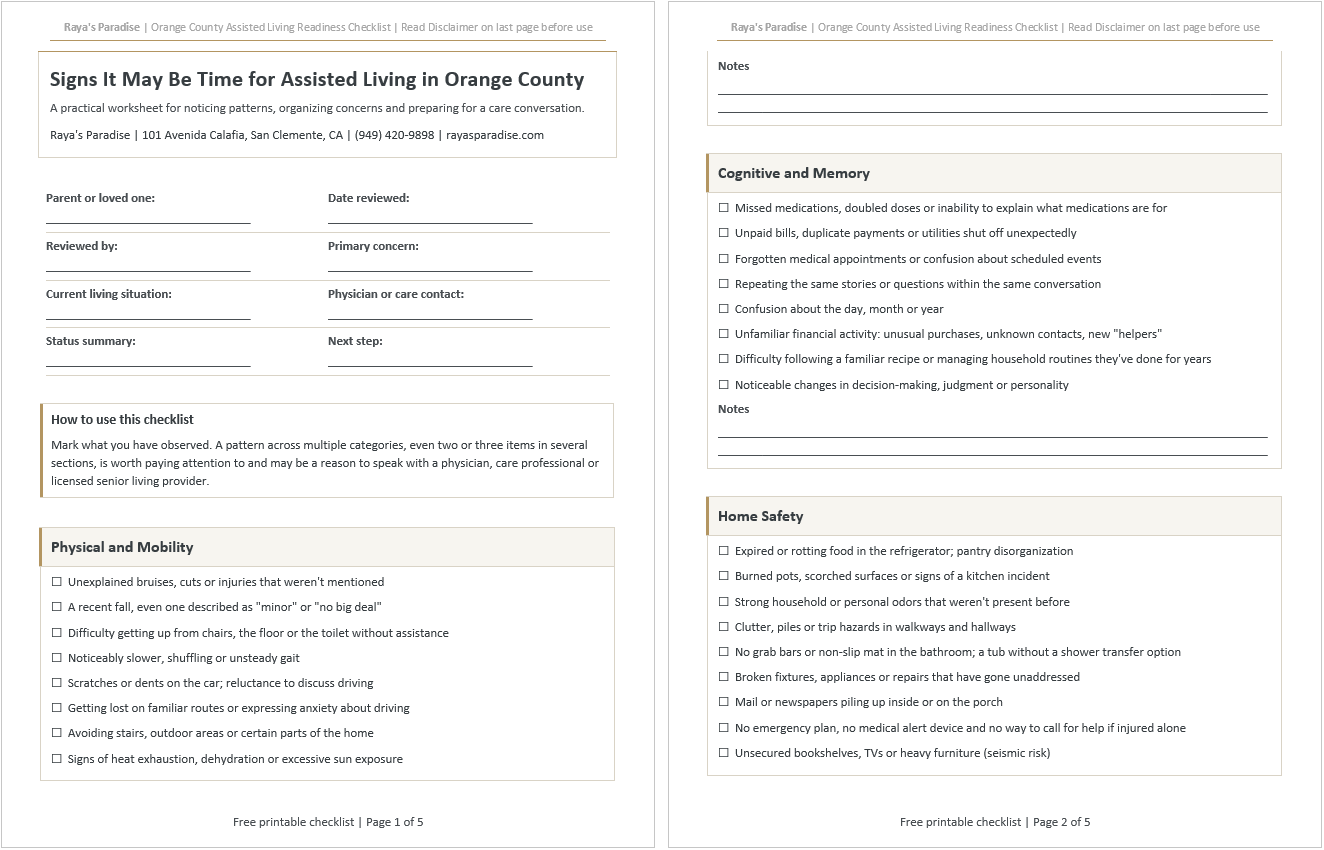
Before you read through the warning signs below, grab the printable version. It’s a five-category worksheet designed for Orange County families: physical and mobility changes, cognitive and memory warning signs, home safety red flags, social isolation and caregiver wellbeing. There’s space to mark what you’ve observed, note your most urgent concerns and record your next step. It’s built to bring to a physician visit, a family conversation or a care consultation.
Available as a print-ready PDF and an editable Word document so you can edit it, fill it in digitally or share it with family members who aren’t in the same room.
Contents
- A Family Checklist – Signs It May Be Time for Assisted Living in Orange County
- Download the Orange County Assisted Living Readiness Checklist
- Key Takeaways
- How to Use This Checklist
- Physical and Mobility Warning Signs
- Cognitive and Memory Warning Signs
- Home Safety Red Flags
- Signs of Social Isolation and Emotional Withdrawal
- Caregiver Burnout Signals
- What Orange County Families Typically Do Next
- How to Start the Conversation
- Printable Orange County Assisted Living Readiness Checklist
- Schedule a Tour at Our Orange County Assisted Living Community
- Sources and Additional Resources
Most families in Orange County don’t sit down one day and decide it’s time for assisted living. The realization tends to arrive gradually. A missed medication here, a fall that “wasn’t serious,” a kitchen that looks a little too quiet on a Sunday afternoon visit.
By the time families start searching for answers, they’ve often been quietly worried for months.
Orange County is home to more than 550,000 residents aged 65 and older, a figure representing roughly 17% of the county’s total population according to 2024 estimates. That’s a lot of families navigating this moment simultaneously, and very few of them have a clear map for what to do next.
This checklist is that map. It’s built specifically for families in South OC, from San Clemente and Dana Point to Mission Viejo and Laguna Niguel, where the combination of active coastal lifestyles, car-dependent geography and a large senior population creates its own set of warning signs that a generic national guide won’t address.
What follows isn’t a verdict. It’s a tool for clarity, a structured way to name what you’ve been noticing and decide whether it’s time to start a conversation. If you check items across multiple categories, that pattern matters more than any single sign on its own.
Raya’s Paradise operates its San Clemente community at 101 Avenida Calafia, and our care team is available to talk through what you’re seeing. No pressure, no obligation.
Wondering whether it’s time to explore care options? Schedule a private visit with our Orange County care team.
Key Takeaways
- Patterns across multiple warning sign categories are more meaningful than isolated incidents.
- Orange County’s car-dependent geography means the loss of driving has outsized social consequences for seniors.
- Short visits and active routines can make gradual physical decline easier for families to miss.
- Alzheimer’s Orange County reports that 164,346 Orange County residents have dementia or mild cognitive impairment (MCI),
- underscoring why families should take early memory, judgment and safety changes seriously.
- Caregiver burnout is a warning sign too, not a personal failing.
- For many families, touring a community together can make assisted living feel more concrete and less intimidating.

How to Use This Checklist
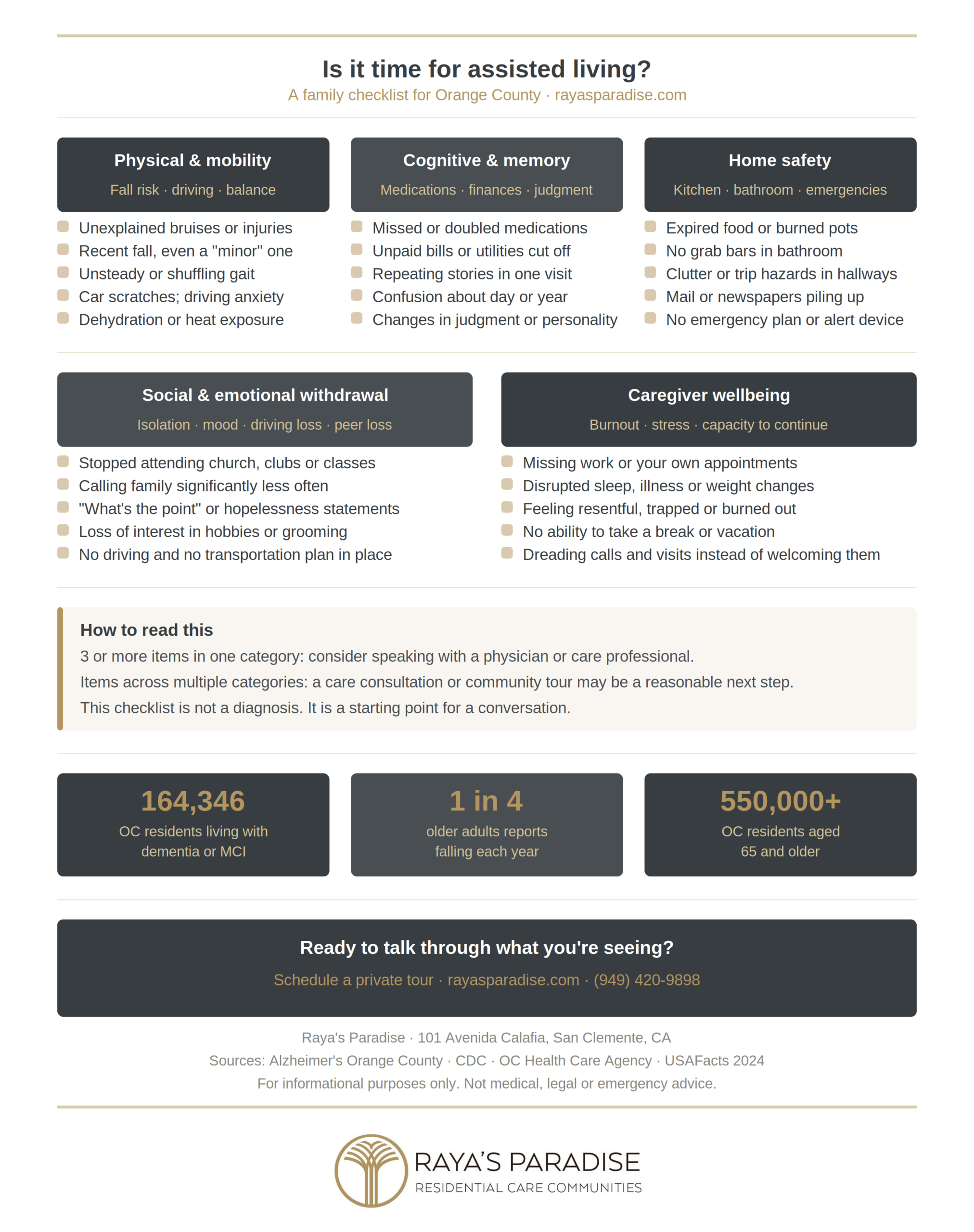
Go through each section one at a time and mark the items that apply. You don’t need to see every sign in a category for it to be meaningful. Even two or three consistent patterns in one area are worth paying attention to.
The goal isn’t to build a case against your parent. It’s to get an honest picture of where things stand so your family can make a thoughtful, informed decision rather than a reactive one after a crisis.
A few things worth knowing before you start. Orange County seniors often remain active and engaged well into their seventies and eighties. The coastal climate, proximity to walking trails and a generally healthy population can make decline easier to miss than in other parts of the country.
A parent who seems fine at a Sunday family lunch may be managing real risks the other six days of the week.
California has more than 7,800 licensed Residential Care Facilities for the Elderly statewide, which means Orange County families often have several types of licensed care settings to compare, from smaller residential homes to larger assisted living communities.
That means families here have genuine choices, and understanding those options early creates far better outcomes than waiting for a hospitalization to force the decision.

Physical and Mobility Warning Signs
Falls are the leading cause of injury among adults 65 and older, and more than one in four older adults reports falling each year.
For families in Orange County, the outdoor lifestyle that keeps seniors healthy longer can also create elevated risk. Coastal walking paths like the San Clemente Beach Trail and the Dana Point Harbor area are beautiful but uneven.
Sun glare, heat and dehydration can also contribute to fatigue, dizziness or unsteadiness, especially during summer months and inland heat spikes in communities like Mission Viejo and Rancho Santa Margarita.
Driving deserves its own conversation. South Orange County remains highly car-dependent, and while senior transportation programs do exist, including OCTA’s Senior Mobility Program and OC ACCESS paratransit, they may not fully replace the freedom, flexibility and social access that driving once provided.
The California DMV’s Mature Driver Improvement Program is a useful resource, but it doesn’t resolve the underlying question of whether a parent can safely manage alone in a geography built around the car.
- Unexplained bruises, cuts or injuries that weren’t mentioned
- A recent fall, even one described as “minor” or “no big deal”
- Difficulty getting up from chairs, the floor or the toilet without assistance
- Noticeably slower, shuffling or unsteady gait
- Scratches or dents on the car; reluctance to discuss driving
- Getting lost on familiar routes or expressing anxiety about driving
- Avoiding stairs, outdoor areas or certain parts of the home
- Signs of heat exhaustion, dehydration or excessive sun exposure

Cognitive and Memory Warning Signs
Orange County’s high cost of living means many seniors here own significant assets: real estate equity, retirement accounts, investment portfolios. Cognitive decline creates particular vulnerability in this context.
Orange County Adult Protective Services handles a significant volume of elder financial exploitation cases each year. Warning signs that a parent may be vulnerable include unfamiliar contractors appearing at the home, uncharacteristic large purchases, new “friends” who’ve appeared recently and shown unusual interest in finances, or confusion about accounts and billing that wasn’t present before.
Alzheimer’s Orange County reports that 164,346 Orange County residents have dementia or mild cognitive impairment (MCI), underscoring why families should take early memory, judgment and safety changes seriously. Alzheimer’s disease and related dementias are among the major health concerns facing Orange County’s older adult population.
Cognitive changes don’t always look like dramatic memory loss at first. They often surface as subtle shifts in judgment, organization and daily routine. An adult child who visits on weekends may not catch what a care professional would recognize immediately during a comprehensive assessment.
One pattern worth noting specifically: many Orange County families are surprised to discover that a parent who seemed sharp during visits was actually concealing confusion.
Seniors who live in comfortable, familiar surroundings and have rehearsed social scripts for family interactions can mask early cognitive decline effectively. The kitchen, the mail and the medication cabinet tell a more honest story than a Sunday dinner conversation does.
- Missed medications, doubled doses or inability to explain what medications are for
- Unpaid bills, duplicate payments or utilities shut off unexpectedly
- Forgotten medical appointments or confusion about scheduled events
- Repeating the same stories or questions within the same conversation
- Confusion about the day, month or year
- Unfamiliar financial activity: unusual purchases, unknown contacts, new “helpers”
- Difficulty following a familiar recipe or managing household routines they’ve done for years
- Noticeable changes in decision-making, judgment or personality

Home Safety Red Flags
Orange County homes are often beautiful, well-maintained and set in appealing neighborhoods, which is exactly why the interior can be so deceiving. A freshly landscaped front yard and a pleasant living room on arrival can make it easy to miss what’s happening in the kitchen, the bathroom and the back bedroom.
When you visit, look past the surfaces. Open the refrigerator. Check the bathroom for safety equipment. Notice whether the mail is piling up inside or on the porch.
Southern California homes present specific safety challenges for aging adults. Many OC properties, particularly in older coastal communities and mid-century tracts, were not designed with aging in place in mind: step-up entries, narrow hallways, tubs rather than walk-in showers, no grab bars in bathrooms and unsecured heavy furniture are common.
Add to that the real seismic risk in Southern California and the practical question of whether a parent living alone has any kind of emergency preparedness plan, or whether they would be able to execute it.
- Expired or rotting food in the refrigerator; pantry disorganization
- Burned pots, scorched surfaces or signs of a kitchen incident
- Strong household or personal odors that weren’t present before
- Clutter, piles or trip hazards in walkways and hallways
- No grab bars or non-slip mat in the bathroom; a tub without a shower transfer option
- Broken fixtures, appliances or repairs that have gone unaddressed
- Mail or newspapers piling up inside or on the porch
- No emergency plan, no medical alert device and no way to call for help if injured alone
- Unsecured bookshelves, TVs or heavy furniture (seismic risk)

Signs of Social Isolation and Emotional Withdrawal
This is the category families miss most often in Orange County, and for a specific reason: the setting is too pleasant. A parent living near the coast, in a tidy neighborhood, with a comfortable home and a nearby park can appear to be doing fine.
“She’s happy. She loves it there.” But contentment with a setting and genuine social connection are not the same thing. Research from AARP shows that loneliness and social disconnection remain serious concerns among older adults, while public health sources including the CDC link social isolation and loneliness with serious physical and mental health risks.
The loss of driving in South OC deserves special attention here. Unlike urban markets where seniors can use transit, rideshare or walkable neighborhoods to stay connected after giving up the car, much of South OC (San Clemente, Dana Point, San Juan Capistrano, Laguna Niguel) is designed around the automobile.
When a senior stops driving, their world can contract quickly unless another transportation plan is already in place. Church, lunch with friends, book clubs, volunteer shifts and casual visits may become harder to maintain. Families often do not realize how isolating this transition has become until mood, motivation or daily routines have already changed.
Orange County also has a large senior population, which means the pace of peer loss (spouses, friends, neighbors) is significant. Each loss can tip a parent further into withdrawal if there’s no structure to support their days.
Life at Raya’s Paradise offers a sense of what structured, engaged community looks like for seniors who’ve made this transition.
- No longer attending church, a club, classes or regular social activities
- Calling family members significantly less frequently than before
- Expressing hopelessness, indifference or “what’s the point” statements
- Loss of interest in hobbies, grooming or things they used to care about
- Unable to name what they did last week or who they’ve spoken to recently
- Recent loss of a spouse, close friend or sibling with no support network in place
- No longer driving with no system to maintain social connections without a car
- Unusual fearfulness, suspicion or paranoia that wasn’t present before

Caregiver Burnout Signals
The national statistics on assisted living readiness focus almost entirely on the senior. But in practice, the tipping point is often the family caregiver, the adult child or spouse who has been quietly absorbing more and more responsibility until the load becomes unsustainable.
Orange County families face a specific version of this challenge: adult children managing demanding careers, long commutes, family responsibilities and aging parents who may live 30 to 60 minutes away across the county, or who require visits from San Diego or Los Angeles. Distance plus responsibility is a formula for exhaustion that arrives faster than most families anticipate.
Recognizing the signs of caregiver burnout early matters for two reasons. First, caregiver burnout can make decisions harder, especially when families are exhausted, overwhelmed or responding to one crisis after another. Second, caregiver health and wellbeing is worth protecting in its own right.
If you’re checking multiple items on the list below, that’s not a character flaw. It may be a signal that additional support is worth exploring, whether that means respite care, in-home help, a physician evaluation or assisted living.
For families not quite ready for a long-term transition, short-term respite care in Orange County is a lower-commitment first step that can provide genuine relief while longer-term options are explored.
- Missing work, personal obligations or your own health appointments to manage care
- Physical symptoms from sustained stress: disrupted sleep, frequent illness, weight changes
- Feeling resentful, trapped or unable to imagine any time that’s truly your own
- No ability to plan a vacation, a weekend away or a sustained break
- Your relationship with your parent has become primarily about managing crises
- Siblings are unavailable, unwilling or geographically distant and you’re carrying it alone
- You’ve started to dread the calls and visits rather than look forward to them
What Orange County Families Typically Do Next
Recognizing the signs is the hard part. Once you’ve gone through this checklist honestly, the path forward tends to be more navigable than families expect. Here’s how most Orange County families move through this process.
- Start with their doctor. When health, medication, mobility or cognitive concerns are present, a physician-led evaluation or geriatric assessment is often a good first step. UCI Health SeniorHealth Center and other Orange County geriatric or primary care providers can help families evaluate health, memory, medication and mobility concerns. A physician’s recommendation also carries more weight with a reluctant parent than an adult child’s concern, which matters enormously for families facing resistance.
- Have the conversation carefully. Most families get this wrong not because they lack love but because they lead with conclusions instead of observations. There’s a full guide to discussing assisted living with a reluctant parent that walks through the specifics of having this conversation without triggering defensiveness or shutting the door on future options.
- Understand your OC care options. Orange County families have real choices across the care spectrum, from in-home support to residential board and care homes to larger assisted living communities. Assisted living in Orange County is a strong starting point for understanding what’s available. If you’re not sure which type of care fits the situation, our team can help you think through it.
- Tour a community, ideally together. No website closes the gap that a good in-person visit does. Many families find that a parent who was resistant in the abstract becomes genuinely interested after seeing a residential community that doesn’t match their institutional preconceptions. Raya’s Paradise at 101 Avenida Calafia in San Clemente offers a more residential, home-like setting rather than an institutional-feeling environment, which often makes a meaningful difference in how a first visit feels. Schedule an Orange County tour here, or explore our San Clemente community before you visit.
- Consider a short-term stay first. For families not yet ready for a permanent transition, or for seniors who need to experience a community before committing, short-term respite care in Orange County offers a genuine, low-pressure path forward. For some families, respite care can be a lower-pressure way to experience a community before considering a longer-term transition.
When you’re ready to look more closely at what to evaluate in a specific community, the Orange County Assisted Living Checklist is the natural next step from this page. It picks up exactly where the recognition phase ends and the evaluation phase begins.
How to Start the Conversation
Orange County seniors (particularly those who’ve built careers, raised families and lived independently in one of the country’s most desirable regions) tend to have a strong, often fierce, sense of independence. This is worth respecting, not overriding.
The families who navigate this transition most successfully don’t win an argument; they earn trust.
Lead with observations, not conclusions. “I noticed the mail was piling up last time I visited” opens a conversation. “We think you can’t manage on your own anymore” closes one. Share specific things you’ve seen without packaging them as a verdict.
Involve their physician. A doctor’s recommendation carries authority that a family member’s concern doesn’t. If you have specific worries about health, cognition or medication management, ask their doctor (with your parent’s permission) to address them directly. Many families find this changes the conversation entirely.
Focus on quality of life, not just safety. “We want you to have more time for things you love, with people around you” lands differently than “We’re worried you’ll fall.” Both may be true, but one leads toward something rather than away from it.
Tour together before any decisions. A visit to a community like Raya’s Paradise in San Clemente, a home-like residential setting with a coastal location, can sometimes do what conversation alone cannot: make the option feel real, specific and less intimidating.
Seeing what a modern residential care community actually looks like is different from what many seniors imagine. There’s no commitment required for a tour.
For a full guide to this conversation, including how to handle common objections and work through family disagreements about timing, see Discussing Assisted Living With a Reluctant Parent.

Printable Orange County Assisted Living Readiness Checklist
Use this consolidated checklist as a shared reference for family conversations or to prepare for a call with a care professional. Mark what you’ve observed. A pattern across multiple categories (even two or three items in several sections) is worth acting on.
Raya’s Paradise • 101 Avenida Calafia, San Clemente, CA • (949) 420-9898 • rayasparadise.com
Physical and Mobility
- ☐ Unexplained bruises, cuts or injuries that weren’t mentioned
- ☐ A recent fall, even one described as “minor” or “no big deal”
- ☐ Difficulty getting up from chairs, the floor or the toilet without assistance
- ☐ Noticeably slower, shuffling or unsteady gait
- ☐ Scratches or dents on the car; reluctance to discuss driving
- ☐ Getting lost on familiar routes or expressing anxiety about driving
- ☐ Avoiding stairs, outdoor areas or certain parts of the home
- ☐ Signs of heat exhaustion, dehydration or excessive sun exposure
Cognitive and Memory
- ☐ Missed medications, doubled doses or inability to explain what medications are for
- ☐ Unpaid bills, duplicate payments or utilities shut off unexpectedly
- ☐ Forgotten medical appointments or confusion about scheduled events
- ☐ Repeating the same stories or questions within the same conversation
- ☐ Confusion about the day, month or year
- ☐ Unfamiliar financial activity: unusual purchases, unknown contacts, new “helpers”
- ☐ Difficulty following a familiar recipe or managing household routines they’ve done for years
- ☐ Noticeable changes in decision-making, judgment or personality
Home Safety
- ☐ Expired or rotting food in the refrigerator; pantry disorganization
- ☐ Burned pots, scorched surfaces or signs of a kitchen incident
- ☐ Strong household or personal odors that weren’t present before
- ☐ Clutter, piles or trip hazards in walkways and hallways
- ☐ No grab bars or non-slip mat in the bathroom; a tub without a shower transfer option
- ☐ Broken fixtures, appliances or repairs that have gone unaddressed
- ☐ Mail or newspapers piling up inside or on the porch
- ☐ No emergency plan, no medical alert device and no way to call for help if injured alone
- ☐ Unsecured bookshelves, TVs or heavy furniture (seismic risk)
Social and Emotional
- ☐ No longer attending church, clubs, classes or regular activities
- ☐ Calling family members significantly less frequently than before
- ☐ Expressing hopelessness, indifference or “what’s the point” statements
- ☐ Loss of interest in hobbies, grooming or things they used to care about
- ☐ Unable to name what they did last week or who they’ve spoken to recently
- ☐ Recent loss of a spouse, close friend or sibling with no support network in place
- ☐ No longer driving with no system to maintain social connections
- ☐ Unusual fearfulness, suspicion or paranoia that wasn’t present before
Caregiver Wellbeing
- ☐ Missing work, personal obligations or your own health appointments to manage care
- ☐ Physical symptoms from sustained stress: disrupted sleep, frequent illness, weight changes
- ☐ Feeling resentful, trapped or unable to imagine any time that’s truly your own
- ☐ No ability to plan a vacation, a weekend away or a sustained break
- ☐ Your relationship with your parent has become primarily about managing crises
- ☐ Siblings are unavailable, unwilling or geographically distant and you’re carrying it alone
- ☐ You’ve started to dread the calls and visits rather than look forward to them
How to read this: If you checked 3 or more items in any single category, consider speaking with a physician, care professional or licensed senior living provider. If you checked items across multiple categories, scheduling a care consultation or community tour may be a reasonable next step. This checklist is not a diagnosis; it is a starting point for a conversation.
Schedule a Tour at Our Orange County Assisted Living Community
Raya’s Paradise offers a more residential, home-like setting rather than an institutional-feeling environment. We offer assisted living, memory care, hospice support in coordination with appropriate providers and short-term respite care, all within a coastal residential setting at 101 Avenida Calafia in San Clemente.
Many families find that a first visit answers questions that weeks of online research never could, and that a more intimate setting looks very different from what their parent imagined when they heard “assisted living.”
There’s no obligation and no commitment required. Our care team is here to listen, help you think through what you’re seeing and show you what daily life at Raya’s actually looks like.
Disclaimer: This checklist is for informational and educational purposes only and does not constitute medical, legal, financial or emergency advice. Assisted living needs and health conditions vary by individual. Families should consult qualified healthcare professionals when making care decisions for a loved one.
For sudden confusion, chest pain, serious injury, suspected stroke symptoms, suicidal statements or immediate danger, call 911 or seek urgent medical care. For concerns about cognitive decline, fall risk or elder financial exploitation, speak with a licensed physician or contact the appropriate professional or agency.