
Download the Orange County Assisted Living Cost Worksheet
The printable worksheet on this page is designed to help families capture and compare the full cost picture across every community they’re seriously considering. It covers base rates, add-on fees, care level charges, deposit and refund terms, rate increase history and contract provisions. Print one copy per community and compare completed worksheets side by side so you can evaluate projected annual costs rather than base rates alone.
Available as a print-ready PDF and an editable Word document.
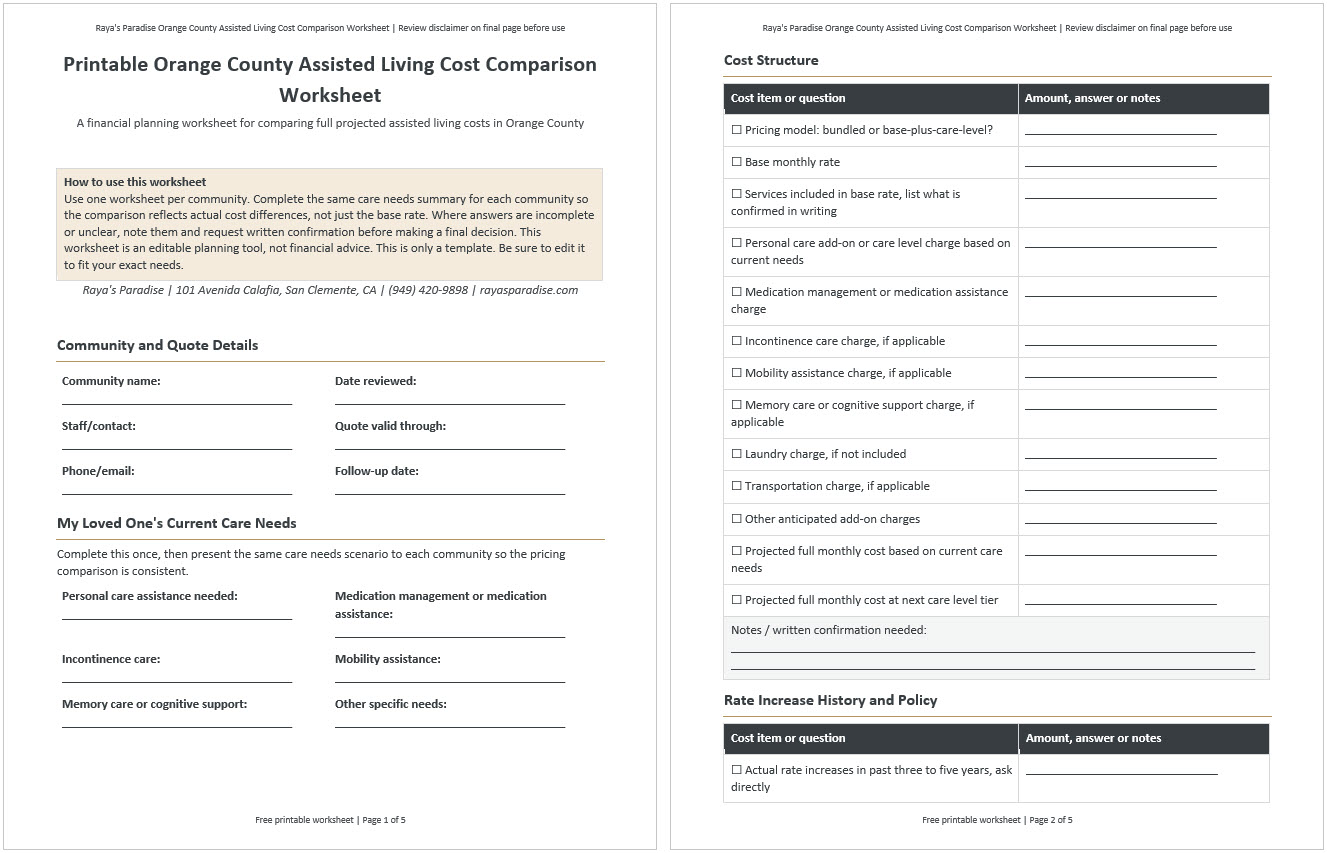
The base monthly rate is rarely the full cost of assisted living in Orange County. It is where the cost conversation starts. Many communities in OC use a tiered or a la carte pricing structure where personal care assistance, medication management or medication assistance, incontinence care, laundry, transportation and other services are either billed separately or added as care level charges on top of the base rate.
Two communities with similar base rates can differ by several hundred or even a few thousand dollars per month once the full care picture is factored in.
This checklist is designed for families who are in the financial evaluation and decision-making phase. It covers what to understand about Orange County assisted living costs, what California law requires communities to disclose, what Medicare and Medi-Cal do and don’t cover, and the specific questions to ask before committing to any community.
This page does not constitute financial, legal or benefits advice. Medicare, Medi-Cal and other program rules change and families should verify current eligibility and coverage with a licensed benefits counselor, elder law attorney or the California State Health
Insurance Assistance Program (SHIP) before making decisions based on program eligibility.
Have questions about pricing at Raya’s Paradise? Schedule a private tour and our care team will walk you through how our pricing is structured.
Key Takeaways
- The base monthly rate is a starting point. The full projected cost, including care level add-ons and anticipated services, is what families need to budget.
- California law requires RCFE admission agreements to disclose key fee, billing, refund and rate-change terms. Families should ask to take the admission agreement home and review it before signing.
- Medicare generally does not cover assisted living room, board and personal care costs. Families should verify current coverage rules with a licensed benefits counselor.
- Medi-Cal’s Assisted Living Waiver is available in Orange County as of 2026, but eligibility is strict, waiting lists are significant and not all RCFE communities participate. Verification with a Care Coordination Agency is essential before relying on this program in financial planning.
- Rate increase history is one of the most important financial questions to ask. A community with a lower base rate and a pattern of larger annual increases may cost more over a multi-year stay than one with a higher starting rate and more modest annual adjustments.
- Understanding the discharge conditions in the admission agreement is as important as understanding the monthly cost. Know under what circumstances a resident could be asked to leave and what notice would be provided.

How Orange County Assisted Living Costs Are Structured
Many Orange County assisted living communities use one of two pricing approaches, and understanding which model a community uses is the first step in any cost comparison.
The first model is an all-inclusive or bundled pricing structure where one monthly rate covers a defined set of services. This model is more common in smaller residential RCFEs and can make cost comparison more straightforward, though the definition of what is and isn’t included still varies between communities and should be confirmed in writing.
The second model is a base-plus-care-level structure where a base rate covers housing, meals and basic supervision, and personal care services are added in tiers or a la carte based on the resident’s assessed needs. This model is common in larger assisted living communities and in communities that serve a wide range of care levels. Two residents living in the same community can have very different monthly costs depending on their care level tier.
Common add-on charges in the second model include assistance with bathing and dressing, medication management or medication assistance, incontinence care and supplies, mobility assistance, laundry, transportation to medical appointments and specialized programming for dementia. The cumulative impact of add-on charges can be substantial. A community with a seemingly manageable base rate may cost substantially more once the resident’s actual care needs are reflected in the full fee structure.
For a detailed overview of current cost benchmarks and what families in the greater LA and OC area are paying, see the assisted living cost guide for the Los Angeles and Orange County area.
Cost Structure Checklist
- ☐ Does this community use a bundled or base-plus-care-level pricing structure?
- ☐ What specific services are included in the base monthly rate?
- ☐ What services are billed separately or as care level add-ons?
- ☐ What are the specific rates for each add-on or care level tier?
- ☐ Based on my loved one’s current care needs, what is the realistic projected full monthly cost?
- ☐ How is the care level assessed and by whom?
- ☐ How often is the care level reassessed and what triggers a reassessment?
- ☐ If care needs increase, how are additional charges assessed and communicated to the family?

California RCFE Pricing Disclosure Requirements
Cost transparency in California assisted living is not a courtesy. It is a legal requirement under Title 22. RCFE admission agreements must disclose key fee, billing, refund and rate-change terms before a resident moves in. California RCFE admission agreements must explain how rates may be changed and what notice applies.
Ask to receive and review the admission agreement before committing, and consider having it reviewed by an elder law attorney or senior living advisor. Any community that pressures you to sign without time to review is exhibiting a red flag worth taking seriously.
The admission agreement is the governing document for a resident’s stay and it should be read carefully.
Key sections to review include the complete fee schedule and what each charge covers, how and when rates may be increased, the circumstances under which a resident may be asked to leave, what notice is required before discharge, the refund policy for prepaid fees and deposits, and how disputes or concerns are handled.
If the language in any of these sections is unclear or vague, ask for clarification in writing before signing. An elder law attorney or senior living advisor can review the agreement if needed.
California Contract and Disclosure Checklist
- ☐ Has the community provided a complete written fee schedule?
- ☐ Has the community provided the full admission agreement for review before any commitment?
- ☐ Does the admission agreement clearly disclose how and when rates may increase?
- ☐ Does the agreement specify what notice is required before a rate increase takes effect?
- ☐ Are the discharge conditions clearly stated, including what circumstances would require a resident to leave and what notice is required?
- ☐ Is the refund policy for deposits and prepaid fees clearly explained?
- ☐ Have you had adequate time to review the agreement without pressure to sign?
- ☐ If contract language is unclear, have you requested written clarification or consulted an elder law attorney

What to Ask About Rate Increases and Long-Term Cost Planning
The base rate a community quotes today is not the rate a family will pay in year two or year three. Most Orange County assisted living communities adjust rates annually, and the pattern and size of those increases has a significant effect on the total cost of a multi-year stay.
A community with a lower starting rate but a pattern of larger annual increases may cost more over time than one with a higher initial rate and more modest adjustments.
California RCFE admission agreements are required to disclose rate-change terms, but the specific language varies between communities. Some contracts specify a maximum percentage increase or a notice period. Others are more open-ended.
Understanding the actual history of rate increases at a specific community, not just the policy language in the contract, gives families a more realistic picture of what they’re committing to financially.
It’s also worth asking directly about what would happen financially if a resident’s care needs increase significantly and a higher care level tier is required. The impact on monthly cost of a care level change can be as significant as an annual rate increase, and families are sometimes surprised by care level adjustments that were not clearly explained during the admissions process.
Rate Increase and Long-Term Cost Checklist
- ☐ What has the community’s actual history of annual rate increases been over the past three to five years?
- ☐ Is there a cap on annual rate increases specified in the admission agreement?
- ☐ What notice is the community required to give before a rate increase takes effect?
- ☐ How are care level adjustments communicated to families and how much notice is provided before additional charges begin?
- ☐ What is the realistic projected full monthly cost at a higher care level if my loved one’s needs increase?
- ☐ Based on current rate history, what might the monthly cost look like in year two and year three of residency?
- ☐ Is there a separate rate increase process for base rate versus care level charges?

What Medicare Covers in Assisted Living and What It Doesn’t
Medicare is one of the most commonly misunderstood parts of assisted living financial planning. Many families begin their search assuming Medicare will cover a substantial portion of assisted living costs. In most circumstances, it does not.
Medicare generally does not cover the ongoing cost of assisted living room, board and personal care services. These are considered custodial or long-term care services, which fall outside Medicare’s primary purpose as a health insurance program.
Medicare may cover certain short-term skilled nursing or rehabilitation services, some physician visits, certain medications under Part D and specific home health or therapy services under defined circumstances. However, this coverage is not tied to a resident’s assisted living placement and does not extend to the cost of care provided by the assisted living facility itself.
The distinction between what Medicare covers and what the assisted living community provides is important and worth clarifying directly with a licensed benefits counselor. Rules can change and coverage specifics depend on the individual’s Medicare plan, care circumstances and the services involved.
The State Health Insurance Assistance Program (SHIP) in California, operated through the California Department of Aging, provides free Medicare counseling and is a reliable starting point for families trying to understand what their specific coverage includes.
Medicare Coverage Checklist
- ☐ Confirmed with a licensed benefits counselor that Medicare does not cover this community’s room, board and personal care charges
- ☐ Understood what short-term Medicare-covered services might be available and under what circumstances
- ☐ Contacted SHIP (California State Health Insurance Assistance Program) for free Medicare counseling if needed
- ☐ Reviewed what Part D prescription drug coverage applies and whether the community can accommodate that coverage structure
- ☐ Confirmed whether any Medicare Advantage plan the resident holds has benefits related to assisted living or personal care services

Medi-Cal and the Assisted Living Waiver in Orange County
California’s Medi-Cal Assisted Living Waiver (ALW) is a home and community-based service program that allows Medi-Cal to help pay for care and services for eligible low-income seniors in licensed RCFEs, including communities in Orange County. Orange County is among the 15 California counties where the ALW is currently available, with the current federal waiver approved through February 2029.
There are several important limitations families need to understand before relying on the ALW in their financial planning.
First, the ALW covers care and services provided by the RCFE or home health agency but does not cover room and board. Participants must have sufficient income to cover their own housing costs or the facility’s room and board rate.
Second, eligibility is strict. Applicants must have full-scope Medi-Cal with no share of cost, must require an institutional level of care and must meet current income and asset requirements. Rules in this area change and families should verify current eligibility requirements with a licensed benefits counselor or Care Coordination Agency.
Third, and most importantly for practical planning purposes: significant waiting lists exist. As of December 2025, approximately 18,365 persons were on the ALW waiting list statewide. Because DHCS updates enrollment and waitlist information monthly, families should verify the current waitlist before making placement decisions. Families should not assume ALW availability when making near-term placement decisions without first confirming current waitlist status and a specific community’s participation in the program.
Not all RCFE communities in Orange County participate in the ALW program. Families considering this program should confirm directly with any community they are evaluating whether they are an enrolled ALW provider and what the current availability and waitlist situation looks like.
This page does not constitute benefits or financial advice. ALW eligibility rules, income limits and program availability can change. Families should contact a California DHCS-approved Care Coordination Agency or a licensed benefits counselor for current, case-specific guidance.
Medi-Cal ALW Checklist
- ☐ Confirmed that this community is an enrolled Medi-Cal ALW provider in Orange County
- ☐ Confirmed current ALW waitlist status with this community or a Care Coordination Agency
- ☐ Consulted a licensed benefits counselor or Care Coordination Agency to assess current ALW eligibility
- ☐ Understood that the ALW covers care and services only, not room and board, and that room and board must be covered by the resident’s own income
- ☐ Verified current income and asset eligibility requirements with a qualified benefits counselor
- ☐ Confirmed that the resident has full-scope Medi-Cal with no share of cost, as required for ALW eligibility
- ☐ Identified alternative financial resources for the period before ALW enrollment, given current waitlist timelines

Other Financial Resources Orange County Families Should Know About
Most Orange County families fund assisted living primarily through private pay, drawing on savings, investment accounts, retirement income and home equity. The national blog article at assisted living costs in Los Angeles and Orange County covers the main funding options in detail. This section provides a brief reference for the financial questions families most commonly encounter during the comparison process.
Long-term care insurance
Some families have long-term care insurance policies that cover a portion of assisted living costs. Coverage terms, daily benefit amounts, elimination periods and inflation protection vary significantly between policies. Families with long-term care insurance should review their policy terms carefully, contact their insurer to understand the claims process and confirm whether specific communities they’re considering are approved providers under the policy.
Veterans benefits
The VA Aid and Attendance benefit provides additional pension income for eligible veterans and surviving spouses who need help with activities of daily living. Eligibility requirements are specific and application processing takes time. Veterans and their families should contact the VA directly or a VA-accredited benefits counselor for current eligibility and application guidance.
SSI and State Supplementary Payment
Eligible California seniors who receive SSI may be able to apply a portion of that income toward assisted living costs. Current SSI and SSP benefit levels and how they interact with RCFE costs should be verified with a benefits counselor, as these amounts change and the application to specific cost structures varies.
Home equity and life insurance options
For families whose primary asset is a family home, proceeds from a sale or a reverse mortgage may fund assisted living costs. Life insurance conversion or policy loans are options some families explore. These are financial decisions with significant implications and families should consult a qualified financial advisor before acting on them.
The California Department of Aging’s SHIP program provides free benefits counseling and is a useful first call for families trying to understand what public programs might be available for a specific situation.
Financial Resources Checklist
- ☐ Reviewed long-term care insurance policy terms and confirmed whether this community is an approved provider
- ☐ Contacted the insurer to understand the claims process and daily benefit applicable to assisted living
- ☐ Consulted a VA-accredited counselor regarding Aid and Attendance eligibility if the resident is a veteran or surviving spouse
- ☐ Confirmed current SSI and SSP benefit levels and how they apply to this community’s cost structure
- ☐ Consulted a qualified financial advisor regarding home equity, life insurance or other asset conversion options if applicable
- ☐ Contacted SHIP for free benefits counseling on Medicare and Medi-Cal coverage questions
- ☐ Identified primary funding source and confirmed estimated runway at projected full monthly cost
- ☐ Identified contingency plan if primary funding source is depleted before end of residency

Financial Questions to Ask Each Orange County Community
These questions are designed to be asked directly to the community’s admissions team or administrator during a tour or follow-up conversation. The goal is not confrontation but clarity.
A community that is confident in its pricing and contract terms will answer these questions readily and specifically. Vague answers, redirects to marketing language or requests to discuss these questions after a commitment is made are worth noting.
Financial Questions Checklist
- ☐ “Can you walk me through the full fee structure? What is included in the base rate and what is billed separately?”
- ☐ “Based on my loved one’s current care needs, what would the realistic projected full monthly cost be?”
- ☐ “Can I have a written itemized fee schedule before our next conversation?”
- ☐ “What specific services are billed as care level add-ons, and at what rates per level?”
- ☐ “What has your actual history of annual rate increases been over the past three to five years?”
- ☐ “Is there a cap on annual rate increases in your admission agreement? What notice is provided before a rate increase takes effect?”
- ☐ “How are care level adjustments handled? How much notice is given and how is the additional cost communicated to the family?”
- ☐ “What is the deposit structure? What is refundable and under what conditions?”
- ☐ “What are the conditions under which a resident could be asked to leave? What notice is required?”
- ☐ “What happens if a resident’s financial resources are depleted during their stay? Is there a policy for this situation?”
- ☐ “Does your community participate in the Medi-Cal Assisted Living Waiver? If so, what is the current enrollment situation?”
- ☐ “Do you accept long-term care insurance? What does the billing process involve and which insurers do you work with?”
- ☐ “Can I take the full admission agreement home to review before making any commitment?”

How to Compare Assisted Living Costs Fairly Across Orange County Communities
Comparing base rates between communities is not a useful cost comparison. Two communities with the same base rate can have projected full monthly costs that differ by a thousand dollars or more depending on how they structure care level charges. The only meaningful comparison is projected full monthly cost, calculated for the same care needs at each community.
To do this effectively, prepare a clear summary of your loved one’s current care needs before requesting pricing from any community. Include the level of personal care assistance needed for bathing, dressing and mobility, medication management or medication assistance requirements, any incontinence care needs, transportation requirements and any specialized programming needs such as memory care support. Present the same care picture to every community you’re seriously considering and ask each one to give you a projected monthly cost based on those specific needs.
Also ask each community to walk you through what would happen to the monthly cost if care needs increase to the next tier. Understanding the cost trajectory at each community, not just the starting point, gives you a more realistic long-term financial picture.
When costs are close between communities after this analysis, rate increase history becomes the tiebreaker. A community with a pattern of larger annual increases may cost meaningfully more over a two or three-year stay. Ask specifically about actual rate increase history, not just the policy language in the contract.
The Orange County Assisted Living Comparison Checklist includes a full side-by-side cost comparison framework as part of its broader community evaluation worksheet.
Cost Comparison Checklist
- ☐ Prepared a clear summary of my loved one’s current care needs to present consistently to each community
- ☐ Requested projected full monthly cost based on specific care needs, not just the base rate, from each community
- ☐ Confirmed which specific services are included and which are billed separately at each community for identical care needs
- ☐ Asked each community for the projected cost at the next care level tier above current needs
- ☐ Asked each community for actual rate increase history over the past three to five years
- ☐ Calculated estimated annual and multi-year projected cost at each community based on current costs and rate history
- ☐ Confirmed deposit structure and refund terms at each community
- ☐ Noted any significant differences in what is included in the base rate at each community that affect the comparison

Printable Orange County Assisted Living Tour Question Worksheet
Use this worksheet to capture and compare cost information across every community you’re seriously considering. Complete the same care needs summary for each community so the comparison is meaningful. Where answers are incomplete or unclear, note them and request written confirmation before making a final decision.
Raya’s Paradise • 101 Avenida Calafia, San Clemente, CA • (949) 420-9898 • rayasparadise.com
Community name: ________________________
Date reviewed: ________________________
Staff/contact: ________________________
Quote valid through: ________________________
Notes: ________________________
My loved one’s current care needs (complete once, present to each community):
- Personal care assistance needed: ________________________
- Medication management or medication assistance: ________________________
- Incontinence care: ________________________
- Mobility assistance: ________________________
- Memory care or cognitive support: ________________________
- Other specific needs: ________________________
Cost Structure
- ☐ Pricing model: bundled or base-plus-care-level?
- ☐ Base monthly rate: $_____________
- ☐ Services included in base rate (list what is confirmed in writing):
- ☐ Personal care add-on or care level charge based on current needs: $_____________
- ☐ Medication management or medication assistance charge: $_____________
- ☐ Incontinence care charge (if applicable): $_____________
- ☐ Mobility assistance charge (if applicable): $_____________
- ☐ Memory care or cognitive support charge (if applicable): $_____________
- ☐ Laundry charge (if not included): $_____________
- ☐ Transportation charge (if applicable): $_____________
- ☐ Other anticipated add-on charges: $_____________
- ☐ Projected full monthly cost based on current care needs: $_____________
- ☐ Projected full monthly cost at next care level tier: $_____________
Rate Increase History and Policy
- ☐ Actual rate increases in past three to five years (ask directly): ________________________
- ☐ Rate increase cap in admission agreement: ________________________
- ☐ Notice required before rate increase: ________________________
- ☐ Care level adjustment notice period: ________________________
Deposit and Refund Terms
- ☐ Deposit amount: $_____________
- ☐ Refundable portion and conditions: ________________________
- ☐ Refund timeline: ________________________
Contract and Discharge Provisions
- ☐ Circumstances under which a resident can be asked to leave: ________________________
- ☐ Notice required before discharge: ________________________
- ☐ Policy if resident’s financial resources are depleted: ________________________
- ☐ Admission agreement taken home for review before signing: yes or no
Financial Program Availability
- ☐ Medi-Cal ALW participation: yes, no, or waitlist status: ________________________
- ☐ Long-term care insurance acceptance: ________________________
- ☐ Insurers currently accepted: ________________________
Long-Term Cost Projection
- ☐ Estimated projected full monthly cost in year one: $_____________
- ☐ Estimated projected full monthly cost in year two (based on rate history): $_____________
- ☐ Estimated projected full monthly cost in year three (based on rate history): $_____________
- ☐ Estimated total two-year cost: $_____________
- ☐ Primary funding source identified and confirmed: ________________________
- ☐ Estimated runway at projected full monthly cost: ________________________
- ☐ Contingency plan if primary funding is depleted: ________________________
Using this worksheet: A fair cost comparison requires the same care needs scenario applied consistently at each community. Base rates alone are not a useful comparison. The communities with the clearest, most specific answers to these questions are demonstrating financial transparency that is in itself meaningful. This worksheet is a planning tool, not financial advice. Families should consult a qualified financial advisor, elder law attorney or benefits counselor for guidance specific to their financial situation.

Ask About Transparent Pricing at Raya’s Paradise in San Clemente, Orange County
Raya’s Paradise at 101 Avenida Calafia in San Clemente is a licensed RCFE serving Orange County families. We offer assisted living, memory care, hospice support in coordination with appropriate providers and short-term respite care, all within a coastal residential setting.
We welcome families who arrive with detailed financial questions. Bring this worksheet when you visit or call. Our team is prepared to walk through this worksheet with you and answer detailed questions about our pricing, care structure and contract process. There is no obligation and no commitment required to have that conversation.
Schedule a private Orange County tour | Explore the Avenida Calafia community
Ask About Transparent Assisted Living Pricing at Raya’s Paradise in San Clemente
A meaningful assisted living cost conversation should go beyond the base monthly rate. It should help your family understand what is included, what may be billed separately, how care level changes affect pricing and what the admission agreement says before you make a decision.
Raya’s Paradise at 101 Avenida Calafia in San Clemente welcomes Orange County families who want clear, detailed answers about assisted living costs, care needs and contract terms. Bring this worksheet with you when you visit or call. Our team can walk through questions about base rates, care level charges, medication support, personal care assistance, deposit terms, refund policies, rate increases and what daily life looks like in our coastal residential setting.
We know families are often comparing several Orange County assisted living communities at once, and we respect that process. You are welcome to take notes, ask follow-up questions and request clarification so you can compare projected full monthly costs, not just starting rates.
There is no pressure and no commitment required. The goal of the conversation is simple: to help your family understand whether Raya’s Paradise is the right fit for your loved one and to give you the financial clarity you need for the next step.
Disclaimer:
This checklist is for informational and educational purposes only and does not constitute medical, legal, financial, benefits or emergency advice. Assisted living costs, program eligibility requirements and regulatory rules vary by individual, community and time and are subject to change. Medicare and Medi-Cal coverage rules, ALW eligibility criteria and program availability should be verified with a licensed benefits counselor, Care Coordination Agency or the California Department of Health Care Services before making any financial planning decisions. Families should consult qualified financial advisors and legal professionals as appropriate. For sudden confusion, serious injury, suspected stroke or immediate danger, call 911.