
Download the Orange County Assisted Living Comparison Worksheet
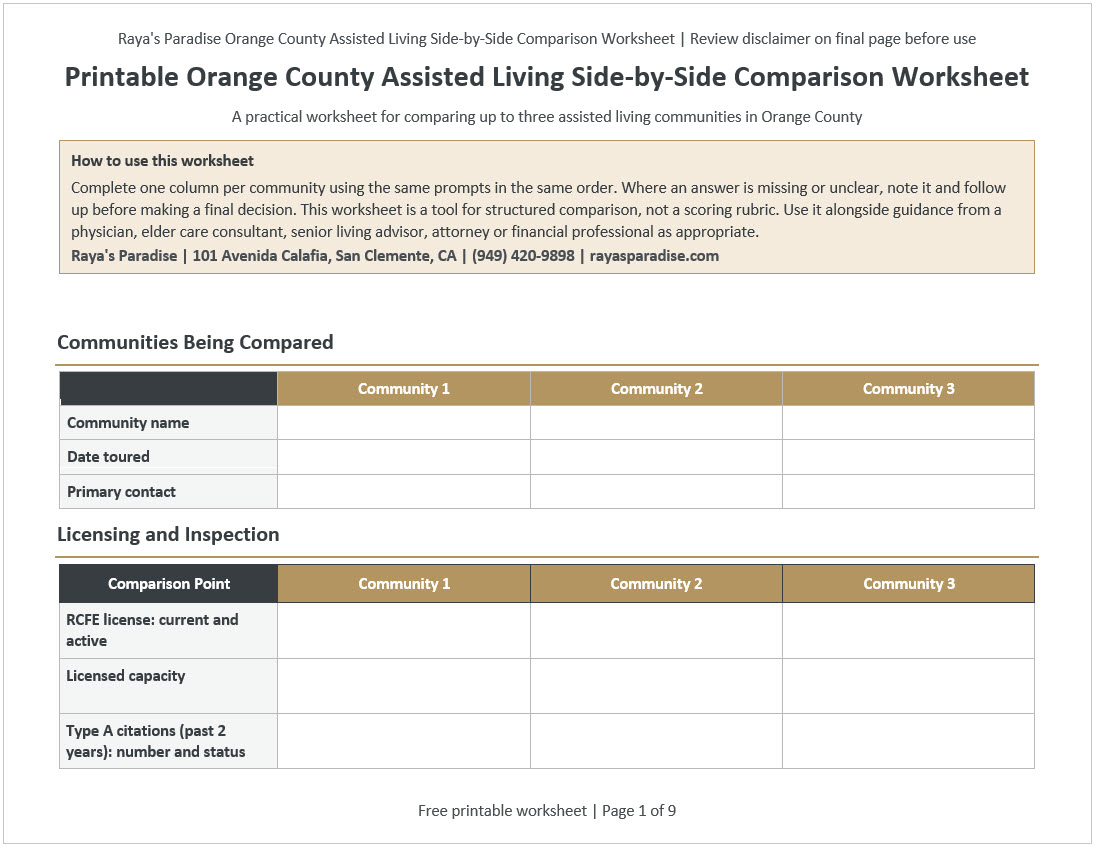
The printable worksheet is designed to be completed one column per community. Bring a fresh copy to each tour, fill it in on site and then lay them side by side when you’re ready to compare.
It covers seven comparison categories: licensing and inspection history, cost and contract structure, care level and staffing, safety and emergency preparedness, daily life and activities, family communication, and overall impressions. The downloadable PDF and Word versions include full side-by-side columns for up to three communities.
Available as a print-ready PDF and an editable Word document so you can edit it, fill it out by hand, type into it digitally or share it with family members helping you compare options.
If you’ve already toured one or more Orange County assisted living communities and are now trying to make a final decision, this page is for you. The evaluation checklist at Orange County Assisted Living Checklist – What Families Should Review Before Choosing a Community covers how to assess any single community in depth. This page does something different: it gives you a structured framework for comparing multiple communities against each other, on the same criteria, so your final decision is based on a consistent evaluation rather than impressions from visits that may have happened weeks apart.
This is the stage where most families struggle. A community that felt warm and personal during a tour may have had higher add-on costs you didn’t fully explore. Another that seemed more institutional may have had a stronger inspection history and more experienced staff. Without a side-by-side framework, these differences get lost in the overall feel of each visit. This checklist is designed to surface them.
One thing this page does not do: duplicate the detailed research guidance in the evaluation checklist. If you haven’t yet verified RCFE licensing records, reviewed inspection reports or worked through the staffing and care plan questions for each community, do that first using the evaluation checklist before coming back here to compare.
Ready to add Raya’s Paradise to your comparison? Schedule a private tour in San Clemente.
Key Takeaways
- Comparing communities on consistent criteria is more reliable than comparing overall impressions from visits that happened at different times under different conditions.
- In practice, families often find meaningful differences in three areas: evening and weekend staffing, the full cost structure beyond the base rate and how proactively each community communicates with families after move-in.
- A community that answers every comparison question confidently and specifically is demonstrating something as meaningful as the answers themselves.
- Return visits at different times of day or on weekends can reveal details that were not obvious during a single formal tour.
- Orange County’s RCFE market includes communities that may look similar on paper but feel very different in daily practice. The comparison framework here is designed to make those differences visible.
- If cost is the deciding factor between two otherwise similar communities, confirm the full projected annual cost, not just the base rate, before treating them as equivalent.
How to Use This Comparison Checklist
This checklist assumes you have already toured at least two communities and gathered information during or after each visit. If you haven’t toured Raya’s Paradise yet and are comparing it with other communities you’ve seen, schedule a tour here so you’re working from firsthand observation rather than website information alone.
For each comparison category below, you’ll find a set of questions to answer for every community you’re seriously considering. Work through the same questions in the same order for each community.
Where you have gaps, note them clearly, and before making a final decision, go back and fill them in with a follow-up call or second visit.
A few things worth knowing before you start. First, differences in how communities answer the same question are often as informative as the answers themselves. A community that answers every staffing question specifically and without hesitation is telling you something different from one that gives vague or deflecting responses.
Second, gut impressions from tours are real data, but they can be misleading when visits happened under different conditions. A Saturday afternoon tour during a community event looks different from a Wednesday morning.
Weight your impressions accordingly. Third, if two communities score similarly across every category and cost is the remaining differentiator, make sure you’re comparing projected annual costs inclusive of all add-ons, not just base rates.

Licensing and Inspection History Comparison
California’s RCFE inspection and citation records are publicly searchable through the CDSS Community Care Licensing facility search. Before finalizing any comparison, pull the record for every community you’re seriously considering.
This is one of the clearest sources of objective, third-party information available to families, and it doesn’t depend on what a community tells you about itself.
When comparing inspection histories, look at the pattern rather than any single citation. A community with one older Type B citation that was promptly corrected is a different situation from a community with multiple Type A citations in the past 18 months.
Also look at the date of the most recent public inspection or visit. A longer gap is not automatically a red flag, but it is worth noting when comparing how current each community’s public record is.
Licensing and Inspection Comparison Questions
- ☐ Is the RCFE license current and active for each community?
- ☐ What is the licensed capacity of each community, and what current occupancy did the community report during your tour or follow-up?
- ☐ How many Type A and Type B citations does each community have on record in the past two years?
- ☐ How recently was each community inspected, and what was the outcome?
- ☐ Has either community had a deficiency-free inspection in the past two years?
- ☐ How did each community respond when asked directly about their citation history?
- ☐ Does either community’s record show a pattern of repeat citations in the same category?
- ☐ Does the public record show complaint-related visits, substantiated complaints or complaint-related citations in the past 12 months?

Cost and Contract Comparison
Cost comparison between Orange County assisted living communities is more complicated than comparing base monthly rates. The base rate is the starting point, not the total.
Most communities in OC use a tiered or a la carte pricing structure where personal care assistance, medication management, incontinence care, laundry, transportation and other services are billed separately or added as care level charges.
Two communities with similar base rates can differ by hundreds or even thousands of dollars per month once the full care picture is factored in.
For a comprehensive guide to understanding and budgeting assisted living costs in Orange County, see the Orange County Assisted Living Cost Checklist. This section focuses specifically on the comparison questions that matter when two or more communities are on your shortlist.
When comparing contracts, pay particular attention to rate increase history and policy. California RCFE admission agreements must disclose key fee, billing, refund and rate-change terms, but the contract language on how and when rates increase varies significantly between communities.
A community with a lower base rate but larger annual increases may cost more over a multi-year stay than one with a higher starting rate and more modest annual adjustments.
Cost and Contract Comparison Questions
- ☐ What is the base monthly rate at each community for the level of care your loved one needs?
- ☐ What services are included in the base rate at each community?
- ☐ What services are billed separately or as care level add-ons, and at what rates?
- ☐ What is the projected full monthly cost at each community, including all anticipated add-ons?
- ☐ What is each community’s history and policy on annual rate increases?
- ☐ What is the deposit structure at each community, and what portion is refundable?
- ☐ Under what circumstances can a resident be asked to leave, and what notice is given?
- ☐ What happens if a resident’s financial resources are depleted? Does either community have a policy for this?
- ☐ Does either community accept long-term care insurance, and what does the billing process involve?
- ☐ Which community’s contract language is clearer and more transparent on fees, changes and discharge conditions?

Care Level and Staffing Comparison
Staffing is the area where the gap between what communities present and what they actually deliver tends to be widest. A well-run tour on a Tuesday afternoon may show a well-staffed, attentive team. That same community at 9 p.m.
on a Saturday may look very different. When comparing communities, the staffing questions that matter most are the ones about off-peak hours, coverage during absences and how staffing changes when a resident’s care needs increase.
California’s Title 22 regulations require RCFEs to maintain sufficient qualified staff to meet resident needs, but do not prescribe a universal caregiver-to-resident ratio. This means staffing levels can vary significantly between communities of similar size, and the only way to compare them is to ask directly.
A community that gives you specific, consistent answers about staffing structure at all hours of the day is a different proposition from one that only speaks to daytime coverage.
Care plan quality is the other staffing-adjacent comparison point worth examining carefully. Ask each community how care plans are developed, who contributes to them and how often they are reviewed.
The depth and specificity of those answers tells you a great deal about how individualized care actually is in practice versus on paper.
Care Level and Staffing Comparison Questions
- ☐ What is the staffing structure at each community during the day, evening, overnight and on weekends?
- ☐ Is an awake staff member present overnight, and under what resident-care circumstances is awake-night staffing required or provided?
- ☐ How does each community handle a caregiver absence? Is there a consistent backup coverage plan?
- ☐ How are care plans developed at each community, and who is involved in the process?
- ☐ How often are care plans formally reviewed and updated at each community?
- ☐ What happens at each community if a resident’s care needs increase beyond what their current care level covers?
- ☐ Do the same caregivers typically work with the same residents at each community?
- ☐ What is the average caregiver tenure at each community? Has turnover been a recent issue? (Ask the community directly.)
- ☐ What dementia-specific training have caregivers completed at each community?
- ☐ Which community gave more specific, confident answers to staffing questions?
Safety and Emergency Preparedness Comparison
Most safety comparisons between assisted living communities focus on physical features: grab bars, call systems, fall prevention. Those matter, but in Orange County they are table stakes.
The more meaningful safety comparison is in emergency preparedness, specifically how each community’s emergency plan accounts for the specific risks of its geographic location.
San Clemente and South OC coastal communities face a different set of emergency scenarios than inland Orange County communities. Wildfire evacuation routes, road closure contingencies and coastal infrastructure vulnerabilities are real considerations that vary meaningfully by location.
A community’s emergency preparedness plan should reflect those specifics, not just generic fire and earthquake protocols. Ask each community whether their Emergency Disaster Plan has been reviewed or updated in the past 12 months and what their evacuation plan looks like for residents with mobility limitations or dementia.
Fall documentation and reporting is the other safety comparison point that families rarely examine. Ask each community how falls are documented, when families are notified and when incidents are required to be reported to California Community Care Licensing. Inconsistency or vagueness in these answers is worth noting.
Safety and Emergency Preparedness Comparison Questions
- ☐ What physical safety features are present in resident rooms, hallways and bathrooms at each community?
- ☐ What is each community’s fall risk assessment process and fall prevention protocol?
- ☐ How does each community document falls, notify families and determine when a physician or licensing agency must be contacted?
- ☐ Does each community have a current Emergency Disaster Plan on file, and when was it last reviewed?
- ☐ How does each community’s emergency plan address wildfire and earthquake scenarios specific to their location?
- ☐ How does each community manage extended power outages, including lighting, refrigeration, medications and resident safety?
- ☐ How are residents with dementia or mobility limitations managed during an emergency evacuation at each community?
- ☐ Which community gave more specific and confident answers to emergency preparedness questions?

Meals, Activities and Daily Life Comparison
Daily life comparison is the area that is most influenced by subjective impression and most difficult to evaluate consistently. Two families can visit the same community on different days and come away with significantly different impressions of resident engagement, meal quality and staff warmth.
The goal of this comparison section is to anchor those impressions to consistent observation criteria so you’re comparing the same things at each community.
One observation worth making deliberately: how residents behave when they are not being engaged by staff. In a community where residents are genuinely comfortable and connected, you will see informal interaction, residents moving through common spaces independently and staff pausing to speak with residents they encounter in passing.
In a community where daily life is more institutional, residents tend to cluster in designated areas and staff tend to be task-focused. This distinction is visible during a tour but easy to miss if you’re focused on the formal presentation.
Meals are worth evaluating with the same rigor as any other category. Ask to see that week’s menu and, if possible, stay for a meal or arrive during a mealtime.
The dining environment, the food quality and how staff interact with residents during meals are among the most reliable quality-of-life indicators available during a visit.
Meals and Daily Life Comparison Questions
- ☐ What did you observe about resident engagement and comfort during your tour of each community?
- ☐ How did staff interact with residents in unscripted moments at each community?
- ☐ What were the dining environment and meal quality like at each community?
- ☐ How does each community’s activities programming match your loved one’s actual interests?
- ☐ How are outdoor spaces used at each community, and what is their condition?
- ☐ How does each community support residents who prefer quieter or less social engagement?
- ☐ What are the housekeeping, laundry and personal care schedules at each community, and how flexible are they?
- ☐ Can residents personalize their space at each community?
- ☐ What does a typical weekday and weekend look like for a resident at a similar care level at each community?
- ☐ At which community did residents appear more engaged, comfortable and connected to staff?

Family Communication and Visiting Policies Comparison
Family communication quality is one of the strongest predictors of long-term satisfaction with an assisted living placement, and it is one of the areas families are least likely to probe during a tour.
The presentation of a community on a visit can be excellent while the day-to-day reality of post-move-in communication is inconsistent, slow or reactive rather than proactive.
In Orange County, where many family caregivers live 20 to 60 minutes from a parent’s community, or in some cases are visiting from out of state, the reliability of communication from the care team has a direct effect on how much anxiety a family carries about the placement.
Proactive communication, where a community reaches out to families with updates rather than waiting to be asked, is meaningfully different from reactive communication, where families have to call regularly to find out how a parent is doing.
When comparing communities on communication, pay attention not just to what they say their communication process is but to how they communicate with you during the comparison process itself. A community that responds to follow-up questions quickly, completely and without being prompted is demonstrating its communication culture directly.
Family Communication Comparison Questions
- ☐ How does each community notify families when a resident’s condition changes?
- ☐ What is each community’s protocol for notifying families after a fall, incident or hospitalization?
- ☐ Who is the primary family contact at each community and how quickly do they typically respond?
- ☐ What are the visiting policies at each community, and how does each accommodate visits at different times of day while protecting resident privacy and safety?
- ☐ How does each community involve families in care plan reviews?
- ☐ What is the formal grievance or complaint process at each community?
- ☐ Does either community use digital tools such as care apps or family portals for updates?
- ☐ How did each community communicate with you during the comparison and follow-up process?
- ☐ Which community’s communication approach gave you more confidence about staying informed after move-in?

What to Ask After Your Tours Before Making a Final Decision
Once you’ve toured and gathered information from each community, there are typically a handful of questions left unanswered or only partially addressed. Before making a final decision, go back and get clear answers to any of the following that you don’t already have.
If you are seriously considering Raya’s Paradise, our care team at 101 Avenida Calafia in San Clemente is available to answer any of these questions directly and without obligation.
We welcome families who are actively comparing communities and want to ask the difficult questions before committing to any placement. You can also review the full questions to ask when touring checklist for a complete tour worksheet.
Post-Tour Follow-Up Questions
- ☐ Can you speak with a current resident’s family member who has agreed to serve as a reference?
- ☐ Can you return for a second visit at a different time of day or on a weekend?
- ☐ Can you review the full admission agreement before making a final commitment?
- ☐ What is the anticipated wait time for a room at each community, and does either have immediate availability?
- ☐ What is the average length of resident stay at each community? (Ask the community directly.)
- ☐ Has either community had significant leadership or ownership changes in the past two years?
- ☐ How does each community handle end-of-life transitions and hospice coordination?
- ☐ Does the public record show any pending regulatory actions or complaint-related citations?
- ☐ What has changed at each community in the past 12 months, including staffing, ownership, programming or physical improvements?
Orange County-Specific Comparison Considerations
A few comparison factors matter specifically in Orange County and are worth weighing deliberately rather than leaving them in the background.
Geography and family proximity. South Orange County covers a wide geographic area, and the difference between a community in San Clemente and one in Mission Viejo can be 30 or more minutes of driving time depending on traffic.
For families who visit regularly, this distance compounds over time. A community that is genuinely more convenient for the people who will be visiting most often is worth factoring into the comparison, particularly if other evaluation criteria are close.
Community scale and environment. Orange County’s RCFE market spans a wide range of settings, from small residential homes serving a handful of residents to larger campus communities serving dozens. The right scale depends on your loved one’s personality and care needs, not on what looks most impressive during a tour.
A parent who values privacy, quiet and close staff relationships may thrive in a smaller residential setting. A parent who is social and enjoys structured programming may prefer a larger community with more on-site activity.
Coastal climate and outdoor access. For communities in the coastal South OC area, including San Clemente and Dana Point, access to outdoor space and natural light is a meaningful quality-of-life factor.
A community where residents have regular, safe access to outdoor space offers something genuinely different from a community where outdoor areas are ornamental rather than functional. During your comparison, weigh how each community actually uses its outdoor environment, not just whether one exists.
Emergency geography. Wildfire evacuation routes in Orange County are not all equivalent. Communities in different parts of the county have different proximity to evacuation corridors and different road closure risk profiles.
If emergency preparedness is a priority in your comparison, ask each community specifically about its evacuation logistics in a road closure scenario relevant to their location.

Printable Orange County Assisted Living Side-by-Side Comparison Worksheet
Use this worksheet to compare up to three communities side by side. The downloadable PDF and Word versions include labeled columns for Community 1, Community 2 and Community 3.
For the on-page version below, note your responses for each community separately. Where answers are missing or unclear, note them and follow up before making a final decision.
Raya’s Paradise • 101 Avenida Calafia, San Clemente, CA • (949) 420-9898 • rayasparadise.com
| Comparison Point | Community 1 | Community 2 | Community 3 |
| Community Information | |||
| Community name | |||
| Date toured | |||
| Contact person | |||
| Licensing and Inspection | |||
| RCFE license: current and active | |||
| Licensed capacity | |||
| Type A citations (past 2 years): number and status | |||
| Type B citations (past 2 years): number and status | |||
| Most recent inspection date and outcome | |||
| Complaint-related visits or citations in public record | |||
| Community response when asked about citation history | |||
| Cost and Contract | |||
| Base monthly rate | |||
| Services included in base rate | |||
| Key add-on or care level charges | |||
| Projected full monthly cost | |||
| Annual rate increase policy and history | |||
| Deposit amount and refund terms | |||
| Discharge conditions and required notice | |||
| Long-term care insurance accepted | |||
| Contract reviewed before signing | |||
| Care Level and Staffing | |||
| Daytime staffing structure | |||
| Evening and overnight staffing structure | |||
| Weekend staffing structure | |||
| Awake overnight staff: confirmed and circumstances | |||
| Absence coverage plan | |||
| Care plan development and review process | |||
| Care escalation process | |||
| Staff continuity and assignments | |||
| Caregiver tenure and turnover (ask directly) | |||
| Dementia care training confirmed | |||
| Safety and Emergency Preparedness | |||
| Fall prevention features observed | |||
| Fall documentation and family notification process | |||
| Emergency Disaster Plan: on file and last reviewed | |||
| Wildfire and earthquake evacuation protocols | |||
| Power outage management plan | |||
| Meals, Activities and Daily Life | |||
| Resident engagement observed during tour | |||
| Staff-resident interaction (unscripted moments) | |||
| Dining environment and meal quality | |||
| Activities programming match for your loved one | |||
| Outdoor space: condition and actual resident use | |||
| Room personalization allowed | |||
| Family Communication | |||
| Health change notification process | |||
| Fall and incident notification protocol | |||
| Primary family contact and response time | |||
| Visiting policies confirmed | |||
| Care plan review participation confirmed | |||
| Grievance process confirmed | |||
| Responsiveness during comparison process | |||
| Post-Tour Follow-Up | |||
| Family reference (with consent) available | |||
| Second visit at different time: completed or scheduled | |||
| Admission agreement reviewed before signing | |||
| Room availability and wait time | |||
| Average resident length of stay (ask directly) | |||
| Leadership or ownership changes in past 2 years | |||
| End-of-life and hospice coordination process | |||
| Recent changes in past 12 months (staffing, ownership, programs) | |||
| Overall Impressions and Decision | |||
| First impression on arrival (cleanliness, smell, noise, resident activity) | |||
| Confidence in administrator and care team | |||
| Comfort level with how questions were answered | |||
| Would your loved one be comfortable here? | |||
| Unresolved concerns or red flags | |||
| Top choice today | |||
| Biggest unresolved concern before deciding | |||
| Follow-up needed before deciding | |||
| Second visit scheduled | |||
| Physician, advisor or family review needed | |||
Using this comparison: A community that answers every category confidently, specifically and without deflection is demonstrating something meaningful beyond the content of its answers. Differences in how communities respond to the same questions are often as informative as the answers themselves.
This worksheet is a tool for structured comparison, not a scoring rubric. Use it alongside guidance from a physician, elder care consultant or senior living advisor as appropriate.

Add Raya’s Paradise to Your Comparison
Once you’ve worked through this checklist across multiple communities, you’ll be in a position to make a comparison that’s grounded in consistent criteria rather than impressions from visits that happened weeks apart.
Raya’s Paradise at 101 Avenida Calafia in San Clemente is a licensed RCFE serving Orange County families. Our care team is available to answer questions about our community, our care approach and our licensing history. We welcome families to visit more than once, ask difficult questions and take the time they need to make a confident decision. Schedule a private Orange County tour here, or explore the Avenida Calafia community before you visit.
You can also browse the broader assisted living in Orange County page for an overview of our services and approach, or return to the Orange County senior care hub for the full range of family resources we’ve built for this market.
Schedule a Tour at Raya’s Paradise in San Clemente, Orange County, CA
Raya’s Paradise at 101 Avenida Calafia in San Clemente is a licensed RCFE serving Orange County families. We offer assisted living, memory care, hospice support in coordination with appropriate providers and short-term respite care, all within a coastal residential setting.
We welcome families who are actively comparing communities. Bring this worksheet when you visit. Every question in it is one our care team is prepared to answer, including our licensing history, staffing structure at all hours of the day, care plan process, cost breakdown and emergency preparedness plan.
If you’d like to return for a second visit at a different time of day or on a weekend, we encourage that too.
There is no obligation and no commitment required for a tour. Our goal is to help you make the most informed decision possible, whether or not that decision leads to Raya’s Paradise.
Disclaimer:
This checklist is for informational and educational purposes only and does not constitute medical, legal, financial, regulatory or emergency advice. Assisted living needs, care options and regulatory requirements vary by individual, community and time.
Families should verify current licensing information directly through CDSS and consult qualified healthcare professionals, licensed senior living advisors and legal or financial professionals as appropriate when making care decisions.
For concerns about elder financial exploitation or abuse, contact Orange County Adult Protective Services or a licensed attorney. For sudden confusion, serious injury, suspected stroke or immediate danger, call 911.
Locations & Contact
Corporate Office
Raya’s Paradise, Inc.
1156 N Gardner St.
West Hollywood, CA 90046
(Directions)
Tel: (310) 289-8834
Fax: (323) 851-0375
San Clemente Community
101 Avenida Calafia
San Clemente, CA 92672
(Directions)
Tel: (949) 420-9898
E-mail: Info@RayasParadise.com
Featured by Assisted Living Magazine as one of the best communities in Orange County