
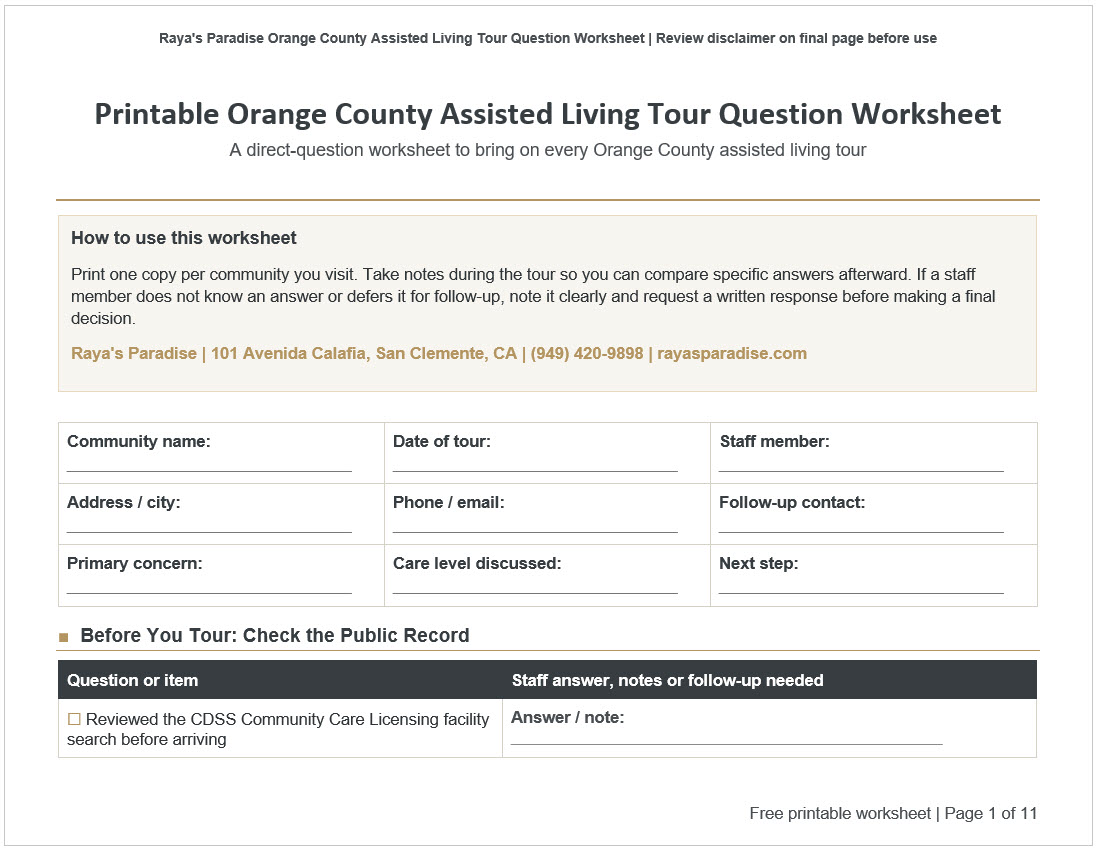
Download the Orange County Assisted Living Tour Question Worksheet
The downloadable worksheet included with this page is a direct-question guide structured for use during a tour. It covers eight question categories: California licensing, care needs and staffing, medication management, safety and emergency preparedness, dementia support, daily life, family communication and costs and contracts. There is space beside each question to record the staff member’s answer and note any follow-up needed.
Available as a print-ready PDF and an editable Word document.
This worksheet is different from the evaluation checklist at Orange County Assisted Living Checklist: What Families Should Review Before Choosing a Community. That page is for independent research, things you verify through public records, observation and background work before or after a tour. This page is a tour worksheet; questions structured for you to ask staff directly, face to face, during a visit to a community you’re seriously considering.
The questions here are written in direct, usable language. They are direct by design. A community with strong operations and a well-trained team should be willing to answer these questions clearly or provide a timely follow-up in writing. A community that becomes evasive, redirects to marketing language or says it will follow up on basic operational questions is giving you important information regardless of what the answers eventually are.
These questions are calibrated for Orange County specifically. California’s RCFE regulatory framework, the 2025 Title 22 updates, and the specific geographic and emergency considerations of South OC communities are all reflected here in ways that generic national tour guides don’t address.
Bringing this worksheet to Raya’s Paradise? Schedule a private tour at our San Clemente community. Our care team is prepared to walk through this worksheet with you and answer detailed questions about our care approach, staffing, licensing, safety and daily life.
Key Takeaways
- The best tour questions are direct and operational, not general. “How does staffing work on Saturday nights?” tells you more than “Do you have good staffing?”
- A community that answers every question on this list confidently and specifically is demonstrating something beyond the content of the answers.
- California-specific questions about RCFE licensing, Title 22 compliance and DOJ background checks are legitimate tour questions. A reputable community should be willing to answer them clearly or provide a timely follow-up in writing.
- Take notes on-site. Impressions from tours fade quickly, and the details that separate communities tend to be in the specifics, not the general presentation.
- If a staff member doesn’t know the answer to a question, note it and ask for a follow-up in writing before making a final decision.
- This worksheet works best when used alongside the evaluation checklist (for research) and the comparison checklist (for post-tour comparison).

Before You Tour – What to Do First
Before you arrive for a tour, take ten minutes to pull the community’s public licensing record through the CDSS Community Care Licensing facility search. Look at the license status, licensed capacity, most recent inspection date and any Type A or Type B citations on file. This gives you specific, factual context before you walk in and means you can ask about anything notable in the record directly rather than relying on the community’s self-presentation.
Also bring a notepad or use your phone to record answers on-site. The questions in this worksheet are designed for real-time use during a visit. The details that matter most, including the specificity of answers, the confidence of the staff member responding and anything that goes unanswered or deferred, are things you want to capture before they blur with the impressions from other tours.
If you haven’t yet worked through the full evaluation checklist for this community, do that before or after your tour using the Orange County Assisted Living Evaluation Checklist. The tour questions here and the evaluation criteria there are designed to be used together.

California Licensing Questions to Ask on Your Tour
Every assisted living community in Orange County operates under a California RCFE license issued by the California Department of Social Services. These questions are not confrontational. They are the kind of basic operational transparency questions that any licensed care provider should be able to answer immediately and without defensiveness.
If a community’s staff member doesn’t know its own licensed capacity, hasn’t heard of the 2025 Title 22 updates or can’t tell you when the most recent unannounced inspection took place, note those gaps. They don’t necessarily indicate problems, but they do indicate how well the team understands its own regulatory context.
Licensing Questions
- “Is your RCFE license current and active? What is your licensed resident capacity?”
- “Does your administrator hold a current California RCFE administrator certificate?”
- “When was your most recent unannounced inspection by the California Community Care Licensing Division, and what was the outcome?”
- “Have you had any Type A or Type B citations in the past two years? If so, can you tell me what they were and how they were resolved?”
- “How has your community implemented the 2025 updates to California’s Title 22 RCFE regulations, particularly the dementia care and behavioral care planning changes?”
- “Are all staff background-checked through California DOJ LiveScan?”
- “If we want to bring in hospice services at some point, does your community have the appropriate hospice waiver and how does that coordination work?”

Care Needs and Staffing Questions to Ask on Your Tour
Staffing is where the most meaningful operational differences between communities live, and it’s the area families are least likely to probe during a tour. The questions below are designed to get past the daytime presentation and into how the community actually operates during the hours when most tours don’t happen.
California’s Title 22 regulations require RCFEs to maintain sufficient qualified staff to meet resident needs but don’t prescribe a universal caregiver-to-resident ratio. That means staffing structures vary significantly and the only way to understand them is to ask directly. A community that gives you confident, specific answers about staffing across all shifts is telling you something important about its operations.
Care plan questions belong in this category too. How a community develops, documents and updates care plans tells you whether individualized care is a genuine practice or a marketing claim. The 2025 Title 22 updates emphasize person-centered, individualized and least-restrictive approaches to dementia care and behavioral expressions, so it is reasonable to ask how those principles show up in each resident’s care plan.
Care and Staffing Questions
- “Can you walk me through how staffing is structured during the day, evenings, overnight and on weekends? Are those numbers consistent or do they vary?”
- “Is there always an awake staff member present overnight? Under what resident-care circumstances is that required or provided here?”
- “If a caregiver calls out sick on a Saturday night, what happens? Is there a consistent coverage plan?”
- “How do you develop a care plan for a new resident? Who is involved in that process?”
- “How often are care plans formally reviewed and updated, and who initiates that when a resident’s needs change?”
- “If my parent’s care needs increase significantly after move-in, what happens? Is there a point at which the community could no longer meet those needs?”
- “Do the same caregivers typically work with the same residents? How is continuity handled?”
- “How long have your current caregivers been with the community? Has there been significant turnover recently?”
- “What training do caregivers complete when they start, and what ongoing training is required?”

Medication Management Questions to Ask on Your Tour
Medication management is one of the most concrete indicators of care quality in an assisted living setting, and it’s an area where meaningful variation exists between communities.
Under California Title 22, RCFEs are residential care settings, not skilled nursing facilities. Medication support should be handled according to each resident’s physician orders, the facility’s policies, staff training and applicable licensing rules.
Ask these questions directly and listen for specificity. A vague answer about medication management, one that uses general language like “we take great care of medications” without describing the actual process, is worth following up on. The process should be specific, documented and consistently applied.
Medication Questions
- “Who is responsible for medication assistance here, and what is that person’s training and qualification?”
- “How are medications stored, tracked and assisted with? Can you walk me through the actual process?”
- “How do you document each medication assistance interaction, and who reviews those records?”
- “What happens if a resident refuses a medication? What is the protocol?”
- “How do you handle a medication error? What is the process for documentation and notification?”
- “If my parent’s physician changes a medication or dosage, how does that update get communicated and implemented here?”
- “Are there any medications or medication types that the community is not able to manage? If so, what would that mean for my parent’s placement here?”
- “How do you coordinate with a resident’s primary care physician around medication concerns or changes?”

Safety and Emergency Preparedness Questions to Ask on Your Tour
Safety questions during a tour should cover two distinct areas: the physical environment and the emergency preparedness plan. Physical safety features are visible during a walk-through. Emergency preparedness requires direct questions because the plan itself is the important part, not the equipment.
For communities in South Orange County, including San Clemente and surrounding coastal communities, emergency preparedness is a specifically meaningful topic. Wildfire evacuation logistics, road closure scenarios and coastal infrastructure considerations are real planning challenges that communities in this geography should have addressed explicitly. A community whose emergency plan only covers fire drills and earthquake procedures may have gaps worth exploring.
Safety and Emergency Preparedness Questions
- “Can you show me the emergency call system in resident rooms and bathrooms? How quickly are staff expected to respond?”
- “How do you assess fall risk for new residents, and what fall prevention measures are in place throughout the building?”
- “If a resident falls, what is the protocol? When is a physician contacted? When is the family notified? When is Community Care Licensing notified?”
- “Does the community have a current Emergency Disaster Plan on file? When was it last reviewed or updated?”
- “Can you walk me through what would happen in a wildfire evacuation scenario? What is the plan for residents with mobility limitations or dementia?”
- “If there’s a major road closure that cuts off access to or from the community, what is the contingency plan?”
- “What happens during an extended power outage? How are lighting, refrigeration, medications and resident safety managed?”
- “How are residents with wandering tendencies or dementia kept safe? What are the specific protocols?”
- “What is the community’s proximity to the nearest hospital or urgent care center, and how are medical emergencies typically handled?”

Dementia Support Questions to Ask on Your Tour
Even if dementia is not the current diagnosis or primary concern, these questions are worth asking. Alzheimer’s Orange County reports that 164,346 Orange County residents are living with dementia or mild cognitive impairment, and cognitive changes can develop gradually after a move-in. Understanding what a community can support in place, and when a transfer to a dedicated memory care setting would be needed, is a forward-planning question that applies to most assisted living placements.
California’s 2025 Title 22 updates strengthened dementia care requirements significantly, shifting toward person-centered behavioral care planning and individualized assessment rather than diagnosis-based restrictions. Ask how each community has implemented these updates in practice, not just in policy.
Dementia Support Questions
- “If my parent’s cognitive needs increase after move-in, what level of dementia support can you provide in place, and at what point would that change?”
- “What specific dementia care training have your caregivers completed? Is that training updated regularly?”
- “How do you handle behavioral expressions in residents with dementia? What is your approach to person-centered, nonpharmacologic care?”
- “If a medication is being considered for behavioral management, how is that decision made and who is involved?”
- “How do you communicate with families when a resident’s cognitive status changes or a behavioral concern arises?”
- “What does your reassessment process look like when a resident’s dementia progresses? Who initiates it?”
- “If my parent’s dementia needs eventually exceed what this community can support, what does that transition look like?”
- “Do you have secure outdoor spaces available for residents with wandering tendencies?”

Daily Life Questions to Ask on Your Tour
Daily life questions reveal what residents experience between scheduled care interactions, which is most of their time. The best way to evaluate daily life is through direct observation during the tour, but the questions below help surface information that observation alone may not capture, particularly about how programming is matched to individual interests, how meals are actually experienced and what flexibility exists within the daily structure.
For communities in coastal South OC, outdoor access questions are especially meaningful. The climate is one of the genuine advantages of a San Clemente or South OC community, and how a community uses that natural environment in residents’ daily lives is worth understanding directly.
Daily Life Questions
- “Can you walk me through a typical day for a resident at a care level similar to my parent’s?”
- “How are activities matched to individual residents’ interests? Who is responsible for programming and how is it adapted over time?”
- “Can I see this week’s menu? How are meals prepared and how are dietary restrictions accommodated?”
- “Can I stay for a meal or arrive during a mealtime to observe the dining environment?”
- “How do residents access outdoor spaces? How often do residents typically spend time outside?”
- “For a resident who prefers quieter, less social engagement, what does daily life look like? Are residents ever pressured to participate in group activities?”
- “Can residents personalize their room? Are there restrictions on what they can bring?”
- “What does a typical Saturday look like compared to a weekday in terms of programming and staff engagement?”
- “What happens when a resident is having a difficult day emotionally or physically? How is that managed?”

Family Communication Questions to Ask on Your Tour
Family communication quality is one of the most consistent predictors of long-term satisfaction with an assisted living placement and one of the areas where communities differ most significantly in day-to-day practice.
Ask these questions specifically and pay attention to whether the staff member answers in generalities or with real operational detail. “We communicate with families regularly” is not an answer. “We call families within two hours of a fall, and the primary care nurse sends a written summary the following day” is an answer.
For Orange County families who live 30 to 60 minutes from a community in South OC, or who are managing care from out of the area, the reliability of post-move-in communication is not a secondary concern. It is the main thing that determines whether a family feels confident or anxious about a placement.
Family Communication Questions
- “If my parent’s condition changes, how and when will I be notified? Who makes that call and what information will they share?”
- “If my parent falls, even a minor fall, will I receive a call that day? What is the process from incident to family notification?”
- “Who is my primary point of contact on the care team? How quickly do they typically respond to calls or messages?”
- “How do I reach someone if I have a concern at 8 p.m. on a Sunday? Is there a direct contact for non-emergency family questions outside of business hours?”
- “How are care plan reviews scheduled and are family members invited to participate?”
- “If I have a concern about my parent’s care that isn’t being resolved, what is the formal process for raising it?”
- “What does communication look like for family members who live out of the area or can’t visit frequently?”
- “Does the community use any digital tools, apps or family portals to provide updates or care notes?

Pricing and Contract Questions to Ask on Your Tour
California RCFE admission agreements must disclose key fee, billing, refund and rate-change terms. Ask to review the admission agreement before signing or making a commitment, and consider having it reviewed by an attorney or advisor when appropriate. Any community that pressures you to sign before you’ve had time to read and understand the contract is exhibiting a red flag.
The questions below focus on areas where cost structures most often surprise families after move-in: add-on charges, care-level adjustments, rate increase history and what happens when a resident’s financial resources change. For a more comprehensive guide to budgeting and financial planning, see the Orange County Assisted Living Cost Checklist. This page focuses on what to ask directly during a tour.
Pricing and Contract Questions
- “Can you walk me through the full fee structure? What is included in the base monthly rate and what is billed separately?”
- “What would my parent’s projected full monthly cost be based on their current care needs, including all anticipated add-ons?”
- “What specific services are billed as care-level add-ons, and at what rates? For example, is incontinence care included or additional?”
- “How does the community assess and adjust care level, and how does that affect the monthly cost?”
- “What has the community’s history been on annual rate increases? Is there a cap or a standard policy?”
- “What is the deposit structure, and what portion of the deposit is refundable and under what conditions?”
- “What are the conditions under which a resident could be asked to leave? What notice would be provided?”
- “What happens if a resident’s financial resources are depleted during their stay? Does the community have a policy for this?”
- “Can I take the admission agreement home to review before making a commitment? Is that standard practice here?”
- “Does the community accept long-term care insurance? What does the billing process involve?”

Questions to Ask Current Residents and Family Members
Ask the community whether any current residents or family members who have agreed to serve as a reference are available to speak with you during your visit. Many reputable communities can facilitate this when a resident or family member has agreed to serve as a reference, and see it as a positive sign of due diligence. The questions below are designed for informal conversation rather than a formal interview. The goal is not to audit the community through a resident but to get an honest sense of what daily life is like from someone who is actually living it.
Keep resident conversations respectful and avoid asking for private health, financial or family details unless the person volunteers them. If a community cannot facilitate a resident or family reference, ask why and whether a consented reference may be available at another time.
Questions for Residents (conversational)
- “How long have you lived here? What made you choose this community?”
- “What do you enjoy most about daily life here?”
- “Is there anything you wish were different?”
- “Do you feel like the staff knows you and takes your preferences into account?”
- “What is mealtime like? Is the food something you look forward to?”
Questions for Family Members (if available)
- “How long has your family member been here? How was the transition?”
- “How responsive is the care team when you have questions or concerns?”
- “Is there anything you wish you had known before choosing this community?”
- “If you had to do it again, would you choose this community?”

Printable Orange County Assisted Living Tour Question Worksheet
Print one copy of this worksheet per community you’re visiting. Take notes beside each question during the tour so you can compare specific answers afterward. Where a staff member doesn’t know the answer or defers it for follow-up, note it clearly and request a written response before making a final decision.
Raya’s Paradise • 101 Avenida Calafia, San Clemente, CA • (949) 420-9898 • rayasparadise.com
Community name: _________________________ Date of tour: _________________________ Staff member: _________________________
Before You Tour: Check the Public Record
- ☐ Reviewed the CDSS Community Care Licensing facility search before arriving
- ☐ License status confirmed as active
- ☐ Inspection history reviewed; any citations noted for follow-up
California Licensing Questions
- ☐ “Is your RCFE license current and active? What is your licensed resident capacity?”
- ☐ “Does your administrator hold a current California RCFE administrator certificate?”
- ☐ “When was your most recent unannounced CCLD inspection, and what was the outcome?”
- ☐ “Have you had any Type A or Type B citations in the past two years? What were they and how were they resolved?”
- ☐ “How has your community implemented the 2025 Title 22 regulatory updates?”
- ☐ “Are all staff background-checked through California DOJ LiveScan?”
- ☐ “If we need hospice services at some point, does your community have an appropriate hospice waiver and how does that coordination work?”
Care Needs and Staffing Questions
- ☐ “Can you walk me through staffing during the day, evenings, overnight and on weekends?”
- ☐ “Is there always an awake staff member present overnight? Under what circumstances?”
- ☐ “If a caregiver calls out sick on a Saturday night, what happens?”
- ☐ “How do you develop a care plan for a new resident? Who is involved?”
- ☐ “How often are care plans formally reviewed and updated?”
- ☐ “If my parent’s care needs increase significantly after move-in, what happens?”
- ☐ “Do the same caregivers typically work with the same residents?”
- ☐ “How long have your current caregivers been with the community?”
- ☐ “What training do caregivers complete when they start, and what ongoing training is required?”
Medication Management Questions
- ☐ “Who is responsible for medication assistance here, and what is their training?”
- ☐ “How are medications stored, tracked and assisted with? Walk me through the process.”
- ☐ “How do you document medication assistance and who reviews those records?”
- ☐ “What happens if a resident refuses a medication?”
- ☐ “How do you handle a medication error?”
- ☐ “If my parent’s physician changes a medication, how does that update get communicated and implemented?”
- ☐ “Are there medication types the community cannot manage? What would that mean for placement?”
- ☐ “How do you coordinate with a resident’s primary care physician around medication concerns?”
Safety and Emergency Preparedness Questions
- ☐ “Can you show me the emergency call system in rooms and bathrooms? How quickly do staff respond?”
- ☐ “How do you assess fall risk for new residents and what fall prevention measures are in place?”
- ☐ “If a resident falls, what is the protocol for physician contact and family notification?”
- ☐ “Does the community have a current Emergency Disaster Plan? When was it last reviewed?”
- ☐ “Walk me through a wildfire evacuation scenario. What happens for residents with mobility limitations or dementia?”
- ☐ “If a road closure cuts off access to the community, what is the contingency plan?”
- ☐ “What happens during an extended power outage?”
- ☐ “How are residents with wandering tendencies kept safe?”
- ☐ “How are medical emergencies handled and how close is the nearest hospital or urgent care?”
Dementia Support Questions
- ☐ “What level of dementia support can you provide in place, and at what point would that change?”
- ☐ “What specific dementia care training have your caregivers completed?”
- ☐ “How do you handle behavioral expressions in residents with dementia?”
- ☐ “How are medication decisions for behavioral management made and who is involved?”
- ☐ “How do you communicate with families when a resident’s cognitive status changes?”
- ☐ “What does your reassessment process look like when dementia progresses?”
- ☐ “If dementia needs eventually exceed what the community can support, what does that transition look like?”
- ☐ “Do you have secure outdoor spaces for residents with wandering tendencies?”
Daily Life Questions
- ☐ “Walk me through a typical day for a resident at a similar care level.”
- ☐ “How are activities matched to individual residents’ interests?”
- ☐ “Can I see this week’s menu? How are dietary restrictions accommodated?”
- ☐ “Can I stay for a meal or arrive during a mealtime?”
- ☐ “How do residents access outdoor spaces and how often are they typically used?”
- ☐ “For a resident who prefers quieter engagement, what does daily life look like?”
- ☐ “Can residents personalize their room? Are there restrictions?”
- ☐ “What does a typical Saturday look like compared to a weekday?”
- ☐ “What happens when a resident is having a difficult day emotionally or physically?”
Family Communication Questions
- ☐ “If my parent’s condition changes, how and when will I be notified?”
- ☐ “If my parent falls, even a minor fall, will I receive a call that day?”
- ☐ “Who is my primary point of contact and how quickly do they typically respond?”
- ☐ “How do I reach someone at 8 p.m. on a Sunday with a non-emergency concern?”
- ☐ “Are family members invited to care plan reviews?”
- ☐ “What is the formal process for raising a concern about care that isn’t being resolved?”
- ☐ “What does communication look like for family members who live out of the area?”
- ☐ “Does the community use any digital tools or family portals for updates?”
Pricing and Contract Questions
- ☐ “Walk me through the full fee structure. What is included in the base rate and what is billed separately?”
- ☐ “What would my parent’s projected full monthly cost be based on current care needs?”
- ☐ “What services are billed as care-level add-ons and at what rates?”
- ☐ “How does the community assess and adjust care level, and how does that affect cost?”
- ☐ “What has the community’s history been on annual rate increases?”
- ☐ “What is the deposit structure and what is refundable?”
- ☐ “What are the conditions under which a resident could be asked to leave?”
- ☐ “What happens if a resident’s financial resources are depleted?”
- ☐ “Can I take the admission agreement home to review before committing?”
- ☐ “Does the community accept long-term care insurance?”
Current Resident and Family Questions
- ☐ Resident or family reference available with consent: yes or no
- ☐ Resident: “How long have you lived here and what do you enjoy most?”
- ☐ Resident: “Is there anything you wish were different?”
- ☐ Family: “How responsive is the care team when you have questions?”
- ☐ Family: “If you had to do it again, would you choose this community?”
Post-Tour Notes
- ☐ Questions not answered or deferred: noted for follow-up
- ☐ Red flags observed or heard: noted
- ☐ Second visit scheduled: yes or no
- ☐ Admission agreement requested to take home: yes or no
- ☐ Overall impression of staff confidence and transparency
Using this worksheet: A community that answers every question on this list confidently, specifically and without deflection is demonstrating something meaningful beyond the content of the answers. Questions that are deferred, answered vaguely or met with discomfort are worth noting and following up on before making a final decision. This worksheet is a tool for structured evaluation, not a scoring system. Use it alongside guidance from a physician, elder care consultant or senior living advisor as appropriate.

What to Do After Your Tour
Once you’ve toured and have notes from this worksheet, a few next steps will help you make the most of what you gathered.
Follow up in writing on any questions that were deferred or answered vaguely. Ask for a written response before making a final commitment. A community that provided specific answers on-site should have no difficulty confirming them in writing.
If cost is still unclear after the tour, request the full written fee schedule and admission agreement and review them before deciding. Ask to take the admission agreement home and review it at your own pace. If you want a second opinion on the contract, an elder law attorney or senior living advisor can help.
Return for a second visit at a different time of day, ideally an evening or weekend. The impression from a second visit often differs meaningfully from the first.
When you’re ready to compare communities side by side, the Orange County Assisted Living Comparison Checklist gives you a structured framework for making a final decision based on consistent criteria across every community you’ve toured.
And if you haven’t yet toured Raya’s Paradise at 101 Avenida Calafia in San Clemente, schedule a private tour here. Bring this worksheet. Our care team is prepared to answer every question on it.
Bring Your Tour Questions to Raya’s Paradise in San Clemente
A good assisted living tour should give you more than a pleasant walkthrough. It should give you clear answers. Raya’s Paradise at 101 Avenida Calafia in San Clemente welcomes Orange County families who want to ask detailed questions before making a care decision.
Bring this worksheet with you when you visit. Our team can walk through questions about RCFE licensing, staffing during days and nights, medication support, dementia care, safety planning, family communication, pricing and what daily life looks like in our coastal residential setting.
We know families are often comparing several communities at once, and we respect that process. You are welcome to take notes, ask follow-up questions and return for another visit if seeing the community at a different time would help you feel more confident.
There is no pressure and no commitment required. The goal of the tour is simple: to help you understand whether Raya’s Paradise is the right fit for your loved one and to give your family the clarity you need for the next step.
Disclaimer:
This worksheet is for informational and educational purposes only and does not constitute medical, legal, financial, regulatory or emergency advice. Assisted living needs, care options, medication-related decisions and regulatory requirements vary by individual, community and time. Families should verify current licensing information directly through CDSS and consult qualified healthcare professionals, licensed senior living advisors and legal or financial professionals as appropriate when making care decisions. For concerns about elder financial exploitation or abuse, contact Orange County Adult Protective Services or a licensed attorney. For sudden confusion, serious injury, suspected stroke or immediate danger, call 911.