
Edit, Download or Print the Orange County Assisted Living Safety Checklist
The printable checklist on this page covers key safety categories for use during an Orange County assisted living tour, including fall prevention, medication support, emergency preparedness, fire safety, staff response, room and bathroom safety and outdoor spaces. Bring a printed copy to every community you’re seriously considering.
Available as a print-ready PDF and an editable Word document.
This checklist has one focus: physical safety and emergency preparedness.
It is not an evaluation of overall community quality, care levels, staffing philosophy, daily life or cost. Those are covered in the full Orange County Assisted Living Evaluation Checklist and the tour question worksheet. This page is for families who want a dedicated safety lens to apply during a tour, independent of the broader evaluation.
Safety evaluation in an Orange County assisted living community means more than checking for grab bars and call buttons.
It means understanding California’s specific regulatory requirements, asking about the Emergency Disaster Plan and how it accounts for the geographic realities of South OC, confirming that fall prevention goes beyond flooring, and verifying that medication support is documented and tracked.
For communities in San Clemente and the surrounding South OC coastal area, emergency preparedness is not a hypothetical concern.
Wildfire evacuation scenarios, road closure contingencies and earthquake preparedness are real planning requirements that communities in this geography should have addressed specifically. This checklist is calibrated for that environment.
Ready to tour Raya’s Paradise with this checklist? Schedule a private visit at our San Clemente community. Our team is prepared to walk through this checklist with you and answer detailed safety questions or provide timely follow-up when needed.
Key Takeaways
- California RCFEs must maintain a written emergency disaster and mass casualty plan. Under Title 22 Section 87212 and the shelter-in-place or assembly procedures, the plan should address staff responsibilities, evacuation, shelter-in-place or assembly procedures, transportation, communication and relocation arrangements.
- For South OC communities, this plan should address wildfire and earthquake scenarios specific to the community’s location.
- The 2025 Title 22 updates replaced “nonskid” with “slip-resistant” for bathtub and shower floors, and those mats, strips or flooring must be maintained in good condition.
- Families should also evaluate flooring, lighting and trip hazards throughout the community as part of their fall-prevention review.
- California RCFEs generally require a fire clearance or approval from the local fire authority as part of the licensing process. Families can ask when the most recent fire clearance or inspection took place.
- Firearm policies must be disclosed in the admission agreement and enforced under California Health and Safety Code Section 1569.282.
- Fall prevention goes beyond flooring. A community’s fall risk assessment process, lighting standards and incident documentation practices are equally important safety indicators.
- Medication support documentation under California Title 22 is a safety function, not just an administrative one. A community that cannot explain its medication assistance process clearly has a safety gap worth noting.
Why Safety Evaluation Deserves Its Own Checklist
Most families who tour an assisted living community pay attention to how it feels.
Does it feel warm? Does it feel clean? Does it feel like somewhere their parent would be comfortable? These impressions are real and they matter. But they can also mask safety gaps that aren’t visible to a family walking through a well-presented tour.
A community can feel warm and welcoming while having flooring that creates fall risk.
It can have a beautiful outdoor courtyard that is not safely secured for residents with dementia. It can have a cheerful common area and a medication support process that is inconsistently documented. The feeling of a tour and the safety of a community are not the same evaluation.
This checklist is designed to run alongside your general tour impression rather than replace it.
It gives you a specific set of questions and observations focused entirely on safety, so that what you see and hear about the physical environment, emergency planning and care protocols is organized rather than incidental.
Falls are the leading cause of injury among adults 65 and older, and more than one in four older adults falls each year.
A community’s approach to fall prevention is one of the clearest indicators of its overall approach to resident safety. It’s a useful lens through which to evaluate everything else.
Fall Prevention and Flooring
California’s 2025 Title 22 updates replaced “nonskid” with “slip-resistant” for bathtub and shower floors, requiring that mats, strips or flooring in those areas be maintained in good condition.
While this specific update applies to bathing areas, families should also evaluate flooring, lighting and potential trip hazards throughout the community as part of their overall fall-prevention review.
Beyond flooring, fall prevention is a clinical and operational function, not just a physical one.
A community should be conducting individualized fall risk assessments for new residents and updating them when a resident’s condition changes. Ask how they assess fall risk, what they do differently for residents identified as high-risk, and what their protocol is when a fall occurs.
The specificity and confidence of the answer tells you a great deal about how seriously fall prevention is embedded in daily operations rather than listed in a policy document.
Lighting is part of the fall prevention picture too.
Inadequate lighting in hallways, bathrooms and resident rooms at night is a significant fall risk factor. Ask about the community’s overnight lighting standards and whether nightlights or motion-activated lighting are used in resident rooms and bathrooms.
Fall Prevention and Flooring Checklist
- ☐ Bathtub and shower floors have slip-resistant mats, strips or flooring in good condition
- ☐ Flooring throughout hallways and common areas observed for condition and potential trip hazards
- ☐ No large area rugs, runners or loose mats that create trip hazards in any area
- ☐ Handrails or appropriate support features present where needed, especially in hallways, stairs or transition areas
- ☐ Grab bars or appropriate bathroom safety supports present where needed and consistent with the resident population served
- ☐ Adequate lighting in all hallways, common areas and resident rooms
- ☐ Nightlights or motion-activated lighting in resident rooms and bathrooms
- ☐ Clear, unobstructed pathways throughout the facility during the tour
- ☐ Community conducts individualized fall risk assessments: process explained specifically
- ☐ Fall documentation and family notification process explained
- ☐ Community asked: when a resident falls, who is notified and what is the protocol?
Medication Support and Documentation
California RCFEs are residential care settings, not skilled nursing facilities.
Under Title 22, staff may assist with self-administration of medications according to physician orders, facility policy, staff training and applicable licensing rules. Actual medication administration may only be performed by appropriately licensed professionals. The quality of a community’s medication support process is one of the clearest windows into its overall operational safety culture.
A well-run medication support process is specific, documented and consistently applied.
Medications are stored securely. Each assistance interaction is recorded according to facility policy. Missed doses, refusals and errors are documented and communicated. Physician contacts are kept current.
Ask the community to walk you through the actual process rather than describing it in general terms. Specificity indicates real practice. Generalities indicate a community that has the policy but may not have the consistent execution.
For residents with dementia or cognitive impairment, medication support is a particularly significant safety function.
The 2025 dementia-care updates place more emphasis on behavioral expressions, individualized assessment and person-centered care. If medication is being considered for behavioral symptoms, ask who is involved, how the decision is documented and how outcomes are monitored.
Medication Support Checklist
- ☐ Medications stored securely and inaccessible to other residents
- ☐ Medication assistance documentation process explained specifically, not generally
- ☐ Each medication assistance interaction documented according to facility policy
- ☐ Protocol for missed doses or resident refusal explained
- ☐ Protocol for medication errors: documentation and family notification process confirmed
- ☐ Refrigerated medications (if applicable) stored properly and temperature monitoring confirmed
- ☐ Controlled substances: storage and documentation requirements asked about
- ☐ Physician contact list current and accessible to staff
- ☐ For residents with dementia: who is involved in behavioral medication decisions, how are they documented and how are outcomes monitored
- ☐ Community asked: when did you last have a medication-related incident and how was it handled?

Emergency Preparedness – California Requirements and South OC Specifics
California RCFEs must maintain a written emergency disaster and mass casualty plan.
Under Title 22 Section 87212, the plan should address staff responsibilities, evacuation procedures, means of exiting, assembly locations, transportation, communication and relocation arrangements. Families can ask the community to explain the plan and whether a copy or summary is available for review.
For communities in San Clemente and the surrounding South OC coastal area, families should look for a plan that addresses local wildfire, road-closure, earthquake and power-outage realities rather than relying only on generic emergency language.
Wildfire evacuation logistics in South OC are meaningfully different from those in other parts of California.
Communities near coastal bluffs have different geographic considerations than communities further inland.
The I-5 corridor is the primary evacuation route for much of South OC and can become severely congested during a wildfire event. Residents with mobility limitations, dementia or medical equipment dependencies require specific evacuation protocols that should be written out rather than improvised.
Earthquake preparedness is the other South OC-specific consideration.
Southern California’s seismic risk is real and a community’s earthquake protocol, including what happens to residents, medications and essential equipment in a significant seismic event, should be part of the emergency plan.
Power outages are a third emergency category that South OC families should ask about specifically.
Extended power outages affect lighting, refrigeration of medications, communications and residents who depend on powered medical equipment. Ask what the community’s plan is for an extended power outage and whether backup power covers critical systems.
Emergency Preparedness Checklist
- ☐ Emergency disaster and mass casualty plan on file; community asked to explain the plan and whether a summary is available to review
- ☐ Date of most recent Emergency Disaster Plan review or update confirmed
- ☐ Evacuation routes clearly marked throughout the facility
- ☐ Plan addresses wildfire evacuation relevant to this community’s specific location
- ☐ Wildfire evacuation plan accounts for I-5 corridor congestion scenarios
- ☐ Plan addresses residents with mobility limitations during evacuation
- ☐ Plan addresses residents with dementia during evacuation (wandering risk, disorientation management)
- ☐ Earthquake preparedness protocol included in the plan
- ☐ Power outage management plan confirmed: lighting, refrigeration, communications, medical equipment
- ☐ Relocation and assembly protocols explained
- ☐ Community asked: when did you last conduct an emergency drill and what did it cover?
- ☐ Staff emergency training confirmed: how often and what does it cover?
Fire Safety Standards
California RCFEs must be maintained in conformity with State Fire Marshal fire and life-safety regulations.
Local fire authorities are involved in fire clearance and inspection processes, though the approving authority may vary by jurisdiction. Ask the community when their most recent fire clearance or inspection took place and what the outcome was.
A community that cannot recall or does not know the date of its most recent fire inspection is telling you something about its operational awareness.
A community that has a recent clean inspection and can tell you specifically what was reviewed is demonstrating a culture of compliance.
Under Health and Safety Code Section 1569.282, admission agreements must specify all policies concerning the retention or prohibition of firearms by residents.
If the community permits residents to retain firearms, those firearms must be stored in compliance with the requirements of that section. This is a legally required disclosure and a community that is unaware of it may be behind on other compliance matters as well.
Fire Safety Checklist
- ☐ Smoke detectors present and visible in resident rooms, hallways and common areas
- ☐ Fire extinguishers present and current inspection tags visible
- ☐ Emergency exit signs illuminated and clearly visible throughout the facility
- ☐ Sprinkler system or applicable fire-clearance requirements confirmed with the community
- ☐ Community asked: when was your most recent local fire clearance or inspection and what was the outcome?
- ☐ Firearm policy disclosed in the admission agreement as required under California Health and Safety Code Section 1569.282
- ☐ No open flames, candles or prohibited heating devices observed anywhere in the facility
- ☐ Kitchen and laundry areas appear safely maintained and free of fire hazards
Staff Response and Overnight Safety
A community’s physical safety features are only as effective as the staff who respond when they’re needed.
Call button systems, emergency pendants and pull cords matter only if staff respond promptly. The physical environment matters only if someone is alert and present to notice when something goes wrong.
The most meaningful staffing safety questions are the ones about off-peak hours.
A community that is fully and attentively staffed during a weekday tour may have a significantly different overnight or weekend picture. Ask specifically about staffing at night and on weekends. Ask what the expected response time is for an emergency call after midnight.
Ask whether an awake staff member is always present overnight and under what circumstances that is required or provided. A community that answers these questions confidently and with specific information is demonstrating a different level of operational transparency than one that gives general reassurances.
For residents with dementia or wandering risk, overnight staffing and room monitoring take on additional safety significance.
Ask whether the community has specific overnight monitoring protocols for residents with high wandering risk.
Staff Response and Overnight Safety Checklist
- ☐ Emergency call systems (buttons or pendants) confirmed in all resident rooms and bathrooms
- ☐ Response time to emergency calls asked about specifically: daytime, evening and overnight
- ☐ Awake overnight staff presence and circumstances requiring awake-night staffing explained
- ☐ Weekend staffing levels asked about: same as weekdays or reduced?
- ☐ Absence coverage plan confirmed: what happens when a caregiver calls out on a Saturday night?
- ☐ Protocol for a resident medical emergency confirmed: who is called, in what order?
- ☐ Family notification process for nighttime incidents confirmed
- ☐ For residents with dementia: overnight monitoring protocols asked about
- ☐ Proximity to nearest hospital or urgent care confirmed

Resident Room and Bathroom Safety
Bathrooms are one of the highest-risk spaces for falls and injuries in many homes and care settings, so they are worth evaluating carefully during an assisted living tour.
Ask to see an actual resident bathroom, not a model room bathroom, if possible. Look specifically at grab bar placement, shower entry, flooring condition and whether the space is genuinely usable for a person with limited mobility.
Families should confirm that resident rooms and bathrooms are appropriate for the resident’s mobility needs, including bathroom safety supports, safe shower access, adequate lighting and doorways that can accommodate mobility aids when needed.
What matters most is not a universal standard but whether the specific room your loved one would occupy is genuinely safe for their particular mobility and cognitive situation.
For residents with dementia or cognitive impairment, room safety also includes environmental considerations beyond physical hazards.
Clear, simple wayfinding, minimal clutter, familiar orientation cues and good lighting all contribute to safety for residents who may become disoriented in a new environment.
Resident Room and Bathroom Safety Checklist
- ☐ Bathroom safety supports (grab bars or equivalent) present beside the toilet and in the shower or tub
- ☐ Shower or tub has a safe, accessible entry: walk-in shower or transfer bench available
- ☐ Bathroom flooring slip-resistant and in good condition
- ☐ Emergency call cord or button accessible from the bathroom floor, or staff can explain how a resident would summon help after a bathroom fall
- ☐ Doorways wide enough to accommodate a walker or wheelchair where needed
- ☐ Adequate lighting in the room: no dark corners or unlit areas
- ☐ Room free of clutter and furniture arranged for safe movement
- ☐ For residents with dementia: room orientation cues, wayfinding support and room identification confirmed
- ☐ Windows have appropriate safety features: screens, locks or limited opening mechanisms as needed
- ☐ Electrical outlets not overloaded; no unsafe extension cord use observed

Outdoor Spaces and Secured Areas
Outdoor spaces in South OC assisted living communities are genuinely valuable, not ornamental.
San Clemente’s coastal climate, with mild temperatures, marine air and natural light, makes outdoor time a meaningful part of daily wellbeing for residents. A community with safe, accessible and actively used outdoor spaces is providing a meaningful quality-of-life resource that may support movement, orientation, mood and social connection.
Safety evaluation of outdoor spaces focuses on two distinct concerns.
The first is fall and injury risk: are pathways even and slip-resistant, is seating stable, is the space free of trip hazards? The second is secure access for residents with dementia or wandering risk: are outdoor boundaries secured in a way that prevents a resident from exiting to an unsafe area, and how is that security maintained without restricting appropriate access for residents who don’t have wandering risk?
Sun safety is also a South OC-specific consideration.
Year-round sun exposure at this latitude is significant, and communities should have shade structures, seating in covered areas and staff practices around encouraging sun protection during outdoor time.
Outdoor Spaces Checklist
- ☐ Outdoor areas accessible and actually used by residents (not decorative)
- ☐ Pathways slip-resistant and even: no uneven pavers, steps without handrails or drainage issues
- ☐ Seating stable and appropriate for residents with limited mobility
- ☐ No trip hazards (garden hoses, loose gravel, raised thresholds) observed
- ☐ Outdoor boundaries secured: fencing or walls prevent exit to unsecured areas for residents with wandering risk
- ☐ Gate or door security confirmed: locked or alarmed access to prevent unsupervised exit
- ☐ Shade structures or covered seating areas available for sun protection
- ☐ Outdoor lighting adequate for early morning or evening use
- ☐ Staff supervision of outdoor areas confirmed: how is outdoor time managed?

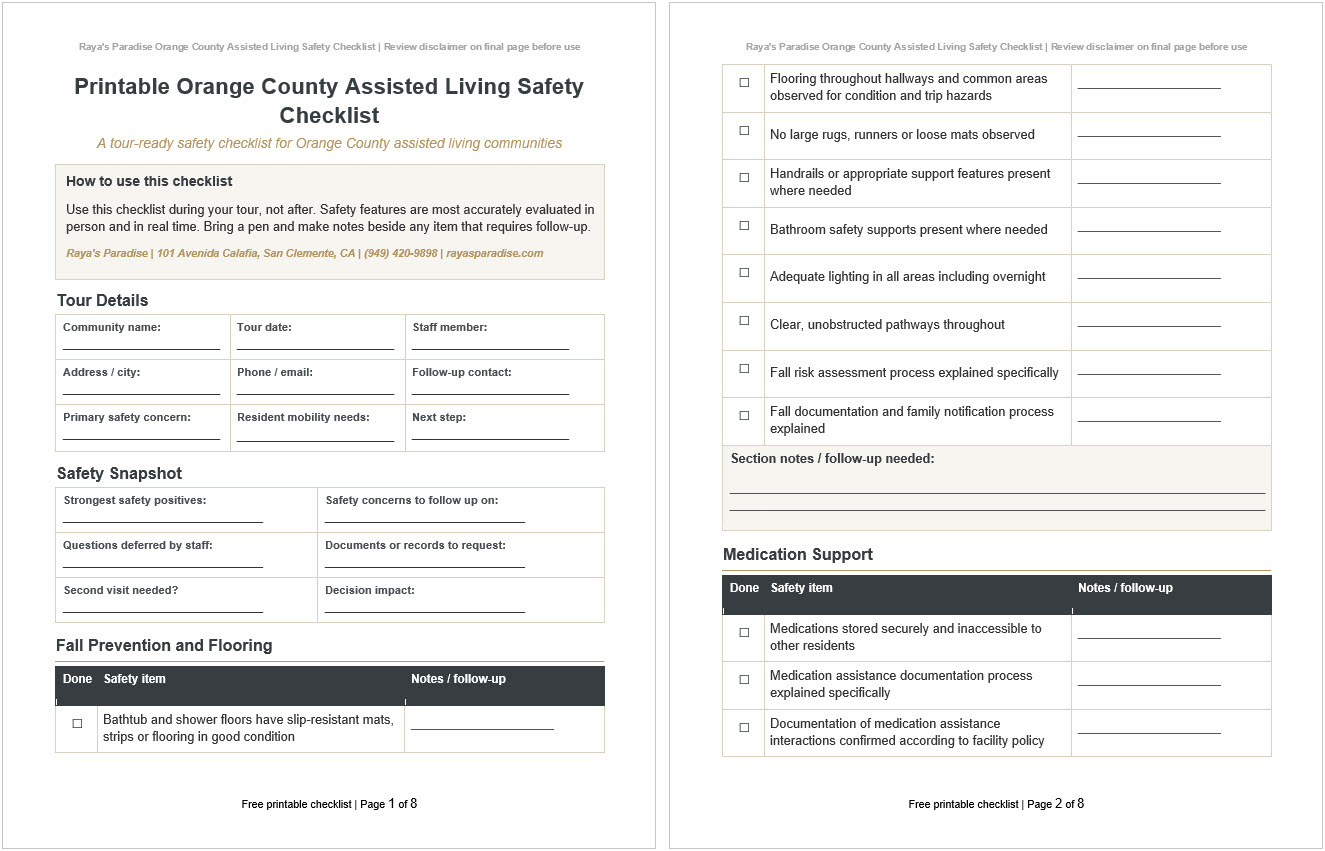
Printable Orange County Assisted Living Safety Checklist
Use this checklist during your tour, not after.
Safety features are most accurately evaluated in person and in real time. Bring a pen and make notes beside any item that requires follow-up.
Raya’s Paradise • 101 Avenida Calafia, San Clemente, CA • (949) 420-9898 • rayasparadise.com
Fall Prevention and Flooring
- ☐ Bathtub and shower floors have slip-resistant mats, strips or flooring in good condition
- ☐ Flooring throughout hallways and common areas observed for condition and trip hazards
- ☐ No large rugs, runners or loose mats observed
- ☐ Handrails or appropriate support features present where needed
- ☐ Bathroom safety supports present where needed
- ☐ Adequate lighting in all areas including overnight
- ☐ Clear, unobstructed pathways throughout
- ☐ Fall risk assessment process explained specifically
- ☐ Fall documentation and family notification process explained
Medication Support
- ☐ Medications stored securely and inaccessible to other residents
- ☐ Medication assistance documentation process explained specifically
- ☐ Documentation of medication assistance interactions confirmed according to facility policy
- ☐ Protocol for missed doses and errors confirmed
- ☐ Refrigerated and controlled substance storage confirmed
- ☐ Physician contact list current and accessible to staff
- ☐ For dementia residents: behavioral medication decision-making and documentation process confirmed
Emergency Preparedness
- ☐ Emergency disaster and mass casualty plan on file; community asked to explain it and whether a summary is available
- ☐ Date of most recent Emergency Disaster Plan review or update confirmed
- ☐ Evacuation routes clearly marked throughout the facility
- ☐ Wildfire evacuation plan specific to this community’s location
- ☐ Wildfire plan accounts for I-5 corridor and road closure scenarios
- ☐ Evacuation protocols for residents with mobility limitations
- ☐ Evacuation protocols for residents with dementia
- ☐ Earthquake preparedness protocol included
- ☐ Power outage management plan confirmed
- ☐ Most recent emergency drill date and content confirmed
Fire Safety
- ☐ Smoke detectors visible in resident rooms, hallways and common areas
- ☐ Fire extinguishers present with current inspection tags
- ☐ Emergency exit signs illuminated and clearly visible
- ☐ Most recent local fire clearance or inspection date and outcome confirmed
- ☐ Firearm policy disclosed in admission agreement per Health and Safety Code Section 1569.282
- ☐ No open flames or prohibited heating devices observed
- ☐ Kitchen and utility areas appear safely maintained
Staff Response and Overnight Safety
- ☐ Emergency call systems confirmed in all resident rooms and bathrooms
- ☐ Response time to emergency calls confirmed: day, evening and overnight
- ☐ Awake overnight staff presence and circumstances requiring awake-night staffing explained
- ☐ Weekend staffing levels confirmed
- ☐ Absence coverage plan confirmed
- ☐ Medical emergency protocol confirmed
- ☐ Family notification for nighttime incidents confirmed
- ☐ Proximity to nearest hospital or urgent care confirmed
Resident Room and Bathroom Safety
- ☐ Bathroom safety supports present beside toilet and in shower or tub
- ☐ Safe shower or tub entry (walk-in or transfer bench)
- ☐ Bathroom flooring slip-resistant and in good condition
- ☐ Emergency call accessible from the bathroom floor or staff can explain how help is summoned after a fall
- ☐ Doorways wide enough for walker or wheelchair where needed
- ☐ Room lighting adequate throughout
- ☐ Room free of clutter; clear pathways
- ☐ No unsafe electrical cord use observed
- ☐ For dementia residents: room orientation cues and wayfinding confirmed
Outdoor Spaces
- ☐ Outdoor areas accessible and actively used by residents
- ☐ Pathways slip-resistant, even and free of trip hazards
- ☐ Seating stable and accessible for residents with limited mobility
- ☐ Boundaries secured for residents with wandering risk
- ☐ Gate or door security confirmed
- ☐ Shade structures or covered seating available
- ☐ Outdoor lighting adequate
- ☐ Staff supervision of outdoor areas confirmed
Using this checklist: Mark each item during your tour.
For any item where the answer is unclear, unsatisfactory or deferred for follow-up, note it and follow up before making a final decision. A community that answers safety questions clearly and specifically, or provides timely follow-up when needed, is demonstrating an operational safety culture that goes beyond what the physical environment alone can show.
Use this checklist alongside the full Orange County Assisted Living Evaluation Checklist for a complete community assessment.

Tour Raya’s Paradise With This Safety Checklist
Raya’s Paradise at 101 Avenida Calafia in San Clemente is a licensed RCFE offering assisted living, memory care, hospice support in coordination with appropriate providers and short-term respite care in a coastal residential setting.
We welcome families who bring detailed safety questions to their tour.
During your visit, our care team can discuss emergency preparedness questions, including wildfire, earthquake and power-outage planning for our San Clemente location.
Our team can also walk you through our fall prevention protocols, medication support process, fire safety systems and overnight staffing structure. We are prepared to walk through this checklist with you and answer detailed safety questions or provide timely follow-up when needed.
There is no obligation and no commitment required for a tour. Schedule a private Orange County tour here, or explore our San Clemente community page before you visit.
For the complete community evaluation framework, see the Orange County Assisted Living Evaluation Checklist, which covers care levels, staffing, costs, contracts and daily life alongside the safety questions on this page.
For a full tour question worksheet, see Questions to Ask Assisted Living Facilities in Orange County.
You can also return to our overview of Orange County’s assisted living options or our hub for personalized senior care in Orange County to find the full range of family resources.
Visit Our Orange County Assisted Living Community
Raya’s Paradise is located at 101 Avenida Calafia in San Clemente, serving families throughout South Orange County, including San Clemente, Dana Point, San Juan Capistrano, Laguna Niguel, Mission Viejo and surrounding coastal communities.
If you are touring communities with a safety checklist in hand, visiting in person gives you the most accurate picture.
Safety features, staff responsiveness and emergency preparedness are best evaluated on-site, not from a website.
During your visit, you can ask about our fall prevention protocols, medication support process, Emergency Disaster Plan, fire safety systems, overnight staffing structure and outdoor spaces.
Bring this checklist. Our team is prepared to walk through every category with you and provide follow-up on anything that requires it.
Use the map to find our San Clemente location, then call (949) 420-9898 or email Info@RayasParadise.com to ask questions or schedule a private tour.
Disclaimer:
This checklist is for informational and educational purposes only and does not constitute medical, legal, regulatory or emergency advice. California RCFE safety requirements, inspection standards and regulatory rules vary by facility type, size, construction date and time and are subject to change. Families should verify current safety compliance directly with each community and through the CDSS Community Care Licensing facility search. For sudden confusion, serious injury, suspected stroke or immediate danger, call 911.
Locations & Contact
Corporate Office
Raya’s Paradise, Inc.
1156 N Gardner St.
West Hollywood, CA 90046
(Directions)
Tel: (310) 289-8834
Fax: (323) 851-0375
San Clemente Community
101 Avenida Calafia
San Clemente, CA 92672
(Directions)
Tel: (949) 420-9898
E-mail: Info@RayasParadise.com
Featured by Assisted Living Magazine as one of the best communities in Orange County