

You spend the night in a hospital bed after going to the emergency room with chest pain. Nurses check on you, doctors order tests and breakfast arrives on a tray. Naturally, you assume you’ve been admitted. Then a staff member hands you a form called the MOON and asks for your signature. What does it mean?
That document is the Medicare Outpatient Observation Notice. It tells you that, despite spending time in the hospital, you are being treated as an outpatient. Under federal rules, the hospital generally must provide this written notice within 36 hours if your observation services last more than 24 hours. It must explain the notice aloud too.
Here are the key takeaways.
- The MOON is required when you receive observation services as an outpatient for more than 24 hours.
- The hospital must provide it no later than 36 hours after observation services are initiated, or sooner if you’re transferred, discharged or admitted.
- Hospitals must use a standardized written notice and give an oral explanation.
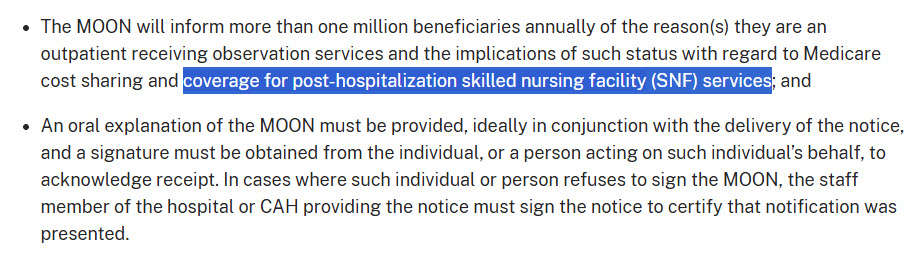
- The MOON explains how outpatient status affects your costs and coverage for post-hospitalization skilled nursing facility (SNF) services.
- California’s HICAP offers free, confidential Medicare counseling if you have questions about the notice.
Who Gets the Medicare Outpatient Observation Notice
The MOON applies when someone entitled to Medicare benefits receives outpatient observation services for more than 24 hours. The rule is 42 CFR 489.20(y). The crucial detail is your official hospital status, not where your bed happens to be.
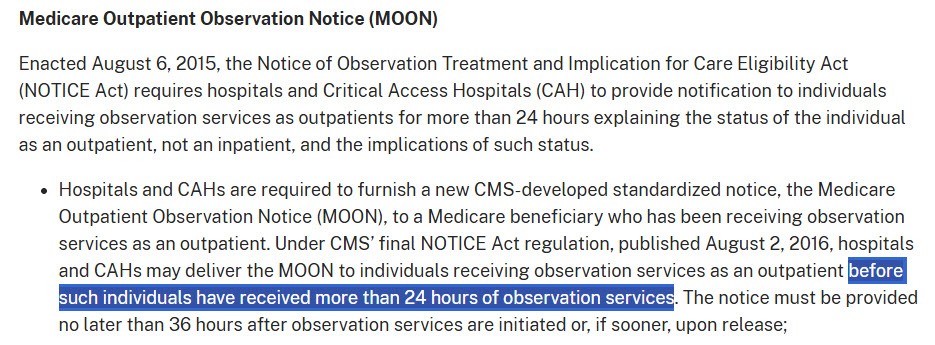
You might receive the notice sooner. The CMS MOON fact sheet permits hospitals to deliver it “before such individuals have received more than 24 hours of observation services.” Early delivery can be helpful, because you have more time to ask how your status could affect the bill and any care you’ll need afterward.
What Observation Means
Observation services give the medical team time to decide whether you need an inpatient admission or can safely go home. Medicare defines them this way. “Observation services are hospital outpatient services you get while your doctor decides whether to admit you as an inpatient or discharge you.”
The distinction can feel strange. You may be in the same room, receive the same tests and speak with the same nurses as someone who is admitted. Yet your classification for Medicare purposes is different. That difference can change your out-of-pocket costs and the rules for follow-up rehabilitation.
A simple question can save confusion. Ask whether you’re formally admitted as an inpatient or receiving observation services. Ask it even if you have already been assigned a room. Your room number does not answer the Medicare coverage question.
An Overnight Stay Doesn’t Make You an Inpatient
Staying overnight does not automatically make you an inpatient. Medicare says “you’re an outpatient even if you spend the night in the hospital” without a formal inpatient admission order. Ask your care team which status is recorded in your chart.
Medicare puts it plainly. “Remember, even if you stay overnight in a regular hospital bed, you might be an outpatient. Ask the doctor or hospital.” With Medicare Advantage, costs and coverage may differ, so contact your plan.

The 36-Hour Deadline
The clock starts when observation services begin, not when you first arrived at the emergency room. CMS states, “The notice must be provided no later than 36 hours after observation services are initiated.” Ask when those services were officially started if you are unsure how long you have been under observation.
The current regulation adds an important qualification. The notice is due within 36 hours “or sooner if the individual is transferred, discharged, or admitted.” If you are leaving after 30 hours of observation, the hospital should give you the required notice before you leave.
A Written Observation Notice, Not Just a Conversation
A hallway conversation does not replace the paperwork. Hospitals must use a standardized written notice that identifies your outpatient observation status, explains the reason and describes possible financial and skilled nursing consequences. Ask for your own copy, not just a chance to glance at the form.
The written MOON is only half the requirement. Hospital staff must also give an oral explanation. If the explanation is rushed or full of unfamiliar terms, ask the person presenting it to go through the cost and rehabilitation sections again. You are allowed to have questions.
Signing the MOON
The hospital will ask you or someone acting for you to acknowledge receipt by signing. If you refuse, the staff member presenting the notice must sign and document that it was delivered, including the date and time. Refusing to sign does not make observation status disappear.
Your signature records receipt, not agreement with the hospital’s classification. Keep a copy with your discharge instructions and take a photograph for your records if that is easier. The notice may be useful if you later question a charge or need to discuss a follow-up care plan.
Questions to Ask When You Get the MOON Notice
The best time to ask questions is while the staff member is explaining the form. Federal rules require the MOON to state the reason for outpatient observation status. Start by asking what prompted that decision and whether it has changed during your stay.
- Why am I an outpatient getting observation services instead of an inpatient?
- Is my doctor still deciding whether to admit me?
- How will outpatient status affect what I pay for this stay?
- If I need rehab afterward, will this stay meet Medicare’s 3-day inpatient requirement?
Have someone write down the answers if you are exhausted or recovering from treatment. Note the name of the staff member you spoke with and the date. If you expect to need rehabilitation or extra help at home, ask to include your discharge planner in the conversation.
If You Never Got a MOON
If you had more than 24 hours of observation and never received a MOON, ask your nurse or the hospital’s patient relations office for it. Medicare says the form explains why you are an outpatient and how that status may affect your costs during and after the hospital stay.
Do not assume a missing notice means the hospital automatically treated you as an inpatient. Ask for your current documented status and the time observation began. Keep any answer in writing if possible, especially when follow-up skilled nursing care is being considered.
Why the Notice Mentions Skilled Nursing
The notice is particularly important if you may need rehabilitation in a skilled nursing facility. CMS says it explains Medicare cost sharing and “coverage for post-hospitalization skilled nursing facility (SNF) services.” In other words, observation status can have consequences that follow you after discharge.
For Original Medicare’s usual three-day qualifying hospital stay requirement, observation time does not count. Medicare says “Time you spend at the hospital under observation or in the emergency room before you’re admitted” does not count toward the qualifying inpatient stay. Confirm your specific coverage before assuming rehab will be paid for.
Observation Status and Skilled Nursing Plans
If a skilled nursing stay seems likely, ask about your status every day rather than waiting until discharge. Have your physician and case manager explain whether you have a formal inpatient admission order and how many qualifying inpatient days you have. A longer hospital stay does not necessarily equal three inpatient days.
For example, two nights under observation followed by one inpatient night usually do not satisfy Original Medicare’s three-day qualifying inpatient stay rule. Ask the discharge planner to count eligible days rather than counting the nights you remember being in a bed.
Our guide to what Medicare covers for senior care notes that “Medicare rehab coverage depends on the setting,” with up to 100 days for skilled nursing rehab. Your hospital status is one of the first things that decides which rules apply.
What Observation Can Cost You
Observation can also change your hospital bill. With Original Medicare, Part B generally applies to outpatient hospital and physician services. Medicare notes that “your total copayment for all outpatient services may be more than the inpatient hospital deductible.” Ask the billing team for an estimate based on your coverage.
If you have a supplemental policy or Medicare Advantage, ask how those benefits affect your expected charges. The MOON explains your status; it is not a personalized final bill. Reviewing costs before discharge may help you avoid surprises.
If You Were an Inpatient First
Another document applies if you were originally admitted as an inpatient and the hospital later changes your status to outpatient observation. Medicare calls it the Medicare Change of Status Notice. It describes fast appeal rights through your state’s BFCC-QIO. Do not confuse that appeal notice with the MOON.
If your status was changed after an inpatient admission, ask about an appeal immediately. Medicare advises, “If possible, it’s best to file an appeal while you’re still in the hospital.” You can also ask about the procedure after discharge.
Free Help With Hospital Observation Rights
For help understanding your options, contact California’s HICAP Medicare counseling program. It “provides free, confidential one-on-one counseling” about Medicare. The statewide number is 1-800-434-0222. It can help you understand coverage questions without pressure to choose a particular care provider.
Planning Your Recovery After Observation
Sometimes you are discharged after observation but still need help with everyday tasks. Our Orange County respite care page discusses support during “post-acute recovery after a hospital or rehabilitation stay.” The right next step depends on whether your needs are medical, personal or both.
Our short-term stay program offers “temporary assisted living for seniors who need time to recover after a hospitalization or rehab stay.” This is residential care, not skilled nursing rehabilitation. Ask your discharge team whether assisted living can safely meet your needs before arranging a stay.
A residential respite stay may help with meals, supervision and personal care, but it cannot replace hospital treatment or skilled nursing services you still require. Share your discharge instructions with any residential provider so the team can evaluate whether the setting is a safe match.
Plan for the Right Support After a Hospital Observation Stay
Getting the MOON notice can be confusing, especially when you’re still waiting for test results and wondering what happens after discharge. Before leaving the hospital, ask your care team whether you need skilled nursing rehabilitation, assistance with everyday activities or both. Spending the night under observation doesn’t necessarily mean you’re ready to return home without help.
If the hospital determines that residential assisted living is an appropriate next step, Raya’s Paradise offers temporary senior care and respite stays in Orange County for older adults who need support with daily routines. Families coordinating a transition can also review our guide to hospital discharge and assisted living admission requirements to better understand what a receiving community needs to assess before accepting a resident.
For patients returning to the Los Angeles area, our residential senior care homes in Los Angeles offer smaller, home-like environments with individualized assistance. If you’re exploring a temporary stay or a longer-term care arrangement, speak with our Orange County care team about your discharge needs and whether the services available at Raya’s Paradise are an appropriate fit. A residential care community cannot replace skilled nursing rehabilitation or medical treatment that your healthcare team determines is necessary.
Our Orange County Senior Assisted Living Community with Specialized Memory Care
Our Los Angeles Assisted Living Residences
Sources & Additional Resources
- Electronic Code of Federal Regulations. “42 CFR 489.20, Basic commitments.” eCFR.
- Centers for Medicare & Medicaid Services. “Medicare Outpatient Observation Notice (MOON).” CMS Newsroom.
- California Department of Aging. “Medicare Counseling (HICAP).” California Department of Aging.
- Medicare.gov. “Inpatient or outpatient hospital status affects your costs.” Centers for Medicare & Medicaid Services.
- Medicare.gov. “Skilled nursing facility care.” Centers for Medicare & Medicaid Services.
- Medicare.gov. “Appeal when a hospital changes your status from inpatient to outpatient getting observation services.” Centers for Medicare & Medicaid Services.
Disclaimer: This article provides general educational information about the Medicare Outpatient Observation Notice (MOON), hospital observation status and federal patient notification requirements under 42 CFR 489.20(y). It is not medical or legal advice and does not determine whether a patient should be classified as an inpatient or outpatient. Hospitals generally must provide the MOON when applicable observation services exceed 24 hours, within 36 hours of their initiation or sooner in specified circumstances. Individual notification requirements, hospital status decisions and discharge arrangements should be confirmed with the treating hospital, discharge planning team or the Centers for Medicare & Medicaid Services. Patients who believe their hospital status was changed incorrectly should ask about the applicable review or appeal procedures. Raya’s Paradise provides residential assisted living and supportive care, not hospital treatment or skilled nursing facility services.
 https://rayasparadise.com/wp-content/uploads/2026/10/Healthcare-Professional-Documenting-Hospital-Observation-Status-and-Discharge-Notes.jpg
1707
2560
Moti Gamburd
https://rayasparadise.com//wp-content/uploads/2019/07/RP-LOGO-Horizontal-Name-Only-websitetrans.png
Moti Gamburd2026-11-02 16:07:082026-10-30 17:06:11The Medicare Outpatient Observation Notice | Hospitals Must Tell You About Observation Within 36 Hours