
Contents
- Hospital Discharge to Assisted Living in California and the Admission Checks That Matter
- The Medical Assessment for a Hospital Discharge to Assisted Living
- Screen for Prohibited Health Conditions
- Check Hospice Waiver Status
- Include the Designated Family Caregiver
- Plan a Safer Transition From Hospital to Assisted Living
- Sources & Additional Resources
- More Assisted Living Resources
- Hospital Discharge to Assisted Living in California and the Admission Checks That Matter
- Choosing Assisted Living for Senior Couples
- History of Assisted Living |How the Option of Assisted Living Developed
- Choosing Assisted Living for Those with Alzheimer's or Dementia
- Paying for Assisted Living, Costs, Insurance, VA Benefits, and Smart Ways to Plan
- Six Myths About Assisted Living - What Senior Living Really Looks Like
- The Benefits of Assisted Living Over In-Home Care
- How to Care for a Loved One in Assisted Living From Afar
- Making a Smooth Transition to Assisted Living
- The Benefits of Small Assisted Living Facilities
- Tips for Selling Your Home to Pay for Assisted Living
- Signs It’s Time for Assisted Living, How to Know When Extra Support Is Needed
- Downsizing to Prepare for a Move to Assisted Living
- Discussing Assisted Living with a Reluctant Parent
- Does Assisted Living Provide Medical Care? Understanding Living Options and Care in Assisted Living Communities
Hospital Discharge to Assisted Living in California and the Admission Checks That Matter

The family has toured. The assisted living community has a room available, and transportation is scheduled for Tuesday afternoon. Then someone notices the patient has a feeding tube following her hospitalization. The community reviews the record and says it cannot accept her. A discharge that felt settled is suddenly back at the beginning.
A hospital discharge to assisted living in California requires more than an available room and a family’s approval. Licensed residential care facilities for the elderly, or RCFEs, must obtain a medical assessment, evaluate the person’s care needs and follow restrictions on certain medical conditions. Hospice care brings additional requirements.
For discharge planners, the practical goal is to identify problems before the family commits to a move. This checklist follows the decisions that can make or break an assisted living referral.

The Medical Assessment for a Hospital Discharge to Assisted Living
Start with the medical paperwork. Under 22 CCR 87458, a facility must obtain a medical assessment signed by a licensed medical professional acting within the scope of practice before accepting a resident.
The document must have been made within the last year.
That one-year window is a regulatory requirement, not reassurance that an older report reflects today’s condition.
A patient who was walking independently six months ago may now need transfer assistance, oxygen or a new medication routine.
The receiving community needs accurate information about the person being discharged now.
What the Assessment Must Cover
The regulation requires a physical examination and medical diagnoses, including documentation addressing communicable tuberculosis and infectious or contagious diseases.
It also calls for relevant medical history, current health status and basic measurements such as height, weight and blood pressure.
Medication information is essential.
The report must list current prescriptions and indicate whether medications need central storage.
Other required details include physical limitations, medically necessary diets, ambulatory status, cognitive conditions and known behavioral expressions.
California’s forms list identifies LIC 602A, Medical Assessment for Residential Care Facilities for the Elderly, revised 4/26.
Ask the receiving facility which form and supporting records it requires before sending anything to the physician for signature.
Make the Discharge Packet Match the Patient
Compare the assessment with the latest discharge orders.
Look for medication changes, mobility restrictions, wounds, infection status and devices added during the hospital stay.
The community may need clarification from the treating clinician before confirming acceptance.
A signed form that contradicts the discharge summary can create confusion even when every document is technically present.
Resolve those discrepancies before scheduling transport.
Make sure the family understands any equipment, supplies or follow-up services that must be arranged separately.
The Community Must Complete Its Own Appraisal
The medical assessment is not the facility’s entire admission decision.
Under 22 CCR 87457, the prospective resident and responsible person, when applicable, must be interviewed as part of a pre-admission appraisal.
The facility considers medical background, functional limitations and whether its services can meet the person’s needs.
Ask when the administrator or admissions representative can complete this review.
A bedside meeting may be possible, but confirm the facility’s process rather than assuming an interview can occur by video.
Give staff an opportunity to ask about nighttime needs and what happens on a difficult day, not only how the patient performs with hospital support.
Screen for Prohibited Health Conditions
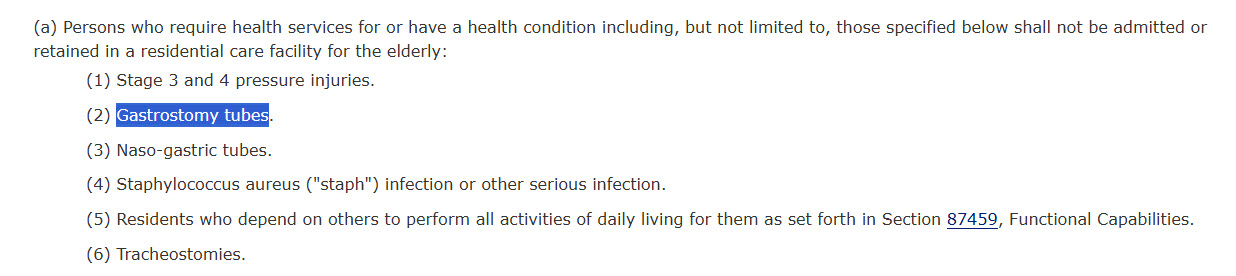
One of the fastest ways to lose a placement is to discover too late that the person has a condition California generally prohibits in assisted living.
22 CCR 87615 identifies conditions that ordinarily prevent admission or retention in an RCFE.
The list includes stage 3 and 4 pressure injuries, gastrostomy tubes, nasogastric tubes, serious infections such as staph, tracheostomies and residents who depend on others to perform all activities of daily living.
The regulation says the list is not exhaustive.
A feeding tube is not a minor footnote in the referral.
The regulation explicitly names gastrostomy tubes.
If that device is present, the admissions team needs to know before discussing a move-in date.
The discharge diagnosis alone is not enough to screen the patient.
Review the actual care being provided and who must perform each task.
The same disease can create very different admission questions depending on wounds, devices and dependence on others.
Restricted Conditions Need a Separate Review
Some health conditions are restricted rather than prohibited.
Under 22 CCR 87612, facilities may care for residents with specified restricted conditions if they comply with the rules governing those needs.
Examples include oxygen use, catheter care, diabetes, colostomy or ileostomy care, incontinence, injections, contractures, wound care and stage 1 or 2 pressure injuries.
Being on the restricted list does not mean every assisted living residence can provide the service.
Ask who will actually deliver the care, what licensed outside professionals are involved and whether the facility can meet the condition-specific requirements.
Written acceptance should reflect the patient’s real needs, not a broad assurance that the staff have experience with similar cases.
Understand the Exception Process
California also permits a facility to request a written exception for certain restricted or prohibited health conditions under 22 CCR 87616.
The facility must document the current condition and propose how it will meet the resident’s needs while protecting other residents.
An exception is not automatic, and the family cannot simply waive a regulatory prohibition.
If a placement depends on an exception, ask whether the facility has received approval and whether all conditions have been satisfied.
Do not schedule transport based only on an intention to apply.

Check Hospice Waiver Status
Hospice adds another admission question that families may not expect.
Under 22 CCR 87632, a facility accepting or retaining a terminally ill resident who will receive care from a hospice agency must have obtained a facility hospice care waiver from the Department of Social Services.
That requirement applies to the residence, not simply the hospice provider.
A family may have selected an excellent hospice agency and still need to confirm that the proposed assisted living community is authorized to accommodate hospice care.
Ask the facility directly whether it holds the waiver and whether it has capacity for the particular resident.
A waiver does not by itself establish that every resident’s needs can be managed safely.
Match the Hospice Plan to the Facility
The assisted living facility and hospice agency must coordinate responsibilities under the hospice care plan, including a required agreement on the care to be provided.
Confirm which tasks hospice personnel perform and which remain the facility’s responsibility.
The distinction becomes especially important when a hospice patient has a condition listed as prohibited or restricted.
22 CCR 87616(c) provides an exception-request exemption for qualifying hospice residents when the facility satisfies hospice-waiver requirements and the hospice plan specifically addresses the condition.
This is a carefully defined regulatory pathway, not general permission to admit any medically complex resident.
Check the terminal illness determination, hospice services, care plan and facility waiver together.
If any piece is uncertain, ask the licensing agency or an appropriately qualified professional before confirming placement.
Confirm the Day-to-Day Care Arrangement
Families may hear that hospice is coming and assume hospice will provide all care around the clock.
Ask the hospice agency what services it will actually provide and when.
Then ask the assisted living team how routine assistance, medication coordination and emergencies will be managed between visits.
If the patient needs services outside the facility’s ability or authorization, another level of care may be more appropriate.
The goal is a safe discharge, not simply finding a residence willing to say yes.

Include the Designated Family Caregiver
Placement paperwork is only part of discharge planning.
California Health and Safety Code section 1262.5 gives hospitalized patients an opportunity to identify one family caregiver who may assist after discharge.
The hospital records that designation in the medical chart.
The law also requires policies for notifying the designated caregiver about discharge or transfer as soon as possible and, in any event, upon issuance of the attending physician’s discharge order.
If the caregiver cannot be reached, the hospital must document its attempt.
The lack of contact shall not delay the patient’s medical care or an appropriate discharge.
The designated caregiver should be offered a chance to participate in discharge planning and receive appropriate information or instruction about posthospital care.
The law doesn’t automatically turn that person into a legal decision-maker or authorize them to sign every admission document.
Bring Everyone Into the Same Conversation
The person touring assisted living homes may not be the person attending hospital rounds.
Ask the patient who should participate and make sure the discharge team, receiving facility and designated caregiver have consistent information about medications, mobility and follow-up care.
Confirm who has legal authority to sign the admission agreement when the resident cannot do so.
It may be the patient, an authorized agent or another legally appropriate representative, depending on the circumstances.
Do not assume caregiver designation alone grants that authority.
A Practical Discharge Checklist
- Obtain a signed medical assessment made within the last year and clarify any changes during hospitalization.
- Reconcile the assessment, discharge medication orders and the facility’s requested forms.
- Complete the receiving community’s pre-admission appraisal before confirming a move-in date.
- Screen for prohibited conditions, restricted conditions and any necessary approved exceptions.
- For hospice patients, verify the facility’s hospice waiver and a workable hospice care plan.
- Notify the designated family caregiver and include that person in planning as appropriate.
- Confirm the facility has accepted the patient’s current care needs and that transportation and follow-up arrangements are ready.
The list is a starting point, not a substitute for individualized clinical judgment.
If a new condition appears after acceptance, tell the facility and reopen the discussion.
A postponed discharge is frustrating, but sending someone to a residence unable to meet their needs can be far worse.
Plan a Safer Transition From Hospital to Assisted Living
A successful discharge starts with knowing whether the receiving community can meet the patient’s needs, not just whether a room is available.
At Raya’s Paradise, we work with families and discharge planners to review individual care requirements and determine whether our residential setting is appropriate.
Our personalized assisted living services in Orange County provide daily support in a welcoming environment, while our San Clemente senior living community offers individualized care in a coastal setting.
For patients transitioning from hospitals in the Los Angeles area, we also offer residential assisted living options in Los Angeles.
If you’re coordinating a hospital discharge, contact our Orange County team to discuss the patient’s needs, admission requirements and next steps before arranging the transfer.
Our Orange County Senior Assisted Living with Memory Care Community
Our Los Angeles Assisted Living Residences
Sources & Additional Resources
- California Code of Regulations (Cornell LII). “Cal. Code Regs. Tit. 22, § 87458 – Medical Assessment.” Legal Information Institute.
- California Department of Social Services. “On-line Forms and Publications I – L.” California Department of Social Services.
- California Code of Regulations (Cornell LII). “Cal. Code Regs. Tit. 22, § 87457 – Pre-Admission Appraisal.” Legal Information Institute.
- California Code of Regulations (Cornell LII). “Cal. Code Regs. Tit. 22, § 87615 – Prohibited Health Conditions.” Legal Information Institute.
- California Code of Regulations (Cornell LII). “Cal. Code Regs. Tit. 22, § 87612 – Restricted Health Conditions.” Legal Information Institute.
- California Code of Regulations (Cornell LII). “Cal. Code Regs. Tit. 22, § 87616 – Exceptions for Health Conditions.” Legal Information Institute.
- California Code of Regulations (Cornell LII). “Cal. Code Regs. Tit. 22, § 87632 – Hospice Care Waiver.” Legal Information Institute.
- Justia. “California Health and Safety Code § 1262.5 (2025).” 2025 California Code.
Disclaimer: This article provides general educational information about hospital discharge planning and admission requirements for California Residential Care Facilities for the Elderly (RCFEs). It is not a substitute for medical advice, professional discharge planning or individualized assessments. Admission eligibility depends on the patient’s current health conditions, functional abilities, facility licensing requirements and available care services. California regulations and facility capabilities may change. Confirm all admission requirements, applicable exceptions and hospice waiver conditions with the receiving facility, treating healthcare team or California Department of Social Services before arranging a transfer. Raya’s Paradise provides residential assisted living and related supportive services, not skilled nursing facility care.
 https://rayasparadise.com/wp-content/uploads/2026/10/Hospital-Discharge-Planning-and-Assisted-Living-Care-Assessment.jpg
1708
2560
Moti Gamburd
https://rayasparadise.com//wp-content/uploads/2019/07/RP-LOGO-Horizontal-Name-Only-websitetrans.png
Moti Gamburd2026-10-16 14:54:522026-10-16 14:54:52Hospital Discharge to Assisted Living in California and the Admission Checks That Matter
https://rayasparadise.com/wp-content/uploads/2026/10/Hospital-Discharge-Planning-and-Assisted-Living-Care-Assessment.jpg
1708
2560
Moti Gamburd
https://rayasparadise.com//wp-content/uploads/2019/07/RP-LOGO-Horizontal-Name-Only-websitetrans.png
Moti Gamburd2026-10-16 14:54:522026-10-16 14:54:52Hospital Discharge to Assisted Living in California and the Admission Checks That Matter https://rayasparadise.com/wp-content/uploads/2013/03/Choosing-Assisted-Living-for-Senior-Couples.jpg
1700
2555
Moti Gamburd
https://rayasparadise.com//wp-content/uploads/2019/07/RP-LOGO-Horizontal-Name-Only-websitetrans.png
Moti Gamburd2026-02-14 06:37:342026-10-12 22:26:28Choosing Assisted Living for Senior Couples
https://rayasparadise.com/wp-content/uploads/2013/03/Choosing-Assisted-Living-for-Senior-Couples.jpg
1700
2555
Moti Gamburd
https://rayasparadise.com//wp-content/uploads/2019/07/RP-LOGO-Horizontal-Name-Only-websitetrans.png
Moti Gamburd2026-02-14 06:37:342026-10-12 22:26:28Choosing Assisted Living for Senior Couples https://rayasparadise.com/wp-content/uploads/2012/12/How-the-Option-of-Assisted-Living-Developed.jpg
1702
2553
Moti Gamburd
https://rayasparadise.com//wp-content/uploads/2019/07/RP-LOGO-Horizontal-Name-Only-websitetrans.png
Moti Gamburd2026-02-12 04:33:042026-10-12 22:09:43History of Assisted Living |How the Option of Assisted Living Developed
https://rayasparadise.com/wp-content/uploads/2012/12/How-the-Option-of-Assisted-Living-Developed.jpg
1702
2553
Moti Gamburd
https://rayasparadise.com//wp-content/uploads/2019/07/RP-LOGO-Horizontal-Name-Only-websitetrans.png
Moti Gamburd2026-02-12 04:33:042026-10-12 22:09:43History of Assisted Living |How the Option of Assisted Living Developed https://rayasparadise.com/wp-content/uploads/2012/10/Choosing-Assisted-Living-for-Those-with-Alzheimers-or-Dementia.jpeg
1695
2546
Moti Gamburd
https://rayasparadise.com//wp-content/uploads/2019/07/RP-LOGO-Horizontal-Name-Only-websitetrans.png
Moti Gamburd2026-02-11 08:14:422026-10-12 22:29:24Choosing Assisted Living for Those with Alzheimer's or Dementia
https://rayasparadise.com/wp-content/uploads/2012/10/Choosing-Assisted-Living-for-Those-with-Alzheimers-or-Dementia.jpeg
1695
2546
Moti Gamburd
https://rayasparadise.com//wp-content/uploads/2019/07/RP-LOGO-Horizontal-Name-Only-websitetrans.png
Moti Gamburd2026-02-11 08:14:422026-10-12 22:29:24Choosing Assisted Living for Those with Alzheimer's or Dementia https://rayasparadise.com/wp-content/uploads/2012/10/Paying-for-Assisted-Living.jpg
1700
2542
Moti Gamburd
https://rayasparadise.com//wp-content/uploads/2019/07/RP-LOGO-Horizontal-Name-Only-websitetrans.png
Moti Gamburd2026-02-10 03:30:062026-10-12 22:30:53Paying for Assisted Living, Costs, Insurance, VA Benefits, and Smart Ways to Plan
https://rayasparadise.com/wp-content/uploads/2012/10/Paying-for-Assisted-Living.jpg
1700
2542
Moti Gamburd
https://rayasparadise.com//wp-content/uploads/2019/07/RP-LOGO-Horizontal-Name-Only-websitetrans.png
Moti Gamburd2026-02-10 03:30:062026-10-12 22:30:53Paying for Assisted Living, Costs, Insurance, VA Benefits, and Smart Ways to Plan https://rayasparadise.com/wp-content/uploads/2012/10/Six-Myths-About-Assisted-Living.jpg
1702
2555
Moti Gamburd
https://rayasparadise.com//wp-content/uploads/2019/07/RP-LOGO-Horizontal-Name-Only-websitetrans.png
Moti Gamburd2026-02-09 04:02:312026-10-12 22:57:13Six Myths About Assisted Living - What Senior Living Really Looks Like
https://rayasparadise.com/wp-content/uploads/2012/10/Six-Myths-About-Assisted-Living.jpg
1702
2555
Moti Gamburd
https://rayasparadise.com//wp-content/uploads/2019/07/RP-LOGO-Horizontal-Name-Only-websitetrans.png
Moti Gamburd2026-02-09 04:02:312026-10-12 22:57:13Six Myths About Assisted Living - What Senior Living Really Looks Like https://rayasparadise.com/wp-content/uploads/2026/02/Assisted-Living-vs-In-Home-Care.jpg
1695
2553
Moti Gamburd
https://rayasparadise.com//wp-content/uploads/2019/07/RP-LOGO-Horizontal-Name-Only-websitetrans.png
Moti Gamburd2026-02-08 06:00:482026-10-12 22:58:19The Benefits of Assisted Living Over In-Home Care
https://rayasparadise.com/wp-content/uploads/2026/02/Assisted-Living-vs-In-Home-Care.jpg
1695
2553
Moti Gamburd
https://rayasparadise.com//wp-content/uploads/2019/07/RP-LOGO-Horizontal-Name-Only-websitetrans.png
Moti Gamburd2026-02-08 06:00:482026-10-12 22:58:19The Benefits of Assisted Living Over In-Home Care https://rayasparadise.com/wp-content/uploads/2013/01/Caring-for-a-Parent-in-Assisted-Living-From-Afar.jpeg
1702
2556
Moti Gamburd
https://rayasparadise.com//wp-content/uploads/2019/07/RP-LOGO-Horizontal-Name-Only-websitetrans.png
Moti Gamburd2026-02-06 08:00:312026-10-12 22:12:38How to Care for a Loved One in Assisted Living From Afar
https://rayasparadise.com/wp-content/uploads/2013/01/Caring-for-a-Parent-in-Assisted-Living-From-Afar.jpeg
1702
2556
Moti Gamburd
https://rayasparadise.com//wp-content/uploads/2019/07/RP-LOGO-Horizontal-Name-Only-websitetrans.png
Moti Gamburd2026-02-06 08:00:312026-10-12 22:12:38How to Care for a Loved One in Assisted Living From Afar https://rayasparadise.com/wp-content/uploads/2012/10/Smooth-Transition-to-Assisted-Living.jpeg
1696
2555
Moti Gamburd
https://rayasparadise.com//wp-content/uploads/2019/07/RP-LOGO-Horizontal-Name-Only-websitetrans.png
Moti Gamburd2026-02-06 01:00:082026-10-12 22:58:44Making a Smooth Transition to Assisted Living
https://rayasparadise.com/wp-content/uploads/2012/10/Smooth-Transition-to-Assisted-Living.jpeg
1696
2555
Moti Gamburd
https://rayasparadise.com//wp-content/uploads/2019/07/RP-LOGO-Horizontal-Name-Only-websitetrans.png
Moti Gamburd2026-02-06 01:00:082026-10-12 22:58:44Making a Smooth Transition to Assisted Living https://rayasparadise.com/wp-content/uploads/2012/10/Benefits-of-Small-Assisted-Living-Facilities.jpg
1702
2551
Moti Gamburd
https://rayasparadise.com//wp-content/uploads/2019/07/RP-LOGO-Horizontal-Name-Only-websitetrans.png
Moti Gamburd2026-02-04 04:23:062026-10-12 22:59:18The Benefits of Small Assisted Living Facilities
https://rayasparadise.com/wp-content/uploads/2012/10/Benefits-of-Small-Assisted-Living-Facilities.jpg
1702
2551
Moti Gamburd
https://rayasparadise.com//wp-content/uploads/2019/07/RP-LOGO-Horizontal-Name-Only-websitetrans.png
Moti Gamburd2026-02-04 04:23:062026-10-12 22:59:18The Benefits of Small Assisted Living Facilities https://rayasparadise.com/wp-content/uploads/2026/01/Tips-for-Selling-Your-Home-to-Pay-for-Assisted-Living.jpg
1702
2555
Moti Gamburd
https://rayasparadise.com//wp-content/uploads/2019/07/RP-LOGO-Horizontal-Name-Only-websitetrans.png
Moti Gamburd2026-01-22 04:00:552026-10-12 22:14:40Tips for Selling Your Home to Pay for Assisted Living
https://rayasparadise.com/wp-content/uploads/2026/01/Tips-for-Selling-Your-Home-to-Pay-for-Assisted-Living.jpg
1702
2555
Moti Gamburd
https://rayasparadise.com//wp-content/uploads/2019/07/RP-LOGO-Horizontal-Name-Only-websitetrans.png
Moti Gamburd2026-01-22 04:00:552026-10-12 22:14:40Tips for Selling Your Home to Pay for Assisted Living https://rayasparadise.com/wp-content/uploads/2012/10/Signs-Its-Time-for-Assisted-Living.jpg
1697
2555
Raya's Paradise
https://rayasparadise.com//wp-content/uploads/2019/07/RP-LOGO-Horizontal-Name-Only-websitetrans.png
Raya's Paradise2026-01-19 03:09:442026-10-12 22:15:27Signs It’s Time for Assisted Living, How to Know When Extra Support Is Needed
https://rayasparadise.com/wp-content/uploads/2012/10/Signs-Its-Time-for-Assisted-Living.jpg
1697
2555
Raya's Paradise
https://rayasparadise.com//wp-content/uploads/2019/07/RP-LOGO-Horizontal-Name-Only-websitetrans.png
Raya's Paradise2026-01-19 03:09:442026-10-12 22:15:27Signs It’s Time for Assisted Living, How to Know When Extra Support Is Needed https://rayasparadise.com/wp-content/uploads/2012/12/Downsizing-to-Prepare-for-Assisted-Living.jpeg
1704
2558
Moti Gamburd
https://rayasparadise.com//wp-content/uploads/2019/07/RP-LOGO-Horizontal-Name-Only-websitetrans.png
Moti Gamburd2026-01-13 04:02:202026-10-13 13:49:32Downsizing to Prepare for a Move to Assisted Living
https://rayasparadise.com/wp-content/uploads/2012/12/Downsizing-to-Prepare-for-Assisted-Living.jpeg
1704
2558
Moti Gamburd
https://rayasparadise.com//wp-content/uploads/2019/07/RP-LOGO-Horizontal-Name-Only-websitetrans.png
Moti Gamburd2026-01-13 04:02:202026-10-13 13:49:32Downsizing to Prepare for a Move to Assisted Living https://rayasparadise.com/wp-content/uploads/2012/11/How-to-Discuss-Assisted-Living-With-a-Reluctant-Parent.jpeg
1704
2553
Moti Gamburd
https://rayasparadise.com//wp-content/uploads/2019/07/RP-LOGO-Horizontal-Name-Only-websitetrans.png
Moti Gamburd2026-01-12 02:33:232026-10-13 13:51:01Discussing Assisted Living with a Reluctant Parent
https://rayasparadise.com/wp-content/uploads/2012/11/How-to-Discuss-Assisted-Living-With-a-Reluctant-Parent.jpeg
1704
2553
Moti Gamburd
https://rayasparadise.com//wp-content/uploads/2019/07/RP-LOGO-Horizontal-Name-Only-websitetrans.png
Moti Gamburd2026-01-12 02:33:232026-10-13 13:51:01Discussing Assisted Living with a Reluctant Parent https://rayasparadise.com/wp-content/uploads/2025/08/Does-Assisted-Living-Provide-Medical-Care.jpg
1704
2548
Raya's Paradise
https://rayasparadise.com//wp-content/uploads/2019/07/RP-LOGO-Horizontal-Name-Only-websitetrans.png
Raya's Paradise2025-08-27 20:32:462026-01-14 19:35:28Does Assisted Living Provide Medical Care? Understanding Living Options and Care in Assisted Living Communities
https://rayasparadise.com/wp-content/uploads/2025/08/Does-Assisted-Living-Provide-Medical-Care.jpg
1704
2548
Raya's Paradise
https://rayasparadise.com//wp-content/uploads/2019/07/RP-LOGO-Horizontal-Name-Only-websitetrans.png
Raya's Paradise2025-08-27 20:32:462026-01-14 19:35:28Does Assisted Living Provide Medical Care? Understanding Living Options and Care in Assisted Living Communities