
Contents
- How to Talk With Someone Who Has Alzheimer’s
- Why Alzheimer’s changes communication
- Create the right environment before you start talking
- Use simple language without talking down to the person
- Why someone with Alzheimer’s may return to their first language
- Listen patiently and allow more time for a response
- Respond to repeated questions, inaccurate stories and confusion
- Use tone, facial expressions, gestures and touch
- Adjust communication as Alzheimer’s progresses
- What not to say to someone with Alzheimer’s
- When a communication change may be medical
- How caregivers can communicate without burning out
- Specialized Memory Care Communication Support in Orange County and Los Angeles
- Sources & Additional Resources
- More Memory Care Resources
- Three Big Questions to Consider After an Alzheimer's Diagnosis
- Five Myths About Alzheimer's Disease
- Should You Seek an Alzheimer's Diagnosis?
- How to Talk with Someone Who Has Alzheimer's
- Coconut Oil for Alzheimer's Disease?
- How to Tell When a Loved One with Dementia Is Sick
- Does Computer Use Help with Dementia Symptoms?
- Coping With Dementia Behavior
- Respect for a Senior with Dementia
- Why Dementia Patients Have Trouble with Eating
- Exercises for the Later Stages of Dementia
- Addressing Agitation in Someone Who Has Dementia
- All About Lewy Body Dementia
- Exercise Benefits for Dementia Patients - Safe Activities, Routines, and Memory Care Support
- Giving Dignity to Dementia Patients
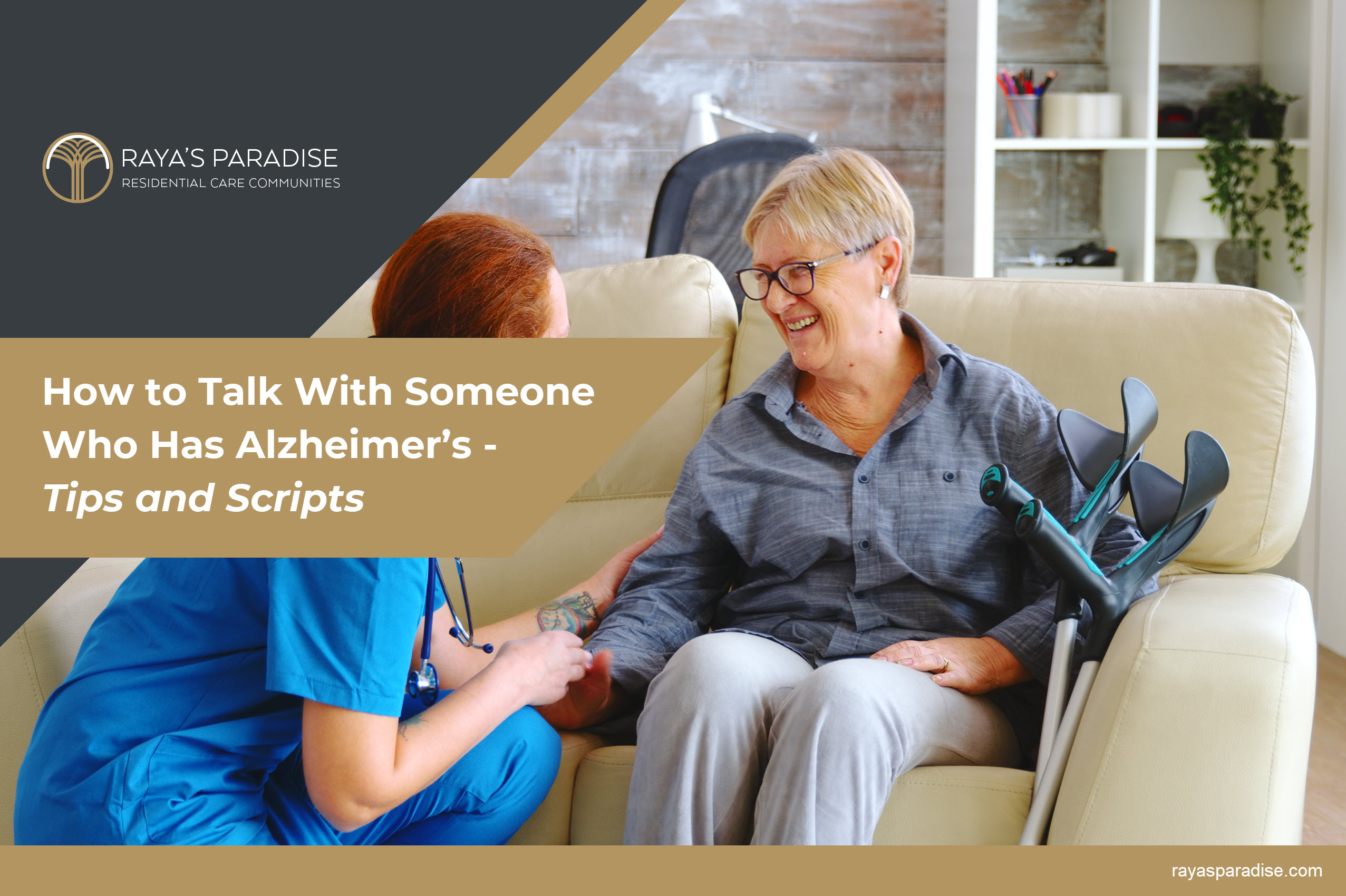
How to Talk With Someone Who Has Alzheimer’s
- Get the person’s attention before speaking, reduce distractions and communicate one-on-one when possible.
- Use short sentences, familiar words and one idea or instruction at a time.
- Allow extra time for a response. Silence does not always mean the person did not understand.
- Ask simple questions and offer two clear choices instead of broad, open-ended options.
- Listen for the emotion or need beneath inaccurate words rather than correcting every detail.
- Tone, facial expression, posture and touch may communicate more than words as Alzheimer’s progresses.
- Sudden communication decline can be caused by illness, pain, medication effects, hearing loss or delirium and should be medically evaluated.
Talking with someone who has Alzheimer’s can feel different from one day to the next.
A conversation may flow easily in the morning, then become confusing or frustrating later that afternoon. Your loved one may lose track of words, repeat the same question, misunderstand what you mean or respond with a story that does not match the facts.
These changes can be painful, especially when conversation was once an important part of your relationship.
However, difficulty communicating does not mean the person no longer needs connection. The need to feel respected, included, safe and understood remains important throughout every stage of Alzheimer’s disease.
The goal is not to conduct a perfect conversation.
It is to create moments of understanding and emotional connection using language, tone, facial expressions, gestures, familiar routines and patience.
Families who need more consistent support can learn about memory care with meaningful daily activities in Orange County or explore dementia care at our Los Angeles residences.
A structured environment can reduce communication pressure by combining familiar routines with dementia-informed care.

Why Alzheimer’s changes communication
Alzheimer’s disease affects much more than memory.
It can gradually interfere with attention, language, reasoning, recognition and the ability to organize thoughts. A person may know what they want to say but be unable to find the word. They may hear every word you speak but need more time to understand the sentence.
Common changes include difficulty finding familiar words, losing track of a conversation, repeating questions, giving answers that seem unrelated and relying more heavily on gestures or facial expressions.
Noisy rooms and group conversations may become especially difficult because the brain must process several voices and ideas at once.
These difficulties may fluctuate with fatigue, anxiety, overstimulation, hunger, pain or time of day.
A difficult conversation does not always mean the disease has suddenly advanced. It may mean the setting, timing or communication approach is making the interaction harder.
Understanding how symptoms change over time can help families adjust expectations.
Our overview of the stages of dementia explains how communication and daily function may evolve.

Create the right environment before you start talking
Communication often improves when the environment becomes easier to process.
Television, music, several people talking, reflective surfaces and household activity can compete for the person’s attention.
Reduce background distractions
Turn off the television or radio. Move away from crowded rooms and choose a familiar, well-lit place.
Avoid trying to have an important conversation while another task is happening.
One-on-one communication is usually easier than a group discussion.
When several relatives speak at once, the person may struggle to identify who is talking, follow changes in topic or decide when to respond.
Make sure they can see and hear you
Approach from the front rather than from behind. Sit or stand at eye level, say the person’s name and make comfortable eye contact before speaking.
Make sure hearing aids and glasses are available, clean and functioning.
Hearing or vision loss can look like worsening dementia because the person may miss information, answer incorrectly or withdraw from conversation.
Choose the right time
Schedule important conversations during the part of the day when your loved one is usually most alert.
For many people, that may be in the morning or shortly after a meal. Avoid difficult topics when the person is tired, hungry, in pain or showing signs of sundowning.
If anxiety, frustration or restlessness is already increasing, focus on reducing distress before continuing the conversation.
Our guide to addressing agitation in someone who has dementia offers practical ways to identify triggers and respond calmly.

Use simple language without talking down to the person
Simple communication is not the same as childish communication.
Adults living with Alzheimer’s deserve an adult tone, respectful language and inclusion in conversations that affect them.
Say one thing at a time
Long explanations place heavy demands on memory and attention. Break information into smaller parts and pause after each statement.
Instead of saying, “We need to get dressed because your appointment is at ten, then we have to stop at the pharmacy before lunch,” try, “It is time to get dressed.”
After that step is complete, explain what comes next.
Use names and specific words
Pronouns such as “he,” “she,” “it” and “there” may become difficult to track.
Use names and specific nouns when they help clarify the message.
Instead of saying, “She will take you there,” say, “Maria will take you to the doctor.”
Instead of asking, “Do you want it,” say, “Would you like the blue sweater?”
Offer two clear choices
Broad questions may feel overwhelming because the person must remember several options and decide among them.
Offer two concrete choices that are both acceptable.
- “Would you like tea or water?”
- “Would you like the blue shirt or the green shirt?”
- “Would you like to sit here or by the window?”
If verbal choices are still difficult, show the two items and let the person point.
Avoid quizzing memory
Questions such as “Do you remember who this is?” can create embarrassment.
Introduce the person naturally instead. Say, “This is your grandson, Daniel. He came to have lunch with us.”
This protects dignity and allows the conversation to begin without a test.
Why someone with Alzheimer’s may return to their first language
Alzheimer’s disease can affect languages differently.
A person who learned English later in life may gradually lose access to English while retaining more of their first language, such as Spanish, Korean, Armenian or another language spoken earlier in life.
This change is not stubbornness or refusal.
Earlier language memories may remain available longer than words learned later. Families may need to involve relatives, caregivers or interpreters who speak the person’s first language.
Familiar songs, prayers, greetings and everyday phrases in that language may provide comfort and improve understanding.
Write down useful phrases for meals, toileting, pain, medication and reassurance so all caregivers can communicate consistently.
The person’s first language, preferred terms and culturally familiar expressions should be included in the care plan.
This can help caregivers respond more effectively during personal care, medical appointments and periods of confusion.
Listen patiently and allow more time for a response
People often fill silence because it feels uncomfortable.
Someone with Alzheimer’s may need several extra seconds to understand the question, find words and organize a response. Asking another question too quickly can interrupt that process.
After speaking, pause. Maintain a relaxed expression and give the person time to respond.
Avoid finishing every sentence unless they clearly want help.
Watch for nonverbal clues
The person may point, reach, look toward an object or change facial expression when words are difficult.
These actions may communicate the message more accurately than speech.
If your loved one is searching around a table, ask one question at a time, such as, “Are you looking for your glasses?” or “Would you like your water?”
Then wait for a response.
Repeat, then rephrase
If the person does not understand, repeat the sentence once using the same calm tone.
If it still does not work, use different words, demonstrate the action or show the object.
Repeating the same sentence more loudly usually does not improve comprehension unless hearing loss is the problem.
Confirm what you think they mean
You do not have to understand every word to understand the message.
Try reflecting back the likely meaning.
- “It sounds like you are uncomfortable.”
- “I think you are asking when we are leaving.”
- “You seem worried about your purse.”
This gives the person an opportunity to confirm or redirect you without making them feel corrected.

Respond to repeated questions, inaccurate stories and confusion
A person with Alzheimer’s may describe something that did not happen, confuse the past with the present or insist on a belief that seems impossible.
Correcting every inaccurate detail may increase distress without improving understanding.
When the same question is repeated
Repetition often reflects anxiety or a need for reassurance rather than a lack of attention.
The person may forget the answer but continue to feel uncertain.
- “You are wondering when we are leaving. We will leave after lunch.”
- “Your appointment is tomorrow. I wrote it here for us.”
- “You are safe. I will stay with you.”
If repeating the answer is increasing frustration, redirect toward a familiar activity, snack, photograph or short walk.
For more guidance, read about answering the same question in dementia care.
When they tell an inaccurate story
Ask whether correcting the detail is necessary for safety.
If it is not, you may be able to remain engaged without endorsing or challenging every fact.
If your mother says she had lunch with a sister who died many years ago, you might respond, “You were always close to your sister. What did you enjoy doing together?”
This acknowledges the emotional meaning without forcing her to experience the loss again.
When they say they want to go home
“Home” may represent comfort, safety, family or an earlier period of life.
Arguing about the person’s current address often misses that emotional need.
- “You miss home. Tell me what you like most about it.”
- “You want to feel comfortable. Let’s sit together for a while.”
- “We can talk about that after we have some tea.”
Our guide to responding when a loved one with dementia wants to go home explains how to identify the need beneath the request.
When the person becomes argumentative
Lower your voice, slow your movements and avoid crowding the person.
Do not insist that they admit they are wrong. A calm pause or change of subject may be more productive than continuing the discussion.
- “I can see this is upsetting.”
- “We do not have to solve this right now.”
- “Let’s take a break.”
- “I am here to help.”
Use tone, facial expressions, gestures and touch
Communication continues even when speech becomes limited.
Tone, posture, facial expression, eye contact, gestures and touch can convey safety or tension before the person understands your words.
Keep your tone calm and matter-of-fact
A cheerful or reassuring tone may help, but avoid sounding exaggerated or patronizing.
Speak as one adult to another.
If you feel tense, take a breath before approaching.
People living with Alzheimer’s may respond to anger in your face or body even when they do not understand why you are upset.
Use gestures and demonstrations
Point to the chair when asking the person to sit. Hold up the toothbrush when it is time to brush their teeth.
Demonstrate the first movement of an activity rather than repeating a verbal instruction several times.
Use touch carefully
A hand on the forearm, holding hands or a gentle hug may be reassuring when the person enjoys touch and recognizes the approach.
Do not assume that touch is always welcome. Approach from the front, explain what you are doing and watch for signs of discomfort.
Protect dignity during personal care
Explain each step before helping with bathing, dressing or toileting. Ask permission before touching.
Cover areas of the body that are not being washed and avoid discussing private care needs in front of others.
Respectful communication is especially important during personal care because embarrassment, cold, fear or confusion can lead to resistance.
Our guide to helping a loved one with Alzheimer’s bathe provides practical strategies for making bathing safer and less distressing.
Adjust communication as Alzheimer’s progresses
Communication strategies should change with the person’s abilities.
What works in an early stage may become frustrating or confusing later.
Early-stage Alzheimer’s
During the early stage, the person may still communicate independently but need extra time, occasional reminders or help finding words.
Speak directly to them rather than allowing relatives to answer every question. Ask how they prefer to receive help and include them in decisions about care, routines and future wishes while communication remains relatively strong.
Avoid assuming every forgotten word or misunderstanding is caused by Alzheimer’s.
Hearing loss, stress, medication effects and ordinary distraction can affect communication too.
Middle-stage Alzheimer’s
During the middle stage, shorter sentences, visual cues and structured choices often become more useful.
Ask one question at a time, rely on familiar routines and use repeated wording for common tasks. When confusion or inaccurate memories arise, acknowledge the person’s emotional response before redirecting toward something safe and familiar.
This is also the stage when group conversations may become harder to follow.
Family members can help by taking turns, avoiding side conversations and giving the person enough time to respond.
Late-stage Alzheimer’s
In the later stage, speech may become limited to a few words or sounds.
The person may still communicate through breathing patterns, facial expressions, movement, eye contact and changes in behavior.
Continue introducing yourself and explaining what you are doing, even when the person cannot answer.
Use familiar music, photographs, scents and comforting objects. Watch closely for signs of pain, hunger, thirst, fatigue, fear or overstimulation.
Do not talk about the person as though they are absent.
Even when verbal responses are limited, your presence, tone and gentle attention can still communicate affection and security.
What not to say to someone with Alzheimer’s
There is no single phrase that ruins a relationship, and every caregiver has moments they wish they could redo.
Still, certain habits repeatedly create shame, defensiveness or confusion.
Avoid memory tests
Try not to ask, “Do you remember what I told you?” or “You know who I am, right?”
Provide the information naturally instead of requiring the person to retrieve it.
Avoid blame
Statements such as, “You already asked me that,” “I just explained this,” or “You are not listening” can make the person feel ashamed.
They may be listening but unable to store or retrieve the information.
Avoid unnecessary correction
Correct information when safety, consent, finances or medical care requires accuracy.
For harmless details, preserving calm and connection may matter more than establishing the exact facts.
Avoid talking over or around the person
Include your loved one even if another family member must answer some questions.
Make eye contact, address them by name and explain what is being discussed.
Our guide to showing respect to a senior with dementia explains how adult language, autonomy and dignity can be preserved as communication abilities change.
When a communication change may be medical
Not every communication change is caused by Alzheimer’s progression.
Sudden or rapid decline may indicate a medical problem.
Contact a clinician promptly if you notice sudden difficulty speaking or understanding language, new slurred speech, a sharp increase in confusion, unusual sleepiness, inability to focus, new hallucinations, changes after a medication adjustment or signs of pain, infection, dehydration or a recent fall.
Stroke symptoms require emergency care.
Sudden confusion may also be delirium caused by infection, dehydration, medication effects or another acute condition.
Our guide to recognizing illness in someone with dementia explains the behavioral and physical changes caregivers should watch for.
How caregivers can communicate without burning out
Repeating yourself, managing confusion and responding patiently throughout the day can be exhausting.
Communication strategies work best when the caregiver has enough rest and support to use them.
A 2022 systematic review published in the Journal of Clinical Nursing found that communication training can improve caregiver knowledge, skills and confidence.
However, the review did not find consistent improvements in caregiver stress, mood or anxiety. Better communication can make interactions easier, but it does not remove the physical and emotional demands of caregiving.
A separate systematic review published in Aging & Mental Health examined 38 studies involving family and professional caregivers.
The authors found that communication training generally improved knowledge and communication performance. They noted that improvements in caregiver quality of life and psychological well-being may require more targeted interventions beyond communication training.
You do not need to remain perfectly calm at all times.
When you feel frustration rising, make sure your loved one is safe, step away briefly and reset. A few quiet minutes can prevent a difficult interaction from becoming a larger conflict.
It may also help to write down phrases that work, share successful approaches with other caregivers and maintain consistent wording for common routines.
Seek additional help if communication difficulties are contributing to constant conflict, sleep loss, anxiety or resentment.
Review the signs of caregiver burnout and consider whether short-term support could provide space to recover and reassess care needs.
Families in Orange County can explore respite care in Orange County.
Families in Los Angeles can review respite care in Los Angeles.
Specialized Memory Care Communication Support in Orange County and Los Angeles
As Alzheimer’s progresses, communication becomes part of nearly every care task.
Meals, medications, bathing, dressing, activities and safety instructions all depend on how information is presented.
A specialized memory care setting can provide consistent routines, simple cues, patient redirection and communication approaches matched to the resident’s current abilities.
This structure may reduce repeated conflict and help family visits feel more relational rather than task-focused.
Families seeking local care can explore memory care in San Clemente or review our Los Angeles communities.
Next Steps
If communication challenges, agitation or daily care needs are becoming difficult to manage at home, contact our team through the Raya’s Paradise contact page.
Call (949) 420-9898 for Orange County or (310) 289-8834 for Los Angeles.
You can also email Info@RayasParadise.com.
To evaluate care in person, schedule an Orange County tour or a Los Angeles tour.
Our Orange County Senior Assisted Living Community with Specialized Memory Care
Our Los Angeles Senior Assisted Living Residences with Specialized Memory Care
Sources & Additional Resources
- National Institute on Aging. “Communicating With Someone Who Has Alzheimer’s Disease.” National Institutes of Health, 2024.
- National Institute on Aging. “Do’s and Don’ts, Communicating With a Person Who Has Alzheimer’s Disease.” National Institutes of Health.
- Alzheimer’s Association. “Communication and Alzheimer’s.” Alzheimer’s Association.
- National Health Service. “Communicating With Someone With Dementia.” NHS.
- Perkins, Luke, et al. “Communication Training Programmes for Informal Caregivers of People Living With Dementia: A Systematic Review.” Journal of Clinical Nursing, 2022.
- Morris, Lydia, et al. “Communication Training Interventions for Family and Professional Carers of People Living With Dementia: A Systematic Review of Effectiveness, Acceptability and Conceptual Basis.” Aging & Mental Health, 2018.
- Eggenberger, Eva, et al. “Communication Skills Training in Dementia Care: A Systematic Review of Effectiveness, Training Content and Didactic Methods in Different Care Settings.” International Psychogeriatrics, 2013.
Disclaimer:
This article provides general educational information and is not medical advice. Sudden changes in speech, comprehension, alertness or behavior may be signs of stroke, infection, delirium or another urgent medical problem. Seek immediate medical help for sudden facial drooping, arm weakness, slurred speech, severe confusion or loss of consciousness.
 https://rayasparadise.com/wp-content/uploads/2013/05/Three-Big-Questions-to-Consider-After-an-Alzheimers-Diagnosis.jpg
1702
2558
Moti Gamburd
https://rayasparadise.com//wp-content/uploads/2019/07/RP-LOGO-Horizontal-Name-Only-websitetrans.png
Moti Gamburd2026-08-08 11:36:042026-08-09 20:58:17Three Big Questions to Consider After an Alzheimer's Diagnosis
https://rayasparadise.com/wp-content/uploads/2013/05/Three-Big-Questions-to-Consider-After-an-Alzheimers-Diagnosis.jpg
1702
2558
Moti Gamburd
https://rayasparadise.com//wp-content/uploads/2019/07/RP-LOGO-Horizontal-Name-Only-websitetrans.png
Moti Gamburd2026-08-08 11:36:042026-08-09 20:58:17Three Big Questions to Consider After an Alzheimer's Diagnosis https://rayasparadise.com/wp-content/uploads/2013/11/Five-Myths-About-Alzheimers-Disease-Whats-Actually-True.jpg
1697
2546
Moti Gamburd
https://rayasparadise.com//wp-content/uploads/2019/07/RP-LOGO-Horizontal-Name-Only-websitetrans.png
Moti Gamburd2026-08-07 16:45:112026-08-07 18:43:03Five Myths About Alzheimer's Disease
https://rayasparadise.com/wp-content/uploads/2013/11/Five-Myths-About-Alzheimers-Disease-Whats-Actually-True.jpg
1697
2546
Moti Gamburd
https://rayasparadise.com//wp-content/uploads/2019/07/RP-LOGO-Horizontal-Name-Only-websitetrans.png
Moti Gamburd2026-08-07 16:45:112026-08-07 18:43:03Five Myths About Alzheimer's Disease https://rayasparadise.com/wp-content/uploads/2026/08/Should-You-Seek-an-Alzheimers-Diagnosis.jpg
1702
2551
Moti Gamburd
https://rayasparadise.com//wp-content/uploads/2019/07/RP-LOGO-Horizontal-Name-Only-websitetrans.png
Moti Gamburd2026-08-06 06:39:192026-08-06 21:28:27Should You Seek an Alzheimer's Diagnosis?
https://rayasparadise.com/wp-content/uploads/2026/08/Should-You-Seek-an-Alzheimers-Diagnosis.jpg
1702
2551
Moti Gamburd
https://rayasparadise.com//wp-content/uploads/2019/07/RP-LOGO-Horizontal-Name-Only-websitetrans.png
Moti Gamburd2026-08-06 06:39:192026-08-06 21:28:27Should You Seek an Alzheimer's Diagnosis? https://rayasparadise.com/wp-content/uploads/2013/02/How-to-Talk-With-Someone-Who-Has-Alzheimers.jpg
1700
2553
Moti Gamburd
https://rayasparadise.com//wp-content/uploads/2019/07/RP-LOGO-Horizontal-Name-Only-websitetrans.png
Moti Gamburd2026-08-06 04:00:212026-10-12 22:20:59How to Talk with Someone Who Has Alzheimer's
https://rayasparadise.com/wp-content/uploads/2013/02/How-to-Talk-With-Someone-Who-Has-Alzheimers.jpg
1700
2553
Moti Gamburd
https://rayasparadise.com//wp-content/uploads/2019/07/RP-LOGO-Horizontal-Name-Only-websitetrans.png
Moti Gamburd2026-08-06 04:00:212026-10-12 22:20:59How to Talk with Someone Who Has Alzheimer's https://rayasparadise.com/wp-content/uploads/2013/09/Coconut-Oil-for-Alzheimers-Disease.jpg
1697
2551
Moti Gamburd
https://rayasparadise.com//wp-content/uploads/2019/07/RP-LOGO-Horizontal-Name-Only-websitetrans.png
Moti Gamburd2026-08-05 04:00:472026-10-12 22:21:40Coconut Oil for Alzheimer's Disease?
https://rayasparadise.com/wp-content/uploads/2013/09/Coconut-Oil-for-Alzheimers-Disease.jpg
1697
2551
Moti Gamburd
https://rayasparadise.com//wp-content/uploads/2019/07/RP-LOGO-Horizontal-Name-Only-websitetrans.png
Moti Gamburd2026-08-05 04:00:472026-10-12 22:21:40Coconut Oil for Alzheimer's Disease? https://rayasparadise.com/wp-content/uploads/2013/10/How-to-Tell-When-a-Loved-One-With-Dementia-Is-Sick.jpg
1697
2555
Moti Gamburd
https://rayasparadise.com//wp-content/uploads/2019/07/RP-LOGO-Horizontal-Name-Only-websitetrans.png
Moti Gamburd2026-03-10 12:43:002026-10-12 22:00:59How to Tell When a Loved One with Dementia Is Sick
https://rayasparadise.com/wp-content/uploads/2013/10/How-to-Tell-When-a-Loved-One-With-Dementia-Is-Sick.jpg
1697
2555
Moti Gamburd
https://rayasparadise.com//wp-content/uploads/2019/07/RP-LOGO-Horizontal-Name-Only-websitetrans.png
Moti Gamburd2026-03-10 12:43:002026-10-12 22:00:59How to Tell When a Loved One with Dementia Is Sick https://rayasparadise.com/wp-content/uploads/2013/08/Does-Computer-Use-Help-With-Dementia-Symptoms.jpg
1700
2557
Moti Gamburd
https://rayasparadise.com//wp-content/uploads/2019/07/RP-LOGO-Horizontal-Name-Only-websitetrans.png
Moti Gamburd2026-03-09 06:49:072026-10-12 22:01:42Does Computer Use Help with Dementia Symptoms?
https://rayasparadise.com/wp-content/uploads/2013/08/Does-Computer-Use-Help-With-Dementia-Symptoms.jpg
1700
2557
Moti Gamburd
https://rayasparadise.com//wp-content/uploads/2019/07/RP-LOGO-Horizontal-Name-Only-websitetrans.png
Moti Gamburd2026-03-09 06:49:072026-10-12 22:01:42Does Computer Use Help with Dementia Symptoms? https://rayasparadise.com/wp-content/uploads/2013/02/Coping-With-Dementia-Behavior.jpeg
1702
2555
Moti Gamburd
https://rayasparadise.com//wp-content/uploads/2019/07/RP-LOGO-Horizontal-Name-Only-websitetrans.png
Moti Gamburd2026-03-08 12:16:332026-10-12 22:02:24Coping With Dementia Behavior
https://rayasparadise.com/wp-content/uploads/2013/02/Coping-With-Dementia-Behavior.jpeg
1702
2555
Moti Gamburd
https://rayasparadise.com//wp-content/uploads/2019/07/RP-LOGO-Horizontal-Name-Only-websitetrans.png
Moti Gamburd2026-03-08 12:16:332026-10-12 22:02:24Coping With Dementia Behavior https://rayasparadise.com/wp-content/uploads/2013/09/Respect-for-a-Senior-With-Dementia.jpg
1700
2557
Moti Gamburd
https://rayasparadise.com//wp-content/uploads/2019/07/RP-LOGO-Horizontal-Name-Only-websitetrans.png
Moti Gamburd2026-03-07 03:14:072026-10-12 22:22:23Respect for a Senior with Dementia
https://rayasparadise.com/wp-content/uploads/2013/09/Respect-for-a-Senior-With-Dementia.jpg
1700
2557
Moti Gamburd
https://rayasparadise.com//wp-content/uploads/2019/07/RP-LOGO-Horizontal-Name-Only-websitetrans.png
Moti Gamburd2026-03-07 03:14:072026-10-12 22:22:23Respect for a Senior with Dementia https://rayasparadise.com/wp-content/uploads/2013/08/Why-Dementia-Patients-Have-Trouble-With-Eating.jpeg
1700
2553
Moti Gamburd
https://rayasparadise.com//wp-content/uploads/2019/07/RP-LOGO-Horizontal-Name-Only-websitetrans.png
Moti Gamburd2026-03-05 11:11:482026-10-12 22:03:01Why Dementia Patients Have Trouble with Eating
https://rayasparadise.com/wp-content/uploads/2013/08/Why-Dementia-Patients-Have-Trouble-With-Eating.jpeg
1700
2553
Moti Gamburd
https://rayasparadise.com//wp-content/uploads/2019/07/RP-LOGO-Horizontal-Name-Only-websitetrans.png
Moti Gamburd2026-03-05 11:11:482026-10-12 22:03:01Why Dementia Patients Have Trouble with Eating https://rayasparadise.com/wp-content/uploads/2013/05/Exercises-for-the-Later-Stages-of-Dementia.jpg
1702
2553
Moti Gamburd
https://rayasparadise.com//wp-content/uploads/2019/07/RP-LOGO-Horizontal-Name-Only-websitetrans.png
Moti Gamburd2026-03-04 11:13:202026-10-12 22:03:40Exercises for the Later Stages of Dementia
https://rayasparadise.com/wp-content/uploads/2013/05/Exercises-for-the-Later-Stages-of-Dementia.jpg
1702
2553
Moti Gamburd
https://rayasparadise.com//wp-content/uploads/2019/07/RP-LOGO-Horizontal-Name-Only-websitetrans.png
Moti Gamburd2026-03-04 11:13:202026-10-12 22:03:40Exercises for the Later Stages of Dementia https://rayasparadise.com/wp-content/uploads/2026/03/Addressing-Agitation-in-Dementia.jpg
1700
2548
Moti Gamburd
https://rayasparadise.com//wp-content/uploads/2019/07/RP-LOGO-Horizontal-Name-Only-websitetrans.png
Moti Gamburd2026-03-03 03:47:592026-10-12 22:04:15Addressing Agitation in Someone Who Has Dementia
https://rayasparadise.com/wp-content/uploads/2026/03/Addressing-Agitation-in-Dementia.jpg
1700
2548
Moti Gamburd
https://rayasparadise.com//wp-content/uploads/2019/07/RP-LOGO-Horizontal-Name-Only-websitetrans.png
Moti Gamburd2026-03-03 03:47:592026-10-12 22:04:15Addressing Agitation in Someone Who Has Dementia https://rayasparadise.com/wp-content/uploads/2026/03/All-About-Lewy-Body-Dementia.jpg
1702
2555
Moti Gamburd
https://rayasparadise.com//wp-content/uploads/2019/07/RP-LOGO-Horizontal-Name-Only-websitetrans.png
Moti Gamburd2026-03-02 04:28:062026-10-12 22:05:24All About Lewy Body Dementia
https://rayasparadise.com/wp-content/uploads/2026/03/All-About-Lewy-Body-Dementia.jpg
1702
2555
Moti Gamburd
https://rayasparadise.com//wp-content/uploads/2019/07/RP-LOGO-Horizontal-Name-Only-websitetrans.png
Moti Gamburd2026-03-02 04:28:062026-10-12 22:05:24All About Lewy Body Dementia https://rayasparadise.com/wp-content/uploads/2013/05/Exercise-Benefits-for-Dementia-Patients.jpg
1703
2555
Moti Gamburd
https://rayasparadise.com//wp-content/uploads/2019/07/RP-LOGO-Horizontal-Name-Only-websitetrans.png
Moti Gamburd2026-03-01 02:39:032026-10-12 22:06:16Exercise Benefits for Dementia Patients - Safe Activities, Routines, and Memory Care Support
https://rayasparadise.com/wp-content/uploads/2013/05/Exercise-Benefits-for-Dementia-Patients.jpg
1703
2555
Moti Gamburd
https://rayasparadise.com//wp-content/uploads/2019/07/RP-LOGO-Horizontal-Name-Only-websitetrans.png
Moti Gamburd2026-03-01 02:39:032026-10-12 22:06:16Exercise Benefits for Dementia Patients - Safe Activities, Routines, and Memory Care Support https://rayasparadise.com/wp-content/uploads/2013/08/Giving-Dignity-to-Dementia-Patients.jpg
1697
2553
Moti Gamburd
https://rayasparadise.com//wp-content/uploads/2019/07/RP-LOGO-Horizontal-Name-Only-websitetrans.png
Moti Gamburd2026-01-14 04:00:032026-10-12 22:18:05Giving Dignity to Dementia Patients
https://rayasparadise.com/wp-content/uploads/2013/08/Giving-Dignity-to-Dementia-Patients.jpg
1697
2553
Moti Gamburd
https://rayasparadise.com//wp-content/uploads/2019/07/RP-LOGO-Horizontal-Name-Only-websitetrans.png
Moti Gamburd2026-01-14 04:00:032026-10-12 22:18:05Giving Dignity to Dementia Patients