
Contents
- Coconut Oil for Alzheimer’s Disease, Does It Really Help?
- Does coconut oil help Alzheimer’s disease?
- Why researchers study ketones and Alzheimer’s disease
- What coconut oil and MCT studies actually found
- Can coconut oil reverse or slow Alzheimer’s disease?
- Is coconut oil safe for someone with Alzheimer’s?
- Questions to ask before trying coconut oil
- What supports brain health more reliably?
- How to evaluate claims about Alzheimer’s supplements and foods
- When nutrition and dementia care become difficult at home
- Specialized Memory Care in Orange County and Los Angeles
- Next Steps
- Sources & Additional Resources
- More Memory Care Resources
- Three Big Questions to Consider After an Alzheimer's Diagnosis
- Five Myths About Alzheimer's Disease
- Should You Seek an Alzheimer's Diagnosis?
- How to Talk with Someone Who Has Alzheimer's
- Coconut Oil for Alzheimer's Disease?
- How to Tell When a Loved One with Dementia Is Sick
- Does Computer Use Help with Dementia Symptoms?
- Coping With Dementia Behavior
- Respect for a Senior with Dementia
- Why Dementia Patients Have Trouble with Eating
- Exercises for the Later Stages of Dementia
- Addressing Agitation in Someone Who Has Dementia
- All About Lewy Body Dementia
- Exercise Benefits for Dementia Patients - Safe Activities, Routines, and Memory Care Support
- Giving Dignity to Dementia Patients
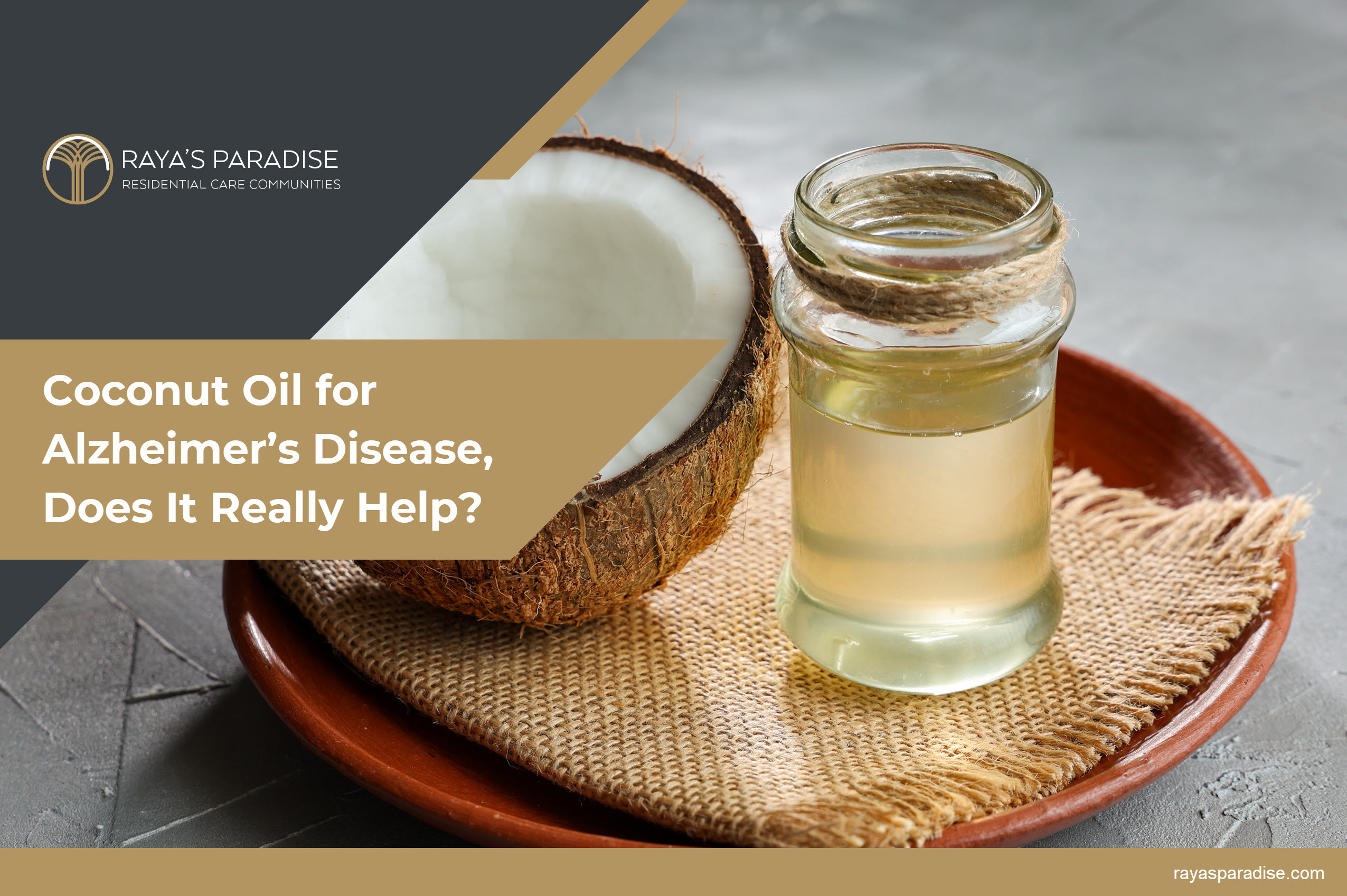
Coconut Oil for Alzheimer’s Disease, Does It Really Help?
- Coconut oil has not been proven to cure, reverse or stop Alzheimer’s disease.
- The theory behind coconut oil involves ketones, an alternative energy source the brain can use when glucose metabolism is impaired.
- Coconut oil, purified MCT products and medically supervised ketogenic diets are not interchangeable.
- Small studies have reported possible cognitive benefits, but the evidence remains limited and inconsistent.
- A 24-week randomized trial found no overall cognitive improvement from virgin coconut oil compared with canola oil.
- The same trial did not find significant differences in lipid profiles or HbA1c at the tested dose, but one study cannot establish safety for every older adult.
- Coconut oil should not replace prescribed treatment, balanced nutrition, physical activity, medical follow-up or meaningful social engagement.
Claims about coconut oil and Alzheimer’s disease have circulated for years.
Families may encounter personal stories describing clearer thinking, better conversation or improved daily functioning after coconut oil was added to a loved one’s diet. These stories can feel especially compelling when conventional treatments have not produced the improvements a family hoped to see.
There is a scientific reason researchers have been interested in coconut oil.
The brain can use ketones as an alternative energy source, and certain dietary fats can increase ketone production. However, a plausible biological explanation is not the same as a proven treatment.
Current research does not establish coconut oil as a treatment that stops, reverses or reliably slows Alzheimer’s disease.
Some small studies have reported possible cognitive benefits, but a larger randomized trial found no overall improvement after 24 weeks. Coconut oil also contains a substantial amount of saturated fat, which may be relevant for people with high LDL cholesterol, cardiovascular disease, diabetes or other health concerns.
Families deserve hope, but that hope should not be exploited by unsupported treatment claims.
Before adding coconut oil, MCT oil or a restrictive diet to an Alzheimer’s care plan, speak with the person’s physician or registered dietitian.
Families who need consistent nutrition support, medication oversight and dementia-informed routines can explore memory care in Orange County or memory care in Los Angeles.

Does coconut oil help Alzheimer’s disease?
The most accurate answer is that researchers have identified a possible biological mechanism, but clinical studies have not shown that coconut oil reliably improves Alzheimer’s symptoms or changes the course of the disease.
A 2023 randomized, placebo-controlled trial published in the Journal of Alzheimer’s Disease enrolled 120 people with mild-to-moderate Alzheimer’s disease in Sri Lanka.
Participants received either 30 mL of virgin coconut oil or canola oil each day for 24 weeks.
The trial found no overall cognitive improvement from virgin coconut oil compared with the control oil.
An exploratory analysis found improved Mini-Mental State Examination scores among participants who carried the APOE ε4 gene variant. This subgroup finding is interesting, but it does not prove that coconut oil benefits APOE ε4 carriers. It must be confirmed in additional trials designed to test that question.
The study also had a 30 percent attrition rate, meaning a substantial portion of participants did not complete it.
Attrition can make trial results more difficult to interpret, especially when researchers are examining subgroup effects.
A 2024 systematic review and meta-analysis evaluated seven studies involving coconut oil or related metabolites and reported favorable results across certain cognitive measures.
However, the studies differed in their interventions, populations, doses, duration and testing methods. Those differences limit how confidently the findings can be applied to everyday Alzheimer’s care.
The practical conclusion for families is straightforward. Coconut oil remains an area of research, but it is not an evidence-based treatment for reversing or stopping Alzheimer’s disease.
For a broader explanation of the condition, diagnosis and expected changes, read Alzheimer’s 101.
Why researchers study ketones and Alzheimer’s disease
Glucose is a major energy source for the brain. Alzheimer’s disease is associated with changes in how certain parts of the brain use glucose.
This has led researchers to investigate whether ketones could provide an alternative source of energy for brain cells.
Ketones are produced when the body breaks down fat under certain metabolic conditions.
Medium-chain triglycerides, commonly called MCTs, are absorbed and processed differently from many longer-chain dietary fats and may increase ketone availability.
This mechanism explains why researchers study ketogenic diets, purified MCT formulations and other exogenous ketone interventions.
It does not establish that ordinary coconut oil improves memory, independence or disease progression.
Coconut oil and MCT oil are not the same
Coconut oil contains several types of fatty acids. Although it is frequently promoted as an MCT-rich food, much of its fat consists of lauric acid.
Lauric acid is metabolized differently from the shorter-chain fats commonly used in clinical MCT products.
Purified MCT oil may contain higher concentrations of caprylic acid or capric acid. These fats generally increase ketone production more efficiently than coconut oil.
Results from a study involving a purified MCT formulation therefore cannot automatically be applied to coconut oil purchased at a grocery store.
Ketogenic diets are also different
A therapeutic ketogenic diet requires substantial changes to carbohydrate, fat and protein intake.
Adding coconut oil to oatmeal or another meal does not create the same metabolic state.
Restrictive diets can also be difficult for older adults who have diabetes, appetite loss, gastrointestinal problems, chewing difficulty, swallowing concerns or unintended weight loss.
A major dietary change should be planned with the person’s physician and a registered dietitian familiar with older-adult nutrition.

What coconut oil and MCT studies actually found
Research into coconut oil, MCT products and exogenous ketones includes several different types of evidence.
Understanding the difference between them helps families avoid overinterpreting headlines and personal testimonials.
Personal reports and caregiver stories
Many coconut oil claims began with caregiver observations. A family member added coconut oil to a person’s diet, then noticed better conversation, improved test performance or an easier time completing daily tasks.
These experiences may be meaningful to the families involved, but they cannot establish cause and effect.
Alzheimer’s symptoms can fluctuate. Sleep, hydration, infections, medication changes, anxiety, testing conditions and caregiver expectations can all influence how a person functions on a particular day.
Small pilot studies
A small 2018 pilot study published in the Journal of Alzheimer’s Disease examined 44 people with Alzheimer’s disease who were randomized into two groups of 22.
Participants followed either a Mediterranean diet or a coconut-oil-enriched Mediterranean diet for 21 days. Researchers reported changes in certain cognitive measures.
The study tested a coconut-oil-enriched dietary pattern rather than coconut oil completely in isolation. It was also brief and involved a small group.
Those limitations make it impossible to determine whether the apparent effects would continue over time or produce meaningful improvements in daily independence.
The 24-week randomized trial
The larger 2023 trial did not find an overall cognitive benefit from 30 mL of virgin coconut oil per day when compared with canola oil.
This finding carries more weight than an uncontrolled testimonial or a very short pilot study because the trial used a randomized comparison group and followed participants for six months.
The APOE ε4 subgroup result provides a possible direction for future investigation.
It should not be used to recommend coconut oil based on a person’s genetic status.
Systematic reviews of MCTs and exogenous ketones
A 2024 systematic review of MCT interventions found that studies used widely different protocols and were affected by design limitations, risk of bias and potential conflicts of interest.
The authors concluded that metabolic changes associated with MCT intake did not consistently translate into measurable clinical improvement.
A separate systematic review published in Nutrition Reviews evaluated 13 trials involving exogenous ketone interventions.
Because the studies differed substantially in their products, doses, durations and outcome measures, the researchers used a narrative synthesis rather than combining the findings into one definitive estimate.
Two of the review’s six authors were affiliated with Nestlé Health Science, a company involved in medical nutrition products.
That industry involvement does not invalidate the peer-reviewed paper, and its conclusions were appropriately cautious. However, the affiliation is relevant when weighing the evidence and reinforces the importance of comparing its conclusions with independent research.
Together, these reviews suggest that ketone-based interventions deserve continued study.
They do not support presenting coconut oil as a standard symptomatic treatment for Alzheimer’s disease.
Can coconut oil reverse or slow Alzheimer’s disease?
There is no reliable evidence that coconut oil reverses Alzheimer’s disease.
There is also insufficient evidence to conclude that it slows the underlying disease process.
Words such as “reversal,” “cure” and “recovery” are particularly misleading in this context.
A person may temporarily appear more alert or perform better on a cognitive assessment without experiencing a change in the underlying neurodegenerative disease.
Alzheimer’s symptoms also vary from day to day.
Someone may communicate more clearly after sleeping well, eating a full meal, recovering from an infection or spending time in a calm environment. That improvement should be appreciated, but it should not automatically be attributed to a new food or supplement.
Understanding expected progression can help families distinguish temporary fluctuations from longer-term changes.
Our guide to the stages of dementia provides additional context.
Is coconut oil safe for someone with Alzheimer’s?
Coconut oil is a food, but that does not mean large or treatment-style quantities are appropriate for everyone.
Its nutritional impact depends on the serving size, the person’s overall eating pattern and their individual medical history.
What the randomized trial found about lipids and blood sugar
In the 24-week randomized trial, consuming 30 mL of virgin coconut oil per day did not significantly worsen lipid profiles or HbA1c compared with the canola-oil control.
The researchers described the intervention as safe within that trial.
This is important fair-balance information, but it should not be interpreted as proof that high coconut-oil intake is safe for every person.
It was one study in a specific population, and 30 percent of enrolled participants did not complete the trial.
Saturated fat and LDL cholesterol
Coconut oil is predominantly saturated fat. The American Heart Association recommends limiting saturated fat because it can raise LDL cholesterol, which is associated with cardiovascular risk.
Individual medical guidance is especially important when a person has high LDL cholesterol, coronary artery disease, a history of heart attack or stroke, diabetes, peripheral vascular disease or multiple cardiovascular risk factors.
The effect of adding coconut oil also depends on what it replaces.
Replacing unsaturated fats such as olive oil with coconut oil may have a different health impact than adding a small amount to a diet that previously contained a less suitable fat.
Digestive side effects
Introducing a large amount of coconut oil or MCT oil quickly can cause nausea, stomach cramping, loose stools or diarrhea.
Diarrhea may contribute to dehydration, weakness and falls in a medically vulnerable older adult.
When a clinician approves coconut oil as an ordinary food, introduce a small amount and monitor tolerance.
Do not begin with the large quantities sometimes promoted through testimonials or supplement marketing.
Calories, appetite and nutrition quality
Oil is calorie dense. Additional calories may be useful for someone struggling to maintain weight, but oil can also displace foods that provide protein, fiber, vitamins and minerals.
As dementia progresses, appetite changes, altered taste, difficulty using utensils and swallowing problems may further affect intake.
Read why people with dementia have trouble eating for practical guidance.
Swallowing safety
Do not give spoonfuls of oil to someone with known or suspected swallowing difficulty without clinical guidance.
Coughing during meals, a wet-sounding voice, recurrent chest infections or food remaining in the mouth may indicate dysphagia and should be evaluated.
Questions to ask before trying coconut oil
Before making coconut oil a regular part of your loved one’s diet, discuss the following issues with their physician or registered dietitian:
- Does the person have high LDL cholesterol or cardiovascular risk?
- Would coconut oil replace a healthier unsaturated fat?
- Could additional fat worsen diarrhea, reflux, nausea or gallbladder symptoms?
- Is the person losing weight or consuming too few calories?
- Does the person have diabetes that requires dietary monitoring?
- Are there signs of chewing or swallowing difficulty?
- What specific outcome are we hoping to improve?
- How long will we monitor the change before deciding whether to stop?
Keep the person’s clinician informed about supplements, special diets and over-the-counter products.
This matters even when something is marketed as natural.
Families who need help preparing for the conversation may benefit from our guide to talking to a parent’s doctor about Alzheimer’s disease.
What supports brain health more reliably?
No single food has been proven to prevent or cure Alzheimer’s disease. A broader care plan is more useful than concentrating on one heavily promoted ingredient.
A balanced dietary pattern
Research into Mediterranean-style and MIND-style eating patterns focuses on combinations of vegetables, leafy greens, berries, whole grains, beans, nuts, fish and unsaturated plant oils. These patterns have stronger support for general cardiovascular and cognitive health than coconut oil as an isolated intervention.
This does not mean food can cure Alzheimer’s disease. It means that an overall eating pattern is generally a more meaningful target than adding a single ingredient.
Physical activity
Movement supports cardiovascular fitness, strength, balance, sleep and emotional well-being. The appropriate activity depends on mobility, fall risk and medical conditions.
Review exercise benefits for people with dementia for realistic ways to encourage movement.
Music, conversation, familiar household tasks, art, gardening and simple games may support engagement and quality of life. Activities should match the person’s current abilities and interests rather than testing what they can no longer do.
For practical ideas that can be adjusted to a person’s interests and current abilities, explore these activities to do with a loved one who has dementia.
Medical treatment and regular review
Families should discuss available Alzheimer’s treatments with a qualified dementia specialist. Treatment decisions depend on the diagnosis, disease stage, health history, test results, potential risks and the person’s care goals.
Do not stop a prescribed medication because an online source claims coconut oil is a natural replacement. Dietary approaches and prescription treatments are not interchangeable.
How to evaluate claims about Alzheimer’s supplements and foods
Use a critical framework whenever a website, video or salesperson claims that a food or supplement improves dementia.
Start by asking whether the claim was tested in people rather than cells or animals. Check whether the research included a comparison group, how many people participated and how long the study lasted. A brief improvement on a cognitive test may not translate into lasting function or greater independence.
Look for replication by independent researchers. One study rarely settles a medical question. Also confirm that the study tested the product being promoted. Findings involving purified MCT oil, ketone esters or a medically supervised ketogenic diet cannot automatically be applied to ordinary coconut oil.
Finally, consider financial incentives. A source selling the oil, supplement, course or treatment plan has a reason to emphasize favorable findings. That does not automatically make every statement false, but it should lead readers to examine the supporting evidence more carefully.
When nutrition and dementia care become difficult at home
As Alzheimer’s disease progresses, nutrition is rarely just a question of selecting the healthiest food.
Families may need to manage meal refusal, forgotten meals, dehydration, pacing, weight loss, unsafe food choices, medication schedules and swallowing concerns.
These challenges can become overwhelming when one caregiver is responsible for every meal, medication and safety decision.
If you are skipping your own meals, losing sleep, becoming increasingly irritable or feeling unable to step away, review the signs of caregiver burnout.
Caregiver strain is part of the care plan, not a separate issue.
Short-term support may provide time to stabilize nutrition routines, recover after hospitalization or evaluate longer-term needs.
Families in Orange County can explore respite care in Orange County. Los Angeles families can review respite care in Los Angeles.
Specialized Memory Care in Orange County and Los Angeles
People living with Alzheimer’s disease often benefit from consistent meal routines, familiar foods, calm encouragement and careful observation.
A specialized memory care environment can help families manage changes in appetite, hydration, medication routines, mobility and behavior without relying on an unproven food as the solution.
At Raya’s Paradise, care planning focuses on the whole person, including daily structure, meaningful engagement, safety supervision and ongoing communication with families as needs change.
Families seeking local options can explore memory care in San Clemente or view our Los Angeles communities.
Next Steps
If nutrition, medication oversight or dementia-related safety needs are becoming difficult to manage at home, contact our team through the Raya’s Paradise contact page.
Call (949) 420-9898 for Orange County or (310) 289-8834 for Los Angeles.
You can also email Info@RayasParadise.com.
To evaluate care in person, schedule an Orange County tour or a Los Angeles tour.
Our Orange County Senior Assisted Living Facility with Specialized Memory Care
Our Los Angeles Assisted Living Residences with Specialized Memory Care
Sources & Additional Resources
- Fernando, Malika G., et al. “Effect of Virgin Coconut Oil Supplementation on Cognition of Individuals with Mild-to-Moderate Alzheimer’s Disease in Sri Lanka (VCO-AD Study): A Randomized Placebo-Controlled Trial.” Journal of Alzheimer’s Disease, 2023.
- Bafail, Duaa, et al. “Impact of Coconut Oil and Its Bioactive Metabolites in Alzheimer’s Disease and Dementia: A Systematic Review and Meta-Analysis.” Diseases, 2024.
- Meer, Nike, and Tobias Fischer. “Medium-Chain Triglycerides for the Symptomatic Treatment of Dementia-Related Diseases: A Systematic Review.” Journal of Nutrition and Metabolism, 2024.
- Krolak-Salmon, Pierre, et al. “Efficacy and Safety of Exogenous Ketones in People With Mild Neurocognitive Disorder and Alzheimer’s Disease: A Systematic Literature Review.” Nutrition Reviews, 2025. Two authors were affiliated with Nestlé Health Science.
- de la Rubia Ortí, José Enrique, et al. “Improvement of Main Cognitive Functions in Patients With Alzheimer’s Disease After Treatment With Coconut Oil Enriched Mediterranean Diet.” Journal of Alzheimer’s Disease, 2018.
- National Institute on Aging. “What Do We Know About Diet and Prevention of Alzheimer’s Disease?” National Institutes of Health.
- Alzheimer’s Association. “Alternative Treatments for Alzheimer’s and Dementia.” Alzheimer’s Association.
- American Heart Association. “Saturated Fat.” American Heart Association.
Disclaimer:
This article provides general educational information. It is not medical advice and does not recommend coconut oil as a treatment for Alzheimer’s disease. Consult a qualified clinician before changing medications, supplements or dietary fat intake, especially when the person has high cholesterol, cardiovascular disease, diabetes, swallowing difficulty or unintended weight loss.
 https://rayasparadise.com/wp-content/uploads/2013/05/Three-Big-Questions-to-Consider-After-an-Alzheimers-Diagnosis.jpg
1702
2558
Moti Gamburd
https://rayasparadise.com//wp-content/uploads/2019/07/RP-LOGO-Horizontal-Name-Only-websitetrans.png
Moti Gamburd2026-08-08 11:36:042026-08-09 20:58:17Three Big Questions to Consider After an Alzheimer's Diagnosis
https://rayasparadise.com/wp-content/uploads/2013/05/Three-Big-Questions-to-Consider-After-an-Alzheimers-Diagnosis.jpg
1702
2558
Moti Gamburd
https://rayasparadise.com//wp-content/uploads/2019/07/RP-LOGO-Horizontal-Name-Only-websitetrans.png
Moti Gamburd2026-08-08 11:36:042026-08-09 20:58:17Three Big Questions to Consider After an Alzheimer's Diagnosis https://rayasparadise.com/wp-content/uploads/2013/11/Five-Myths-About-Alzheimers-Disease-Whats-Actually-True.jpg
1697
2546
Moti Gamburd
https://rayasparadise.com//wp-content/uploads/2019/07/RP-LOGO-Horizontal-Name-Only-websitetrans.png
Moti Gamburd2026-08-07 16:45:112026-08-07 18:43:03Five Myths About Alzheimer's Disease
https://rayasparadise.com/wp-content/uploads/2013/11/Five-Myths-About-Alzheimers-Disease-Whats-Actually-True.jpg
1697
2546
Moti Gamburd
https://rayasparadise.com//wp-content/uploads/2019/07/RP-LOGO-Horizontal-Name-Only-websitetrans.png
Moti Gamburd2026-08-07 16:45:112026-08-07 18:43:03Five Myths About Alzheimer's Disease https://rayasparadise.com/wp-content/uploads/2026/08/Should-You-Seek-an-Alzheimers-Diagnosis.jpg
1702
2551
Moti Gamburd
https://rayasparadise.com//wp-content/uploads/2019/07/RP-LOGO-Horizontal-Name-Only-websitetrans.png
Moti Gamburd2026-08-06 06:39:192026-08-06 21:28:27Should You Seek an Alzheimer's Diagnosis?
https://rayasparadise.com/wp-content/uploads/2026/08/Should-You-Seek-an-Alzheimers-Diagnosis.jpg
1702
2551
Moti Gamburd
https://rayasparadise.com//wp-content/uploads/2019/07/RP-LOGO-Horizontal-Name-Only-websitetrans.png
Moti Gamburd2026-08-06 06:39:192026-08-06 21:28:27Should You Seek an Alzheimer's Diagnosis? https://rayasparadise.com/wp-content/uploads/2013/02/How-to-Talk-With-Someone-Who-Has-Alzheimers.jpg
1700
2553
Moti Gamburd
https://rayasparadise.com//wp-content/uploads/2019/07/RP-LOGO-Horizontal-Name-Only-websitetrans.png
Moti Gamburd2026-08-06 04:00:212026-08-06 15:23:18How to Talk with Someone Who Has Alzheimer's
https://rayasparadise.com/wp-content/uploads/2013/02/How-to-Talk-With-Someone-Who-Has-Alzheimers.jpg
1700
2553
Moti Gamburd
https://rayasparadise.com//wp-content/uploads/2019/07/RP-LOGO-Horizontal-Name-Only-websitetrans.png
Moti Gamburd2026-08-06 04:00:212026-08-06 15:23:18How to Talk with Someone Who Has Alzheimer's https://rayasparadise.com/wp-content/uploads/2013/09/Coconut-Oil-for-Alzheimers-Disease.jpg
1697
2551
Moti Gamburd
https://rayasparadise.com//wp-content/uploads/2019/07/RP-LOGO-Horizontal-Name-Only-websitetrans.png
Moti Gamburd2026-08-05 04:00:472026-08-05 21:50:26Coconut Oil for Alzheimer's Disease?
https://rayasparadise.com/wp-content/uploads/2013/09/Coconut-Oil-for-Alzheimers-Disease.jpg
1697
2551
Moti Gamburd
https://rayasparadise.com//wp-content/uploads/2019/07/RP-LOGO-Horizontal-Name-Only-websitetrans.png
Moti Gamburd2026-08-05 04:00:472026-08-05 21:50:26Coconut Oil for Alzheimer's Disease? https://rayasparadise.com/wp-content/uploads/2013/10/How-to-Tell-When-a-Loved-One-With-Dementia-Is-Sick.jpg
1697
2555
Moti Gamburd
https://rayasparadise.com//wp-content/uploads/2019/07/RP-LOGO-Horizontal-Name-Only-websitetrans.png
Moti Gamburd2026-03-10 12:43:002026-03-18 01:37:19How to Tell When a Loved One with Dementia Is Sick
https://rayasparadise.com/wp-content/uploads/2013/10/How-to-Tell-When-a-Loved-One-With-Dementia-Is-Sick.jpg
1697
2555
Moti Gamburd
https://rayasparadise.com//wp-content/uploads/2019/07/RP-LOGO-Horizontal-Name-Only-websitetrans.png
Moti Gamburd2026-03-10 12:43:002026-03-18 01:37:19How to Tell When a Loved One with Dementia Is Sick https://rayasparadise.com/wp-content/uploads/2013/08/Does-Computer-Use-Help-With-Dementia-Symptoms.jpg
1700
2557
Moti Gamburd
https://rayasparadise.com//wp-content/uploads/2019/07/RP-LOGO-Horizontal-Name-Only-websitetrans.png
Moti Gamburd2026-03-09 06:49:072026-03-18 00:31:00Does Computer Use Help with Dementia Symptoms?
https://rayasparadise.com/wp-content/uploads/2013/08/Does-Computer-Use-Help-With-Dementia-Symptoms.jpg
1700
2557
Moti Gamburd
https://rayasparadise.com//wp-content/uploads/2019/07/RP-LOGO-Horizontal-Name-Only-websitetrans.png
Moti Gamburd2026-03-09 06:49:072026-03-18 00:31:00Does Computer Use Help with Dementia Symptoms? https://rayasparadise.com/wp-content/uploads/2013/02/Coping-With-Dementia-Behavior.jpeg
1702
2555
Moti Gamburd
https://rayasparadise.com//wp-content/uploads/2019/07/RP-LOGO-Horizontal-Name-Only-websitetrans.png
Moti Gamburd2026-03-08 12:16:332026-03-16 16:35:15Coping With Dementia Behavior
https://rayasparadise.com/wp-content/uploads/2013/02/Coping-With-Dementia-Behavior.jpeg
1702
2555
Moti Gamburd
https://rayasparadise.com//wp-content/uploads/2019/07/RP-LOGO-Horizontal-Name-Only-websitetrans.png
Moti Gamburd2026-03-08 12:16:332026-03-16 16:35:15Coping With Dementia Behavior https://rayasparadise.com/wp-content/uploads/2013/09/Respect-for-a-Senior-With-Dementia.jpg
1700
2557
Moti Gamburd
https://rayasparadise.com//wp-content/uploads/2019/07/RP-LOGO-Horizontal-Name-Only-websitetrans.png
Moti Gamburd2026-03-07 03:14:072026-03-16 15:47:50Respect for a Senior with Dementia
https://rayasparadise.com/wp-content/uploads/2013/09/Respect-for-a-Senior-With-Dementia.jpg
1700
2557
Moti Gamburd
https://rayasparadise.com//wp-content/uploads/2019/07/RP-LOGO-Horizontal-Name-Only-websitetrans.png
Moti Gamburd2026-03-07 03:14:072026-03-16 15:47:50Respect for a Senior with Dementia https://rayasparadise.com/wp-content/uploads/2013/08/Why-Dementia-Patients-Have-Trouble-With-Eating.jpeg
1700
2553
Moti Gamburd
https://rayasparadise.com//wp-content/uploads/2019/07/RP-LOGO-Horizontal-Name-Only-websitetrans.png
Moti Gamburd2026-03-05 11:11:482026-03-16 02:07:05Why Dementia Patients Have Trouble with Eating
https://rayasparadise.com/wp-content/uploads/2013/08/Why-Dementia-Patients-Have-Trouble-With-Eating.jpeg
1700
2553
Moti Gamburd
https://rayasparadise.com//wp-content/uploads/2019/07/RP-LOGO-Horizontal-Name-Only-websitetrans.png
Moti Gamburd2026-03-05 11:11:482026-03-16 02:07:05Why Dementia Patients Have Trouble with Eating https://rayasparadise.com/wp-content/uploads/2013/05/Exercises-for-the-Later-Stages-of-Dementia.jpg
1702
2553
Moti Gamburd
https://rayasparadise.com//wp-content/uploads/2019/07/RP-LOGO-Horizontal-Name-Only-websitetrans.png
Moti Gamburd2026-03-04 11:13:202026-03-15 21:09:55Exercises for the Later Stages of Dementia
https://rayasparadise.com/wp-content/uploads/2013/05/Exercises-for-the-Later-Stages-of-Dementia.jpg
1702
2553
Moti Gamburd
https://rayasparadise.com//wp-content/uploads/2019/07/RP-LOGO-Horizontal-Name-Only-websitetrans.png
Moti Gamburd2026-03-04 11:13:202026-03-15 21:09:55Exercises for the Later Stages of Dementia https://rayasparadise.com/wp-content/uploads/2026/03/Addressing-Agitation-in-Dementia.jpg
1700
2548
Moti Gamburd
https://rayasparadise.com//wp-content/uploads/2019/07/RP-LOGO-Horizontal-Name-Only-websitetrans.png
Moti Gamburd2026-03-03 03:47:592026-03-15 19:55:59Addressing Agitation in Someone Who Has Dementia
https://rayasparadise.com/wp-content/uploads/2026/03/Addressing-Agitation-in-Dementia.jpg
1700
2548
Moti Gamburd
https://rayasparadise.com//wp-content/uploads/2019/07/RP-LOGO-Horizontal-Name-Only-websitetrans.png
Moti Gamburd2026-03-03 03:47:592026-03-15 19:55:59Addressing Agitation in Someone Who Has Dementia https://rayasparadise.com/wp-content/uploads/2026/03/All-About-Lewy-Body-Dementia.jpg
1702
2555
Moti Gamburd
https://rayasparadise.com//wp-content/uploads/2019/07/RP-LOGO-Horizontal-Name-Only-websitetrans.png
Moti Gamburd2026-03-02 04:28:062026-03-15 17:53:10All About Lewy Body Dementia
https://rayasparadise.com/wp-content/uploads/2026/03/All-About-Lewy-Body-Dementia.jpg
1702
2555
Moti Gamburd
https://rayasparadise.com//wp-content/uploads/2019/07/RP-LOGO-Horizontal-Name-Only-websitetrans.png
Moti Gamburd2026-03-02 04:28:062026-03-15 17:53:10All About Lewy Body Dementia https://rayasparadise.com/wp-content/uploads/2013/05/Exercise-Benefits-for-Dementia-Patients.jpg
1703
2555
Moti Gamburd
https://rayasparadise.com//wp-content/uploads/2019/07/RP-LOGO-Horizontal-Name-Only-websitetrans.png
Moti Gamburd2026-03-01 02:39:032026-03-15 16:50:15Exercise Benefits for Dementia Patients - Safe Activities, Routines, and Memory Care Support
https://rayasparadise.com/wp-content/uploads/2013/05/Exercise-Benefits-for-Dementia-Patients.jpg
1703
2555
Moti Gamburd
https://rayasparadise.com//wp-content/uploads/2019/07/RP-LOGO-Horizontal-Name-Only-websitetrans.png
Moti Gamburd2026-03-01 02:39:032026-03-15 16:50:15Exercise Benefits for Dementia Patients - Safe Activities, Routines, and Memory Care Support https://rayasparadise.com/wp-content/uploads/2013/08/Giving-Dignity-to-Dementia-Patients.jpg
1697
2553
Moti Gamburd
https://rayasparadise.com//wp-content/uploads/2019/07/RP-LOGO-Horizontal-Name-Only-websitetrans.png
Moti Gamburd2026-01-14 04:00:032026-01-15 18:26:55Giving Dignity to Dementia Patients
https://rayasparadise.com/wp-content/uploads/2013/08/Giving-Dignity-to-Dementia-Patients.jpg
1697
2553
Moti Gamburd
https://rayasparadise.com//wp-content/uploads/2019/07/RP-LOGO-Horizontal-Name-Only-websitetrans.png
Moti Gamburd2026-01-14 04:00:032026-01-15 18:26:55Giving Dignity to Dementia Patients
