
Contents
- Who to Report Assisted Living Neglect to in California, and When to Call the Ombudsman, APS or Licensing
- The Ombudsman Is Often Who to Report Assisted Living Neglect to in California First
- Where APS Fits
- State Licensing
- Reading Past Investigations
- Know What to Look for When Choosing a Senior Care Community
- Sources & Additional Resources
- More Assisted Living Resources
- Who to Report Assisted Living Neglect to in California, and When to Call the Ombudsman, APS or Licensing
- When a Parent Is Running Out of Money in Assisted Living in California
- Alternatives to Nursing Home Care in California Through PACE, ALW, IHSS and MSSP
- Hospital Discharge to Assisted Living in California and the Admission Checks That Matter
- Choosing Assisted Living for Senior Couples
- History of Assisted Living |How the Option of Assisted Living Developed
- Choosing Assisted Living for Those with Alzheimer's or Dementia
- Paying for Assisted Living, Costs, Insurance, VA Benefits, and Smart Ways to Plan
- Six Myths About Assisted Living - What Senior Living Really Looks Like
- The Benefits of Assisted Living Over In-Home Care
- How to Care for a Loved One in Assisted Living From Afar
- Making a Smooth Transition to Assisted Living
- The Benefits of Small Assisted Living Facilities
- Tips for Selling Your Home to Pay for Assisted Living
- Signs It’s Time for Assisted Living, How to Know When Extra Support Is Needed
Who to Report Assisted Living Neglect to in California, and When to Call the Ombudsman, APS or Licensing

Your dad has complained about waiting too long for help getting to the bathroom. When you visit, his clothes are soiled and nobody seems to know when they were last changed. Then you notice a bruise on his arm that staff can’t explain. You’ve already spoken with the administrator, but you’re not seeing much improvement.
Now you’re wondering who to report assisted living neglect to in California. Should you call the ombudsman, Adult Protective Services or the state agency that licenses the community?
All three have roles in protecting older adults, but they handle different situations. The ombudsman helps residents with care concerns and reports of abuse inside facilities. Licensing investigates possible violations of state rules. APS generally handles abuse involving people living outside long-term care facilities. If your dad is in immediate danger, call 911.
You don’t have to choose only one agency. The important thing is understanding what each can do so your concern reaches someone with the authority to act.
The Ombudsman Is Often Who to Report Assisted Living Neglect to in California First
The California Long-Term Care Ombudsman Program is often a good first call when something is wrong inside assisted living.
Its representatives help residents with concerns involving daily care, personal rights, health, safety and the way they’re treated.
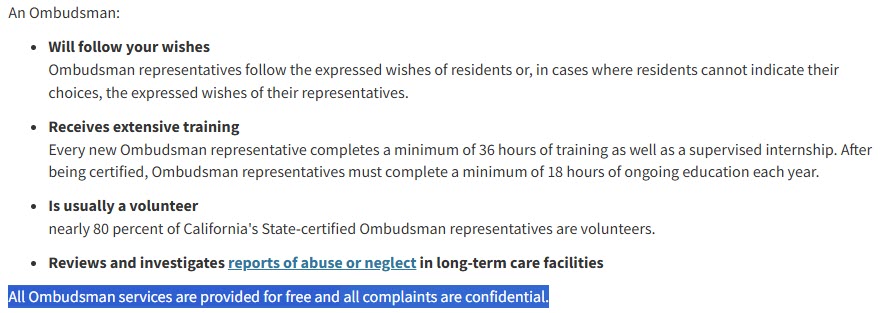
The program also reviews and investigates reports of abuse or neglect in long-term care facilities.
That includes assisted living communities, which California generally licenses as residential care facilities for the elderly.
So if your dad regularly waits for assistance, isn’t receiving appropriate personal care or says staff are treating him disrespectfully, the ombudsman can help.
You can also contact the program about improper transfers, discharge concerns or suspected financial abuse.
There’s no charge to use the service.
The state says, “All Ombudsman services are provided for free and all complaints are confidential.”
That confidentiality is important, particularly when your parent worries that speaking up might make life harder.
Ombudsman representatives follow the wishes of residents or, when residents cannot express their choices, their representatives.
How to Reach the Ombudsman
The statewide Long-Term Care Ombudsman Hotline is 1-800-231-4024.
It is available 24 hours a day, seven days a week to receive calls and refer complaints involving long-term care residents.
California also has local ombudsman programs.
Assisted living communities must post the local program’s contact information, along with the statewide number, somewhere residents and visitors can see it.
If your dad lives in Orange County, our senior resources guide includes contact information under In-Care Facility Concerns.
You don’t need to have the entire situation figured out before calling.
Explain what you’ve seen, what your dad has told you and what you’re concerned might happen if the problem continues.
Write Down What Happened
A general statement that the care is poor may be difficult to investigate.
Specific incidents give the person receiving your complaint somewhere to begin.
Write down the dates and times your dad asked for help, what he needed and how long it took someone to respond.
Note whether the problem happened once or repeatedly.
If you spoke with staff, record whom you contacted and what they said.
Photographs can help when they’re appropriate and respect other residents’ privacy.
Save relevant emails, text messages and written replies from the community.
If your dad can describe what happened, record his account in his own words.
You don’t need to turn it into a polished statement.
His experience is an important part of understanding the concern.
What the Ombudsman Can and Can’t Do
An ombudsman advocates for the resident.
Representatives can discuss concerns, visit facilities, investigate certain complaints and work toward resolving problems in ways consistent with the resident’s wishes.
They can also explain residents’ rights and help you understand where another agency may need to become involved.
What they don’t do is issue state licensing citations.
The ombudsman and Community Care Licensing have different responsibilities, so the best response sometimes involves contacting both.
Do You Have to Complain to the Administrator First?
No.
For an ordinary disagreement about meals, housekeeping or a service schedule, talking with the administrator may produce a quick solution.
But contacting management isn’t a required first step before seeking outside help.
Don’t delay outside reporting when you suspect abuse, serious neglect or an immediate safety problem.
You can contact the ombudsman, licensing or law enforcement directly, depending on the circumstances.
If your dad needs urgent medical attention, seek appropriate medical help immediately rather than waiting for a complaint investigation.
California also protects residents from retaliation.
Under Title 22 section 87468.2, residents must be free from interference, coercion, discrimination and retaliation when exercising their rights, including making complaints.
If your dad says he’s afraid staff will be angry with him, tell the agency receiving the complaint.
That concern deserves attention, too.

Where APS Fits
Adult Protective Services sounds like the obvious agency for any report of elder abuse.
But in California, where the abuse happened makes a difference.
Every county has an APS program.
The California Department of Social Services says those programs help “elder adults (60 years and older)” and dependent adults who may be experiencing abuse, neglect or exploitation.
APS generally investigates situations involving people living in private homes, apartments, hotels or other community settings.
It can also serve people who are experiencing homelessness or are at risk of it.
The same state guidance assigns reports of abuse occurring inside nursing homes and residential care facilities for the elderly to the Office of the State Long-Term Care Ombudsman.
That makes the ombudsman the more appropriate first contact for suspected neglect inside your dad’s assisted living community.
Calling APS doesn’t automatically mean an investigation will be handled by APS itself.
When APS Is the Right Call
Imagine your dad hasn’t moved into assisted living yet.
He’s living alone, missing meals and struggling to manage his medication.
A neighbor has also noticed someone taking money from his bank account.
Those are the kinds of concerns APS may investigate.
The agency addresses abuse, neglect, self-neglect and exploitation of older or dependent adults living in the community.
For help finding your county’s APS program, call 1-833-401-0832 and enter the relevant five-digit ZIP code when prompted.
The state says the reporting number operates 24 hours a day, seven days a week.
If you’re uncertain which agency has jurisdiction, explain the person’s living situation when you call.
APS and other agencies have referral and cross-reporting responsibilities, but a clear description helps the report reach the right place sooner.
When to Call the Police or 911
If someone is in immediate danger, call 911.
Don’t wait for the ombudsman to return a call or for a licensing investigation to begin.
Suspected physical or sexual abuse may also need a report to local law enforcement.
California’s licensing complaint guidance specifically advises reporting physical or sexual abuse to police in addition to filing a licensing complaint.
These reports can happen alongside an ombudsman complaint.
You don’t have to decide that only one agency should know what happened.

State Licensing
California assisted living communities are licensed by the Department of Social Services through its Community Care Licensing Division, commonly called CCLD.
Licensing looks at a different question from the ombudsman.
Rather than primarily advocating for your dad, its staff investigate possible violations of the rules a licensed community must follow.
That can include concerns about resident care, supervision, staffing requirements, medication practices or residents’ rights.
When an investigation substantiates a violation, licensing has enforcement tools that can include citations and other regulatory actions.
California gives residents the right to contact licensing directly.
The state’s assisted living personal rights form, LIC 613C, says they have the right “To contact the State Department of Social Services, the long-term care ombudsman, or both.”
That last phrase is useful.
You don’t have to wait for an ombudsman to finish helping your dad before asking the licensing agency to look into a suspected violation.
How to File a Licensing Complaint
The Community Care Licensing complaint hotline is 844-538-8766.
You can also email letusno@dss.ca.gov or use the state’s online complaint information page.
When you file, identify the assisted living community and describe the issue clearly.
Include the dates of the incidents, what you witnessed and whether the concern is ongoing.
For example, instead of saying that staff never help your dad, explain that he waited approximately an hour after requesting bathroom assistance on two specific mornings.
Include any relevant written communications.
The state says a complainant’s name will remain anonymous unless permission is given to use it.
If you want updates, ask what contact information the agency needs and how confidentiality will be handled.
Keep the complaint reference number, if one is provided.
Ask how you can follow up and whether the local regional licensing office will handle the investigation.
Ombudsman or Licensing, or Both?
Think about the outcome you’re seeking.
If your dad needs someone to hear his concerns, explain his rights and advocate for changes in his daily care, the ombudsman is a strong place to begin.
If you believe the community is violating California licensing requirements, file with CCLD.
An inspection or regulatory investigation may be appropriate even when staff have promised to fix the issue.
For serious or repeated concerns, both calls may make sense.
The agencies have different jobs, and using one doesn’t automatically replace the other.
You also don’t need proof beyond doubt before making a good-faith report.
Describe what you know, distinguish facts from suspicions and let the appropriate agency decide what to investigate.
Reading Past Investigations
You can also learn from complaints and inspections that happened before your family became concerned.
California’s facility search provides licensing information about assisted living communities.
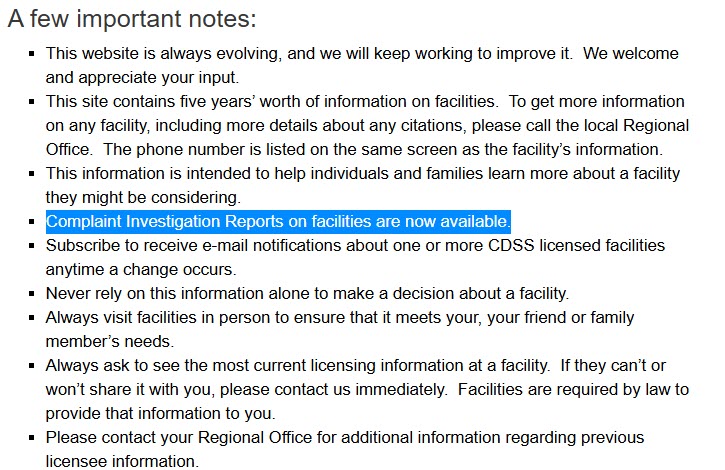
The state says, “Complaint Investigation Reports on facilities are now available.”
Its website contains five years’ worth of facility information.
Start with the facility’s name and license record.
Look at the dates of investigations, the findings and whether citations were issued.
A complaint being reported is not automatically proof that a violation occurred.
Pay attention to repeated problems.
Several findings involving similar issues over time may tell you more than one isolated event.
Also look for evidence of corrective action and ask the community what changed afterward.
Online records aren’t necessarily the complete history.
The department advises contacting the local regional licensing office for additional details about facilities and citations.
This review is useful before choosing a residence, too.
It gives you questions to bring on a tour instead of relying only on photographs, reviews or the community’s own description of its care.
Know What to Look for When Choosing a Senior Care Community
When something feels wrong about a parent’s care, you deserve clear answers, not excuses or unanswered questions.
Knowing how to report concerns is important, but so is choosing a community where residents are treated with dignity and families feel comfortable speaking up.
Before making a decision, ask how caregivers respond to requests for assistance, how concerns are documented and what happens when a resident’s needs change.
At Raya’s Paradise, we believe those conversations should begin long before move-in day.
Families exploring our individualized assisted living and personal care services in Orange County can learn more about our approach to daily assistance, resident well-being and communication with loved ones.
Our San Clemente senior living residence offers a welcoming coastal setting where families can explore the care environment firsthand.
If you’re evaluating care options for a loved one, arrange a visit to our Orange County senior living community.
Meet the team, ask the difficult questions and see whether the environment feels right for your family.
If you suspect an older adult is currently experiencing abuse or neglect, contact the appropriate authorities rather than waiting for a facility tour.
Our Orange County Senior Assisted Living Community with Specialized Memory Care
Our Los Angeles Assisted Living Residences
Sources & Additional Resources
- California Department of Aging. “Long-Term Care Ombudsman (Consumer).” California Department of Aging.
- California Code of Regulations (Cornell LII). “Cal. Code Regs. Tit. 22, § 87468.2 – Additional Personal Rights of Residents in Privately Operated Facilities.” Legal Information Institute.
- California Department of Social Services. “Adult Protective Services.” California Department of Social Services.
- California Department of Social Services. “LIC 613C Personal Rights, Residential Care Facilities for the Elderly.” Community Care Licensing Division.
- California Department of Social Services. “CCLD Complaint Hotline.” Community Care Licensing Division.
- California Department of Social Services. “Facility Search Welcome.” Community Care Licensing Division.
Disclaimer: This article provides general educational information about reporting suspected elder abuse, neglect and resident rights violations in California assisted living facilities. It is not a substitute for legal advice, medical evaluation or guidance from the appropriate protective agency. The Long-Term Care Ombudsman Program, Adult Protective Services and California Community Care Licensing Division have different responsibilities and reporting procedures. Agency jurisdiction and investigative processes may vary depending on the circumstances. If you suspect abuse or neglect, contact the appropriate agency promptly. For immediate danger or a medical emergency, call 911. Reporting concerns in good faith does not require proof that a violation has occurred.
 https://rayasparadise.com/wp-content/uploads/2026/10/Reviewing-Assisted-Living-Care-Concerns-and-Resident-Rights-in-California.jpg
1769
2560
Moti Gamburd
https://rayasparadise.com//wp-content/uploads/2019/07/RP-LOGO-Horizontal-Name-Only-websitetrans.png
Moti Gamburd2026-10-22 04:54:162026-10-16 20:21:47Who to Report Assisted Living Neglect to in California, and When to Call the Ombudsman, APS or Licensing
 https://rayasparadise.com/wp-content/uploads/2026/10/Senior-Woman-Concerned-About-Running-Out-of-Money-in-Assisted-Living.jpg
1706
2560
Moti Gamburd
https://rayasparadise.com//wp-content/uploads/2019/07/RP-LOGO-Horizontal-Name-Only-websitetrans.png
Moti Gamburd2026-10-20 10:26:362026-10-20 18:19:50When a Parent Is Running Out of Money in Assisted Living in California
 https://rayasparadise.com/wp-content/uploads/2026/10/In-Home-Senior-Care-and-Alternatives-to-Nursing-Home-Placement-in-California.jpg
1707
2560
Moti Gamburd
https://rayasparadise.com//wp-content/uploads/2019/07/RP-LOGO-Horizontal-Name-Only-websitetrans.png
Moti Gamburd2026-10-18 15:03:492026-10-16 19:30:18Alternatives to Nursing Home Care in California Through PACE, ALW, IHSS and MSSP
 https://rayasparadise.com/wp-content/uploads/2026/10/Hospital-Discharge-Planning-and-Assisted-Living-Care-Assessment.jpg
1708
2560
Moti Gamburd
https://rayasparadise.com//wp-content/uploads/2019/07/RP-LOGO-Horizontal-Name-Only-websitetrans.png
Moti Gamburd2026-10-16 14:54:522026-10-16 14:54:52Hospital Discharge to Assisted Living in California and the Admission Checks That Matter
 https://rayasparadise.com/wp-content/uploads/2013/03/Choosing-Assisted-Living-for-Senior-Couples.jpg
1700
2555
Moti Gamburd
https://rayasparadise.com//wp-content/uploads/2019/07/RP-LOGO-Horizontal-Name-Only-websitetrans.png
Moti Gamburd2026-02-14 06:37:342026-10-12 22:26:28Choosing Assisted Living for Senior Couples
 https://rayasparadise.com/wp-content/uploads/2012/12/How-the-Option-of-Assisted-Living-Developed.jpg
1702
2553
Moti Gamburd
https://rayasparadise.com//wp-content/uploads/2019/07/RP-LOGO-Horizontal-Name-Only-websitetrans.png
Moti Gamburd2026-02-12 04:33:042026-10-12 22:09:43History of Assisted Living |How the Option of Assisted Living Developed
 https://rayasparadise.com/wp-content/uploads/2012/10/Choosing-Assisted-Living-for-Those-with-Alzheimers-or-Dementia.jpeg
1695
2546
Moti Gamburd
https://rayasparadise.com//wp-content/uploads/2019/07/RP-LOGO-Horizontal-Name-Only-websitetrans.png
Moti Gamburd2026-02-11 08:14:422026-10-12 22:29:24Choosing Assisted Living for Those with Alzheimer's or Dementia
 https://rayasparadise.com/wp-content/uploads/2012/10/Paying-for-Assisted-Living.jpg
1700
2542
Moti Gamburd
https://rayasparadise.com//wp-content/uploads/2019/07/RP-LOGO-Horizontal-Name-Only-websitetrans.png
Moti Gamburd2026-02-10 03:30:062026-10-12 22:30:53Paying for Assisted Living, Costs, Insurance, VA Benefits, and Smart Ways to Plan
 https://rayasparadise.com/wp-content/uploads/2012/10/Six-Myths-About-Assisted-Living.jpg
1702
2555
Moti Gamburd
https://rayasparadise.com//wp-content/uploads/2019/07/RP-LOGO-Horizontal-Name-Only-websitetrans.png
Moti Gamburd2026-02-09 04:02:312026-10-12 22:57:13Six Myths About Assisted Living - What Senior Living Really Looks Like
 https://rayasparadise.com/wp-content/uploads/2026/02/Assisted-Living-vs-In-Home-Care.jpg
1695
2553
Moti Gamburd
https://rayasparadise.com//wp-content/uploads/2019/07/RP-LOGO-Horizontal-Name-Only-websitetrans.png
Moti Gamburd2026-02-08 06:00:482026-10-12 22:58:19The Benefits of Assisted Living Over In-Home Care
 https://rayasparadise.com/wp-content/uploads/2013/01/Caring-for-a-Parent-in-Assisted-Living-From-Afar.jpeg
1702
2556
Moti Gamburd
https://rayasparadise.com//wp-content/uploads/2019/07/RP-LOGO-Horizontal-Name-Only-websitetrans.png
Moti Gamburd2026-02-06 08:00:312026-10-12 22:12:38How to Care for a Loved One in Assisted Living From Afar
 https://rayasparadise.com/wp-content/uploads/2012/10/Smooth-Transition-to-Assisted-Living.jpeg
1696
2555
Moti Gamburd
https://rayasparadise.com//wp-content/uploads/2019/07/RP-LOGO-Horizontal-Name-Only-websitetrans.png
Moti Gamburd2026-02-06 01:00:082026-10-12 22:58:44Making a Smooth Transition to Assisted Living
 https://rayasparadise.com/wp-content/uploads/2012/10/Benefits-of-Small-Assisted-Living-Facilities.jpg
1702
2551
Moti Gamburd
https://rayasparadise.com//wp-content/uploads/2019/07/RP-LOGO-Horizontal-Name-Only-websitetrans.png
Moti Gamburd2026-02-04 04:23:062026-10-12 22:59:18The Benefits of Small Assisted Living Facilities
 https://rayasparadise.com/wp-content/uploads/2026/01/Tips-for-Selling-Your-Home-to-Pay-for-Assisted-Living.jpg
1702
2555
Moti Gamburd
https://rayasparadise.com//wp-content/uploads/2019/07/RP-LOGO-Horizontal-Name-Only-websitetrans.png
Moti Gamburd2026-01-22 04:00:552026-10-12 22:14:40Tips for Selling Your Home to Pay for Assisted Living
 https://rayasparadise.com/wp-content/uploads/2012/10/Signs-Its-Time-for-Assisted-Living.jpg
1697
2555
Raya's Paradise
https://rayasparadise.com//wp-content/uploads/2019/07/RP-LOGO-Horizontal-Name-Only-websitetrans.png
Raya's Paradise2026-01-19 03:09:442026-10-12 22:15:27Signs It’s Time for Assisted Living, How to Know When Extra Support Is Needed