
Contents
- Is the Assisted Living Community Fee Refundable in California? Know the 80, 60 and 40 Percent Rule
- Community Fee Means Preadmission Fee in California
- Leaving Before the Appraisal Means a Full Refund
- The Assisted Living Community Fee Refund Schedule for the First Three Months
- After Month Four
- Prepare for Your Parent’s Next Chapter With Confidence
- Sources & Additional Resources
- More Assisted Living Resources
- The 7 Assisted Living Basic Services Every California Community Must Provide
- Is the Assisted Living Community Fee Refundable in California? Know the 80, 60 and 40 Percent Rule
- California Assisted Living Rate Increase Notice Rules and Why Older Documents Still Say 60 Days
- Medi-Cal Assisted Living Options Include the Assisted Living Waiver and Health Plan Community Supports
- Who to Report Assisted Living Neglect to in California, and When to Call the Ombudsman, APS or Licensing
- When a Parent Is Running Out of Money in Assisted Living in California
- Alternatives to Nursing Home Care in California Through PACE, ALW, IHSS and MSSP
- Hospital Discharge to Assisted Living in California and the Admission Checks That Matter
- Choosing Assisted Living for Senior Couples
- History of Assisted Living |How the Option of Assisted Living Developed
- Choosing Assisted Living for Those with Alzheimer's or Dementia
- Paying for Assisted Living, Costs, Insurance, VA Benefits, and Smart Ways to Plan
- Six Myths About Assisted Living - What Senior Living Really Looks Like
- The Benefits of Assisted Living Over In-Home Care
- How to Care for a Loved One in Assisted Living From Afar
Is the Assisted Living Community Fee Refundable in California? Know the 80, 60 and 40 Percent Rule

Your mom moved into assisted living five weeks ago. The room is lovely, but she isn’t settling in. She’s lonely, her care needs have changed and you’ve found a smaller home closer to family. Then you remember the $4,000 community fee you paid before move-in. When you ask about a refund, someone says it was nonrefundable.
That answer may not reflect California law. An assisted living community fee refund may be required when your parent cancels before admission, leaves during the first three months or has to move because the facility closes or changes use. The amount depends on when things happen and how much you paid. Here is what to check.
Community Fee Means Preadmission Fee in California
You may see a community fee, entrance fee or move-in fee on the paperwork. Those names sound different, but California generally treats money requested or accepted before admission as a preadmission fee. Health and Safety Code section 1569.651 specifically includes application, processing, admission, entrance and community fees in that definition.
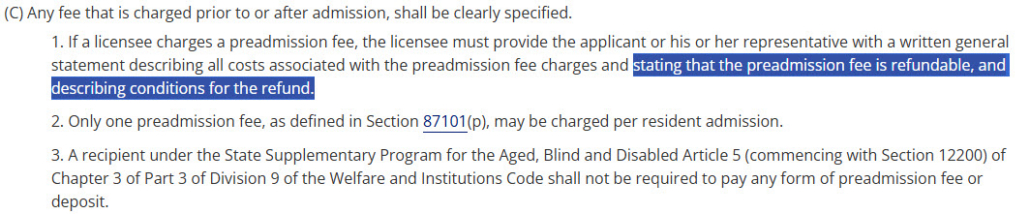
What matters is what the charge actually covers, not the label used by the sales office. Under Title 22 section 87507, a facility charging a preadmission fee must give you a written statement describing its costs and “stating that the preadmission fee is refundable, and describing conditions for the refund.” Ask for that statement before paying.
A brochure may describe the charge as nonrefundable. Don’t stop there. California sets minimum refund protections that the admission agreement cannot simply disregard. Some circumstances require every dollar back. Others require a percentage of the amount above $500. The timing matters, so keep your payment receipt and copies of every agreement.
Only One Preadmission Fee per Admission
The rules also limit the number of preadmission fees. Only one may be charged per resident admission. If a bill includes an application fee, administrative fee and community fee, ask which are being treated as preadmission charges and how the total complies with that limit.
Other protections are easy to overlook. A person receiving benefits under the State Supplementary Program cannot be required to pay a preadmission fee or deposit. The facility also cannot demand money as a deposit against possible damage by the resident. These restrictions are separate from the ordinary refund percentages, and worth reviewing before signing.
The Same Rules Apply in Memory Care
The label memory care doesn’t erase RCFE protections. If your parent’s memory care program operates under a residential care facility for the elderly license, the same preadmission fee rules apply. The state’s dementia care regulation is part of the RCFE framework. Ask how the residence is licensed if you aren’t sure.

Leaving Before the Appraisal Means a Full Refund
Suppose your family has paid the fee but Mom hasn’t moved in. Sometimes the law requires the whole amount back. Under section 87507, “A 100 percent refund of a preadmission fee shall be provided to an applicant” if the applicant cancels before the facility completes its preadmission appraisal, or if the required written disclosure wasn’t provided.
Notice the difference between touring a home and completing the formal appraisal. Your mom can love a room, pay a fee and then decide against moving before that appraisal is completed. The first rule requires a full refund. The second rule protects applicants when the facility fails to disclose the fees and refund conditions fully in writing.
What the Appraisal Is
The preadmission appraisal is the facility’s review of whether it can meet the prospective resident’s needs. Section 87457 calls for an interview about medical background, functional limitations and the care the person needs. It is more than a friendly tour or a phone call asking whether a room is open.
If you’re uncertain about the move, ask exactly when the appraisal will be completed. Don’t assume a tentative room reservation preserves the full-refund window indefinitely. Keep emails showing when you changed your mind and when the facility received that decision. Those dates can matter if the community disputes your request.
The disclosure requirement is independent of the appraisal timing. Even if the appraisal was completed, the rule provides for a full refund when the community failed to give the required complete written explanation of preadmission charges and refund conditions. Ask for the actual document rather than accepting a verbal explanation after the fact.
For example, if your mom pays a fee on Monday but the facility has not yet evaluated her care needs, a Tuesday cancellation may fall under the full-refund rule. If the appraisal was completed Monday afternoon, the sliding scale may be the relevant rule instead. Ask for the appraisal completion date in writing.
The Assisted Living Community Fee Refund Schedule for the First Three Months
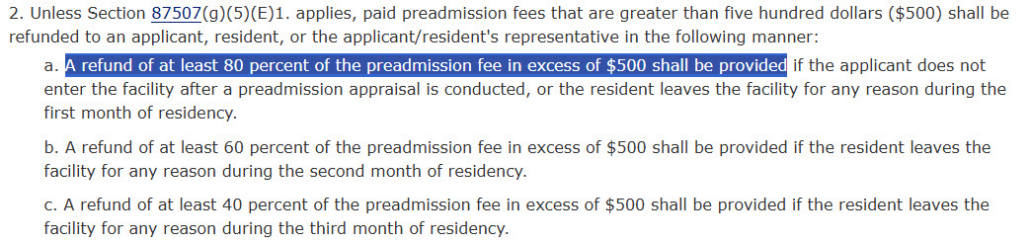
After the appraisal, the usual first-three-month schedule is based on how long the resident stays and the size of the fee. Under section 87507, fees greater than $500 receive minimum percentage refunds. The crucial detail is that the percentage applies only to the amount above $500, not the entire fee.
If the applicant changes plans after the appraisal without moving in, or leaves during the first month, the regulation says “A refund of at least 80 percent of the preadmission fee in excess of $500 shall be provided.” During the second month that minimum falls to 60 percent. In the third month it is 40 percent.
- First month, or no move-in after the appraisal, at least 80 percent of the amount above $500
- Second month, at least 60 percent of the amount above $500
- Third month, at least 40 percent of the amount above $500
What the Math Looks Like
Here’s the arithmetic for an imaginary $4,000 community fee. First subtract $500, leaving $3,500. Apply the appropriate percentage to that remainder. Leaving in month one means a minimum $2,800 refund. Month two means $2,100. Month three means $1,400. These numbers illustrate the law, not Raya’s Paradise fees.
For the first three months, the regulation applies when a resident leaves for any reason. A resident might return to family, move somewhere closer or need a setting that can provide different care. You don’t have to prove the community did something wrong to qualify for the applicable minimum refund.
An agreement may be more generous. Some communities could voluntarily refund the full amount or return more than the minimum. The words at least are significant. If your signed contract promises a larger refund, request the amount provided by that agreement rather than stopping at the state’s floor.
Write the math on the same page as the fee receipt. The formula is simple. Subtract $500 from the preadmission fee, then multiply the balance by 0.80, 0.60 or 0.40. For fees of $500 or less, this particular sliding-scale provision does not create a percentage refund.

After Month Four
Once a resident has lived in the community for four or more months, the ordinary sliding-scale requirement ends. Section 87507 says “the licensee may, but is not required to, make a refund of the preadmission fee.” This doesn’t eliminate a more generous contractual promise or the special closure rules below.
Review the fee disclosure and admission agreement before assuming nothing is recoverable. Ask the administrator to identify the exact provision being applied and to respond in writing. Also keep move-out charges, prepaid monthly fees and preadmission fees separate. Different rules can apply to different kinds of money.
Refunds When a Community Closes or Changes Use
There is another refund schedule, but it applies only in defined circumstances. Section 87507 addresses certain displacements when a facility’s license is forfeited in a sale or transfer, surrendered or abandoned, or when the facility changes use. It isn’t a refund promise for every eviction or every ordinary move.
This separate schedule also applies its percentages to the portion of the preadmission fee above $500, not automatically to the entire fee.
- Paid within six months of the eviction notice, a 100 percent refund
- More than six but not more than 12 months before, 75 percent
- More than 12 but not more than 18 months before, 50 percent
- More than 18 but less than 25 months before, 25 percent
For the specified closure or change-of-use situations, the percentage depends on when the preadmission fee was paid relative to the eviction notice. No refund is required under that schedule for a fee paid 25 months or more beforehand. Required refunds are due within 15 days of the notice, and residents may request a monthly-fee credit instead.
A routine nonpayment eviction or a move because the family prefers another home is not automatically covered by this special schedule. If the community issues a notice because it is closing, surrendering its license or changing use, ask which statutory provision the notice invokes before calculating the refund.
Questions to Ask Before You Pay
- Is this the only preadmission fee for this admission?
- Where is the written statement of costs and refund conditions?
- When will the preadmission appraisal take place?
- Does the agreement offer more than the state minimum refund?
Keep the answers with your parent’s admission agreement. If you later request a refund, send a short dated email stating the amount paid, the relevant dates and your calculation. Ask for a written response and save the receipt or bank record showing payment.
Prepare for Your Parent’s Next Chapter With Confidence
Sometimes a move into assisted living doesn’t work out the way a family expected. Your mom may struggle to settle in, her care needs may change or a different residence might offer the environment she’s been looking for. Before making another move, take time to understand how a community evaluates new residents, supports their adjustment and responds when circumstances change.
Raya’s Paradise offers several resources to help families make a more informed choice. Our senior living community comparison checklist can help you evaluate different residences, while our assisted living move-in preparation guide covers important details to consider before the transition. For families who prefer a smaller residential setting, our Los Angeles senior care homes offer another approach to personalized assisted living, with intimate environments and individualized daily support.
Whether you’re considering a first move or helping a loved one find a better fit, arrange a visit to our residential assisted living homes in Los Angeles or connect with our Orange County care team. The right setting should address your parent’s needs while helping them feel comfortable, respected and supported.
Our Orange County Senior Assisted Living Community with Specialized Memory Care
Our Los Angeles Assisted Living Residences
Sources & Additional Resources
- California Code of Regulations (Cornell LII). “Cal. Code Regs. Tit. 22, § 87507 – Admission Agreements.” Legal Information Institute.
- FindLaw. “California Code, Health and Safety Code – HSC § 1569.651.” FindLaw Codes.
- California Code of Regulations (Cornell LII). “Cal. Code Regs. Tit. 22, § 87705 – Care of Persons with Dementia.” Legal Information Institute.
- California Code of Regulations (Cornell LII). “Cal. Code Regs. Tit. 22, § 87457 – Pre-Admission Appraisal.” Legal Information Institute.
Disclaimer: This article provides general educational information about California’s preadmission fee requirements, assisted living community fee refunds and resident protections under Health and Safety Code section 1569.651 and Title 22 section 87507. It is not legal advice or a determination of any resident’s entitlement to a refund. Applicable requirements depend on when the preadmission appraisal was completed, the duration of residency, the terms of the admission agreement and the circumstances surrounding cancellation, departure or facility closure. Families should review their written agreements and consult the California Department of Social Services or a qualified elder law attorney if they have questions about their rights or a disputed refund.
 https://rayasparadise.com/wp-content/uploads/2026/11/Assisted-Living-Caregiver-Serving-Nutritious-Meals-to-Senior-Residents.jpg
1707
2560
Moti Gamburd
https://rayasparadise.com//wp-content/uploads/2019/07/RP-LOGO-Horizontal-Name-Only-websitetrans.png
Moti Gamburd2026-11-14 17:33:452026-11-02 16:35:18The 7 Assisted Living Basic Services Every California Community Must Provide
 https://rayasparadise.com/wp-content/uploads/2026/10/Senior-Couple-Reviewing-Assisted-Living-Admission-Agreements-and-Community-Fee-Refund-Policies.jpg
1707
2560
Moti Gamburd
https://rayasparadise.com//wp-content/uploads/2019/07/RP-LOGO-Horizontal-Name-Only-websitetrans.png
Moti Gamburd2026-10-28 15:20:152026-10-30 17:05:23Is the Assisted Living Community Fee Refundable in California? Know the 80, 60 and 40 Percent Rule
 https://rayasparadise.com/wp-content/uploads/2026/10/Senior-Couple-Reviewing-Assisted-Living-Rate-Increase-Notice-in-California.jpg
1804
2560
Moti Gamburd
https://rayasparadise.com//wp-content/uploads/2019/07/RP-LOGO-Horizontal-Name-Only-websitetrans.png
Moti Gamburd2026-10-26 14:36:182026-10-30 17:04:55California Assisted Living Rate Increase Notice Rules and Why Older Documents Still Say 60 Days
 https://rayasparadise.com/wp-content/uploads/2026/10/Senior-Couple-Reviewing-Assisted-Living-Care-Options-in-California.jpg
1707
2560
Moti Gamburd
https://rayasparadise.com//wp-content/uploads/2019/07/RP-LOGO-Horizontal-Name-Only-websitetrans.png
Moti Gamburd2026-10-24 00:27:412026-10-30 17:04:24Medi-Cal Assisted Living Options Include the Assisted Living Waiver and Health Plan Community Supports
 https://rayasparadise.com/wp-content/uploads/2026/10/Reviewing-Assisted-Living-Care-Concerns-and-Resident-Rights-in-California.jpg
1769
2560
Moti Gamburd
https://rayasparadise.com//wp-content/uploads/2019/07/RP-LOGO-Horizontal-Name-Only-websitetrans.png
Moti Gamburd2026-10-22 04:54:162026-10-30 17:03:53Who to Report Assisted Living Neglect to in California, and When to Call the Ombudsman, APS or Licensing
 https://rayasparadise.com/wp-content/uploads/2026/10/Senior-Woman-Concerned-About-Running-Out-of-Money-in-Assisted-Living.jpg
1706
2560
Moti Gamburd
https://rayasparadise.com//wp-content/uploads/2019/07/RP-LOGO-Horizontal-Name-Only-websitetrans.png
Moti Gamburd2026-10-20 10:26:362026-10-30 17:03:20When a Parent Is Running Out of Money in Assisted Living in California
 https://rayasparadise.com/wp-content/uploads/2026/10/In-Home-Senior-Care-and-Alternatives-to-Nursing-Home-Placement-in-California.jpg
1707
2560
Moti Gamburd
https://rayasparadise.com//wp-content/uploads/2019/07/RP-LOGO-Horizontal-Name-Only-websitetrans.png
Moti Gamburd2026-10-18 15:03:492026-10-30 17:02:44Alternatives to Nursing Home Care in California Through PACE, ALW, IHSS and MSSP
 https://rayasparadise.com/wp-content/uploads/2026/10/Hospital-Discharge-Planning-and-Assisted-Living-Care-Assessment.jpg
1708
2560
Moti Gamburd
https://rayasparadise.com//wp-content/uploads/2019/07/RP-LOGO-Horizontal-Name-Only-websitetrans.png
Moti Gamburd2026-10-16 14:54:522026-10-30 17:02:13Hospital Discharge to Assisted Living in California and the Admission Checks That Matter
 https://rayasparadise.com/wp-content/uploads/2013/03/Choosing-Assisted-Living-for-Senior-Couples.jpg
1700
2555
Moti Gamburd
https://rayasparadise.com//wp-content/uploads/2019/07/RP-LOGO-Horizontal-Name-Only-websitetrans.png
Moti Gamburd2026-02-14 06:37:342026-10-12 22:26:28Choosing Assisted Living for Senior Couples
 https://rayasparadise.com/wp-content/uploads/2012/12/How-the-Option-of-Assisted-Living-Developed.jpg
1702
2553
Moti Gamburd
https://rayasparadise.com//wp-content/uploads/2019/07/RP-LOGO-Horizontal-Name-Only-websitetrans.png
Moti Gamburd2026-02-12 04:33:042026-10-12 22:09:43History of Assisted Living |How the Option of Assisted Living Developed
 https://rayasparadise.com/wp-content/uploads/2012/10/Choosing-Assisted-Living-for-Those-with-Alzheimers-or-Dementia.jpeg
1695
2546
Moti Gamburd
https://rayasparadise.com//wp-content/uploads/2019/07/RP-LOGO-Horizontal-Name-Only-websitetrans.png
Moti Gamburd2026-02-11 08:14:422026-10-12 22:29:24Choosing Assisted Living for Those with Alzheimer's or Dementia
 https://rayasparadise.com/wp-content/uploads/2012/10/Paying-for-Assisted-Living.jpg
1700
2542
Moti Gamburd
https://rayasparadise.com//wp-content/uploads/2019/07/RP-LOGO-Horizontal-Name-Only-websitetrans.png
Moti Gamburd2026-02-10 03:30:062026-10-12 22:30:53Paying for Assisted Living, Costs, Insurance, VA Benefits, and Smart Ways to Plan
 https://rayasparadise.com/wp-content/uploads/2012/10/Six-Myths-About-Assisted-Living.jpg
1702
2555
Moti Gamburd
https://rayasparadise.com//wp-content/uploads/2019/07/RP-LOGO-Horizontal-Name-Only-websitetrans.png
Moti Gamburd2026-02-09 04:02:312026-10-12 22:57:13Six Myths About Assisted Living - What Senior Living Really Looks Like
 https://rayasparadise.com/wp-content/uploads/2026/02/Assisted-Living-vs-In-Home-Care.jpg
1695
2553
Moti Gamburd
https://rayasparadise.com//wp-content/uploads/2019/07/RP-LOGO-Horizontal-Name-Only-websitetrans.png
Moti Gamburd2026-02-08 06:00:482026-10-12 22:58:19The Benefits of Assisted Living Over In-Home Care
 https://rayasparadise.com/wp-content/uploads/2013/01/Caring-for-a-Parent-in-Assisted-Living-From-Afar.jpeg
1702
2556
Moti Gamburd
https://rayasparadise.com//wp-content/uploads/2019/07/RP-LOGO-Horizontal-Name-Only-websitetrans.png
Moti Gamburd2026-02-06 08:00:312026-10-12 22:12:38How to Care for a Loved One in Assisted Living From Afar