
Contents
- Alternatives to Nursing Home Care in California Through PACE, ALW, IHSS and MSSP
- PACE Offers Comprehensive Alternatives to Nursing Home Care in California
- The Assisted Living Waiver
- IHSS
- MSSP
- Finding the Right Senior Care Setting Beyond a Nursing Home
- Sources & Additional Resources
- More Senior Care Resources
- Alternatives to Nursing Home Care in California Through PACE, ALW, IHSS and MSSP
- Hospital Discharge to Assisted Living in California and the Admission Checks That Matter
- Different Types of Senior Care
- Video Games and Virtual Reality Finds New Takers
- Advice for Traveling with Seniors
- Old Friends, New Friends
- Aging with friends
- When is it time to hire an in-home Caregiver?
- Guide to Buying Medication Online
- Should Your Parent See a Geriatric Specialist?
- Senior Day Trip Idea: Visit the Zoo
- How to Lower Medical Expenses
- Physical Therapy for Parkinson's Disease
- Understanding Parkinson's Disease
- How to Address the Effects of Vision Loss
Alternatives to Nursing Home Care in California Through PACE, ALW, IHSS and MSSP

Your patient is ready for discharge, but her daughter is not ready to take her home. Mom needs help getting dressed, remembering medications and moving safely around the house. A nursing home may be one option, but her daughter wants to know what else California offers.
Several alternatives to nursing home care in California can help people with substantial care needs live in their communities. Four worth understanding are PACE, the Assisted Living Waiver, In-Home Supportive Services and the Multipurpose Senior Services Program. All involve public support, but they are not four versions of the same benefit.
One coordinates nearly all medical care. One funds services in participating assisted living settings. Another authorizes help in a person’s own home. The fourth arranges a network of community services. Here is how to choose which door to knock on first.
PACE Offers Comprehensive Alternatives to Nursing Home Care in California
PACE is not a home care allowance that a family spends on whichever caregiver it chooses.
The Program of All-Inclusive Care for the Elderly is a coordinated medical and social care model.
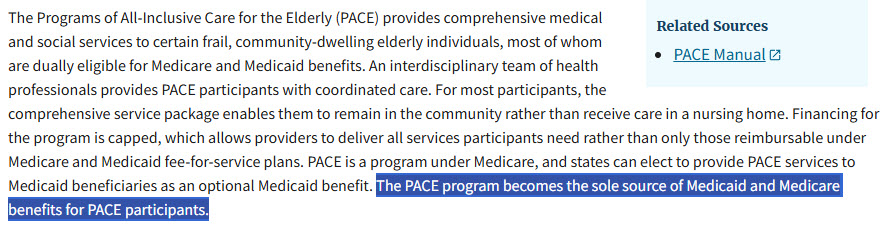
Medicaid.gov describes it as comprehensive support for certain frail older adults living in the community, many of whom qualify for both Medicare and Medicaid.
Four basic screening questions come first.
Is the patient at least 55? Does a PACE organization serve the home address? Does the patient meet nursing home level-of-care criteria? Can the person live safely in the community at enrollment?
All four must be answered before considering how care will be delivered.
How PACE Works
PACE brings medical and social care together under one interdisciplinary team.
The official description is unusually clear.
“The PACE program becomes the sole source of Medicaid and Medicare benefits for PACE participants.”
An interdisciplinary team coordinates the participant’s care.
For a daughter juggling three specialists and missed appointments, one coordinated program may be a relief.
But enrollment changes how Medicare and Medi-Cal benefits are delivered.
Ask whether a longtime physician participates, how referrals work and what happens when care is needed outside the usual network.
PACE may work well when substantial medical needs can still be met at home with coordinated support.
It is less like hiring an aide by the hour and more like changing to a comprehensive care organization.
Confirm the patient understands that trade-off and agrees with the proposed arrangement.
Ask the patient whether the priority is preserving a particular doctor, having one team coordinate appointments or getting more supervision at home.
Those preferences can change which program feels workable, even before an eligibility decision.
Questions to Ask About PACE
- Is there a PACE organization serving the patient’s home address?
- How would enrolling affect the patient’s current doctors and specialists?
- How does the program determine nursing home eligibility, and how long does enrollment take?
- What happens if the patient’s needs increase after enrolling?
Our Orange County senior resources guide lists local PACE contacts, and families elsewhere can ask their county’s aging services office.

The Assisted Living Waiver
Unlike PACE, the Assisted Living Waiver is specifically a pathway to eligible assisted living care.
A patient who cannot manage alone at home but could live safely in a licensed assisted living setting may be a candidate.
It funds authorized care services rather than functioning as a general housing benefit.
Geography matters before any application begins.
DHCS says “The program is available in 15 counties in California.”
Both Los Angeles and Orange are included.
But a patient still needs to qualify and find a participating residence that can meet the care needs.
Who the Waiver Serves
Applicants must be at least 21 and “Have full-scope Medi-Cal eligibility with no share of cost.”
Their care needs must meet the program’s nursing facility standard, and they must be able to reside safely in an eligible assisted living setting or public subsidized housing.
Two financial and timing questions must be settled separately.
DHCS says “ALW participants must pay the facility directly for their room and board.”
There are also limited enrollment slots and currently a waitlist.
A clinical match does not mean a bed or funding is immediately available.
How to Start a Waiver Referral
The starting point is a Care Coordination Agency, not simply choosing a room and asking the residence to bill Medi-Cal.
DHCS advises families to contact the Care Coordination Agency of their choice.
Its enrollment dashboard is updated monthly.
Ask about assessment documents, waitlist status and participating residences early in the discharge process.

IHSS
In-Home Supportive Services, or IHSS, belongs in a different part of the discharge conversation.
It is for people who can remain in their own homes with authorized help.
CDSS calls it an “alternative to out-of-home care,” not a benefit used to pay an assisted living residence.
An applicant must live in California, receive a Medi-Cal eligibility determination and reside at home or in another qualifying living arrangement.
A licensed community care facility is not considered the recipient’s own home for IHSS purposes.
A county social worker assesses what assistance is needed and authorizes the appropriate service hours.
How IHSS Works
IHSS requires a workable caregiving arrangement.
County-specific provider arrangements also exist.
Approval alone does not guarantee that someone is available for every needed shift.
Families apply through the county IHSS office.
Our Orange County senior resources guide notes that “IHSS is a statewide program administered locally by the Orange County Social Services Agency.”
Ask how the required health certification, county assessment and provider enrollment will be coordinated.
For a patient returning to an apartment, IHSS might cover help with bathing, meals or other approved tasks.
But look at the actual authorized hours and the coverage between visits.
If your patient needs overnight supervision, a few daytime hours may not be a safe discharge arrangement.
The home must also work for the person’s mobility and safety.
Confirm whether stairs, bathroom access, transportation and family availability create gaps that paid hours alone cannot solve.

MSSP
The Multipurpose Senior Services Program, run by the California Department of Aging, “provides both social and health care management services.”
It buys services that aren’t otherwise available “to prevent or delay institutionalization.”
MSSP serves eligible adults age 60 and older who have a qualifying Medi-Cal aid code and “who are certified or certifiable for placement in a skilled nursing facility.”
A discharge diagnosis does not establish eligibility by itself.
The program must assess the person’s needs.
How MSSP Works
MSSP starts with a health and social assessment and an individualized plan.
Possible services include adult day care, minor home repairs, respite, transportation, counseling, meals and supplemental personal care.
Which services are arranged depends on the person’s circumstances and what other programs already provide.
That makes MSSP different from IHSS.
It is not a fixed number of aide hours assigned to every enrollee.
The care management team helps coordinate available resources and may purchase additional services when appropriate.
The state notes that many MSSP participants also use IHSS.
For example, an older adult may have authorized help with bathing yet still miss appointments because transportation and care coordination are unreliable.
MSSP may address that broader pattern rather than simply adding another aide visit.
A patient living with family may benefit from IHSS hours and MSSP care management.
Another patient who needs consolidated medical services may find PACE more suitable.
Someone who needs an assisted living residence may need to start with the waiver.
The right referral begins with a realistic picture of where daily care can happen.
The Four Programs Side by Side
A quick comparison helps narrow the referrals.
It does not replace the assessment process, but it can prevent a patient from being sent to a program designed for a completely different living situation.
- PACE. Ages 55 and up who are eligible for nursing home care and can live safely in the community. One organization provides all Medicare and Medicaid benefits.
- Assisted Living Waiver. Ages 21 and up with full-scope Medi-Cal and no share of cost, with nursing facility level care needs. Pays for care services in assisted living in 15 counties. The resident pays room and board, and there’s a waitlist.
- IHSS. Aged, blind or disabled California residents with a Medi-Cal eligibility determination. Pays for in-home help with authorized hours, and the recipient hires the provider.
- MSSP. Ages 60 and up on Medi-Cal who are certified or certifiable for skilled nursing facility placement. Provides care management and purchases services to help the person stay home.
Choosing Where to Start
Begin with the proposed address.
A return to a private home may point toward IHSS, MSSP or PACE, depending on age and care needs.
A move into participating assisted living points more directly toward ALW.
Then check the patient’s insurance, level of care and the local availability of services.
Do not assume the four programs can all be combined.
Some services may complement one another, while others have enrollment restrictions or overlapping responsibilities.
Confirm the arrangement with each program.
Our Orange County senior resources guide provides local contact information for PACE, IHSS and MSSP.
Be clear about what is confirmed and what remains pending.
An application is not an authorization, and approved services do not necessarily mean an available provider.
If the patient cannot return home safely today, the clinical team needs an interim plan that does not depend on an uncertain approval date.
Give the family a written summary of pending referrals, phone numbers and next steps whenever possible.
A clear handoff matters when several agencies are involved and no single organization manages the entire discharge.
Finding the Right Senior Care Setting Beyond a Nursing Home
Not every older adult who needs daily assistance requires nursing home care.
The challenge is finding a setting that offers the right balance of personal support, supervision and independence.
For families considering a residential alternative, Raya’s Paradise offers personalized senior assisted living in Orange County, with care tailored to each resident’s daily routines, mobility needs and preferences.
Our San Clemente senior living community provides a welcoming coastal environment for older adults who would benefit from assistance with everyday activities.
If remaining at home is still a possibility, families can also explore in-home senior care and caregiver support through our sister company, CARE Homecare.
Not sure which setting makes sense?
Connect with our Orange County care team to discuss your loved one’s needs and explore the available options.
Our Orange County Senior Assisted Living with Memory Care Community
Our Los Angeles Assisted Living Residences
Sources & Additional Resources
- Medicaid.gov. “Program of All-Inclusive Care for the Elderly.” Medicaid.gov.
- California Department of Health Care Services. “Assisted Living Waiver.” Department of Health Care Services.
- California Department of Social Services. “In-Home Supportive Services (IHSS) Program.” California Department of Social Services.
- California Department of Aging. “Multipurpose Senior Services Program.” California Department of Aging.
Disclaimer: This article is intended for general educational purposes and does not replace individualized medical advice, professional care assessments or guidance from qualified program administrators. PACE, the Assisted Living Waiver (ALW), In-Home Supportive Services (IHSS) and the Multipurpose Senior Services Program (MSSP) have distinct eligibility requirements, service limitations and geographic restrictions that may change over time. Participation in one program does not establish eligibility for another. Families and discharge planners should confirm current requirements directly with the appropriate California agency and consult the individual’s healthcare team when determining whether home care, assisted living or a skilled nursing facility is the safest and most appropriate setting. Raya’s Paradise provides residential assisted living and supportive care services, not skilled nursing facility care.
 https://rayasparadise.com/wp-content/uploads/2026/10/In-Home-Senior-Care-and-Alternatives-to-Nursing-Home-Placement-in-California.jpg
1707
2560
Moti Gamburd
https://rayasparadise.com//wp-content/uploads/2019/07/RP-LOGO-Horizontal-Name-Only-websitetrans.png
Moti Gamburd2026-10-18 15:03:492026-10-16 19:30:18Alternatives to Nursing Home Care in California Through PACE, ALW, IHSS and MSSP
 https://rayasparadise.com/wp-content/uploads/2026/10/Hospital-Discharge-Planning-and-Assisted-Living-Care-Assessment.jpg
1708
2560
Moti Gamburd
https://rayasparadise.com//wp-content/uploads/2019/07/RP-LOGO-Horizontal-Name-Only-websitetrans.png
Moti Gamburd2026-10-16 14:54:522026-10-16 14:54:52Hospital Discharge to Assisted Living in California and the Admission Checks That Matter
 https://rayasparadise.com/wp-content/uploads/2012/09/Different-Types-of-Senior-Care-Explained.jpeg
1695
2553
Moti Gamburd
https://rayasparadise.com//wp-content/uploads/2019/07/RP-LOGO-Horizontal-Name-Only-websitetrans.png
Moti Gamburd2026-01-15 03:36:302026-10-12 22:59:46Different Types of Senior Care
 https://rayasparadise.com/wp-content/uploads/2020/03/Video-Games-for-Elderly.png
841
1454
Raya's Paradise
https://rayasparadise.com//wp-content/uploads/2019/07/RP-LOGO-Horizontal-Name-Only-websitetrans.png
Raya's Paradise2020-03-04 16:11:552026-01-14 19:16:21Video Games and Virtual Reality Finds New Takers
 https://rayasparadise.com/wp-content/uploads/2013/11/TravelingFeatured.jpg
800
1212
Raya's Paradise
https://rayasparadise.com//wp-content/uploads/2019/07/RP-LOGO-Horizontal-Name-Only-websitetrans.png
Raya's Paradise2019-12-02 04:00:282026-01-14 18:39:14Advice for Traveling with Seniors
 https://rayasparadise.com/wp-content/uploads/2019/11/Old-Friends-New-Friends.jpg
403
768
Raya's Paradise
https://rayasparadise.com//wp-content/uploads/2019/07/RP-LOGO-Horizontal-Name-Only-websitetrans.png
Raya's Paradise2019-11-18 06:00:112026-01-14 19:06:14Old Friends, New Friends
 https://rayasparadise.com/wp-content/uploads/2018/04/Aging-with-friends.jpg
700
900
Raya's Paradise
https://rayasparadise.com//wp-content/uploads/2019/07/RP-LOGO-Horizontal-Name-Only-websitetrans.png
Raya's Paradise2017-10-16 15:04:052026-01-14 18:40:08Aging with friends
 https://rayasparadise.com/wp-content/uploads/2018/04/When-is-it-time-to-hire-an-in-home-Caregiver.jpg
700
900
Raya's Paradise
https://rayasparadise.com//wp-content/uploads/2019/07/RP-LOGO-Horizontal-Name-Only-websitetrans.png
Raya's Paradise2014-04-16 12:52:362026-05-30 03:30:18When is it time to hire an in-home Caregiver?
 https://rayasparadise.com/wp-content/uploads/2013/12/Guide-to-Buying-Medication-Online-2.jpg
1698
2547
Raya's Paradise
https://rayasparadise.com//wp-content/uploads/2019/07/RP-LOGO-Horizontal-Name-Only-websitetrans.png
Raya's Paradise2013-12-03 05:38:142026-01-14 19:40:58Guide to Buying Medication Online
 Raya's Paradise
https://rayasparadise.com//wp-content/uploads/2019/07/RP-LOGO-Horizontal-Name-Only-websitetrans.png
Raya's Paradise2013-11-28 04:00:592026-01-14 19:11:57Should Your Parent See a Geriatric Specialist?
https://rayasparadise.com/wp-content/uploads/2013/10/Senior-at-the-Zoo-with-Daughter-scaled.jpg
1703
2560
Raya's Paradise
https://rayasparadise.com//wp-content/uploads/2019/07/RP-LOGO-Horizontal-Name-Only-websitetrans.png
Raya's Paradise2013-10-31 08:16:512026-01-14 19:41:21Senior Day Trip Idea: Visit the Zoo
Raya's Paradise
https://rayasparadise.com//wp-content/uploads/2019/07/RP-LOGO-Horizontal-Name-Only-websitetrans.png
Raya's Paradise2013-10-24 04:00:012026-01-14 19:02:51How to Lower Medical Expenses
Raya's Paradise
https://rayasparadise.com//wp-content/uploads/2019/07/RP-LOGO-Horizontal-Name-Only-websitetrans.png
Raya's Paradise2013-09-24 04:00:522026-01-14 19:08:13Physical Therapy for Parkinson's Disease
Raya's Paradise
https://rayasparadise.com//wp-content/uploads/2019/07/RP-LOGO-Horizontal-Name-Only-websitetrans.png
Raya's Paradise2013-04-16 04:00:412026-01-14 19:16:07Understanding Parkinson's Disease
Raya's Paradise
https://rayasparadise.com//wp-content/uploads/2019/07/RP-LOGO-Horizontal-Name-Only-websitetrans.png
Raya's Paradise2013-04-11 04:00:142026-01-14 19:02:03How to Address the Effects of Vision Loss