
Contents
- When a Parent Is Running Out of Money in Assisted Living in California
- Nonpayment Is a Listed Eviction Reason
- The 30-Day Notice Still Applies
- SSI Board and Care Rate
- The Assisted Living Waiver
- Choose a Senior Living Community That Feels Like Home
- Sources & Additional Resources
- More Assisted Living Resources
- Is the Assisted Living Community Fee Refundable in California? Know the 80, 60 and 40 Percent Rule
- California Assisted Living Rate Increase Notice Rules and Why Older Documents Still Say 60 Days
- Medi-Cal Assisted Living Options Include the Assisted Living Waiver and Health Plan Community Supports
- Who to Report Assisted Living Neglect to in California, and When to Call the Ombudsman, APS or Licensing
- When a Parent Is Running Out of Money in Assisted Living in California
- Alternatives to Nursing Home Care in California Through PACE, ALW, IHSS and MSSP
- Hospital Discharge to Assisted Living in California and the Admission Checks That Matter
- Choosing Assisted Living for Senior Couples
- History of Assisted Living |How the Option of Assisted Living Developed
- Choosing Assisted Living for Those with Alzheimer's or Dementia
- Paying for Assisted Living, Costs, Insurance, VA Benefits, and Smart Ways to Plan
- Six Myths About Assisted Living - What Senior Living Really Looks Like
- The Benefits of Assisted Living Over In-Home Care
- How to Care for a Loved One in Assisted Living From Afar
- Making a Smooth Transition to Assisted Living
When a Parent Is Running Out of Money in Assisted Living in California

Your mom’s savings were supposed to last five years. It’s been three, and the latest bank statement suggests she has enough for another eight months. She loves her room, knows everyone at lunch and has finally settled into a comfortable routine. Now you’re trying to imagine how she’ll manage if she can’t afford to stay.
When a parent is running out of money in assisted living, the first question is often whether the community can make them leave. In California, nonpayment is a legally permitted reason for eviction, but the facility must follow written notice requirements. It cannot simply remove a resident because the family is struggling to pay.
There may also be financial assistance worth exploring. Supplemental Security Income, known as SSI, can help some eligible residents pay for licensed residential care. Medi-Cal’s Assisted Living Waiver may cover certain care services for people who meet its requirements. Neither option guarantees a place to live, and both take planning.
That’s why the time to act is when your mom still has savings, not when the last payment is due. Understanding the rules now gives your family more room to make a careful decision.
Nonpayment Is a Listed Eviction Reason
California allows assisted living communities to evict residents only for specified reasons.
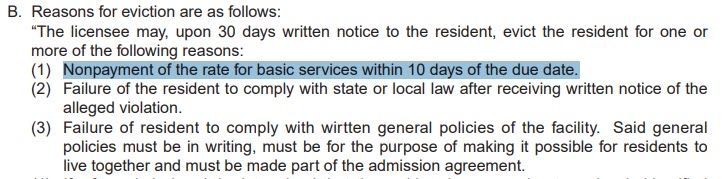
One is failure to pay the basic services rate within ten days after the payment is due.
You’ll find that language in the state’s LIC 604A admission agreement guide.
The same provision appears in Title 22 section 87224, the regulation governing eviction procedures for residential care facilities for the elderly.
The wording is specific.
It concerns the rate for basic services, not every disagreement over a charge on the bill.
If you’re questioning an unexpected extra fee, ask the administrator to identify the agreement provision that authorizes it.
Keep that dispute separate from payments your mom clearly owes under her contract.
Ten days past the due date establishes one permissible ground for eviction.
It doesn’t mean staff can ask your parent to pack immediately.
California requires a separate process before a resident can be removed.
Talk Before You Miss a Payment
Waiting until a bill goes unpaid can narrow your options quickly.
If your calculations show that your mom’s savings will last another eight months, arrange a conversation with the administrator now.
Ask how the community handles residents whose finances change.
Find out whether a different room or service arrangement could reduce her monthly expenses.
Some communities may have options, while others may not be able to change their rates.
Bring a realistic estimate of her remaining resources.
Include Social Security, pension income, other recurring payments and the savings available to cover the difference.
That makes the conversation more useful than a general statement that money is getting tight.
Ask about the admission agreement’s payment terms and what happens if she needs to move.
A difficult discussion today can leave far more time to compare alternatives than an overdue notice later.
The 30-Day Notice Still Applies
Even if your mom falls behind on her basic monthly rate, the community must follow California’s eviction procedures.
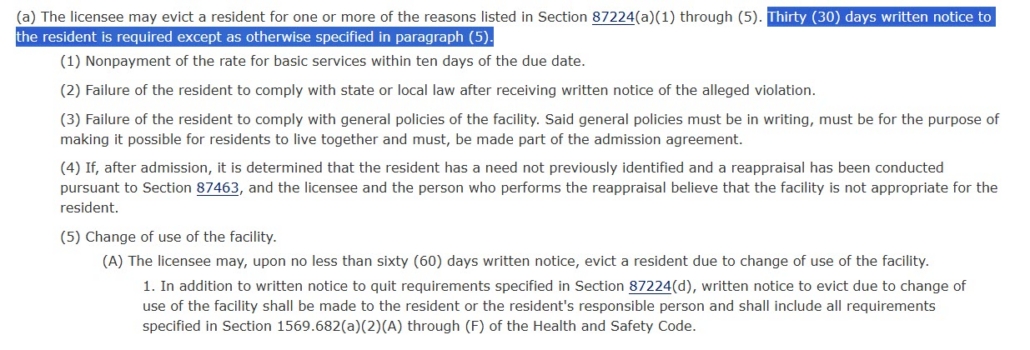
The general rule requires 30 days’ written notice for nonpayment.
Section 87224 states, “Thirty (30) days written notice to the resident is required except as otherwise specified in paragraph (5).”
Paragraph five addresses a facility’s change of use rather than a resident’s failure to pay.
The written notice must explain the reasons for the proposed eviction and include information about resources for alternative housing and care.
It must also tell residents about their right to contact the licensing agency.
If a notice arrives, read it carefully and save a copy.
Record when your mom received it, check the stated effective date and compare the reason given with her admission agreement.
A Notice Isn’t a Lockout
Receiving an eviction notice is not the same as receiving a court order.
If your mom remains after the effective date, the facility must pursue the required court process before it can legally evict her.
The regulation explains that a facility must file an unlawful detainer action in superior court and obtain a written judgment signed by a judge.
Staff cannot simply change the locks or remove your mom’s belongings because the notice period has ended.
Contact the Long-Term Care Ombudsman Program at 1-800-231-4024 if you have concerns about a notice.
An elder law attorney can also explain the legal process and help you understand the options available.
Most importantly, begin exploring benefits and other residences before a notice arrives.
Thirty days may be enough time to review a document, but it may not be enough to obtain new benefits or arrange a suitable placement.
SSI Board and Care Rate
Supplemental Security Income provides monthly income to eligible people with limited income and resources.
It serves adults 65 and older as well as people who are blind or have qualifying disabilities.
California adds a state payment to federal SSI.
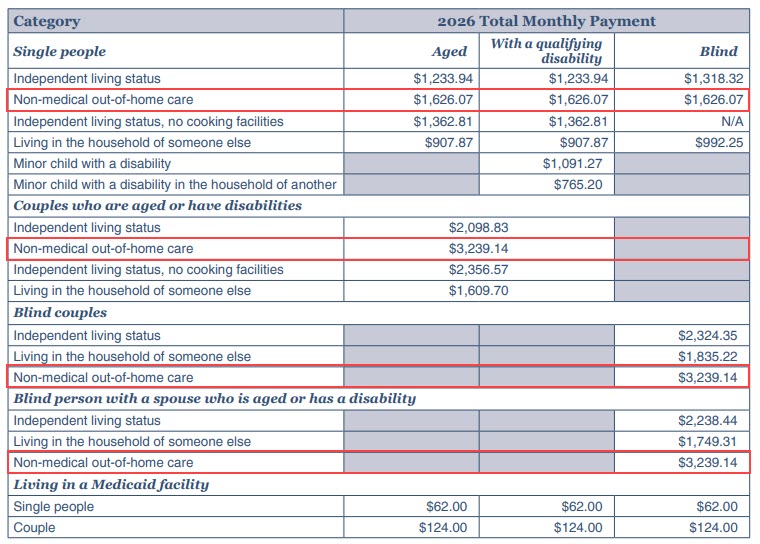
The combined amount depends partly on a person’s living arrangement, which is why the Social Security Administration’s California SSI publication includes a category for nonmedical out-of-home care.
For 2026, the listed maximum monthly payment for an eligible individual in that category is $1,626.07.
That is a benefit amount, not a statewide price that assisted living communities must charge.
The distinction is important.
Your mom might qualify for the special SSI living arrangement category yet still be unable to afford the community where she currently lives.
Social Security’s operations manual explains that the category includes certain state-licensed nonmedical residential care settings where eligible people receive care or supervision.
That means the benefit is relevant to some board-and-care arrangements.
It doesn’t establish that every assisted living home participates or agrees to accept that amount as full payment.
Who Qualifies for SSI
SSI is means-tested.
Social Security reviews income, resources and other eligibility conditions before determining whether someone qualifies and how much they can receive.
According to its 2026 California guide, countable resources generally must be below $2,000 for an individual or $3,000 for a married couple living together.
Some possessions, including a home in which the person lives, may be excluded under program rules.
Many people paying privately for assisted living won’t qualify while they still have substantial savings.
That’s one reason to ask about SSI well before those funds disappear.
Call Social Security at 1-800-772-1213 or visit ssa.gov to discuss eligibility and applying.
Ask specifically how the nonmedical out-of-home-care living arrangement would apply to your parent’s situation.
What the SSI Rate Means in Practice
The monthly benefit and the monthly care bill are two different numbers.
Our guide to paying for assisted living makes that point clearly.
“The gap between a benefit check and the monthly bill is why payment planning matters.”
If SSI is likely to become your mom’s main income source, begin calling licensed communities and ask whether they accept residents who rely on that benefit.
Request their actual rates and admission requirements.
Don’t assume a residence takes SSI simply because it’s licensed.
Confirm what it charges, what care it can provide and whether a suitable room is available.
The Assisted Living Waiver
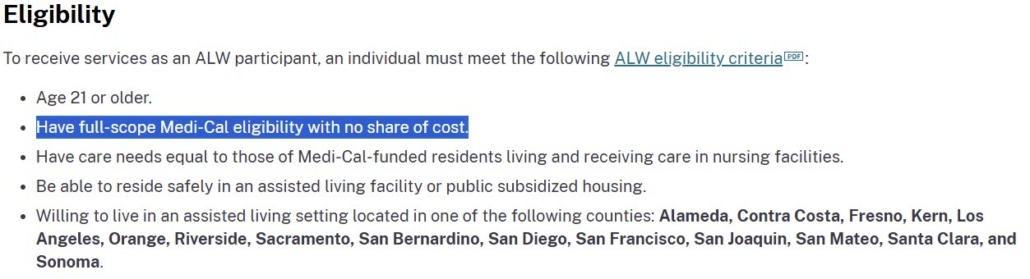
Medi-Cal has a separate program called the Assisted Living Waiver, or ALW. It can pay for certain assisted living care services for eligible people whose needs are comparable to those of residents receiving nursing facility care.
The program is available in 15 California counties, including Los Angeles and Orange. But living in a participating county doesn’t automatically make someone eligible.
Applicants must be at least 21 years old and have full-scope Medi-Cal with no share of cost. They must also meet the waiver’s care-level requirements and be able to live safely in an eligible assisted living setting.
That makes the waiver different from SSI. SSI is an income benefit. The waiver provides qualifying care services through a participating program and facility. A family may need to investigate both.
The Waiver Doesn’t Pay Rent
The waiver doesn’t pay for room and board. DHCS states that participants must pay the assisted living facility directly for those costs and retain some money for personal needs.
Before selecting a participating community, ask what the resident’s monthly room-and-board payment would be. Compare that charge with the income the person will actually receive after eligibility is determined.
Also remember that not every assisted living facility participates in the waiver. Your mom may be eligible for benefits without being able to use them at the residence she currently calls home.
Start Early Because of the Waitlist
DHCS reports that waiver enrollment is limited and that new applicants currently face a waiting list. Families should not assume that submitting an application means an assisted living placement will be available within a few weeks.
The department advises applicants to contact a Care Coordination Agency for information about eligibility and the enrollment process.
For a family whose savings may last another eight months, that conversation should happen now. Find out what documents are needed, how eligibility is assessed and what to expect while waiting.
Ask whether your parent’s current community is a participating provider. If it isn’t, request information about facilities that are. A move to another residence may be necessary even if the waiver eventually approves services.
A Planning Timeline
No single timetable works for every family, but these steps can make the process less rushed.
- A year or more before savings run out. Estimate the monthly shortfall between your parent’s income and the full assisted living bill. Include expected increases and other regular expenses.
- Six to twelve months ahead. Talk with the administrator, Social Security and the county Medi-Cal office about possible options and eligibility.
- Several months ahead. Contact an Assisted Living Waiver Care Coordination Agency and identify communities that participate in the program or accept the relevant SSI payment.
- Before private funds are exhausted. Confirm where your parent can live, how the care will be paid for and what happens if benefit approval is still pending.
An elder law attorney or experienced benefits counselor can help with more complicated eligibility questions. If your parent is married or owns assets, obtain individualized guidance before making financial transfers or changes.
Choose a Senior Living Community That Feels Like Home
When circumstances change, the thought of moving a parent out of a familiar assisted living community can be difficult.
Beyond finding another residence, families must consider the routines, relationships and personal care needs that make everyday life comfortable.
If a transition becomes necessary, taking time to explore the right environment can help your loved one feel more confident about what comes next.
At Raya’s Paradise, our personalized residential care and assisted living services in Orange County focus on helping older adults maintain their independence while receiving support with daily activities.
Families can also explore our coastal senior living community in San Clemente, where individualized care, engaging activities and a welcoming atmosphere help residents settle into their new surroundings.
If you’re considering a change in your parent’s living arrangements, schedule a visit to our San Clemente assisted living community to see the environment firsthand and discuss how our team approaches personalized senior care.
Our Orange County Senior Assisted Living community with Specialized Memory Care
Our Los Angeles Assisted Living Residences
Sources & Additional Resources
- California Department of Social Services. “LIC 604A Admission Agreements for Residential Care Facilities for the Elderly (2/05).” Community Care Licensing Division.
- California Code of Regulations (Cornell LII). “Cal. Code Regs. Tit. 22, § 87224 – Eviction Procedures.” Legal Information Institute.
- California Department of Aging. “Long-Term Care Ombudsman (Consumer).” California Department of Aging.
- Social Security Administration. “Supplemental Security Income (SSI) in California.” Publication No. 05-11125.
- Social Security Administration. “SI SF01415.120 California Optional State Supplement (OSS) B – Nonmedical Out-of-Home Care (NMOHC).” Program Operations Manual System.
- California Department of Health Care Services. “Assisted Living Waiver.” Department of Health Care Services.
Disclaimer: This article provides general educational information about California assisted living residency rights, eviction procedures and senior living transitions. It is not intended as legal advice or a substitute for professional guidance. Resident protections, notice requirements and eviction procedures are governed by applicable California laws and regulations and may depend on individual circumstances. Families facing a possible involuntary discharge or eviction should consult a qualified elder law attorney, the California Department of Social Services or the Long-Term Care Ombudsman Program to understand their rights and available options. Raya’s Paradise provides residential assisted living and supportive care services, not skilled nursing facility care.
 https://rayasparadise.com/wp-content/uploads/2026/10/Senior-Couple-Reviewing-Assisted-Living-Admission-Agreements-and-Community-Fee-Refund-Policies.jpg
1707
2560
Moti Gamburd
https://rayasparadise.com//wp-content/uploads/2019/07/RP-LOGO-Horizontal-Name-Only-websitetrans.png
Moti Gamburd2026-10-28 15:20:152026-10-30 17:05:23Is the Assisted Living Community Fee Refundable in California? Know the 80, 60 and 40 Percent Rule
 https://rayasparadise.com/wp-content/uploads/2026/10/Senior-Couple-Reviewing-Assisted-Living-Rate-Increase-Notice-in-California.jpg
1804
2560
Moti Gamburd
https://rayasparadise.com//wp-content/uploads/2019/07/RP-LOGO-Horizontal-Name-Only-websitetrans.png
Moti Gamburd2026-10-26 14:36:182026-10-30 17:04:55California Assisted Living Rate Increase Notice Rules and Why Older Documents Still Say 60 Days
 https://rayasparadise.com/wp-content/uploads/2026/10/Senior-Couple-Reviewing-Assisted-Living-Care-Options-in-California.jpg
1707
2560
Moti Gamburd
https://rayasparadise.com//wp-content/uploads/2019/07/RP-LOGO-Horizontal-Name-Only-websitetrans.png
Moti Gamburd2026-10-24 00:27:412026-10-30 17:04:24Medi-Cal Assisted Living Options Include the Assisted Living Waiver and Health Plan Community Supports
 https://rayasparadise.com/wp-content/uploads/2026/10/Reviewing-Assisted-Living-Care-Concerns-and-Resident-Rights-in-California.jpg
1769
2560
Moti Gamburd
https://rayasparadise.com//wp-content/uploads/2019/07/RP-LOGO-Horizontal-Name-Only-websitetrans.png
Moti Gamburd2026-10-22 04:54:162026-10-30 17:03:53Who to Report Assisted Living Neglect to in California, and When to Call the Ombudsman, APS or Licensing
 https://rayasparadise.com/wp-content/uploads/2026/10/Senior-Woman-Concerned-About-Running-Out-of-Money-in-Assisted-Living.jpg
1706
2560
Moti Gamburd
https://rayasparadise.com//wp-content/uploads/2019/07/RP-LOGO-Horizontal-Name-Only-websitetrans.png
Moti Gamburd2026-10-20 10:26:362026-10-30 17:03:20When a Parent Is Running Out of Money in Assisted Living in California
 https://rayasparadise.com/wp-content/uploads/2026/10/In-Home-Senior-Care-and-Alternatives-to-Nursing-Home-Placement-in-California.jpg
1707
2560
Moti Gamburd
https://rayasparadise.com//wp-content/uploads/2019/07/RP-LOGO-Horizontal-Name-Only-websitetrans.png
Moti Gamburd2026-10-18 15:03:492026-10-30 17:02:44Alternatives to Nursing Home Care in California Through PACE, ALW, IHSS and MSSP
 https://rayasparadise.com/wp-content/uploads/2026/10/Hospital-Discharge-Planning-and-Assisted-Living-Care-Assessment.jpg
1708
2560
Moti Gamburd
https://rayasparadise.com//wp-content/uploads/2019/07/RP-LOGO-Horizontal-Name-Only-websitetrans.png
Moti Gamburd2026-10-16 14:54:522026-10-30 17:02:13Hospital Discharge to Assisted Living in California and the Admission Checks That Matter
 https://rayasparadise.com/wp-content/uploads/2013/03/Choosing-Assisted-Living-for-Senior-Couples.jpg
1700
2555
Moti Gamburd
https://rayasparadise.com//wp-content/uploads/2019/07/RP-LOGO-Horizontal-Name-Only-websitetrans.png
Moti Gamburd2026-02-14 06:37:342026-10-12 22:26:28Choosing Assisted Living for Senior Couples
 https://rayasparadise.com/wp-content/uploads/2012/12/How-the-Option-of-Assisted-Living-Developed.jpg
1702
2553
Moti Gamburd
https://rayasparadise.com//wp-content/uploads/2019/07/RP-LOGO-Horizontal-Name-Only-websitetrans.png
Moti Gamburd2026-02-12 04:33:042026-10-12 22:09:43History of Assisted Living |How the Option of Assisted Living Developed
 https://rayasparadise.com/wp-content/uploads/2012/10/Choosing-Assisted-Living-for-Those-with-Alzheimers-or-Dementia.jpeg
1695
2546
Moti Gamburd
https://rayasparadise.com//wp-content/uploads/2019/07/RP-LOGO-Horizontal-Name-Only-websitetrans.png
Moti Gamburd2026-02-11 08:14:422026-10-12 22:29:24Choosing Assisted Living for Those with Alzheimer's or Dementia
 https://rayasparadise.com/wp-content/uploads/2012/10/Paying-for-Assisted-Living.jpg
1700
2542
Moti Gamburd
https://rayasparadise.com//wp-content/uploads/2019/07/RP-LOGO-Horizontal-Name-Only-websitetrans.png
Moti Gamburd2026-02-10 03:30:062026-10-12 22:30:53Paying for Assisted Living, Costs, Insurance, VA Benefits, and Smart Ways to Plan
 https://rayasparadise.com/wp-content/uploads/2012/10/Six-Myths-About-Assisted-Living.jpg
1702
2555
Moti Gamburd
https://rayasparadise.com//wp-content/uploads/2019/07/RP-LOGO-Horizontal-Name-Only-websitetrans.png
Moti Gamburd2026-02-09 04:02:312026-10-12 22:57:13Six Myths About Assisted Living - What Senior Living Really Looks Like
 https://rayasparadise.com/wp-content/uploads/2026/02/Assisted-Living-vs-In-Home-Care.jpg
1695
2553
Moti Gamburd
https://rayasparadise.com//wp-content/uploads/2019/07/RP-LOGO-Horizontal-Name-Only-websitetrans.png
Moti Gamburd2026-02-08 06:00:482026-10-12 22:58:19The Benefits of Assisted Living Over In-Home Care
 https://rayasparadise.com/wp-content/uploads/2013/01/Caring-for-a-Parent-in-Assisted-Living-From-Afar.jpeg
1702
2556
Moti Gamburd
https://rayasparadise.com//wp-content/uploads/2019/07/RP-LOGO-Horizontal-Name-Only-websitetrans.png
Moti Gamburd2026-02-06 08:00:312026-10-12 22:12:38How to Care for a Loved One in Assisted Living From Afar
 https://rayasparadise.com/wp-content/uploads/2012/10/Smooth-Transition-to-Assisted-Living.jpeg
1696
2555
Moti Gamburd
https://rayasparadise.com//wp-content/uploads/2019/07/RP-LOGO-Horizontal-Name-Only-websitetrans.png
Moti Gamburd2026-02-06 01:00:082026-10-12 22:58:44Making a Smooth Transition to Assisted Living