
Contents
- California’s Rules for Moving From Assisted Living to Memory Care
- What Triggers an Assisted Living to Memory Care Move
- The Family Must Be Told About Significant Changes
- When a New Need Becomes a Reason to Leave
- Regular Observation Is Part of Basic Care
- Explore Memory Care Options That Respect Your Parent’s Needs and Routines
- Sources & Additional Resources
- More Memory Care Resources
- California's Rules for Moving From Assisted Living to Memory Care When Mom Needs More Care
- A Dementia Diagnosis Alone Does Not Unlock Hospice Respite | The 3 Medicare Conditions for Hospice Respite Eligibility
- Three Big Questions to Consider After an Alzheimer's Diagnosis
- Five Myths About Alzheimer's Disease
- Should You Seek an Alzheimer's Diagnosis?
- How to Talk with Someone Who Has Alzheimer's
- Coconut Oil for Alzheimer's Disease?
- How to Tell When a Loved One with Dementia Is Sick
- Does Computer Use Help with Dementia Symptoms?
- Coping With Dementia Behavior
- Respect for a Senior with Dementia
- Why Dementia Patients Have Trouble with Eating
- Exercises for the Later Stages of Dementia
- Addressing Agitation in Someone Who Has Dementia
- All About Lewy Body Dementia

The director calls on Tuesday afternoon. She says Mom needs memory care and wants to discuss moving her soon. You visited on Sunday, when Mom laughed through lunch and recognized everyone at the table. You know her memory is changing, but the urgency of the call catches you off guard.
An assisted living to memory care move is a major decision. California has rules for evaluating changing needs. A written reappraisal helps explain what has changed.
If the residence decides it cannot continue caring for Mom and seeks to end her residency, separate eviction rules generally require 30 days written notice with specific reasons. Here is what to review before making a decision.
Here are the key takeaways
- Communities must update a resident’s appraisal as frequently as necessary or once every 12 months, whichever comes first.
- The community must tell the resident and their representative about any significant change in condition and arrange a meeting to share the reappraisal.
- Ending residency because of a new need requires a reappraisal and 30 days written notice with specific facts behind the reasons.
- A move to a different room in the same community generally requires written notice at least 30 days in advance.
- The state’s long-term care ombudsman helps free of charge when a transfer or discharge seems improper.

The Reappraisal That Starts the Move
What Triggers an Assisted Living to Memory Care Move
Start with the reappraisal rather than the label of memory care. Under 22 CCR 87463, the pre-admission appraisal must be updated in writing as often as necessary or at least every 12 months, whichever comes first. Staff should not have to wait for the annual review when Mom has a significant change in condition.
The reappraisal should describe what changed, not simply note a diagnosis. The regulation includes “Cognitive functions, such as thinking, remembering, reasoning, exercising judgement, and decision-making.” Ask what Mom could do before, what she struggles with now and when staff first noticed the difference.
Behavior Has to Be Written Down
Staff may see things the family does not. The regulation identifies potentially harmful behavioral expressions “such as unsafe wandering, elopement, hallucinations, lacking in hazard awareness, or lacking in impulse control.” Ask for specific examples, dates and circumstances rather than a general description of Mom as confused.
If behavior has caused or may cause harm, staff must document what occurred, what preceded it when known and the interventions planned. The rule also directs the community to “use the least restrictive intervention” appropriate to Mom. Ask which approaches were tried and whether they helped.
A Dementia Diagnosis Alone Isn’t the Trigger
A dementia diagnosis does not automatically require a different residence. California permits assisted living communities to care for residents with dementia when they meet 22 CCR 87705. The regulation “applies to the care of residents diagnosed with dementia” and clarifies that “Mild cognitive impairment” is not dementia.
Sometimes more support can make it possible to stay. For example, section 87705 calls for an awake night staff person in certain smaller facilities when a reappraisal shows a resident with dementia needs awake night supervision. The question is whether this particular residence can safely meet Mom’s documented needs.
Our guide to choosing dementia-capable assisted living vs memory care notes that “Assisted living with dementia support can work when your loved one is still fairly independent, can accept help, and has a lower wandering risk.”
Our page on the dedicated memory care neighborhood at our San Clemente community makes a similar point about warning signs. “These signs do not determine a diagnosis or automatically mean Memory Care is the right next step.”

Your Right to Hear About Changes First
The Family Must Be Told About Significant Changes
When a facility says Mom needs memory care, you should understand what significant change prompted the conversation. Section 87463(f) requires communication with the resident and, when applicable, the representative “about any significant change in condition” immediately or as soon as reasonably possible. A surprise call is a reason to ask what was previously communicated.
The community must also bring significant changes to an appropriate licensed medical professional and document that communication, including any change in care to be provided. Ask what the professional recommended.
You Can Ask for a Meeting
You do not have to sort through this over the phone. When there is a significant change in condition, the community must arrange an in-person or virtual meeting or conference call to share the reappraisal with Mom, her representative when applicable and appropriate staff.
Include Mom as much as she can participate. California’s resident rights protect her right “To fully participate in planning their care” and to involve people she chooses. Talk about what makes her feel safe and comfortable, not just the placement staff prefer.
Questions to Bring to the Meeting
Bring the written reappraisal, take notes and ask for clear examples.
- What significant change in condition was documented, and on what date?
- What did the licensed medical professional recommend?
- Which interventions were tried, and what happened?
- Could added staffing or supervision meet her needs where she lives now?
Staffing is part of the assessment, too. Section 87463 requires the community to evaluate whether there are enough direct care staff to meet the needs identified in residents’ appraisals. Ask whether the concern is a need for specialized memory care, a staffing limitation or both.
When Unmet Needs Become an Exit Reason
When a New Need Becomes a Reason to Leave
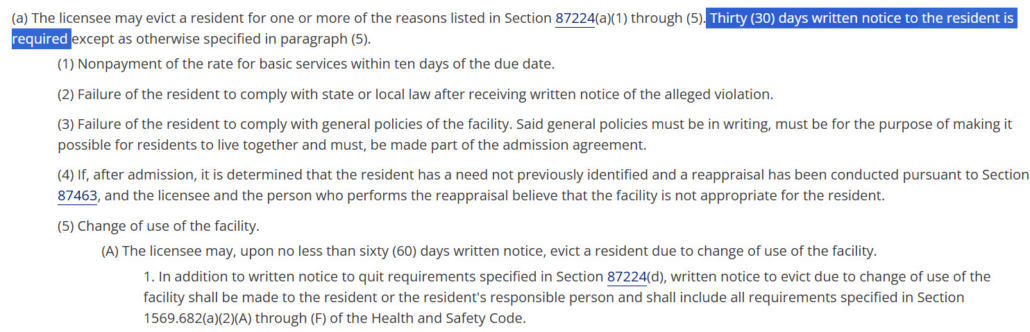
Being told Mom needs memory care doesn’t mean the community can simply tell her to leave. If the community seeks to discharge Mom, 22 CCR 87224 controls the eviction process. It generally states “Thirty (30) days written notice to the resident is required” for the applicable grounds, subject to specified exceptions.
For a newly identified need, section 87224(a)(4) requires more than an administrator’s opinion. The need must not have been identified at admission, a reappraisal has been conducted and both the licensee and the person performing it must believe the community is not appropriate for the resident.
What the Written Notice Must Say
A proper eviction notice needs concrete details. Section 87224 says it must state the reasons “with specific facts to permit determination of the date, place, witnesses, and circumstances.” It also must include the effective date, relocation resources and information about contacting licensing and the ombudsman.
The community must send a copy to the responsible person as required. The notice must also explain that if Mom stays past the effective date, the facility “must file an unlawful detainer action in superior court and receive a written judgment signed by a judge.” A notice does not authorize physically forcing Mom out.
A shorter three-day eviction notice is possible only with prior written approval from licensing and qualifying threatening behavior affecting health or safety. It is not a shortcut for an ordinary disagreement about the right care level.
Moving Within the Same Community
Sometimes the proposed memory care room is in the same building. If the change is a room transfer rather than an eviction, a different resident right matters: “To written notice of any room changes at least 30 days in advance.” Ask whether the move changes Mom’s contract, care plan or charges.
If the monthly bill rises, our guide to California’s 90-day notice rule for assisted living rate increases and its level-of-care exception explains why “Not every higher assisted living bill is a general rate increase.”
The room-change rule has three exceptions: “the request for a change is agreed to by the resident, required to fill a vacant bed, or necessary due to an emergency.” Make sure Mom understands any consent request. Do not confuse agreement to discuss options with agreement to move immediately.
If You Disagree With a Forced Move to Memory Care
If you dispute an eviction, you can ask the California Department of Social Services to review the reasons. Under section 87224(e), the department must investigate the reasons given for the eviction upon request. Keep the reappraisal, notice and your written questions together.
The Long-Term Care Ombudsman also helps with concerns about “Improper transfer or discharge of a resident.” California says “All Ombudsman services are provided for free and all complaints are confidential.” Call the statewide ombudsman hotline at 1-800-231-4024 for assistance.
Our guide on when to call the ombudsman, Adult Protective Services or state licensing explains the roles. “Licensing investigates possible violations of state rules.”

What Staff Must Watch For
Regular Observation Is Part of Basic Care
Regular observations help explain what changed between family visits. Under 22 CCR 87466, a community must ensure “residents are regularly observed for changes in physical, mental, emotional and social functioning” and that assistance is provided when observations reveal unmet needs.
A change such as weight loss or declining mental ability must be documented and brought to the attention of the resident’s physician and responsible person. Ask what was reported, to whom and when. That timeline can clarify whether the move is responding to a new concern or a longer pattern.
Ask to See the Change of Condition Notes
Ask to review the observations and reappraisal with the appropriate authorization. Compare the entries with your own visits, but remember that you see only part of Mom’s day. Nighttime wandering, repeated falls or difficulty accepting help may not be apparent during Sunday lunch.
When Memory Care Is the Right Next Step
A move to memory care can be difficult, especially when Mom is comfortable where she lives. But sometimes her changing needs call for a different kind of support. Our guide explains that “Memory care is designed for progressive cognitive change and higher safety needs.”
Plan for the transition itself. The Alzheimer’s Association’s guide to changing care providers as dementia needs change warns that “A person may suffer temporary sleep problems, wandering, falls and appetite changes.” When visiting any memory care home, ask how its team handles wandering, familiar routines and the first weeks after a move.
Explore Memory Care Options That Respect Your Parent’s Needs and Routines
Hearing that Mom needs memory care can feel overwhelming, especially when she’s comfortable in her current assisted living community. Before agreeing to a move, take time to understand what’s changed, which safety concerns need attention and whether additional support could help her remain where she is. If a transition becomes necessary, finding a community that respects her routines, personality and preferences can make the adjustment easier for everyone.
At Raya’s Paradise, we understand that dementia care isn’t one-size-fits-all. Our personalized Alzheimer’s and dementia care services in Orange County focus on creating a supportive environment for older adults experiencing cognitive changes. Families can explore the dedicated memory care neighborhood at our San Clemente community, where individualized assistance and engaging activities help residents maintain familiar routines. If you’re uncertain whether specialized care is necessary, our guide to choosing between dementia-capable assisted living and memory care can help you understand which setting may be appropriate.
For families considering a smaller residential environment, our intimate memory care homes in Los Angeles offer personalized support for seniors living with Alzheimer’s disease and other forms of dementia. Before comparing residences, you may also find our senior living community comparison checklist helpful for evaluating caregiver availability, safety features and everyday services.
If your parent’s current community has recommended a move, connect with our Orange County memory care team to discuss their changing needs and learn how Raya’s Paradise approaches resident assessments, dementia support and transitions into residential care. The goal isn’t simply to find another place for Mom to live. It’s to find an environment where she can continue feeling safe, comfortable and understood.
Our Orange County Senior Assisted Living Facility with Specialized Memory Care
Our Los Angeles Senior Assisted Living Residences with Specialized Memory Care Support
Sources & Additional Resources
- Legal Information Institute. “Cal. Code Regs. Tit. 22, § 87463 Reappraisals.” Cornell Law School.
- Legal Information Institute. “Cal. Code Regs. Tit. 22, § 87224 Eviction Procedures.” Cornell Law School.
- California Legislative Information. “Health and Safety Code Section 1569.269.” California Legislature.
- California Department of Aging. “Long-Term Care Ombudsman (Consumer).” California Department of Aging.
- Legal Information Institute. “Cal. Code Regs. Tit. 22, § 87705 Care of Persons with Dementia.” Cornell Law School.
- Legal Information Institute. “Cal. Code Regs. Tit. 22, § 87466 Observation of the Resident.” Cornell Law School.
- Alzheimer’s Association. “Changing Care Providers.” Alz.org.
Disclaimer: This article provides general educational information about California’s requirements for transitioning residents from assisted living to memory care, including resident reappraisals, significant changes in condition, room transfers and involuntary discharges. It is not medical or legal advice or an individualized determination that memory care is necessary. Under California Code of Regulations Title 22, sections 87463 and 87466, licensed Residential Care Facilities for the Elderly (RCFEs) must evaluate and document residents’ changing care needs and follow applicable communication requirements. Separate provisions under section 87224 and California Health and Safety Code section 1569.269 govern certain eviction procedures, notices and resident protections. Notice periods and procedural requirements may differ depending on whether a proposed move involves a room change within the same community, a voluntary transfer or an involuntary discharge. A dementia diagnosis alone does not automatically require placement in a dedicated memory care setting. Families should review the resident’s current appraisal, consult their healthcare provider and contact the California Department of Social Services, Long-Term Care Ombudsman Program or a qualified elder law attorney when questions arise about resident rights or disputed transfers. Raya’s Paradise provides residential assisted living, memory care and supportive services, not skilled nursing facility care.
 https://rayasparadise.com/wp-content/uploads/2026/11/Family-Support-During-the-Transition-From-Assisted-Living-to-Memory-Care.jpg
1707
2560
Moti Gamburd
https://rayasparadise.com//wp-content/uploads/2019/07/RP-LOGO-Horizontal-Name-Only-websitetrans.png
Moti Gamburd2026-11-23 17:29:382026-11-05 16:21:49California's Rules for Moving From Assisted Living to Memory Care When Mom Needs More Care
 https://rayasparadise.com/wp-content/uploads/2026/10/Compassionate-Senior-Caregiver-Providing-Comfort-and-Respite-Support-to-an-Older-Adult.jpg
1707
2560
Moti Gamburd
https://rayasparadise.com//wp-content/uploads/2019/07/RP-LOGO-Horizontal-Name-Only-websitetrans.png
Moti Gamburd2026-11-04 18:20:432026-10-30 17:06:42A Dementia Diagnosis Alone Does Not Unlock Hospice Respite | The 3 Medicare Conditions for Hospice Respite Eligibility
 https://rayasparadise.com/wp-content/uploads/2013/05/Three-Big-Questions-to-Consider-After-an-Alzheimers-Diagnosis.jpg
1702
2558
Moti Gamburd
https://rayasparadise.com//wp-content/uploads/2019/07/RP-LOGO-Horizontal-Name-Only-websitetrans.png
Moti Gamburd2026-08-08 11:36:042026-08-09 20:58:17Three Big Questions to Consider After an Alzheimer's Diagnosis
 https://rayasparadise.com/wp-content/uploads/2013/11/Five-Myths-About-Alzheimers-Disease-Whats-Actually-True.jpg
1697
2546
Moti Gamburd
https://rayasparadise.com//wp-content/uploads/2019/07/RP-LOGO-Horizontal-Name-Only-websitetrans.png
Moti Gamburd2026-08-07 16:45:112026-08-07 18:43:03Five Myths About Alzheimer's Disease
 https://rayasparadise.com/wp-content/uploads/2026/08/Should-You-Seek-an-Alzheimers-Diagnosis.jpg
1702
2551
Moti Gamburd
https://rayasparadise.com//wp-content/uploads/2019/07/RP-LOGO-Horizontal-Name-Only-websitetrans.png
Moti Gamburd2026-08-06 06:39:192026-08-06 21:28:27Should You Seek an Alzheimer's Diagnosis?
 https://rayasparadise.com/wp-content/uploads/2013/02/How-to-Talk-With-Someone-Who-Has-Alzheimers.jpg
1700
2553
Moti Gamburd
https://rayasparadise.com//wp-content/uploads/2019/07/RP-LOGO-Horizontal-Name-Only-websitetrans.png
Moti Gamburd2026-08-06 04:00:212026-10-12 22:20:59How to Talk with Someone Who Has Alzheimer's
 https://rayasparadise.com/wp-content/uploads/2013/09/Coconut-Oil-for-Alzheimers-Disease.jpg
1697
2551
Moti Gamburd
https://rayasparadise.com//wp-content/uploads/2019/07/RP-LOGO-Horizontal-Name-Only-websitetrans.png
Moti Gamburd2026-08-05 04:00:472026-10-12 22:21:40Coconut Oil for Alzheimer's Disease?
 https://rayasparadise.com/wp-content/uploads/2013/10/How-to-Tell-When-a-Loved-One-With-Dementia-Is-Sick.jpg
1697
2555
Moti Gamburd
https://rayasparadise.com//wp-content/uploads/2019/07/RP-LOGO-Horizontal-Name-Only-websitetrans.png
Moti Gamburd2026-03-10 12:43:002026-10-12 22:00:59How to Tell When a Loved One with Dementia Is Sick
 https://rayasparadise.com/wp-content/uploads/2013/08/Does-Computer-Use-Help-With-Dementia-Symptoms.jpg
1700
2557
Moti Gamburd
https://rayasparadise.com//wp-content/uploads/2019/07/RP-LOGO-Horizontal-Name-Only-websitetrans.png
Moti Gamburd2026-03-09 06:49:072026-10-12 22:01:42Does Computer Use Help with Dementia Symptoms?
 https://rayasparadise.com/wp-content/uploads/2013/02/Coping-With-Dementia-Behavior.jpeg
1702
2555
Moti Gamburd
https://rayasparadise.com//wp-content/uploads/2019/07/RP-LOGO-Horizontal-Name-Only-websitetrans.png
Moti Gamburd2026-03-08 12:16:332026-10-12 22:02:24Coping With Dementia Behavior
 https://rayasparadise.com/wp-content/uploads/2013/09/Respect-for-a-Senior-With-Dementia.jpg
1700
2557
Moti Gamburd
https://rayasparadise.com//wp-content/uploads/2019/07/RP-LOGO-Horizontal-Name-Only-websitetrans.png
Moti Gamburd2026-03-07 03:14:072026-10-12 22:22:23Respect for a Senior with Dementia
 https://rayasparadise.com/wp-content/uploads/2013/08/Why-Dementia-Patients-Have-Trouble-With-Eating.jpeg
1700
2553
Moti Gamburd
https://rayasparadise.com//wp-content/uploads/2019/07/RP-LOGO-Horizontal-Name-Only-websitetrans.png
Moti Gamburd2026-03-05 11:11:482026-10-12 22:03:01Why Dementia Patients Have Trouble with Eating
 https://rayasparadise.com/wp-content/uploads/2013/05/Exercises-for-the-Later-Stages-of-Dementia.jpg
1702
2553
Moti Gamburd
https://rayasparadise.com//wp-content/uploads/2019/07/RP-LOGO-Horizontal-Name-Only-websitetrans.png
Moti Gamburd2026-03-04 11:13:202026-10-12 22:03:40Exercises for the Later Stages of Dementia
 https://rayasparadise.com/wp-content/uploads/2026/03/Addressing-Agitation-in-Dementia.jpg
1700
2548
Moti Gamburd
https://rayasparadise.com//wp-content/uploads/2019/07/RP-LOGO-Horizontal-Name-Only-websitetrans.png
Moti Gamburd2026-03-03 03:47:592026-10-12 22:04:15Addressing Agitation in Someone Who Has Dementia
 https://rayasparadise.com/wp-content/uploads/2026/03/All-About-Lewy-Body-Dementia.jpg
1702
2555
Moti Gamburd
https://rayasparadise.com//wp-content/uploads/2019/07/RP-LOGO-Horizontal-Name-Only-websitetrans.png
Moti Gamburd2026-03-02 04:28:062026-10-12 22:05:24All About Lewy Body Dementia