
Contents
- The 7 Assisted Living Basic Services Every California Community Must Provide
- What Counts as Assisted Living Basic Services
- Meals, Care and Observation
- Activities and Health Arrangements
- See How Everyday Care Comes Together at Raya’s Paradise
- Sources & Additional Resources
- More Assisted Living Resources
- The 7 Assisted Living Basic Services Every California Community Must Provide
- Is the Assisted Living Community Fee Refundable in California? Know the 80, 60 and 40 Percent Rule
- California Assisted Living Rate Increase Notice Rules and Why Older Documents Still Say 60 Days
- Medi-Cal Assisted Living Options Include the Assisted Living Waiver and Health Plan Community Supports
- Who to Report Assisted Living Neglect to in California, and When to Call the Ombudsman, APS or Licensing
- When a Parent Is Running Out of Money in Assisted Living in California
- Alternatives to Nursing Home Care in California Through PACE, ALW, IHSS and MSSP
- Hospital Discharge to Assisted Living in California and the Admission Checks That Matter
- Choosing Assisted Living for Senior Couples
- History of Assisted Living |How the Option of Assisted Living Developed
- Choosing Assisted Living for Those with Alzheimer's or Dementia
- Paying for Assisted Living, Costs, Insurance, VA Benefits, and Smart Ways to Plan
- Six Myths About Assisted Living - What Senior Living Really Looks Like
- The Benefits of Assisted Living Over In-Home Care
- How to Care for a Loved One in Assisted Living From Afar

You have toured three assisted living communities, and each one gave you a different monthly price. One seems affordable until you wonder whether bathing assistance, meals and activities are included. Comparing numbers is hard when you are not comparing the same services.
California gives you a starting point. Every licensed community must provide seven categories of assisted living basic services, from care and supervision and three daily meals to personal assistance, help arranging health needs and planned activities.
That does not mean every service is included in one flat monthly price. Here is what the law requires and how to find the real cost of your care.
Key Takeaways
- California requires seven basic services as a condition of getting and keeping a license, so every licensed community must provide them.
- The seven services are care and supervision, safe living accommodations, three meals and snacks daily, personal assistance, regular observation, health arrangements and planned activities.
- They don’t all have to be in the base rate, but the admission agreement must include a fee schedule for basic services not included in the single fee.
- Residents who receive SSI/SSP get basic services at the basic rate at no additional charge.
- Compare full estimated monthly costs, because the base rate is the starting point, not the total.

The License Minimum Explained
What Counts as Assisted Living Basic Services
The rule is Title 22 section 87464. It says “basic services are those services required to be provided in order to obtain and maintain a license.”
These are the RCFE required services, the minimum a licensed residential care facility for the elderly must make available. You can use the same seven categories to compare homes, but do not assume that each community bills for them in the same way.
The California Department of Social Services, which licenses these homes, notes that “Residential Care Facilities for the Elderly are often referred to as assisted living facilities, or board and care homes.” You can review a community’s licensing reports on the state’s Facility Search website.
Basic Services and the Base Rate Aren’t Always the Same
Here’s an important detail. The law requires every community to provide basic services, but it doesn’t require all of them to be bundled into one assisted living base rate.
Title 22 requires the admission agreement to explain what one monthly fee covers. It also requires “the corresponding fee schedule for all basic services not included in the single fee.” Personal care may therefore have a separate charge, even though providing it is a licensing requirement.
State law adds a safeguard. Under Health and Safety Code section 1569.884, “A facility may assess a separate charge for an item or service only if that separate charge is authorized by the admission agreement.” You should also receive a “monthly statement itemizing all separate charges.”
The Agreement Should Say Which Services You Get
The same section says “The admission agreement shall specify which of the basic services are desired and/or needed by, and will be provided for, each resident.”
Read the service list beside the fee schedule. If you need help bathing every morning, ask where that assistance appears and whether it is covered by the monthly room price. This is more useful than comparing two advertised starting rates. That’s how you find out what your monthly assisted living cost actually includes.
Ask the admissions coordinator to walk through a typical day with you. Which services happen routinely and which depend on your individual assessment? Find out how the plan is updated when needs change, including how any resulting charges are explained.
Questions to Ask on Your Tour
Bring the list of seven services with you. For each community, ask the same questions so the answers line up.
- Which basic services are covered by the base rate?
- Which basic services carry a separate fee, and how much?
- How is personal care priced, and what moves you to a higher level?
- Where does the admission agreement list each service?
Keep one page of answers for each home. Ask for a sample monthly statement showing the room price, basic services charged separately and any optional services you would use. A realistic total is more useful than the lowest advertised rate.
A Special Rule for SSI Residents
Residents who receive SSI/SSP have a stronger protection. For them, basic services “shall be provided and/or made available at the basic rate at no additional charge to the resident.”
California Advocates for Nursing Home Reform (CANHR) adds that “Extra charges for a resident on SSI can only be made for special food services or a private room.”
Three Meals and Daily Personal Care
Meals, Care and Observation
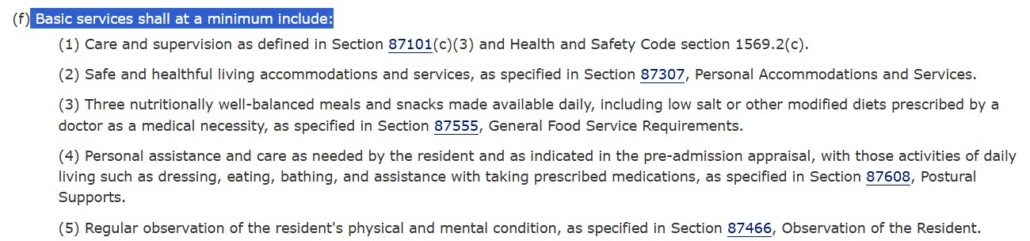
Section 87464(f) lists the services. It opens with “Basic services shall at a minimum include” and then names seven. The first five cover daily life.
- Care and supervision
- Safe and healthful living accommodations and services
- Three nutritionally well-balanced meals and snacks made available daily
- Personal assistance and care as needed
- Regular observation of your physical and mental condition
Those words “at a minimum” matter. A community can offer more, but it can’t offer less.
The list describes categories rather than a fixed number of minutes of care. Ask how staff decide the amount of assistance each resident needs.
Three Meals and Snacks Every Day
Food is part of the license. The rule requires “Three nutritionally well-balanced meals and snacks made available daily,” including low salt or other modified diets a doctor prescribes as a medical necessity.
If you follow a doctor-prescribed diet, ask how the kitchen handles it. The rule covers prescribed diets. Preferences beyond that may be handled differently.
During your tour, look at a current menu and ask what happens when you don’t like a scheduled meal. Find out how snacks are offered and whether staff can accommodate prescribed food modifications. The answer should be practical, not just a promise of good food.
Personal Care as Needed
Personal assistance covers activities of daily living “such as dressing, eating, bathing, and assistance with taking prescribed medications,” as needed and as shown in your pre-admission appraisal.
Many communities price this assistance through care levels or service tiers. Ask what help you would receive at your current level, how the team assesses your needs and what triggers a different charge if those needs increase.
Ask about the small things too. CANHR warns that “many residents are surprised when they receive charges for more than one shower a week or for having food trays brought to the room when they are sick.”
A Safe and Comfortable Place to Live
Safe living accommodations matter every day. During a tour, examine the actual room, bathroom and route to the dining area. If you use a walker, picture yourself navigating the space at night. Ask how the staff handle safety concerns and maintenance requests.
Someone Keeping an Eye on You
Regular observation can be less visible than meals or housekeeping, but it matters. Ask how caregivers recognize changes in your mobility, appetite or mood and whom they notify. You want to understand the process, not assume that observation means constant one-on-one monitoring.

Social Programs Are Not Optional
Activities and Health Arrangements
The last two basic services are about life outside your room. The sixth is “Arrangements to meet health needs, including arranging transportation.” The seventh is “A planned activities program which includes social and recreational activities appropriate to the interests” and capabilities of each resident.
Assisted living meals and activities are both required services. Still, a licensing requirement and a particular fee are different questions. Ask what the community provides as standard and whether transportation arrangements or optional outings involve additional charges.
When reviewing a calendar, consider your own personality. Someone who enjoys groups may want exercise classes and shared meals. Someone who prefers quieter activities may be happier with gardening or music. The program should be suited to residents, not just look full on paper.
A Planned Activities Program
Title 22 section 87219 spells out what that program should include. The activities “shall include” socialization, daily living skills, mental stimulation, sensory activities, leisure time, physical activity, education and free time.
The rule gives examples, too, from reminiscence and gardening to crossword puzzles, music and exercises that “promote balance, strength, coordination, flexibility, and range of motion.” Ask to see a monthly calendar on your tour.
You Can Help Shape the Calendar
Activities aren’t only something done for you. Section 87219 says residents “shall be encouraged to contribute to the planning, preparation, conduct, clean-up and critique” of the activities program. If you love gardening, music or cards, say so. A good community will use that to build the calendar.
Help Arranging Health Care
Helping arrange health care is not the same as operating a medical clinic. Ask who schedules appointments, how transportation is arranged and whether the ride carries a charge. If a resident needs an outside nurse or specialist, clarify what the community coordinates and what a third party provides.
Memory Care Basic Services
The same seven services apply in memory care. Memory care basic services start from the same list, and communities caring for residents with dementia also follow Title 22 section 87705, which “applies to the care of residents diagnosed with dementia.” Ask what’s added on top of the basic list.
For memory care, ask how staff adapt dining, activities and personal assistance for residents who have difficulty remembering routines or expressing preferences. CANHR notes that “It is common for facilities to charge higher rates for specialized dementia care or hospice care.” The seven basic categories remain your starting checklist.
What a Respite Stay Must Include
The basic services rule applies to every resident, including respite guests. Our page on short-term respite stays for caregiver relief across our Los Angeles communities explains our approach. “Short-term residents receive the same core care, hospitality, and residential experience as our full-time residents.” Ask what the daily or weekly respite rate covers before the stay begins.
How to Compare Assisted Living Prices
Our family checklist for comparing costs, staffing, licensing and contracts side by side makes the key point. “The base rate is the starting point, not the total.”
To compare prices fairly, note the services you would use and calculate the charges you would actually pay.
For example, compare your full estimated monthly cost at each home rather than using the starting room rate. Include the care level you currently need and any separately priced transportation or personal services. Ask for a written estimate you can review at home with family.
What Our Rate Includes
Here’s how it works at Raya’s Paradise. Our answers to common questions about meals, care and daily life say “Meals, housekeeping, and laundry are part of daily life at Raya’s Paradise.” Residents enjoy three home-style meals each day.
For anyone asking about Los Angeles assisted living, what is included depends on your care plan. Our page on home-like assisted living residences across Los Angeles explains that “The cost of your care level will be added to your room price.” We’ll walk you through both parts.
See How Everyday Care Comes Together at Raya’s Paradise
Three meals a day, help getting dressed and a calendar of activities may sound like straightforward expectations. But when you’re choosing assisted living for a parent, the details matter. How does the community adjust assistance when mobility changes? Will someone notice if Mom stops joining activities or loses her appetite? And can the team accommodate her routines without making every day feel scheduled for her?
At Raya’s Paradise, we encourage families to look closely at the daily experience, not just the list of services. Our answers to common questions about meals, personal care and resident activities offer a useful starting point. You can also explore our guide to helping a parent settle into assisted living during the first month or learn more about the individualized daily assistance and senior living experience in San Clemente.
If your family prefers a smaller residential environment, our Los Angeles assisted living homes offer another approach to personalized support. Whether you’re exploring Orange County or Los Angeles, use our assisted living tour questions guide to prepare for meaningful conversations about caregiver availability, meals, safety and daily routines. A community should be able to explain not only which services it provides, but how those services fit the person receiving them.
Our South Orange County Senior Assisted Living Community
Our Los Angeles Senior Assisted Living Residences
Sources & Additional Resources
- Legal Information Institute. “Cal. Code Regs. Tit. 22, § 87464 Basic Services.” Cornell Law School.
- Legal Information Institute. “Cal. Code Regs. Tit. 22, § 87507 Admission Agreements.” Cornell Law School.
- California Department of Social Services. “Resources for Residents and Families.” CDSS Senior Care Licensing.
- California Legislative Information. “Health and Safety Code Section 1569.884.” California Legislature.
- California Advocates for Nursing Home Reform. “RCFEs Admission Agreements.” CANHR.
- Legal Information Institute. “Cal. Code Regs. Tit. 22, § 87219 Planned Activities.” Cornell Law School.
- Legal Information Institute. “Cal. Code Regs. Tit. 22, § 87705 Care of Persons with Dementia.” Cornell Law School.
Disclaimer: This article provides general educational information about the basic services required at California Residential Care Facilities for the Elderly (RCFEs) under Title 22 section 87464. It is not legal advice or an individualized assessment of a resident’s care needs. California regulations establish minimum requirements for care and supervision, accommodations, meals, personal assistance, observation, arrangements to meet healthcare needs and planned activities. The specific assistance provided to each resident depends on their preadmission appraisal, ongoing care needs and the facility’s licensed capabilities. Additional requirements may apply to residents with dementia or specialized care needs. Families should review the community’s admission agreement and individualized service plan and consult the California Department of Social Services when questions arise about licensing requirements or resident protections. Raya’s Paradise provides residential assisted living and supportive care, not skilled nursing facility services.
 https://rayasparadise.com/wp-content/uploads/2026/11/Assisted-Living-Caregiver-Serving-Nutritious-Meals-to-Senior-Residents.jpg
1707
2560
Moti Gamburd
https://rayasparadise.com//wp-content/uploads/2019/07/RP-LOGO-Horizontal-Name-Only-websitetrans.png
Moti Gamburd2026-11-14 17:33:452026-11-02 16:35:18The 7 Assisted Living Basic Services Every California Community Must Provide
 https://rayasparadise.com/wp-content/uploads/2026/10/Senior-Couple-Reviewing-Assisted-Living-Admission-Agreements-and-Community-Fee-Refund-Policies.jpg
1707
2560
Moti Gamburd
https://rayasparadise.com//wp-content/uploads/2019/07/RP-LOGO-Horizontal-Name-Only-websitetrans.png
Moti Gamburd2026-10-28 15:20:152026-10-30 17:05:23Is the Assisted Living Community Fee Refundable in California? Know the 80, 60 and 40 Percent Rule
 https://rayasparadise.com/wp-content/uploads/2026/10/Senior-Couple-Reviewing-Assisted-Living-Rate-Increase-Notice-in-California.jpg
1804
2560
Moti Gamburd
https://rayasparadise.com//wp-content/uploads/2019/07/RP-LOGO-Horizontal-Name-Only-websitetrans.png
Moti Gamburd2026-10-26 14:36:182026-10-30 17:04:55California Assisted Living Rate Increase Notice Rules and Why Older Documents Still Say 60 Days
 https://rayasparadise.com/wp-content/uploads/2026/10/Senior-Couple-Reviewing-Assisted-Living-Care-Options-in-California.jpg
1707
2560
Moti Gamburd
https://rayasparadise.com//wp-content/uploads/2019/07/RP-LOGO-Horizontal-Name-Only-websitetrans.png
Moti Gamburd2026-10-24 00:27:412026-10-30 17:04:24Medi-Cal Assisted Living Options Include the Assisted Living Waiver and Health Plan Community Supports
 https://rayasparadise.com/wp-content/uploads/2026/10/Reviewing-Assisted-Living-Care-Concerns-and-Resident-Rights-in-California.jpg
1769
2560
Moti Gamburd
https://rayasparadise.com//wp-content/uploads/2019/07/RP-LOGO-Horizontal-Name-Only-websitetrans.png
Moti Gamburd2026-10-22 04:54:162026-10-30 17:03:53Who to Report Assisted Living Neglect to in California, and When to Call the Ombudsman, APS or Licensing
 https://rayasparadise.com/wp-content/uploads/2026/10/Senior-Woman-Concerned-About-Running-Out-of-Money-in-Assisted-Living.jpg
1706
2560
Moti Gamburd
https://rayasparadise.com//wp-content/uploads/2019/07/RP-LOGO-Horizontal-Name-Only-websitetrans.png
Moti Gamburd2026-10-20 10:26:362026-10-30 17:03:20When a Parent Is Running Out of Money in Assisted Living in California
 https://rayasparadise.com/wp-content/uploads/2026/10/In-Home-Senior-Care-and-Alternatives-to-Nursing-Home-Placement-in-California.jpg
1707
2560
Moti Gamburd
https://rayasparadise.com//wp-content/uploads/2019/07/RP-LOGO-Horizontal-Name-Only-websitetrans.png
Moti Gamburd2026-10-18 15:03:492026-10-30 17:02:44Alternatives to Nursing Home Care in California Through PACE, ALW, IHSS and MSSP
 https://rayasparadise.com/wp-content/uploads/2026/10/Hospital-Discharge-Planning-and-Assisted-Living-Care-Assessment.jpg
1708
2560
Moti Gamburd
https://rayasparadise.com//wp-content/uploads/2019/07/RP-LOGO-Horizontal-Name-Only-websitetrans.png
Moti Gamburd2026-10-16 14:54:522026-10-30 17:02:13Hospital Discharge to Assisted Living in California and the Admission Checks That Matter
 https://rayasparadise.com/wp-content/uploads/2013/03/Choosing-Assisted-Living-for-Senior-Couples.jpg
1700
2555
Moti Gamburd
https://rayasparadise.com//wp-content/uploads/2019/07/RP-LOGO-Horizontal-Name-Only-websitetrans.png
Moti Gamburd2026-02-14 06:37:342026-10-12 22:26:28Choosing Assisted Living for Senior Couples
 https://rayasparadise.com/wp-content/uploads/2012/12/How-the-Option-of-Assisted-Living-Developed.jpg
1702
2553
Moti Gamburd
https://rayasparadise.com//wp-content/uploads/2019/07/RP-LOGO-Horizontal-Name-Only-websitetrans.png
Moti Gamburd2026-02-12 04:33:042026-10-12 22:09:43History of Assisted Living |How the Option of Assisted Living Developed
 https://rayasparadise.com/wp-content/uploads/2012/10/Choosing-Assisted-Living-for-Those-with-Alzheimers-or-Dementia.jpeg
1695
2546
Moti Gamburd
https://rayasparadise.com//wp-content/uploads/2019/07/RP-LOGO-Horizontal-Name-Only-websitetrans.png
Moti Gamburd2026-02-11 08:14:422026-10-12 22:29:24Choosing Assisted Living for Those with Alzheimer's or Dementia
 https://rayasparadise.com/wp-content/uploads/2012/10/Paying-for-Assisted-Living.jpg
1700
2542
Moti Gamburd
https://rayasparadise.com//wp-content/uploads/2019/07/RP-LOGO-Horizontal-Name-Only-websitetrans.png
Moti Gamburd2026-02-10 03:30:062026-10-12 22:30:53Paying for Assisted Living, Costs, Insurance, VA Benefits, and Smart Ways to Plan
 https://rayasparadise.com/wp-content/uploads/2012/10/Six-Myths-About-Assisted-Living.jpg
1702
2555
Moti Gamburd
https://rayasparadise.com//wp-content/uploads/2019/07/RP-LOGO-Horizontal-Name-Only-websitetrans.png
Moti Gamburd2026-02-09 04:02:312026-10-12 22:57:13Six Myths About Assisted Living - What Senior Living Really Looks Like
 https://rayasparadise.com/wp-content/uploads/2026/02/Assisted-Living-vs-In-Home-Care.jpg
1695
2553
Moti Gamburd
https://rayasparadise.com//wp-content/uploads/2019/07/RP-LOGO-Horizontal-Name-Only-websitetrans.png
Moti Gamburd2026-02-08 06:00:482026-10-12 22:58:19The Benefits of Assisted Living Over In-Home Care
 https://rayasparadise.com/wp-content/uploads/2013/01/Caring-for-a-Parent-in-Assisted-Living-From-Afar.jpeg
1702
2556
Moti Gamburd
https://rayasparadise.com//wp-content/uploads/2019/07/RP-LOGO-Horizontal-Name-Only-websitetrans.png
Moti Gamburd2026-02-06 08:00:312026-10-12 22:12:38How to Care for a Loved One in Assisted Living From Afar