
Contents
- PACE Program Eligibility Starts at Age 55
- The Four PACE Program Eligibility Rules
- Do You Need Medi-Cal to Join PACE?
- PACE Replaces Your Other Coverage
- The Drug Plan Trap
- Find Senior Care That Fits Your Needs and Your Way of Life
- Sources & Additional Resources
- More Senior Care Resources
- PACE Program Eligibility Starts at Age 55 | Who Qualifies, What It Costs Without Medi-Cal and What It Replaces
- Rehab Discharge Too Soon? Your Rehab Discharge Appeal Starts With the 2-Day Notice
- A Dementia Diagnosis Alone Does Not Unlock Hospice Respite | The 3 Medicare Conditions for Hospice Respite Eligibility
- The Medicare Outpatient Observation Notice | Hospitals Must Tell You About Observation Within 36 Hours
- The IHSS Hours Cap Can Reach 283 a Month | How the 195-Hour Limit and Paid Family Caregiver Hours Work
- Is the Assisted Living Community Fee Refundable in California? Know the 80, 60 and 40 Percent Rule
- California Assisted Living Rate Increase Notice Rules and Why Older Documents Still Say 60 Days
- Medi-Cal Assisted Living Options Include the Assisted Living Waiver and Health Plan Community Supports
- Who to Report Assisted Living Neglect to in California, and When to Call the Ombudsman, APS or Licensing
- When a Parent Is Running Out of Money in Assisted Living in California
- Alternatives to Nursing Home Care in California Through PACE, ALW, IHSS and MSSP
- Hospital Discharge to Assisted Living in California and the Admission Checks That Matter
- Different Types of Senior Care
- Video Games and Virtual Reality Finds New Takers
- Advice for Traveling with Seniors
PACE Program Eligibility Starts at Age 55
Who Qualifies, What It Costs Without Medi-Cal and What It Replaces

You want to stay in your own home, but getting to appointments has become harder. You take several prescriptions, the stairs are tiring and your daughter worries about you being alone after a hospital visit. A friend suggests PACE. Another says you cannot join unless you receive Medi-Cal. Which is right?
PACE program eligibility starts at age 55, and you do not need Medi-Cal to qualify. You must live in a participating service area, need a nursing home level of care and be able to live safely in the community. Medi-Cal mainly changes what you pay. Here is how to check whether PACE could work for you.
Here are the key takeaways.
- The Program of All-Inclusive Care for the Elderly has four eligibility conditions, and Medi-Cal isn’t one of them.
- With Medi-Cal, you won’t pay a monthly premium. With Medicare only, you pay a premium for the long-term care part and for Part D drugs.
- PACE becomes the sole source of your Medicare and Medicaid benefits, so you use the PACE team’s care.
- Joining a separate Medicare drug plan while you’re in PACE disenrolls you from PACE.
- In California, DHCS decides whether you meet the nursing home level of care.
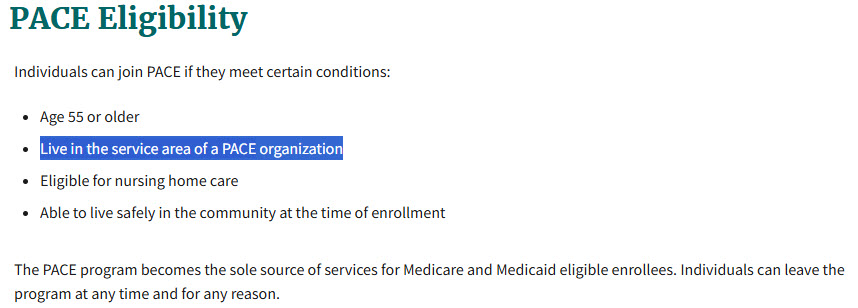
The Four PACE Program Eligibility Rules
PACE, short for the Program of All-Inclusive Care for the Elderly, has four eligibility rules. You must be 55 or older and “Live in the service area of a PACE organization.” You must also be eligible for nursing home care and able to live safely in the community when you enroll.
Notice what is not on the list. You do not have to receive Medi-Cal or meet a particular income limit to qualify for PACE itself. Your finances matter when it comes to premiums, but eligibility begins with your age, location, care needs and ability to remain safely in the community.
Check Your ZIP Code First
Start with your address. A PACE center can serve only its approved geographic area. Medicare notes that PACE is only available in some states that offer the program through Medicaid. Even within California, living a few miles outside a service boundary may matter.
To find out if a program serves your address, Medicare suggests you “search for PACE plans in your area” or call your Medicaid office. Do this first, whether you’re looking for PACE in Los Angeles or PACE in Orange County. Everything else depends on the answer.
You can also ask how often you would need to visit the PACE center. Transportation may be arranged, but the location and travel time matter if you have limited energy or depend on someone else to help you get ready.
California has also paused applications for new PACE organizations and service area expansions. DHCS began the pause on November 20, 2025, for at least two years. This does not prevent existing PACE centers from enrolling eligible people within their approved areas.
What Nursing Home Level of Care Means
Needing a nursing home level of care doesn’t mean you’ll live in a nursing home. It describes how much help you need. In California, you must “be determined eligible at the nursing home level of care by the Department of Health Care Services.”
The point of PACE is the opposite of a move. Medicaid.gov says that for most participants, the services let them “remain in the community rather than receive care in a nursing home.”
Ask who will assess your eligibility and what records they need from your current doctors. The determination concerns your overall care needs, so bring a current medication list, recent discharge paperwork and notes about where daily tasks have become difficult.
Safe at Home When You Enroll
The last rule is about safety. Medicaid.gov says you must be “Able to live safely in the community at the time of enrollment.” Be ready to talk about your home, your health and the help you already have when you apply.

Do You Need Medi-Cal to Join PACE?
You can qualify for PACE without Medi-Cal. Medi-Cal is California’s Medicaid program, and it affects how much you pay. Medicare’s PACE page states, “If you have Medicaid, you won’t pay a monthly premium for PACE.”
The PACE Premium Without Medicaid
If you have Medicare but not Medi-Cal, expect a different cost discussion. Your amount depends partly on whether you have Medicare Part A and Part B. Medicare lists “A monthly premium to cover the long-term care part of the PACE benefit” plus a premium for Part D prescription drugs.
You may also join without Medicare or Medicaid and pay the PACE premium yourself if you meet the other requirements. Medicare does not publish one universal monthly dollar amount for these situations. Ask the specific organization serving your address to provide a written quote based on your coverage.
What You Won’t Pay
PACE can make approved-care costs more predictable. Medicare says that “Regardless of your financial situation,” you will not owe deductibles, copayments or coinsurance for drugs, services or care approved by your PACE team. Monthly premiums, when applicable, are a separate expense.
That differs from paying separately for every hour of private home care. But it does not automatically make PACE less expensive for everyone. Compare the full monthly premium with your current costs and consider how comfortable you would feel changing medical providers.
Ask for the Numbers in Writing
Ask the PACE enrollment counselor for a written estimate before you sign anything. Have them explain the long-term care premium, drug premium and what happens if you later qualify for Medi-Cal. Also ask when enrollment and any changes in your current coverage would take effect.

PACE Replaces Your Other Coverage
PACE is not simply another benefit you add to your existing coverage. Medicaid.gov explains, “The PACE program becomes the sole source of Medicaid and Medicare benefits for PACE participants.” This is a major choice, especially if you value your current doctors.
In return, PACE coordinates many kinds of support. Medicare says it covers “all Medicare- and Medicaid-covered care and services,” as well as other services your PACE team determines are needed, including prescription medications.
What PACE Can Cover
Medicare’s list of services PACE may cover includes adult day primary care, home care, hospital care, personal care, prescription drugs and physical therapy. It also includes transportation to and from the PACE center and medical appointments, and nursing home care when medically necessary.
PACE is built around coordinated care rather than isolated appointments. Ask who would become your primary care provider, how urgent concerns are handled after hours and whether transportation is available for each appointment you expect to keep.
An interdisciplinary team of health professionals coordinates it all. DHCS describes a PACE Center that provides and coordinates preventive, primary, acute and long-term care.
The Trade You’re Making
The tradeoff is how care is arranged. Your PACE team helps decide what services you need and coordinates the providers. Our guide comparing PACE, ALW, IHSS and MSSP explains, “PACE is not a home care allowance that a family spends on whichever caregiver it chooses.”
Before you join, ask whether your current doctors work with the PACE organization.
If a long-standing specialist matters to you, ask about that relationship before enrolling. Find out whether the doctor participates in the program, whether an outside consultation might be approved and who makes the final decision about referrals.
You Can Leave
You can leave PACE. Medicaid.gov says “Individuals can leave the program at any time and for any reason.” Ask the PACE team to explain the disenrollment process and how to avoid a gap in medical or drug coverage during the transition.

The Drug Plan Trap
One enrollment mistake can change your entire care arrangement. Medicare warns, “If you join a separate Medicare drug plan while you’re in the PACE program, you’ll be disenrolled from PACE.” This is more than a change in prescription coverage.
You don’t need a separate plan anyway. With Medicare, you get your Part D covered drugs and all other necessary medication from PACE.
PACE and Part D During Open Enrollment
During fall open enrollment, you may receive calls and mail offering Medicare drug plans. Someone helping with your coverage might think a separate Part D plan would save money. Tell them you receive prescription benefits through PACE and that joining a different drug plan can end PACE enrollment.
Before responding to any drug plan offer, contact your PACE enrollment coordinator. Ask them to review the offer and explain what it would do to your existing coverage. Checking first is much easier than dealing with an unexpected loss of PACE benefits.
PACE vs Home Care or Assisted Living
PACE is one option, not the answer for everyone. You may prefer to keep your current doctors while arranging private help at home. Our home care in Los Angeles page notes that “A family may begin with home care, then later compare it with assisted living” if daily needs keep growing.
We offer home care through our sister home care company. Our home care in Orange County works the same way. “This non-medical support focuses on safety, routine, companionship, and quality of life rather than skilled nursing treatment.” That’s the key difference from PACE, which coordinates your medical care too.
If living at home is getting harder, assisted living in Orange County is another option to compare. Whichever path you choose, ask what each one covers, what you pay and who makes the decisions.
Compare the full picture instead of looking only at the monthly price. Think about where you want to live, who will help each day, which doctors you can see and how quickly you can get support if your needs change.
Find Senior Care That Fits Your Needs and Your Way of Life
PACE can be a good option for older adults who need coordinated medical care but want to continue living at home. Still, it isn’t the right fit for everyone. You may prefer to keep your current doctors, arrange help with everyday activities or explore a residential community where assistance is available throughout the day. The important thing is understanding what each option offers before making a decision that changes your daily routine.
If staying at home is your priority, Raya’s Paradise can help you explore personalized in-home assistance for older adults in Orange County through our sister company, CARE Homecare. Families weighing several care arrangements may also find our comparison of California senior care programs and services useful for understanding how different approaches support aging in place. For those considering a residential setting, our senior living community comparison checklist can help identify which amenities, care services and daily routines matter most.
Raya’s Paradise also offers personalized residential assisted living in Los Angeles for older adults who would benefit from a smaller, home-like environment. Whether you’re exploring additional support at home or considering a move to assisted living, connect with our senior care team to discuss your needs and learn more about the available options. Raya’s Paradise does not operate a PACE program, but we can help families understand the residential and non-medical caregiving services we provide.
Our Orange County Senior Assisted Living Community
Our Los Angeles Senior Assisted Living Residences
Sources & Additional Resources
- Medicare.gov. “PACE.” Centers for Medicare & Medicaid Services.
- Medicaid.gov. “Program of All-Inclusive Care for the Elderly.” Centers for Medicare & Medicaid Services.
- California Department of Health Care Services. “Program of All-Inclusive Care for the Elderly.” DHCS.
Disclaimer: This article provides general educational information about the Program of All-Inclusive Care for the Elderly (PACE), its eligibility requirements and how it differs from other senior care arrangements. It is not medical advice or an individualized determination of eligibility. PACE participation generally requires individuals to be at least 55 years old, reside within an approved service area, meet the applicable nursing home level-of-care criteria and be able to live safely in the community at enrollment. Eligibility assessments, service areas, participating providers and program requirements may change. Individuals should confirm current qualifications and enrollment procedures with their local PACE organization or the California Department of Health Care Services. Raya’s Paradise is not a PACE provider and offers residential assisted living and non-medical home care through its sister company, rather than PACE-coordinated medical services.
 https://rayasparadise.com/wp-content/uploads/2026/10/Senior-Woman-Receiving-In-Home-Care-and-Mobility-Assistance-While-Aging-in-Place.jpg
1707
2560
Moti Gamburd
https://rayasparadise.com//wp-content/uploads/2019/07/RP-LOGO-Horizontal-Name-Only-websitetrans.png
Moti Gamburd2026-11-09 16:17:332026-10-30 16:59:19PACE Program Eligibility Starts at Age 55 | Who Qualifies, What It Costs Without Medi-Cal and What It Replaces
 https://rayasparadise.com/wp-content/uploads/2026/10/Senior-Patient-Reviewing-Rehabilitation-Discharge-Paperwork-With-Healthcare-Professional.jpg
1707
2560
Moti Gamburd
https://rayasparadise.com//wp-content/uploads/2019/07/RP-LOGO-Horizontal-Name-Only-websitetrans.png
Moti Gamburd2026-11-06 15:20:512026-10-30 17:07:15Rehab Discharge Too Soon? Your Rehab Discharge Appeal Starts With the 2-Day Notice
 https://rayasparadise.com/wp-content/uploads/2026/10/Compassionate-Senior-Caregiver-Providing-Comfort-and-Respite-Support-to-an-Older-Adult.jpg
1707
2560
Moti Gamburd
https://rayasparadise.com//wp-content/uploads/2019/07/RP-LOGO-Horizontal-Name-Only-websitetrans.png
Moti Gamburd2026-11-04 18:20:432026-10-30 17:06:42A Dementia Diagnosis Alone Does Not Unlock Hospice Respite | The 3 Medicare Conditions for Hospice Respite Eligibility
 https://rayasparadise.com/wp-content/uploads/2026/10/Healthcare-Professional-Documenting-Hospital-Observation-Status-and-Discharge-Notes.jpg
1707
2560
Moti Gamburd
https://rayasparadise.com//wp-content/uploads/2019/07/RP-LOGO-Horizontal-Name-Only-websitetrans.png
Moti Gamburd2026-11-02 16:07:082026-10-30 17:06:11The Medicare Outpatient Observation Notice | Hospitals Must Tell You About Observation Within 36 Hours
 https://rayasparadise.com/wp-content/uploads/2026/10/Family-Caregiver-Helping-an-Elderly-Woman-With-a-Walker-in-a-Garden.jpg
1707
2560
Moti Gamburd
https://rayasparadise.com//wp-content/uploads/2019/07/RP-LOGO-Horizontal-Name-Only-websitetrans.png
Moti Gamburd2026-10-30 15:08:252026-10-30 17:05:46The IHSS Hours Cap Can Reach 283 a Month | How the 195-Hour Limit and Paid Family Caregiver Hours Work
 https://rayasparadise.com/wp-content/uploads/2026/10/Senior-Couple-Reviewing-Assisted-Living-Admission-Agreements-and-Community-Fee-Refund-Policies.jpg
1707
2560
Moti Gamburd
https://rayasparadise.com//wp-content/uploads/2019/07/RP-LOGO-Horizontal-Name-Only-websitetrans.png
Moti Gamburd2026-10-28 15:20:152026-10-30 17:05:23Is the Assisted Living Community Fee Refundable in California? Know the 80, 60 and 40 Percent Rule
 https://rayasparadise.com/wp-content/uploads/2026/10/Senior-Couple-Reviewing-Assisted-Living-Rate-Increase-Notice-in-California.jpg
1804
2560
Moti Gamburd
https://rayasparadise.com//wp-content/uploads/2019/07/RP-LOGO-Horizontal-Name-Only-websitetrans.png
Moti Gamburd2026-10-26 14:36:182026-10-30 17:04:55California Assisted Living Rate Increase Notice Rules and Why Older Documents Still Say 60 Days
 https://rayasparadise.com/wp-content/uploads/2026/10/Senior-Couple-Reviewing-Assisted-Living-Care-Options-in-California.jpg
1707
2560
Moti Gamburd
https://rayasparadise.com//wp-content/uploads/2019/07/RP-LOGO-Horizontal-Name-Only-websitetrans.png
Moti Gamburd2026-10-24 00:27:412026-10-30 17:04:24Medi-Cal Assisted Living Options Include the Assisted Living Waiver and Health Plan Community Supports
 https://rayasparadise.com/wp-content/uploads/2026/10/Reviewing-Assisted-Living-Care-Concerns-and-Resident-Rights-in-California.jpg
1769
2560
Moti Gamburd
https://rayasparadise.com//wp-content/uploads/2019/07/RP-LOGO-Horizontal-Name-Only-websitetrans.png
Moti Gamburd2026-10-22 04:54:162026-10-30 17:03:53Who to Report Assisted Living Neglect to in California, and When to Call the Ombudsman, APS or Licensing
 https://rayasparadise.com/wp-content/uploads/2026/10/Senior-Woman-Concerned-About-Running-Out-of-Money-in-Assisted-Living.jpg
1706
2560
Moti Gamburd
https://rayasparadise.com//wp-content/uploads/2019/07/RP-LOGO-Horizontal-Name-Only-websitetrans.png
Moti Gamburd2026-10-20 10:26:362026-10-30 17:03:20When a Parent Is Running Out of Money in Assisted Living in California
 https://rayasparadise.com/wp-content/uploads/2026/10/In-Home-Senior-Care-and-Alternatives-to-Nursing-Home-Placement-in-California.jpg
1707
2560
Moti Gamburd
https://rayasparadise.com//wp-content/uploads/2019/07/RP-LOGO-Horizontal-Name-Only-websitetrans.png
Moti Gamburd2026-10-18 15:03:492026-10-30 17:02:44Alternatives to Nursing Home Care in California Through PACE, ALW, IHSS and MSSP
 https://rayasparadise.com/wp-content/uploads/2026/10/Hospital-Discharge-Planning-and-Assisted-Living-Care-Assessment.jpg
1708
2560
Moti Gamburd
https://rayasparadise.com//wp-content/uploads/2019/07/RP-LOGO-Horizontal-Name-Only-websitetrans.png
Moti Gamburd2026-10-16 14:54:522026-10-30 17:02:13Hospital Discharge to Assisted Living in California and the Admission Checks That Matter
 https://rayasparadise.com/wp-content/uploads/2012/09/Different-Types-of-Senior-Care-Explained.jpeg
1695
2553
Moti Gamburd
https://rayasparadise.com//wp-content/uploads/2019/07/RP-LOGO-Horizontal-Name-Only-websitetrans.png
Moti Gamburd2026-01-15 03:36:302026-10-12 22:59:46Different Types of Senior Care
 https://rayasparadise.com/wp-content/uploads/2020/03/Video-Games-for-Elderly.png
841
1454
Raya's Paradise
https://rayasparadise.com//wp-content/uploads/2019/07/RP-LOGO-Horizontal-Name-Only-websitetrans.png
Raya's Paradise2020-03-04 16:11:552026-01-14 19:16:21Video Games and Virtual Reality Finds New Takers
 https://rayasparadise.com/wp-content/uploads/2013/11/TravelingFeatured.jpg
800
1212
Raya's Paradise
https://rayasparadise.com//wp-content/uploads/2019/07/RP-LOGO-Horizontal-Name-Only-websitetrans.png
Raya's Paradise2019-12-02 04:00:282026-01-14 18:39:14Advice for Traveling with Seniors