
Contents
- A California Health Care Power of Attorney Usually Starts Only After a Finding of Incapacity
- When a Health Care Power of Attorney in California Takes Effect
- Writing an Immediate-Effect Clause
- Social Security Doesn’t Follow the POA
- Keeping the Directive Findable
- Make Sure Your Parent’s Wishes Guide Their Future Care
- Sources & Additional Resources
- More Senior Care Resources
- A California Health Care Power of Attorney Usually Starts Only After a Finding of Incapacity
- Why Observation Status Doesn't Count Toward Medicare's 3-Day Rule and How to Appeal a Status Change
- Who Pays for Respite Care in California? Medicare, Medi-Cal, VA and Private Pay Compared
- PACE Program Eligibility Starts at Age 55 | Who Qualifies, What It Costs Without Medi-Cal and What It Replaces
- Rehab Discharge Too Soon? Your Rehab Discharge Appeal Starts With the 2-Day Notice
- A Dementia Diagnosis Alone Does Not Unlock Hospice Respite | The 3 Medicare Conditions for Hospice Respite Eligibility
- The Medicare Outpatient Observation Notice | Hospitals Must Tell You About Observation Within 36 Hours
- The IHSS Hours Cap Can Reach 283 a Month | How the 195-Hour Limit and Paid Family Caregiver Hours Work
- Is the Assisted Living Community Fee Refundable in California? Know the 80, 60 and 40 Percent Rule
- California Assisted Living Rate Increase Notice Rules and Why Older Documents Still Say 60 Days
- Medi-Cal Assisted Living Options Include the Assisted Living Waiver and Health Plan Community Supports
- Who to Report Assisted Living Neglect to in California, and When to Call the Ombudsman, APS or Licensing
- When a Parent Is Running Out of Money in Assisted Living in California
- Alternatives to Nursing Home Care in California Through PACE, ALW, IHSS and MSSP
- Hospital Discharge to Assisted Living in California and the Admission Checks That Matter

You’re at the hospital with Mom’s advance health care directive in your bag. She named you as her agent years ago, but the doctor keeps asking her to make decisions. When you request an update, the nurse hesitates. You start wondering what that paperwork actually allows you to do.
Often, the document is working exactly as intended. With a health care power of attorney in California, the agent’s authority usually starts only after a determination that your parent lacks capacity, unless the document says otherwise. Until then, Mom makes her own medical decisions. Here’s what changes that and how to prepare.
Here are the key takeaways.
- California’s Probate Code 4682 starts an agent’s authority when your parent is found to lack capacity and ends it if capacity returns.
- Unless the directive says otherwise, the capacity determination is made by the primary physician.
- California’s statutory form has a box that makes the agent’s authority take effect immediately.
- A health care POA doesn’t let you manage Social Security, because a payee must apply for and be appointed by SSA.
- The state’s Advance Health Care Directive Registry shares information only on request, so give copies to doctors and family too.

Incapacity Is the Default Trigger
When a Health Care Power of Attorney in California Takes Effect
So when does a medical POA take effect? Under Probate Code section 4682, “the authority of an agent becomes effective only on a determination that the principal lacks capacity.” The principal is your parent. The agent is the person your parent named.
In California, a health care power of attorney is commonly included in an advance health care directive. Our practical California guide to POA types, choosing an agent and signing rules explains that “In California, medical decision-making is typically handled through an Advance Health Care Directive.”
Your Parent Is Presumed Able to Decide
The law starts from respect for your parent’s independence. Probate Code 4657 says “A patient is presumed to have the capacity to make a health care decision.” A diagnosis alone doesn’t erase that presumption.
That’s why Mom may still make her own medical choices even with early memory loss. Naming an agent gives her a decision maker when she needs one. Even with immediate authority, Probate Code 4689 says an agent can’t make a health care decision “if the principal objects to the decision.”
Who Makes the Incapacity Determination
Unless the directive names someone else, the decision about capacity “shall be made by the primary physician,” according to Probate Code 4658. A worried family member can’t make that call.
Once the determination is made, the physician “shall promptly record the determination” in the health record under Probate Code 4732. The physician also notifies the patient when possible and the authorized decision maker. Ask if the determination is recorded.
Authority Can Stop Again
Losing decision-making capacity is not always permanent. Section 4682 also says the agent’s authority “ceases to be effective on a determination that the principal has recovered capacity.” If capacity returns after a temporary illness, the decisions go back to your parent.
Why Doctors May Talk to Your Parent Instead of You
If your POA seems ignored by the hospital, federal privacy rules may be part of the reason. HHS explains that “The Privacy Rule does not require a health care provider or health plan to share information with your family or friends, unless they are your personal representatives.”
Under HIPAA, a personal representative is someone with legal authority to act on behalf of the individual in making health care related decisions. If your agent authority hasn’t started yet, staff may treat your parent as the person to talk to.
HIPAA Authorization vs POA
For ordinary updates, start with Mom’s permission rather than assuming you need to take over her decisions. Providers can share information with family when “You tell the provider or plan that it can do so.” Your parent can simply tell the doctor’s office that it’s okay to talk with you.
HHS also notes that “If you do not object, your doctor could talk with the friend who goes with you to the hospital.” With Mom’s permission, attending appointments together may be easier than invoking an inactive POA.

The Document Can Say Otherwise
Writing an Immediate-Effect Clause
Waiting for a finding of incapacity is the default, not the only choice. Section 4682 opens with “Unless otherwise provided in a power of attorney for health care,” so your parent can choose a different start date in the document itself.
The Box on California’s Statutory Form
California’s sample advance health care directive form in Probate Code 4701 builds this choice in. By default, “My agent’s authority becomes effective when my primary physician determines that I am unable to make my own health care decisions.”
If your parent marks the box in section 1.3, “my agent’s authority to make health care decisions for me takes effect immediately.” Look at your parent’s signed form. Many families never notice whether that box was checked.
Families do not have to use that exact state form. Under Probate Code 4700, the statutory form “may, but need not, be used to create an advance health care directive.” An attorney-drafted directive may word the start date differently, so read the actual document.
What an Active Agent Can Do
Once the authority is effective, the agent may decide “to the same extent the principal could make health care decisions if the principal had the capacity to do so,” subject to any limits in the document. That’s Probate Code 4683.
The agent also usually comes first. Under Probate Code 4685, an available agent “has priority over any other person in making health care decisions for the principal.” Siblings with different opinions don’t outrank the named agent.
Decisions Beyond Medical Treatment
A directive can reach daily life, too. Probate Code 4671 lets a parent grant authority over personal care, including “determining where the principal will live.” That matters if a move to assisted living or memory care may come up later.
Immediate authority is a significant choice. Ask an elder law attorney how it would work alongside Mom’s ability to make her own decisions.
A Separate Appointment Is Needed
Social Security Doesn’t Follow the POA
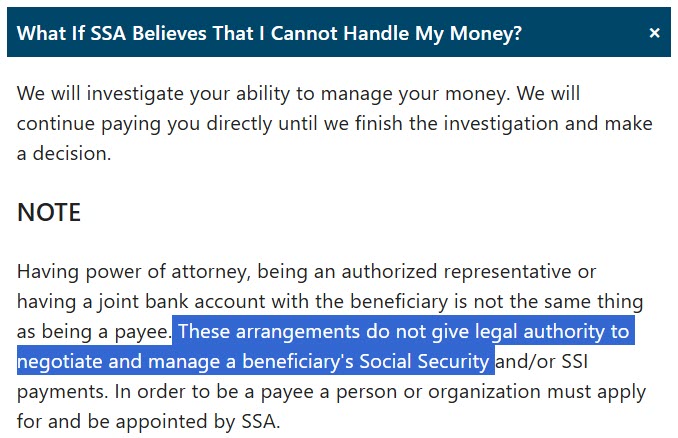
Even an active agent can’t manage your parent’s Social Security check. SSA says power of attorney and joint accounts are not the same as being a payee, and “These arrangements do not give legal authority to negotiate and manage a beneficiary’s Social Security” or SSI payments.
If your parent can no longer manage benefits, a separate application is needed. “In order to be a payee a person or organization must apply for and be appointed by SSA.”
Plan Ahead With Advance Designation
Your parent can name preferred payees now. SSA’s advance designation program “allows you to designate up to three individuals who could serve as a representative payee for you if the need ever arises.”
SSA is clear that advance designation isn’t an appointment or a power of attorney. SSA considers that list first if a payee is needed later.
Keep Health and Money Authority Separate
These documents have different jobs, even when the same person is named in all of them. Our POA guide notes that “A financial POA does not automatically grant medical decision-making authority.” The reverse is true as well, since a health care agent doesn’t automatically control bank accounts.
If you’re taking over bills too, our five steps for taking responsibility for a parent’s finances offers practical advice. “Make sure you have legal authorization to act on their behalf.”

Register It With the State
Keeping the Directive Findable
A directive helps only if the hospital can find it. The California Secretary of State runs an Advance Health Care Directive Registry. Registered information is “made available upon request to the registrant’s health care provider,” public guardian or legal representative.
Your parent can attach a copy of the directive to the registration form, or list where the directive is kept instead. The registry doesn’t send it automatically. “A request for information must state the need for the information.”
Who Should Have a Copy
Think of registration as a backup, not a substitute for handing out copies. The statutory form itself says to “Give a copy of the signed and completed form to your physician,” other providers, any facility giving care and every agent named. Trusted family members likely to get the first call deserve a copy too.
Plan to revisit the document as well. The National Institute on Aging suggests treating advance directives as living documents that you “review at least once each year and update if a major life event occurs,” such as a move or a significant change in health.
Bring It to Any Move Into Care
Care settings will want to see it as well. At our home-like senior assisted living residences in Los Angeles, “a member of our medical team will meet with you to review your medical history.” Bring the directive to that meeting.
Start Before Memory Changes Advance
Planning ahead can be especially important when a parent is living with dementia. Probate Code 4671 says “An adult having capacity may execute a power of attorney for health care.” If your parent waits until capacity is gone, it may be too late to sign one.
Without a directive, a family may end up looking at court options. California’s court self-help guide lists the advance health care directive among the less restrictive alternatives to conservatorship and explains that a family seeking a conservatorship must first show that less restrictive options would not work.
Families exploring our luxury memory care community in coastal San Clemente often find the paperwork works best when it’s done early. Raya’s Paradise “provides memory care in Orange County at our San Clemente community” for older adults living with Alzheimer’s disease, dementia and other cognitive impairments.
Make Sure Your Parent’s Wishes Guide Their Future Care
Having a health care power of attorney doesn’t necessarily mean you can make medical decisions for Mom today. And when the time comes for you to step in, the last thing you want is to discover that her wishes are unclear or an important document is missing. Talking through those decisions while your parent can still participate gives everyone a better understanding of what matters most to her.
If you’re just beginning the process, Raya’s Paradise offers a practical guide to establishing power of attorney and choosing a trusted decision-maker. It’s also worth thinking ahead about how your parent’s care preferences may affect future living arrangements. Our assisted living move-in preparation checklist can help families organize important documents and care information before a transition becomes necessary.
For families navigating Alzheimer’s disease or other cognitive changes, our personalized memory care services in San Clemente provide a supportive residential environment designed around individual needs and daily routines. Families considering care closer to Los Angeles can also explore our intimate residential assisted living homes throughout Los Angeles, where individualized assistance helps older adults maintain comfort and dignity as their needs evolve.
Whether your parent is planning ahead or preparing for a move, connect with our Orange County senior care team to learn how Raya’s Paradise approaches admission assessments, family communication and individualized care planning. We can help you understand the information our communities need before welcoming a new resident, while questions about creating or interpreting a health care power of attorney should be directed to a qualified California elder law attorney.
Our OC Senior Assisted Living Community
Our LA Senior Assisted Living Residences
Sources & Additional Resources
- California Legislative Information. “Probate Code Section 4682.” California Legislature.
- California Legislative Information. “Probate Code Section 4658.” California Legislature.
- California Legislative Information. “Probate Code Section 4701.” California Legislature.
- Social Security Administration. “FAQs for Beneficiaries Who Have a Representative Payee.” SSA.gov.
- California Secretary of State. “Advance Health Care Directive Registry.” California Secretary of State.
- California Legislative Information. “Probate Code Section 4657.” California Legislature.
- California Legislative Information. “Probate Code Section 4689.” California Legislature.
- California Legislative Information. “Probate Code Section 4732.” California Legislature.
- U.S. Department of Health and Human Services. “Family Members and Friends.” HHS.gov.
- U.S. Department of Health and Human Services. “Personal Representatives.” HHS.gov.
- California Legislative Information. “Probate Code Section 4700.” California Legislature.
- California Legislative Information. “Probate Code Section 4683.” California Legislature.
- California Legislative Information. “Probate Code Section 4685.” California Legislature.
- California Legislative Information. “Probate Code Section 4671.” California Legislature.
- Social Security Administration. “Advance Designation of Representative Payee.” SSA.gov.
- National Institute on Aging. “Advance Care Planning, Advance Directives for Health Care.” NIA.NIH.gov.
- Judicial Branch of California. “Options to Help Someone With an Impairment or Disability.” California Courts Self-Help Guide.
Disclaimer: This article provides general educational information about health care powers of attorney, advance health care directives and medical decision-making authority under California law. It is not legal or medical advice and does not establish whether a particular document is valid or an individual’s decision-making capacity has changed. Under California Probate Code section 4682, a health care agent’s authority generally becomes effective when the principal is determined to lack capacity, unless the directive specifies otherwise. The person authorized to make that determination, the scope of an agent’s authority and the conditions under which that authority begins or ends may depend on the document’s language and applicable law. A health care power of attorney does not automatically grant authority over financial matters or Social Security benefits, and access to protected medical information remains subject to applicable privacy requirements. Families should consult a qualified California elder law attorney regarding advance directives and work with the individual’s healthcare providers when questions arise about capacity or medical decision-making. Raya’s Paradise provides residential assisted living, memory care and supportive services, not legal representation or skilled nursing facility care.
 https://rayasparadise.com/wp-content/uploads/2026/11/California-Health-Care-Power-of-Attorney-and-Advance-Directive-Planning-for-Seniors.jpg
1707
2560
Moti Gamburd
https://rayasparadise.com//wp-content/uploads/2019/07/RP-LOGO-Horizontal-Name-Only-websitetrans.png
Moti Gamburd2026-11-19 19:08:522026-11-03 17:23:45A California Health Care Power of Attorney Usually Starts Only After a Finding of Incapacity
 https://rayasparadise.com/wp-content/uploads/2026/11/Elderly-Hospital-Patient-and-Medicare-Observation-Status-Three-Day-Rule.jpg
1707
2560
Moti Gamburd
https://rayasparadise.com//wp-content/uploads/2019/07/RP-LOGO-Horizontal-Name-Only-websitetrans.png
Moti Gamburd2026-11-16 01:18:112026-11-03 15:49:52Why Observation Status Doesn't Count Toward Medicare's 3-Day Rule and How to Appeal a Status Change
 https://rayasparadise.com/wp-content/uploads/2026/11/Compassionate-Respite-Care-and-Senior-Companionship-in-a-Residential-Care-Setting.jpg
1707
2560
Moti Gamburd
https://rayasparadise.com//wp-content/uploads/2019/07/RP-LOGO-Horizontal-Name-Only-websitetrans.png
Moti Gamburd2026-11-11 19:40:022026-11-02 15:50:19Who Pays for Respite Care in California? Medicare, Medi-Cal, VA and Private Pay Compared
 https://rayasparadise.com/wp-content/uploads/2026/10/Senior-Woman-Receiving-In-Home-Care-and-Mobility-Assistance-While-Aging-in-Place.jpg
1707
2560
Moti Gamburd
https://rayasparadise.com//wp-content/uploads/2019/07/RP-LOGO-Horizontal-Name-Only-websitetrans.png
Moti Gamburd2026-11-09 16:17:332026-10-30 16:59:19PACE Program Eligibility Starts at Age 55 | Who Qualifies, What It Costs Without Medi-Cal and What It Replaces
 https://rayasparadise.com/wp-content/uploads/2026/10/Senior-Patient-Reviewing-Rehabilitation-Discharge-Paperwork-With-Healthcare-Professional.jpg
1707
2560
Moti Gamburd
https://rayasparadise.com//wp-content/uploads/2019/07/RP-LOGO-Horizontal-Name-Only-websitetrans.png
Moti Gamburd2026-11-06 15:20:512026-10-30 17:07:15Rehab Discharge Too Soon? Your Rehab Discharge Appeal Starts With the 2-Day Notice
 https://rayasparadise.com/wp-content/uploads/2026/10/Compassionate-Senior-Caregiver-Providing-Comfort-and-Respite-Support-to-an-Older-Adult.jpg
1707
2560
Moti Gamburd
https://rayasparadise.com//wp-content/uploads/2019/07/RP-LOGO-Horizontal-Name-Only-websitetrans.png
Moti Gamburd2026-11-04 18:20:432026-10-30 17:06:42A Dementia Diagnosis Alone Does Not Unlock Hospice Respite | The 3 Medicare Conditions for Hospice Respite Eligibility
 https://rayasparadise.com/wp-content/uploads/2026/10/Healthcare-Professional-Documenting-Hospital-Observation-Status-and-Discharge-Notes.jpg
1707
2560
Moti Gamburd
https://rayasparadise.com//wp-content/uploads/2019/07/RP-LOGO-Horizontal-Name-Only-websitetrans.png
Moti Gamburd2026-11-02 16:07:082026-10-30 17:06:11The Medicare Outpatient Observation Notice | Hospitals Must Tell You About Observation Within 36 Hours
 https://rayasparadise.com/wp-content/uploads/2026/10/Family-Caregiver-Helping-an-Elderly-Woman-With-a-Walker-in-a-Garden.jpg
1707
2560
Moti Gamburd
https://rayasparadise.com//wp-content/uploads/2019/07/RP-LOGO-Horizontal-Name-Only-websitetrans.png
Moti Gamburd2026-10-30 15:08:252026-10-30 17:05:46The IHSS Hours Cap Can Reach 283 a Month | How the 195-Hour Limit and Paid Family Caregiver Hours Work
 https://rayasparadise.com/wp-content/uploads/2026/10/Senior-Couple-Reviewing-Assisted-Living-Admission-Agreements-and-Community-Fee-Refund-Policies.jpg
1707
2560
Moti Gamburd
https://rayasparadise.com//wp-content/uploads/2019/07/RP-LOGO-Horizontal-Name-Only-websitetrans.png
Moti Gamburd2026-10-28 15:20:152026-10-30 17:05:23Is the Assisted Living Community Fee Refundable in California? Know the 80, 60 and 40 Percent Rule
 https://rayasparadise.com/wp-content/uploads/2026/10/Senior-Couple-Reviewing-Assisted-Living-Rate-Increase-Notice-in-California.jpg
1804
2560
Moti Gamburd
https://rayasparadise.com//wp-content/uploads/2019/07/RP-LOGO-Horizontal-Name-Only-websitetrans.png
Moti Gamburd2026-10-26 14:36:182026-10-30 17:04:55California Assisted Living Rate Increase Notice Rules and Why Older Documents Still Say 60 Days
 https://rayasparadise.com/wp-content/uploads/2026/10/Senior-Couple-Reviewing-Assisted-Living-Care-Options-in-California.jpg
1707
2560
Moti Gamburd
https://rayasparadise.com//wp-content/uploads/2019/07/RP-LOGO-Horizontal-Name-Only-websitetrans.png
Moti Gamburd2026-10-24 00:27:412026-10-30 17:04:24Medi-Cal Assisted Living Options Include the Assisted Living Waiver and Health Plan Community Supports
 https://rayasparadise.com/wp-content/uploads/2026/10/Reviewing-Assisted-Living-Care-Concerns-and-Resident-Rights-in-California.jpg
1769
2560
Moti Gamburd
https://rayasparadise.com//wp-content/uploads/2019/07/RP-LOGO-Horizontal-Name-Only-websitetrans.png
Moti Gamburd2026-10-22 04:54:162026-10-30 17:03:53Who to Report Assisted Living Neglect to in California, and When to Call the Ombudsman, APS or Licensing
 https://rayasparadise.com/wp-content/uploads/2026/10/Senior-Woman-Concerned-About-Running-Out-of-Money-in-Assisted-Living.jpg
1706
2560
Moti Gamburd
https://rayasparadise.com//wp-content/uploads/2019/07/RP-LOGO-Horizontal-Name-Only-websitetrans.png
Moti Gamburd2026-10-20 10:26:362026-10-30 17:03:20When a Parent Is Running Out of Money in Assisted Living in California
 https://rayasparadise.com/wp-content/uploads/2026/10/In-Home-Senior-Care-and-Alternatives-to-Nursing-Home-Placement-in-California.jpg
1707
2560
Moti Gamburd
https://rayasparadise.com//wp-content/uploads/2019/07/RP-LOGO-Horizontal-Name-Only-websitetrans.png
Moti Gamburd2026-10-18 15:03:492026-10-30 17:02:44Alternatives to Nursing Home Care in California Through PACE, ALW, IHSS and MSSP
 https://rayasparadise.com/wp-content/uploads/2026/10/Hospital-Discharge-Planning-and-Assisted-Living-Care-Assessment.jpg
1708
2560
Moti Gamburd
https://rayasparadise.com//wp-content/uploads/2019/07/RP-LOGO-Horizontal-Name-Only-websitetrans.png
Moti Gamburd2026-10-16 14:54:522026-10-30 17:02:13Hospital Discharge to Assisted Living in California and the Admission Checks That Matter